Imagine this: A fire breaks out in a 500,000 sq. ft. warehouse in Pune at 2:00 AM. Security teams rush to pull footage, but the NVR server room is one of the first areas affected. Every minute of footage from the last six hours is gone.
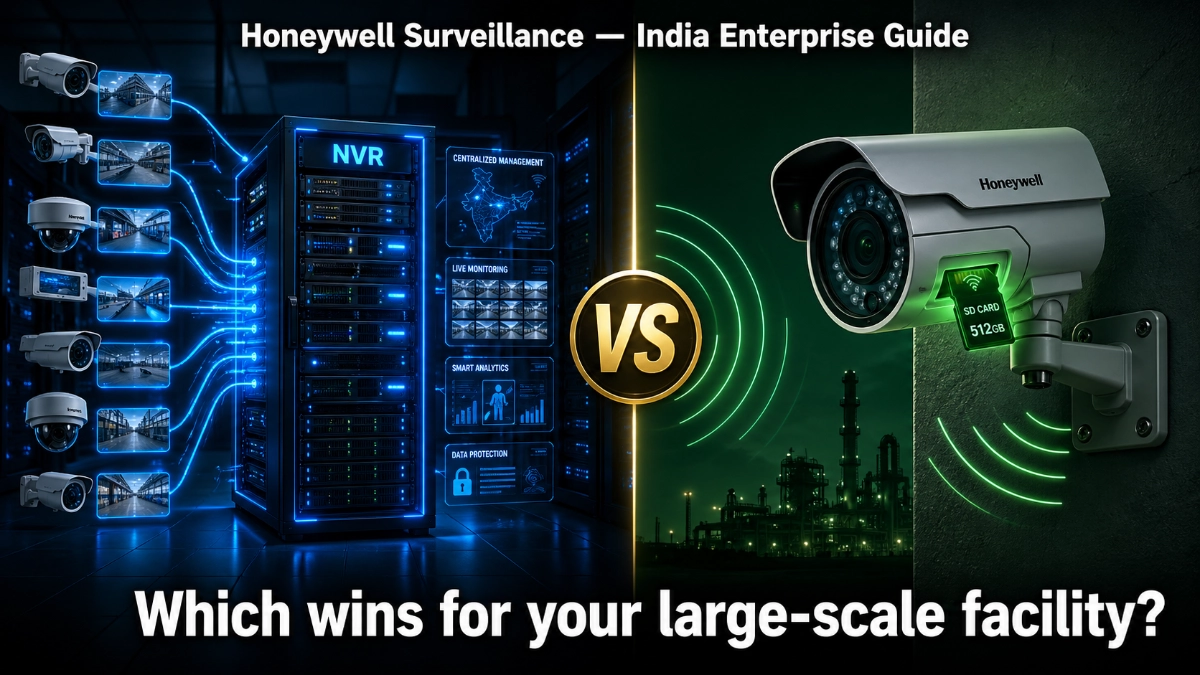
Now imagine a different facility. Same fire. But here, every camera records independently to its own storage. Even with the server offline, footage survives. Investigators have what they need.
This isn’t just a hypothetical. It’s the core architectural debate every security planner faces today: NVR-based centralised recording vs. Edge recording. And for large-scale Honeywell surveillance deployments across Indian factories, warehouses, airports and smart city projects, the stakes could not be higher.
Quick Definitions
NVR (Network Video Recorder) Recording: Video data from IP cameras streams continuously over the network to a centralised NVR server or appliance, which stores and manages all footage.
Edge Recording: Each IP camera stores footage directly on its own onboard memory (SD card or internal flash), independent of any central server or network connectivity.
Section 1: What Is NVR Recording in Honeywell Systems?
Architecture Overview
In an NVR-based setup, IP cameras capture video and stream it in real time or near-real time over your LAN or WAN to a dedicated NVR appliance or software-based server. The NVR handles all recording, indexing and storage.
Honeywell’s enterprise NVR solutions integrate seamlessly with their camera ecosystem, supporting ONVIF compliance for maximum flexibility. Security operators manage all feeds, playback and exports from a single, unified interface.
Key Benefits of NVR Recording
- Centralised Control: All cameras, all footage, one dashboard. Ideal for command centres in airports, metro stations and corporate campuses.
- Scalability: Add cameras or increase storage without touching individual devices. Scale from 16 channels to thousands.
- Advanced Analytics: Centralised servers can run AI-powered video analytics (facial recognition, crowd density, object detection) with dedicated processing power.
- Easier Compliance: For Indian enterprises needing audit trails or CCTV data retention policies, centralised management ensures consistent, trackable storage.
- Faster Search & Retrieval: Find footage from any camera on any date within seconds, no manual device access required.
Limitations of NVR Recording
- Bandwidth Dependency: Continuous streaming demands significant LAN/WAN capacity. In multi-building factories or logistics parks with older infrastructure, this can be a challenge.
- Single Point of Failure: If the NVR server goes down due to hardware failure, power outage, or cyberattack, you lose active recording across all connected cameras.
- Higher Upfront Cost: Enterprise NVR hardware and storage arrays require meaningful capital investment.
| Common Mistake: Many integrators underestimate bandwidth requirements for high-resolution (4K) NVR streams. Always calculate bandwidth per camera and multiply by simultaneous streams before specifying infrastructure. |
Section 2: What Is Edge Recording?
Architecture Overview
Edge recording shifts the storage responsibility to the camera itself. Each camera writes video to an onboard SD card or embedded flash memory. The camera operates as an autonomous recording unit; it doesn’t need a server to capture and save footage.
Modern Honeywell IP cameras and Impact by Honeywell cameras support edge storage, enabling continuous recording even during network outages.
Key Benefits of Edge Recording
- Resilience: No single point of failure. Each camera records independently, making the system robust against server failures, network disruptions, or power events at the server end.
- Bandwidth Efficiency: Since video doesn’t stream continuously to a central server, network load is dramatically reduced. Only clips or triggered events need to be transmitted.
- Lower Entry Cost: No need for high-capacity NVR hardware for smaller deployments. A camera with a 256GB SD card can store days of high-resolution footage.
- Ideal for Remote or WAN-Dependent Sites: For Indian industrial environments with unreliable internet or limited connectivity (mining sites, rural logistics hubs, highway toll plazas), edge recording ensures no gaps in coverage.
Limitations of Edge Recording
- Management Complexity at Scale: Managing SD cards across 500 cameras is operationally intensive. Card failures, write limits, and capacity checks across hundreds of devices create real overhead.
- Retrieval Challenges: Pulling footage requires accessing individual cameras either physically or via software. For large investigations, this is slow.
- Physical Vulnerability: SD cards in outdoor cameras can be damaged by heat, vibration, or tampering. For Indian industrial environments with extreme temperature variation, card durability matters.
- Limited Analytics: Edge devices have constrained processing power for running advanced AI analytics compared to a centralised server.
| Pro Tip: Use industrial-grade SD cards (rated for -40°C to +85°C) in cameras deployed in outdoor or high-temperature Indian industrial environments. Standard consumer cards fail prematurely. |
Section 3: Key Differences — NVR vs Edge Recording
Here’s a side-by-side comparison to help you evaluate which approach suits your deployment:
| Feature | NVR Recording | Edge Recording |
| Storage Location | Centralised server / NVR appliance | Onboard camera (SD card / local storage) |
| Reliability | Single point of failure risk | Resilient — each camera is independent |
| Bandwidth Usage | High — continuous stream to the server | Low — only sends footage when needed |
| Scalability | Easy to scale centrally | Complex to manage at scale |
| Retrieval | Fast, centralised search & export | Manual per-device, slower at scale |
| Maintenance | Simpler — one system to manage | Higher effort across many devices |
| Cost (Initial) | Higher upfront hardware cost | Lower per-device cost |
| Cost (Long-term) | Lower — centralised maintenance | Higher — distributed management overhead |
| Ideal For | Airports, campuses, command centres | Remote sites, WAN-constrained locations |
| Hybrid Compatible | Yes — works with edge fallback | Yes — pairs well with NVR as backup |
Use this table as a quick-reference checklist when advising enterprise clients or planning large-scale deployments.
Section 4: Which Is Better for Large-Scale Honeywell Deployments?
It Depends on Your Environment
There is no universal answer, and anyone who tells you otherwise is oversimplifying. The right choice depends on your facility type, network infrastructure, budget and operational requirements.
For large, well-connected facilities, such as airports, IT campuses, shopping malls, and government buildings, NVR recording offers unmatched centralised control, analytics capability and ease of management.
For distributed, network-constrained, or remote deployments, remote warehouses, factory shop floors with wireless dead zones, highway monitoring systems, edge recording provides resilience that centralised systems simply cannot guarantee.
The Hybrid Approach: The Best Practice for 2024 and Beyond
Leading security architects and Honeywell-certified integrators increasingly recommend a hybrid architecture: NVR as the primary recording backbone, with edge storage on cameras as an automatic failover.
In practical terms, this means:
- Cameras stream footage to the NVR under normal conditions.
- If network connectivity drops or the NVR goes offline, cameras automatically switch to local SD card recording.
- When connectivity is restored, cameras sync locally stored footage back to the NVR.
This architecture eliminates the single point of failure risk while maintaining centralised management and analytics. For large-scale surveillance projects in India, particularly in manufacturing corridors like Pune-Nashik, DMIC nodes, or port logistics zones, this hybrid model is rapidly becoming the standard.
| Pro Tip: When specifying a hybrid deployment, ensure your Honeywell cameras and NVR firmware versions support automatic failover sync. Not all entry-level models include this feature; verify compatibility with your integrator. |
| Common Mistake: Deploying edge recording as a cost-cutting measure across 200+ cameras without a centralised management platform leads to a nightmare for investigations. Always pair edge recording with a VMS (Video Management Software) that can centrally query and retrieve footage from all edge devices. |
Section 5: Real-World Use Cases — India-Focused
1. Factory Surveillance (Manufacturing Sector)
In large-scale surveillance projects in India’s manufacturing sector, auto components, pharmaceuticals and electronics factories need 24/7 coverage of production lines, entry points and hazardous zones.
Recommended Setup: NVR as primary, edge as failover. Production floors often have vibration and EM interference; edge recording ensures footage is never lost during brief network disruptions.
2. Warehouse and Logistics Hubs
India’s e-commerce boom has created massive warehousing complexes in Bhiwandi, Kundli and Gurgaon that span millions of square feet. Multiple buildings, dock areas and perimeter zones create complex surveillance requirements.
Recommended Setup: Zone-based NVR architecture for each building cluster, with edge recording on all perimeter and dock cameras for resilience. Central command centre with unified VMS.
3. Smart City Projects
Government-funded smart city surveillance in Lucknow, Surat, Bhopal and other Tier-2 cities involves thousands of cameras across public spaces, traffic junctions and critical infrastructure.
For Indian industrial environments operating under smart city initiatives, a hybrid model with centralised city-level NVR infrastructure and edge failover at each pole-mounted camera is the proven architecture.
4. Airports and Critical Infrastructure
Airports like Hyderabad, Kochi and Chandigarh operate 24/7 with zero tolerance for footage gaps. Regulatory requirements mandate continuous recording and defined retention periods.
Recommended Setup: High-capacity NVR arrays in secure server rooms, with edge as an added redundancy layer for airside and perimeter cameras.
Section 6: Why Honeywell Surveillance Systems Stand Out
Honeywell has built one of the most trusted surveillance ecosystems in the world, and for Indian enterprise deployments, this reliability translates to measurable operational value.
Reliability and Build Quality
Honeywell cameras are designed for harsh industrial environments, dust, humidity and heat extremes. This is particularly relevant for Indian factories and outdoor deployments, where less hardware fails prematurely.
Seamless NVR and Edge Integration
Honeywell’s NVR lineup natively supports both centralised and edge recording configurations. Cameras and recorders are engineered to work together, minimising integration headaches and firmware compatibility issues.
Scalability from 4 to 4,000+ Channels
Whether you’re securing a single facility or an entire industrial estate, Honeywell’s architecture scales without requiring a platform change. This matters enormously for phased deployments, a common requirement in Indian infrastructure projects.
Explore Impact by Honeywell
For enterprise-grade surveillance hardware that supports both NVR and edge recording architectures, Explore Impact by Honeywell surveillance solutions offers a comprehensive portfolio of IP cameras, NVRs and accessories engineered for demanding large-scale deployments.
Impact by Honeywell cameras support onboard SD card storage, dual-stream recording and seamless NVR integration, making them ideal anchors for hybrid architectures across Indian industrial and commercial projects.
Section 7: Best Practice Recommendations
Choose NVR When:
- You have a well-connected, high-bandwidth network (LAN with gigabit infrastructure).
- Your deployment is centralised, single campus, airport, or large commercial complex.
- You need advanced AI video analytics (crowd management, intrusion detection, facial recognition).
- Compliance and audit trail requirements demand centralised, tamper-evident storage.
- You have a dedicated IT team to manage server infrastructure.
Choose Edge Recording When:
- Your cameras are in remote or network-constrained locations.
- You need guaranteed recording even during network outages.
- Bandwidth is limited or expensive (WAN links, mobile data backhaul).
- You’re deploying in temporary or rapidly evolving infrastructure (construction sites, events).
Combine Both (Hybrid) When:
- You’re deploying in large Indian industrial complexes where both reliability and central control matter.
- You cannot tolerate any footage gaps, even during server maintenance or unexpected failures.
- You want centralised VMS management with resilient per-camera fallback recording.
- Your phased deployment plan starts with the edge and adds NVR infrastructure over time.
| Pro Tip: For any deployment over 50 cameras in India, build your architecture around the hybrid model from day one. Retrofitting edge failover capability after the fact is significantly more expensive than specifying it up front. |
Make the Right Call for Your Deployment
NVR and edge recording are not competing technologies; they’re complementary layers of a resilient, scalable surveillance architecture. Choosing between them isn’t an either/or decision. It’s about understanding where each technology delivers maximum value in your specific environment.
For system integrators and security consultants working on large-scale projects in India, from smart city corridors to automotive manufacturing campuses, the hybrid approach delivers the best of both worlds: centralised control, operational efficiency and rock-solid resilience.
Honeywell’s surveillance ecosystem is purpose-built to support exactly this kind of architecture. From high-performance IP cameras with onboard storage to enterprise NVR platforms with multi-site management, every component is designed to work together.
Ready to plan your next large-scale surveillance project? Explore Impact by Honeywell surveillance solutions to find cameras, NVRs and accessories that match your architecture requirements or consult with a certified Honeywell integrator for a deployment-specific recommendation.
Read Also: Top 10 CCTV Trends Every Business Should Know in 2026
Read Also: Cloud NVR vs Traditional NVR – What’s Better in 2026?