Picture this: a large manufacturing conglomerate operates 14 facilities across Mumbai, Delhi, Pune, Hyderabad and Chennai. One night, a fire breaks out in a storage unit at their Hyderabad plant. The local alarm goes off, but no one at the central security desk in Mumbai knows about it. By the time the local team responds, the damage is irreversible.
This is not a hypothetical situation. It is a real risk that thousands of Indian enterprises face every day. Managing fire safety across multiple cities is one of the most underestimated challenges in large-scale facility management.
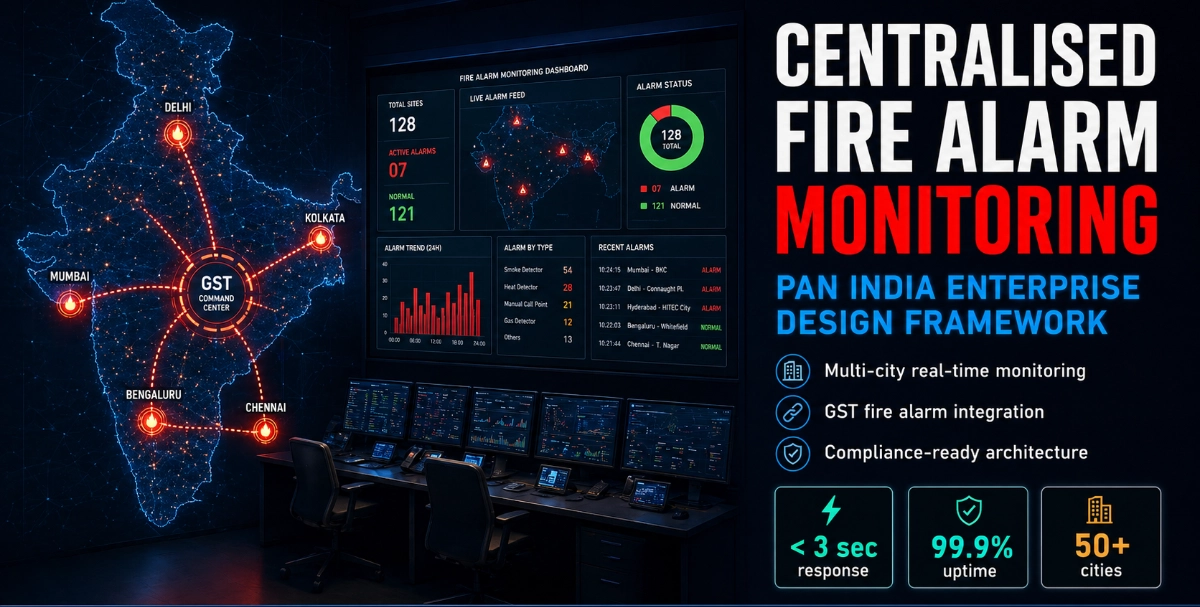
Centralised fire alarm monitoring in India is the answer. It connects every fire detection device across all your locations into one unified command system. Decision-makers can track, respond to, and manage fire risks from a single dashboard, no matter where the facility is.
This article provides a proven design framework for deploying a PAN India fire alarm network. Whether you manage hospitals, manufacturing units, data centres, or retail chains, this guide will help you build a smarter, safer system.
What Is Centralised Fire Alarm Monitoring?
Centralised fire alarm monitoring is a system that connects fire detection devices from multiple locations into one central platform. Instead of managing each site independently, all alarms, alerts and status updates flow into a single command centre or software dashboard in real time.
How Does It Differ from Standalone Systems?
A standalone fire alarm system works only within one building. It alerts occupants locally but has no link to other sites or a central team. A centralised system, by contrast, integrates every site into a PAN India fire alarm network. When an alarm triggers in Bengaluru, your team in Delhi knows within seconds.
| Standalone System: One building. One alarm. No remote visibility. Centralised System: All sites. All alarms. Real-time command centre control. |
Why Multi-City Enterprises Critically Need Centralised Monitoring
Operational Challenges
Large enterprises face fragmented safety management. Each site may have a different alarm panel brand, a different maintenance team and a different response protocol. This creates dangerous gaps in fire safety coverage.
Risk Factors
Delayed detection and slow response are the biggest killers in fire incidents. When a fire goes unnoticed at a remote facility for even a few minutes, it can cause catastrophic damage. Without a remote fire alarm monitoring system, this delay is almost guaranteed.
Compliance Complexity Across India
India’s fire safety landscape involves multiple regulations, including the National Building Code (NBC), state fire service acts and industry-specific norms. Multi-site enterprises must comply with all applicable rules across every state in which they operate. A centralised system simplifies compliance reporting, audit trails, and documentation.
Additionally, large industries must meet industrial safety compliance India standards set by bodies such as DGFASLI and state factory inspectorates. A unified monitoring system ensures consistent adherence across all facilities.
Essential Components of a Centralised Fire Monitoring System
Every reliable centralised fire monitoring system is built on four key components. Understanding each one helps in making informed decisions during system design.
1. Control Panels
The control panel is the brain of any fire alarm setup. In a multi-site deployment, two types of panels are used. An addressable fire alarm panel identifies the exact device that triggered the alarm, down to the room and zone level. This precision is critical for large buildings and campuses. A conventional fire alarm panel divides a building into zones and indicates which zone has an alarm, suitable for smaller or older facilities.
A well-designed PAN India network integrates both types depending on each site’s size, budget and risk profile.
2. Communication Protocols
Connecting all sites to a central command requires a reliable communication backbone. The three most common protocols used in fire alarm integration in India are IP-based networks (broadband or leased lines), GSM or cellular communication for remote locations, and cloud-based platforms for scalable, real-time monitoring. Each has its strengths and most enterprise deployments use a combination of all three for redundancy.
3. Command Centre / Dashboard
The command centre is where all data comes together. It gives facility managers and security teams a live view of every site. Modern dashboards show sensor status, alarm history, maintenance schedules and compliance logs. Some advanced platforms also allow remote isolation of zones and integration with building management systems (BMS).
4. Field Devices
Field devices include smoke detectors, heat detectors, manual call points, beam detectors and sounders. In addressable deployments, addressable detectors send individual signals to the panel. Each device has a unique address, enabling pinpoint identification. In conventional setups, conventional detectors send zone-based signals.
Selecting the right mix of devices for each site is critical. High-ceiling warehouses need beam detectors. Server rooms need aspirating smoke detection. Kitchens need heat detectors. The design must match the device type to the environment.
Proven Design Framework for PAN India Deployment
Deploying a centralised fire alarm system across multiple cities requires a structured approach. Follow this six-step framework to ensure a reliable, scalable and compliant rollout.
Step 1: Site Assessment Strategy
- Survey every facility for size, occupancy, fire load and risk level.
- Document existing fire alarm systems, panel brands and communication infrastructure.
- Categorise sites as high-risk, medium-risk, or low-risk based on NBC guidelines.
- Map out connectivity options available at each location (IP, GSM, fibre).
Step 2: Network Architecture Design
- Design a hub-and-spoke or mesh architecture depending on the number of sites.
- Select primary (IP/broadband) and backup (GSM/cloud) communication paths.
- Ensure the central command centre has redundant internet connectivity.
- Plan for cybersecurity measures for all IP-connected panels and dashboards.
Step 3: Integration of Addressable and Conventional Systems
- Retain existing conventional fire alarm panels where replacement is not feasible.
- Add addressable fire alarm panels at high-risk or new sites for superior detection.
- Use gateway devices or protocol converters to link conventional systems into the centralised network.
- Standardise alarm and event codes across all panels for consistent data reporting.
Step 4: Data Centralisation
- Deploy a SCADA-based or cloud-based monitoring platform to aggregate all site data.
- Configure real-time alerts via SMS, email and app notifications for key personnel.
- Implement role-based access so regional managers see their sites and national heads see all.
- Maintain a centralised event log for compliance and audit purposes.
Step 5: Redundancy Planning
- Ensure every panel has a battery backup of at least 24 hours (72 hours for critical facilities).
- Use dual-path communication so if IP fails, GSM takes over automatically.
- Set up a backup monitoring centre or DR site for the command dashboard.
- Test redundancy protocols quarterly as part of a preventive maintenance schedule.
Step 6: Compliance Alignment
- Map every site’s system design to the National Building Code fire detection requirements.
- Align with IS 2189 (Indian Standard for fire alarm systems) for equipment and installation.
- Prepare site-wise compliance documents and store them on the central platform.
- Schedule periodic third-party audits and integrate audit reports into the central dashboard.
The Role of GST Fire Alarm Systems in PAN India Networks
For enterprises seeking a reliable and scalable solution, GST fire alarm systems have emerged as a trusted choice among system integrators and facility managers across India.
GST offers a comprehensive range of panels, from the addressable fire alarm panel for large and complex sites to solutions compatible with conventional fire alarm panel installations for cost-effective deployments. Their systems are designed with network capability built in, making remote fire alarm monitoring system integration straightforward.
Key Advantages of GST in Multi-Site Deployments
- Scalable architecture supports integration across hundreds of sites on a single platform.
- Advanced detection algorithms reduce false alarms and improve response accuracy.
- Wide range of addressable detectors and conventional detectors compatible with mixed environments.
- Strong compliance with Indian and international fire safety standards.
- Integration flexibility with third-party BMS, access control and CCTV systems.
For enterprises building a fire alarm integration India strategy, GST provides the technology backbone to make centralised monitoring a reality.
Common Challenges and Practical Solutions
| Challenge | Practical Solution |
| Connectivity Issues in Tier 2/3 Cities | Use dual-path communication (IP + GSM). In truly remote areas, satellite communication modules can serve as backup. |
| Legacy System Integration | Deploy protocol gateways or converters that translate signals from older panels into IP-based data streams compatible with modern platforms. |
| False Alarms Disrupting Operations | Use intelligent addressable detectors with multi-criteria sensing (smoke + heat + CO). Set up pre-alarm stages to filter spurious signals. |
| Maintenance Across Multiple Locations | Centralise maintenance scheduling on the dashboard. Use remote diagnostics to identify faulty devices without site visits. Train local staff for first-response maintenance. |
| High Initial Investment | Phase the rollout. Prioritise high-risk sites first. Lease monitoring-as-a-service (MaaS) platforms to reduce upfront capital expenditure. |
Best Practices for Successful Implementation
- Start with a comprehensive fire risk assessment for every facility before choosing equipment.
- Standardise equipment brands and panel types as much as possible to simplify maintenance.
- Train a central response team on the monitoring dashboard and escalation protocols.
- Define clear SLAs for alarm response times for both local and central teams.
- Conduct bi-annual mock drills at all sites and document results on the central platform.
- Keep firmware and software on all panels and monitoring dashboards updated regularly.
- Integrate the fire alarm system with automatic sprinklers, smoke vents, and elevator controls.
- Ensure all installations comply with IS 2189 and get certified by a licensed fire system integrator.
- Use cloud-based monitoring platforms to enable mobile access for senior management on the go.
- Review and update the system design after any major renovation or change in facility use.
Future Trends in Centralised Fire Alarm Monitoring
The landscape of fire safety in India is evolving rapidly, driven by smart building technologies and government initiatives around smart cities in India.
AI-Based Intelligent Alerts
Artificial intelligence is transforming how fire alarm systems respond. AI algorithms can analyse sensor data patterns to predict fire risks before an alarm even triggers. This moves monitoring from reactive to predictive, dramatically reducing response time.
IoT-Enabled Fire Safety Systems
The Internet of Things (IoT) enables every fire device to communicate data in real time. IoT-enabled systems in smart buildings in India allow automated suppression systems, real-time occupancy data and integration with emergency services, all from a single connected platform.
Smart City Integration
Many Indian cities are investing in smart city infrastructure. Future centralised monitoring systems will integrate directly with city-level emergency response platforms. This means a fire alert at a factory in Pune will simultaneously notify local fire stations through the smart city network, cutting emergency response times significantly.
Cloud-Native Monitoring Platforms
Cloud-native platforms offer enterprises zero-hardware infrastructure at the command centre level. They enable real-time global access, automatic updates and massive scalability. Enterprises operating PAN India can manage their entire fire safety network from any device, anywhere.
Note: Managing fire safety across multiple cities is one of the most critical responsibilities for PAN India enterprises. A fragmented, site-by-site approach leaves dangerous gaps in coverage, compliance and response capability.
Centralised fire alarm monitoring in India closes these gaps. By integrating every site into a unified PAN India fire alarm network, enterprises gain real-time visibility, faster response, simplified compliance and long-term cost efficiency.
The design framework in this article provides a clear path from site assessment to full deployment. By combining the right mix of addressable fire alarm panels, conventional fire alarm panels, addressable detectors, conventional detectors and a reliable platform like GST fire alarm systems, any enterprise can build a world-class, scalable fire safety infrastructure.
The question is not whether your enterprise needs centralised fire monitoring. The question is whether you can afford to wait any longer to put it in place.
Read Also: Engineering Use Cases of GST-IFP8 vs GST100 in Industrial Deployments
Read Also: Root Cause Analysis of False Alarms in Dust-Heavy Industrial Environments