| What This Article Covers: Modern smart fire alarm systems, IoT-based detection networks, cloud-connected panels and AI monitoring tools have transformed fire safety. But they also introduce new, often-overlooked risks: network failures, false alarms, cyberattacks, software bugs, cloud outages and dangerous over-reliance on automation. This article explains exactly what those risks are, why they matter and what safety teams can do about them. |
Fire safety technology has come a long way. The days of a standalone smoke detector connected to a simple sounder are long gone. Today, buildings from hospitals and data centres to oil refineries and high-rise commercial towers rely on sophisticated intelligent fire detection systems that pull data from hundreds of sensors, analyse patterns using AI, report to cloud dashboards and integrate directly with building management systems (BMS).
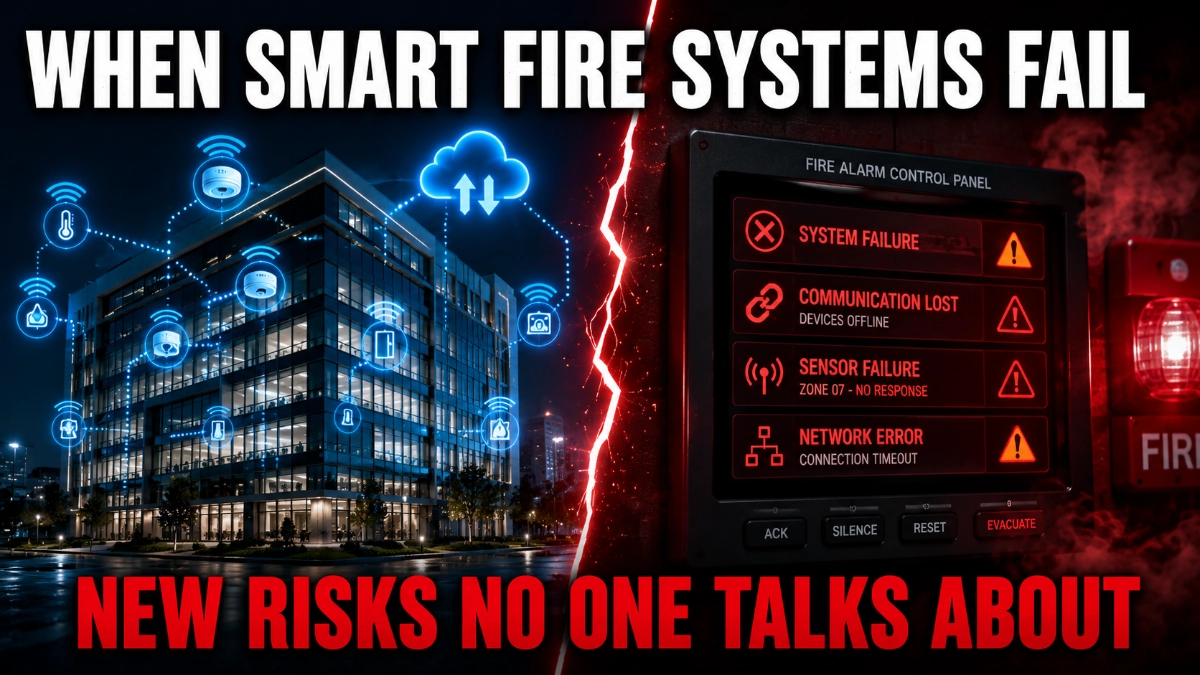
That progress is real. Detection speeds have improved. False negative rates have dropped. Remote monitoring has made the response faster. But here is the part that rarely gets enough attention: the more complex and connected a fire system becomes, the more ways it can fail.
And in fire safety, failure is not recoverable. It can mean lives lost, assets destroyed and facilities shut down. This is not a reason to reject modern technology; it is a reason to understand it more clearly.
This article breaks down the new categories of risk that smart fire systems introduce, explains them in plain terms, and outlines what engineers, safety managers and facility directors need to do to stay ahead of them.
The Evolution of Smart Fire Systems
Traditional fire alarm systems were simple by design. A conventional fire alarm panel connected to detection zones, with each zone reporting back when triggered. No software updates. No IP addresses. No cloud connectivity. Limited integration. What you saw was what you got.
The shift began with addressable fire alarm panels, which allowed individual devices to report their precise location back to the panel. That was a significant step forward; instead of knowing a fire was in ‘Zone 3’, operators could identify exactly which addressable detector was triggered, down to the room and device number.
The next wave brought digital intelligence into the equation. AI algorithms began analysing sensor data over time, learning what normal environmental conditions looked like in a given space and filtering out patterns that typically lead to false alarms. This was especially valuable in industrial environments where steam, dust, or exhaust fumes could otherwise trigger constant nuisance alarms.
Then came the era of full IoT integration. Fire alarm control panels began connecting to local area networks and even to the internet. Cloud-based dashboards allowed safety managers to monitor multiple sites from a single screen. Automated alerts reached mobile devices within seconds. Integration with access control, HVAC and sprinkler systems became the new standard for smart buildings.
Each of these developments delivered genuine value. But each also introduced a new layer of complexity and with complexity comes vulnerability.
| Expert Insight: The fundamental design principle of any fire detection system is reliability under the worst possible conditions. Every time you add a new layer of technology software, network dependency, or cloud connectivity, you need to ask: what happens to detection capability when this layer fails? That question often gets skipped during procurement. |
How Modern Smart Fire Systems Actually Work
Before exploring where things go wrong, it helps to understand how these systems function at a technical level.
A modern intelligent fire detection system typically consists of several interconnected layers:
Layer 1: Detection Devices
These include addressable detectors, smoke, heat, multi-sensor and carbon monoxide detectors positioned throughout a building. Unlike conventional detectors, addressable units communicate their individual status to the panel using a digital protocol. Each device has its own address, which makes fault location precise.
Layer 2: The Fire Alarm Control Panel
The fire alarm control panel (FACP) is the central brain. It receives input from all connected devices, processes that data and triggers appropriate outputs, alarms, notifications, and relay activations. In a smart system, this panel often runs on an operating system of its own, and in advanced setups, it connects to a network.
Layer 3: Network and Communication Infrastructure
Modern panels may use Ethernet, fibre optic loops, wireless mesh networks, or even cellular connections to communicate with monitoring centres, BMS platforms, or cloud servers. This layer is where many new risks originate.
Layer 4: Cloud Monitoring and Management Platforms
Cloud platforms aggregate data from multiple panels across multiple sites. They generate analytics, issue maintenance alerts, log historical events and enable remote configuration. These platforms are powerful tools, but they depend entirely on uninterrupted connectivity and secure infrastructure.
Layer 5: AI and Analytics Engines
The most advanced systems use machine learning models to distinguish between real fire signatures and benign events that produce similar sensor readings. These models require regular training data updates to remain accurate as environmental conditions change.
New Categories of Risk Introduced by Smart Fire Technologies
This is the core of what safety professionals need to understand. Smart fire systems do not eliminate risk, they transform it. Below are the most significant new risk categories that emerge when fire detection becomes digitally intelligent and network-connected.
1. Network Dependency Risks
A fire alarm system that depends on a live network connection to function correctly carries a structural vulnerability that older systems never had. If the network goes down due to a router failure, a fibre cut, a software misconfiguration, or a cyberattack, the system’s ability to transmit alerts or update its operational state may be compromised.
In practice, most well-designed systems include local backup logic that allows the panel itself to trigger alarms even when the network is unavailable. But features like remote monitoring, automated notifications to off-site teams, and integration with BMS systems all depend on that connection.
In a large industrial fire alarm system covering multiple buildings or remote sites, a single network failure can create blind spots that operators may not immediately detect.
| Real-World Scenario: A facility management team receives all fire system alerts through a cloud dashboard. A misconfigured firewall update blocks the panel’s outbound connection at 11 PM. The panel continues to operate locally, but the cloud dashboard shows all sensors as ‘offline’ rather than ‘in alarm’. An early-stage fire in a storage room generates a local alert, but no mobile notification reaches the night duty team. The alarm is missed for 40 minutes. |
2. AI False Alarm and False Negative Risks
AI-based fire detection is genuinely impressive when it works correctly. But AI systems trained on specific environmental data can fail in both directions when conditions change.
A false alarm occurs when the system detects a pattern it classifies as fire-relevant but which is actually benign. Persistent false alarms erode staff trust in the system. In high-frequency false alarm environments, teams begin to delay response, a documented phenomenon sometimes called ‘alarm fatigue’. This is dangerous.
More concerning is the false negative: the system fails to flag a genuine fire event because the sensor signature does not match the model’s training data. In a new building configuration, after a significant change in industrial processes, or after equipment is modified, the AI baseline may no longer reflect actual conditions.
AI models must be retrained as environments change. That retraining requires time, expertise and up-to-date sensor data, and in many facilities, it simply does not happen on schedule.
3. Cloud Connectivity Failures
Cloud-based fire alarm monitoring systems centralise data from many sites into a single platform, which is operationally efficient. The trade-off is clear: if the cloud platform experiences downtime, all centralised visibility disappears simultaneously.
Cloud outages do happen. Platform maintenance windows, server failures, regional internet disruptions and software update complications can all interrupt service. When a fire alarm monitoring system is cloud-dependent, and the cloud goes down, safety teams lose visibility at exactly the moment they may need it most.
The risk compounds when a cloud outage coincides with a fire event, statistically improbable but not impossible, especially during severe weather events that simultaneously affect infrastructure and create fire risk conditions.
4. Cybersecurity Vulnerabilities in Smart Fire Alarm Systems
This is one of the most underappreciated risks in the modern fire safety landscape. When fire alarm control panels connect to IP networks, they become potential targets for cyberattacks. The consequences of a successful attack on a fire system are severe.
An attacker who gains access to a networked fire alarm system could potentially trigger false evacuations, suppress genuine fire alarms, alter sensor thresholds, disable notification outputs, or extract building layout data that informs further physical attacks.
Industrial control system (ICS) security researchers have identified fire alarm panels as part of the broader attack surface in smart buildings. Many legacy panels were not designed with cybersecurity in mind; they were designed for reliability in an isolated environment. Connecting them to a network without appropriate security hardening creates exposure.
| Cybersecurity Risk | Mitigation Approach |
| Default or unchanged credentials on networked panels | Use strong, unique credentials and enforce credential rotation |
| Unencrypted communication protocols between devices | Deploy systems using encrypted communication standards |
| Outdated firmware with unpatched vulnerabilities | Establish a firmware update and vulnerability patch schedule |
| Inadequate network segmentation isolates fire systems | Isolate fire alarm systems on dedicated VLANs |
| No intrusion detection for panel access attempts | Implement access logging and anomaly alerts for panel access |
5. Software Update and Firmware Failure Risks
Smart fire systems run on software. Software needs updates. Updates can introduce bugs. This is not a hypothetical risk; it is a well-documented pattern across all categories of industrial software.
A failed firmware update on a fire alarm control panel can render devices unresponsive, corrupt address maps, alter detection thresholds, or cause the panel to enter an undefined state. In some cases, update failures have caused networked panels to drop all device communications until a manual reset was performed.
The challenge is that fire systems cannot simply be taken offline during maintenance the way a server can. Updates must be carefully staged, tested in isolated environments first and rolled back if problems occur. Many facilities lack the technical processes to manage this safely.
6. Integration Risks with Building Management Systems
Modern smart buildings integrate fire alarm systems with HVAC control, access control, elevator management, lighting systems and security platforms, all operating under a unified BMS. This integration creates powerful coordinated responses to fire events. It also creates interdependencies that can propagate failures.
If a BMS software update alters communication protocols between subsystems, the fire alarm integration may break silently. The system appears operational from the panel’s perspective, but the expected downstream actions, air handling shutdown, door release and elevator recall, may no longer execute correctly.
Integration failures of this type are difficult to detect without regular end-to-end testing of the full response chain, which is often skipped due to cost and disruption.
7. Power Backup Limitations in Smart Systems
Traditional fire alarm systems had relatively modest power demands, and backup battery calculations were straightforward. Modern smart systems consume significantly more power, processing units, network interfaces, wireless communication modules, and cloud connectivity hardware, all of which draw continuous current.
If backup power capacity has not been recalculated after system upgrades, the effective runtime during a mains failure may be substantially shorter than required by fire safety compliance standards. In the event of a fire preceded by a power disruption, a common combination, the system may lose full functionality before emergency services arrive.
8. Human Over-Reliance on Automation
Automation creates complacency. When staff know that the system will alert them automatically, detect problems remotely, and integrate with emergency response protocols, their own situational awareness tends to diminish. This is a documented psychological effect, not a criticism of any individual.
In older systems, control room operators actively monitored panels, physically inspected zones and maintained a detailed mental model of system status. In automated smart systems, operators may not interact directly with the fire alarm panel for days or weeks at a time. When something goes wrong, when the automation fails, the human fallback capability may no longer be reliable.
Fire safety compliance requires regular training and manual override competency. In practice, these requirements are often treated as formalities rather than genuine capability maintenance exercises.
Industrial Environments: Where Smart Fire System Risks Are Amplified
The risks described above exist in every smart building. In industrial environments, such as petrochemical facilities, power plants, data centres, manufacturing plants and pharmaceutical production sites, they are significantly amplified.
- Harsh Physical Conditions: Extreme temperatures, vibration, dust, humidity and chemical exposure degrade sensors and wiring faster than in standard commercial environments. Addressable detectors in such environments require accelerated maintenance schedules that IoT-based predictive maintenance tools may not account for accurately.
- Complex Hazard Profiles: Industrial facilities often contain multiple simultaneous fire hazards, such as flammable liquids, compressed gases and electrical arc risks, each of which produces different fire signatures. AI models trained on standard data may not accurately classify composite industrial fire signatures.
- High Consequence of Delayed Response: In a data centre, a 90-second delay in detection and suppression can destroy irreplaceable equipment. In a petrochemical facility, it can initiate a cascade failure. The tolerance for smart system failures is near zero.
- Regulatory Scrutiny: Industrial sites in high-hazard categories operate under strict fire safety compliance frameworks. A smart system failure that results in a compliance gap can lead to facility shutdown, regulatory penalties and insurance consequences, independent of whether an actual fire occurred.
| Expert Insight: In high-hazard industrial environments, the fire detection architecture should never rely on a single point of failure. The intelligent layer adds value, but it must sit on top of a reliable, independently testable conventional or addressable infrastructure, not replace it. Redundancy is not optional. It is the architecture. |
Why Reliable Panel Architecture Still Defines System Safety
Across all the technology layers of a modern fire system, the fire alarm control panel remains the single most critical component. It is the device that processes sensor inputs, makes detection decisions and activates outputs. Everything else in the system depends on the panel functioning correctly.
High-quality addressable fire alarm panels from established manufacturers, including GST fire alarm systems, which are widely deployed in demanding commercial and industrial environments, are designed with the core principles of deterministic behaviour, fault tolerance and isolation logic. These panels are engineered so that a failure in one communication loop does not cascade across the entire system.
When evaluating fire alarm architecture, the questions that matter most are not about features. They are about what happens when things go wrong:
- If the network connection drops, does the panel continue to detect and respond locally?
- If a single loop develops a fault, do other loops remain fully operational?
- If a software fault is encountered, does the panel fail safe, defaulting to alarm rather than fail silent?
- Is the panel certified to the relevant standards for the environment it operates in?
- Does the manufacturer provide a verified firmware update process with rollback capability?
The distinction between a conventional fire alarm panel and a modern addressable fire alarm panel is significant from a risk perspective. Conventional systems, while simpler, provide zone-level fault isolation. Addressable systems provide device-level precision but require more sophisticated loop management. The choice depends on the specific risk profile and regulatory requirements of the facility.
Compliance and Maintenance: Why They Still Matter More Than Ever
There is a misconception that connected, smart fire systems are inherently lower maintenance because they report faults automatically and enable predictive service scheduling. This is partially true. Automated diagnostics do catch many faults earlier than traditional manual inspection.
But fire safety compliance formal inspection, testing, documentation, and certification is not reducible to diagnostic alerts. It requires human verification of the full system response chain, not just individual component status.
What Compliance Testing Must Cover in Smart Systems
For an intelligent fire detection system operating in a modern smart building, compliance testing should include:
- End-to-end scenario testing: Trigger a sensor and verify the complete response chain, including BMS integration actions, remote notifications and cloud dashboard updates
- Network failure simulation: Disconnect the panel from the network and verify local detection and alarm capability
- Power backup verification: Measure actual battery runtime under current system load, not theoretical capacity
- Firmware version audit: Verify that panel and device firmware are current and that the update history is documented
- Cybersecurity review: Confirm network segmentation, access controls and credential management meet current security standards
- AI model review: For systems with adaptive detection algorithms, verify that the model baseline reflects current environmental conditions
| Key Point on Compliance: Automated monitoring supplements compliance, but it does not replace it. A fire alarm monitoring system that shows all-green status on a cloud dashboard can still have critical integration failures that only manifest during an actual event. Regular human-led testing remains legally and operationally mandatory for fire safety compliance. |
Best Practices to Reduce Smart Fire System Failures
The following practices reflect current industry understanding of how to maintain reliable fire safety infrastructure in intelligent, connected environments. They apply to building owners, facility managers, fire system integrators and safety compliance professionals.
Design Phase
- Define failure modes explicitly during system design. For every smart feature, document what happens if that feature fails. Ensure the system remains life-safety capable in degraded states.
- Apply the principle of independent layers. The intelligent fire detection layer should not be able to disable the basic detection and alarm layer.
- Require network isolation from day one. Fire alarm systems should operate on dedicated, physically or logically separate network segments with no access from general corporate networks.
Installation and Commissioning
- Change all default credentials on networked components before the system goes live. Document all credentials in a secure, access-controlled system.
- Conduct a full integration test with every connected BMS subsystem before handover. Do not accept commissioning documentation that does not include verified end-to-end test results.
- Verify backup power runtime under actual system load. Do not rely on theoretical calculations that predate system upgrades.
Ongoing Operations
- Schedule AI model reviews whenever significant changes are made to the building environment, industrial processes, or occupancy patterns.
- Test manual override and local alarm capabilities regularly. Ensure all control room staff can operate the fire alarm control panel without relying on the remote dashboard.
- Monitor cloud platform uptime and define a formal protocol for operating without cloud visibility. Do not treat cloud outages as low-risk events.
Cybersecurity Practices
- Apply firmware updates through a tested, documented process. Stage updates in a test environment before deploying to live panels.
- Maintain an asset register of all networked fire system components, including firmware versions and last-update dates.
- Conduct annual vulnerability assessments of fire system network infrastructure, treated with the same urgency as OT security reviews for industrial control systems.
The Future of Intelligent Fire Safety
The trajectory of fire detection technology continues towards greater intelligence, deeper integration and more autonomous response. Several developments are worth tracking closely from a risk management perspective.
Edge Computing in Fire Detection
Moving AI processing to the edge, running detection algorithms on the panel or in local gateways rather than in the cloud, addresses some network dependency risks. Edge-based systems maintain full intelligent detection capability without requiring cloud connectivity. This is the direction the most reliable intelligent fire detection systems are moving.
Digital Twin Integration
Advanced smart building platforms now incorporate digital twins: virtual models of building layouts, occupancy patterns, and environmental conditions that fire systems can reference during detection and response. This improves response precision but introduces a new risk: if the digital twin model is outdated or inaccurate, it can generate incorrect guidance during an actual incident.
Predictive Maintenance Analytics
IoT-enabled fire systems can now generate maintenance predictions based on sensor drift, communication quality, and device operating hours. This is genuinely valuable for extending reliable service intervals and catching device degradation before it causes a detection gap. However, predictive analytics supplements rather than replaces scheduled physical inspection.
5G and Wireless Fire Detection
5G connectivity opens the door to fully wireless fire alarm systems in environments where cabling is impractical. The reliability and latency characteristics of 5G are improving rapidly. But wireless systems introduce radio frequency interference risks and dependency on cellular infrastructure, both of which require specific engineering consideration.
The overriding principle for the future of fire safety technology is the same as it has always been: intelligence enhances fire protection, but it must never become a single point of failure within it.
Note: Smart fire safety technology is not a problem to be solved. It is a capability to be managed responsibly. The intelligent fire detection systems, cloud-connected panels, AI-based monitoring tools and IoT-integrated infrastructures available today are more powerful than anything available a decade ago, and they can save lives when they work correctly.
But they are also more complex than their predecessors, more interconnected and therefore more vulnerable to a new generation of failure modes. Network dependencies, cybersecurity exposure, AI model degradation, cloud platform outages, software update failures and the slow erosion of human manual competency are not theoretical concerns. They are documented risks that have already caused real incidents in real facilities.
The facilities that manage these risks well share a common approach: they treat smart features as enhancement layers added on top of a robust, certified, independently testable core system. They test failure scenarios as rigorously as they test normal operation. They invest in cybersecurity with the same seriousness as physical security. And they maintain human competency as a genuine operational requirement, not a compliance formality.
Fire safety compliance standards are beginning to catch up with these realities, but the standards always lag behind the technology. Safety professionals cannot wait for regulation to define best practice. The time to understand and address smart fire system risks is before an incident, not after.
When selecting fire detection infrastructure for critical environments, the question is not simply ‘how intelligent is this system?’ It is: ‘how reliably does this system perform under the full range of conditions it will actually face, including the ones it was not designed for?’
That question answered honestly, with evidence, is the foundation of modern fire safety engineering.
Read Also: Fire Detection Strategy in Open vs Compartmentalised Industrial Layouts
Read Also: How Enterprises Standardise Surveillance Infrastructure Across Multiple Plants in India