AI-based surveillance systems have transformed how organisations think about physical security. Gone are the days of human operators squinting at dozens of CCTV monitors for eight-hour shifts. Today, intelligent video analytics can detect intruders, identify faces, track license plates, flag unusual behaviour, and generate real-time alerts all without a single human glancing at a screen.
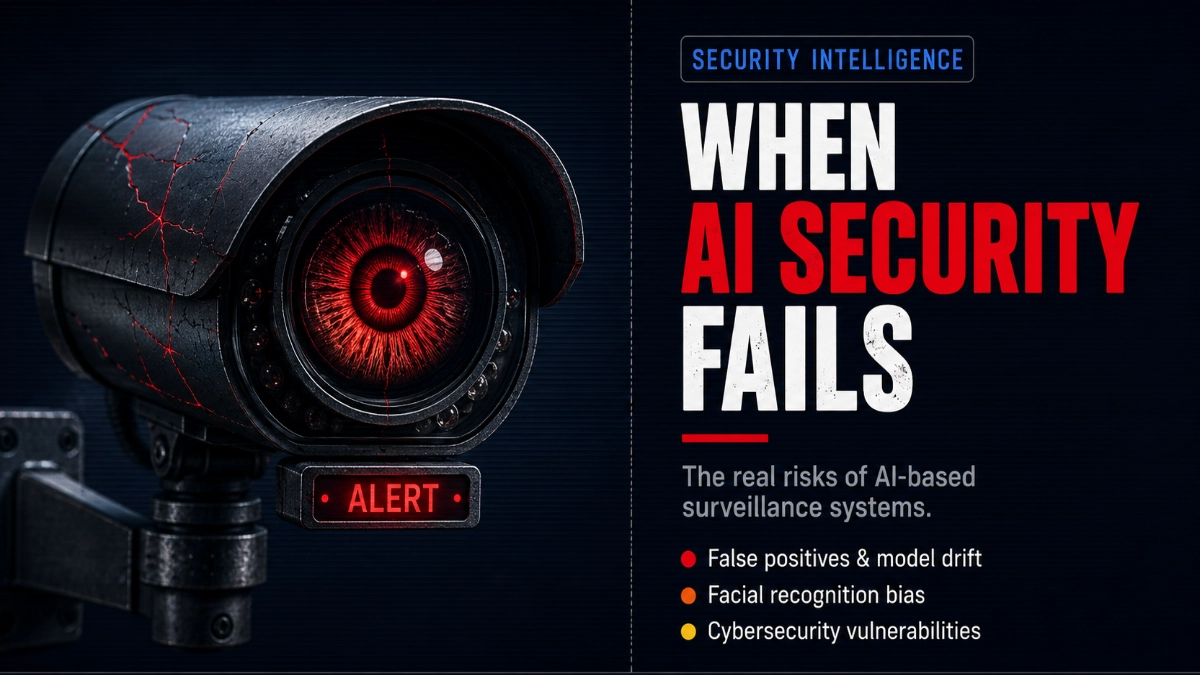
But here is the uncomfortable truth that few vendors discuss openly: AI surveillance systems can fail. And when they do, the consequences range from minor operational hiccups to serious safety incidents, compliance violations and even wrongful accusations.
This article takes an honest, expert look at the real risks of AI-based surveillance systems. Whether you manage security for a manufacturing plant, a smart city infrastructure, a data centre, or a commercial building, understanding these failure points is not optional; it is essential to building a genuinely secure environment.
What Are AI-Based Surveillance Systems?
AI-based surveillance systems combine traditional CCTV hardware with advanced software powered by machine learning (ML), computer vision and deep neural networks. These systems do not simply record video; they analyse it in real time, looking for specific objects, behaviours, anomalies or individuals.
Core components of a modern AI surveillance system typically include:
- IP cameras with onboard or edge-based AI processing chips.
- Video Management Software (VMS) integrated with AI analytics engines.
- Facial recognition and biometric identification modules.
- License plate recognition (LPR) systems.
- Behavioural analytics software that detects loitering, crowd gathering, or abandoned objects.
- Cloud platforms for data storage, AI model training and centralised monitoring.
- Network infrastructure, including switches, routers and cybersecurity layers.
These systems are deployed across a wide range of industries:
- Airports and transit hubs for passenger screening and perimeter security.
- Manufacturing plants and industrial facilities for worker safety and intrusion detection.
- Warehouses and logistics centres for inventory monitoring and access control.
- Smart cities for traffic management and public safety applications.
- Data centres for high-security zone monitoring and access verification.
- Commercial buildings, retail spaces and hospitals for general surveillance.
How AI Surveillance Works in Modern Security Infrastructure
Understanding how these systems work makes it much easier to understand why and how they fail.
When a camera captures video, the footage is passed through an AI inference engine, a software layer that uses pre-trained models to analyse the content frame by frame. The system compares what it sees against patterns it has learned during training. If the system detects a match (a face, a weapon, unusual movement), it triggers an alert, logs the event and often sends a notification to a security operator or an automated response system.
The quality of this process depends on three critical factors:
- The quality and diversity of the training data used to build the AI model.
- The computational power available to process video in real time.
- The reliability of the hardware, network and software infrastructure supporting the system.
When any of these three factors is compromised, the surveillance system’s performance can degrade significantly, sometimes without anyone noticing immediately.
The Major Risks and Failure Points of AI Surveillance Systems
1. False Positives and False Negatives
This is arguably the most common and operationally disruptive failure mode. A false positive occurs when the AI flags something as a threat when it is not. A false negative occurs when the AI fails to detect an actual threat.
In a busy warehouse, for example, an AI behavioural analytics system might repeatedly flag workers moving quickly near restricted zones as potential intruders, overwhelming security teams with meaningless alerts. Over time, this leads to “alert fatigue,” a well-documented psychological phenomenon where operators begin ignoring alerts because most of them turn out to be false.
The flip side is even more dangerous. A false negative means the system lets a genuine security breach go undetected. If an intruder moves in a way the AI has not been trained to recognise as suspicious, they may pass through the facility unnoticed.
Industry Observation: Studies from the security technology sector consistently show that alert fatigue is one of the leading causes of operator error in AI-assisted monitoring environments.
2. AI Misidentification
AI surveillance systems are not perfect at identifying what they see. An AI model trained primarily on indoor environments may struggle with outdoor settings. A system trained on clear, daylight footage may misidentify objects or people in different lighting conditions.
In airport security, misidentification can have serious consequences. If an AI system wrongly flags a passenger’s carry-on bag as containing a prohibited item, it creates disruption, delays and potential legal exposure. In industrial facilities, misidentifying a worker in an unauthorised zone can trigger emergency lockdown procedures unnecessarily.
3. Poor Low-Light and Environmental Performance
Most AI video analytics models are trained on high-quality, well-lit footage. Real-world surveillance environments are rarely that cooperative. Nighttime monitoring, fog, rain, smoke, steam (common in manufacturing and industrial settings) and direct sunlight creating lens flare can all degrade AI performance significantly.
A security system protecting an outdoor perimeter at night, or monitoring a facility with poor interior lighting, may have a dramatically lower detection accuracy than the vendor’s specifications suggest. This gap between lab performance and real-world performance is a serious risk that many organisations discover only after deployment.
4. Bias in Facial Recognition
Facial recognition technology remains one of the most controversial components of AI surveillance. Multiple independent studies have demonstrated that many commercial facial recognition systems perform with significantly lower accuracy on women, people with darker skin tones and older individuals compared to young white men.
For organisations deploying facial recognition at building entrances, airports, or access control points, this bias creates two parallel risks:
- Operational risk: Legitimate employees or visitors being denied access or flagged incorrectly.
- Legal and compliance risk: Potential violations of anti-discrimination laws, GDPR, or local biometric data regulations.
In smart city deployments, biased facial recognition has already led to wrongful identification incidents documented by civil liberties organisations in multiple countries, creating significant reputational and legal consequences for the deploying authorities.
5. Network Dependency Failures
Modern AI surveillance systems are heavily dependent on network connectivity. Cloud-based AI analytics require a stable, high-bandwidth internet connection to function. When the network goes down, so does the AI processing capability.
In a manufacturing plant where AI-powered cameras monitor safety compliance on the production floor, a network outage does not just create a monitoring gap; it can leave workers in dangerous situations without the automated safety alerts the system was specifically deployed to provide.
Even local network issues within a facility, such as a failed switch, a cable fault, or a misconfigured VLAN, can disable AI surveillance coverage across entire zones without triggering any visible alarm to security teams.
6. Cloud Downtime Risks
Organisations increasingly rely on cloud platforms for AI video analytics, centralised storage and remote monitoring. Cloud providers, despite their high reliability targets, do experience outages. When they do, AI surveillance systems that depend on cloud-based inference lose their analytical capability entirely.
This creates a particularly dangerous scenario in critical infrastructure environments, such as data centres, power facilities, or financial institutions, where continuous AI-powered monitoring is not a luxury but a security requirement.
7. Cybersecurity Vulnerabilities
AI surveillance cameras and their supporting infrastructure are networked devices, and networked devices can be hacked. The history of IP camera security is not a reassuring one. Many cameras ship with default credentials, outdated firmware and unencrypted data streams, making them attractive targets for cybercriminals.
The consequences of a compromised surveillance system can be severe:
- Attackers can disable cameras remotely, creating blind spots for physical breaches.
- Footage can be intercepted or manipulated, undermining the evidentiary value of recordings.
- Compromised cameras can be enrolled in botnets, using the organisation’s network as a platform for wider cyberattacks.
- AI models can be targeted by adversarial attacks, specially crafted inputs designed to fool the AI into misclassifying threats.
For industrial facilities and critical infrastructure, a cyberattack on the surveillance system is not just a privacy incident; it is a physical security breach.
8. Edge AI Processing Failures
Edge AI processes video analytics locally on the camera or a nearby compute device, rather than sending footage to the cloud. While this reduces network dependency and latency, it introduces different failure risks.
Edge AI chips can overheat in challenging environments, particularly in industrial settings with high ambient temperatures. Processing load from high-resolution video streams can overwhelm edge hardware. Firmware updates to edge devices can introduce bugs that affect AI performance. And because edge devices operate with limited redundancy compared to cloud infrastructure, a hardware failure at the edge can silently disable AI analytics for that camera without triggering a system alert.
9. Hardware Overheating and Storage Corruption
Physical hardware failures remain a significant risk for any surveillance system, AI-powered or not. Camera housings exposed to extreme temperatures common in outdoor industrial environments, cold storage facilities, or desert climates can suffer from condensation, thermal expansion, or direct heat damage.
Storage corruption is another underappreciated risk. AI surveillance systems generate enormous volumes of data. Hard drives or SSDs storing this footage are subject to mechanical failure, write errors, and corruption. In a legal investigation, corrupted or missing footage from a critical incident can have serious consequences both operationally and legally.
10. AI Model Drift Over Time
This is one of the most insidious failure modes because it is invisible until something goes wrong. AI model drift occurs when the real-world conditions the surveillance system operates in change sufficiently that the AI’s original training data no longer accurately represents what the cameras are seeing.
Examples include: a warehouse that expands its operations and introduces new types of machinery the AI was never trained to recognise; a facility that changes its shift patterns, resulting in crowd behaviours the behavioural analytics model flags as suspicious; or a retail environment that undergoes a renovation, changing the layout the AI uses as its baseline for anomaly detection.
Without regular model retraining and performance auditing, an AI surveillance system can silently degrade to the point where it provides little more security value than a standard CCTV camera.
11. Privacy and Compliance Risks
AI surveillance systems that capture biometric data, such as faces, gait patterns and voice, are subject to increasingly stringent regulations worldwide. GDPR in Europe, CCPA in California, BIPA in Illinois and emerging national AI governance frameworks all impose requirements on how biometric surveillance data can be collected, stored and used.
Organisations that deploy AI surveillance without fully understanding their compliance obligations face significant risks: regulatory fines, civil litigation, reputational damage and in some jurisdictions, criminal liability for senior executives.
12. Overdependence on Automation
Perhaps the most strategic risk of AI surveillance is the one that happens before any system failure: the organisational decision to reduce human oversight because the AI is assumed to be reliable.
When security teams are downsized on the assumption that AI will handle monitoring, or when response protocols are redesigned around automated AI alerts without human verification steps, the organisation becomes dangerously dependent on a system that can fail in the ways described above.
The most resilient security operations treat AI as a powerful tool that augments human judgment, not as a replacement for it.
13. Failure During Critical Incidents
AI surveillance systems are most important during the moments when they are most likely to be stressed beyond their design parameters. A fire or chemical release can obscure camera views. A cyberattack timed to coincide with a physical breach can disable AI monitoring. Power failures during severe weather events can take down both cameras and the network infrastructure supporting them.
Organisations that have not tested their surveillance systems under realistic stress conditions, including AI analytics performance during these scenarios, often discover critical gaps at the worst possible time.
Traditional CCTV vs. AI-Powered Surveillance: A Comparison
| Feature | Traditional CCTV | AI-Powered Surveillance |
| Detection Method | Passive recording; human review | Real-time AI analytics and automated alerts |
| Alert Generation | Manual monitoring required | Automated with configurable thresholds |
| False Positives | Low (human judgment) | Variable; can be high without proper tuning |
| False Negatives | High (operator fatigue) | Lower when properly trained; degrades with model drift |
| Network Dependency | Low; local recording | High cloud analytics require stable connectivity |
| Cybersecurity Risk | Moderate | Higher; AI models are an additional attack surface |
| Bias Risk | Human operator bias | Algorithmic bias in training data |
| Scalability | Requires proportional human staff | Scales without proportional staffing increase |
| Maintenance Complexity | Low | High; requires model updates and auditing |
| Compliance Complexity | Standard data retention rules | Biometric data regulations apply |
| Cost (Long-Term) | Lower technology cost | Higher technology cost; lower staffing cost |
Real-World Scenarios: Failure in Action
Manufacturing Plant
An automotive parts manufacturer deploys AI behavioural analytics to monitor worker safety on the production floor. Six months after deployment, the system begins generating hundreds of false alerts daily as new seasonal workers adopt different movement patterns that the model was not trained on. Security staff start ignoring alerts entirely. When a genuine safety incident occurs, the alert is lost in the noise.
Airport
An international airport implements facial recognition at immigration checkpoints. Due to biased training data, the system consistently underperforms for passengers from certain demographic groups, causing disproportionate delays and secondary screening requests. The airport faces a regulatory investigation and significant reputational damage.
Warehouse and Logistics
A major e-commerce distribution centre relies on AI surveillance for inventory security. A targeted cyberattack compromises the camera network, giving attackers real-time visibility into the facility’s layout and security patrol patterns. The AI system continues operating normally from the security team’s perspective, while the attackers plan their physical intrusion.
Smart City
A city deploys AI-powered traffic and crowd monitoring across its downtown core. A software update to the cloud-based analytics platform introduces a bug that causes the AI to stop generating alerts for anomalous behaviour. The issue is not discovered for two weeks, during which the system records but does not analyse footage, providing a false sense of security to city security operators.
Data Centre
A tier-four data centre’s edge AI cameras are deployed in server halls to detect unauthorised access. During a particularly hot summer, edge processing units begin throttling due to thermal constraints, reducing frame analysis rates from the designed 30fps to 6fps. The system continues to appear operational, but is processing only a fraction of the actual video feed.
How to Reduce the Risks of AI Surveillance Failure
Conduct Rigorous Pre-Deployment Testing
Before going live, test AI surveillance systems under the full range of real-world conditions they will encounter: different lighting, weather, crowd densities, equipment configurations and operational scenarios. Do not rely solely on vendor-provided performance benchmarks.
Implement Layered Redundancy
Design your surveillance architecture with redundancy at every critical layer:
- Redundant network paths and backup connectivity (4G/5G failover)
- Local edge recording that continues if cloud connectivity is lost
- Backup power systems, including UPS and generator coverage for camera infrastructure
- Redundant storage with automated integrity checking
Establish Regular AI Model Auditing
Schedule quarterly reviews of AI surveillance performance. Measure false positive and false negative rates over time. Compare current performance against baseline metrics from deployment. If drift is detected, initiate model retraining with updated data that reflects current operational conditions.
Maintain Human Oversight
Never design security operations that depend entirely on automated AI responses. Maintain trained human operators who review AI alerts, verify detections before escalating responses, and can monitor camera feeds directly if the AI system fails.
Prioritise Cybersecurity Hardening
Treat every camera and AI processing device as a potential attack vector:
- Change default credentials on all devices immediately upon installation.
- Segment surveillance networks from operational IT networks using VLANs or physical separation.
- Implement firmware update policies and monitor for security advisories from camera manufacturers.
- Encrypt video streams both in transit and at rest.
- Conduct regular penetration testing of surveillance infrastructure.
Ensure Compliance from Day One
Engage legal and compliance teams before deploying AI surveillance, particularly any system that captures biometric data. Document your data collection, storage, and retention policies. Ensure they align with applicable regulations in every jurisdiction where the system operates.
Build Incident Response Plans for System Failure
Create documented procedures for what happens when the AI surveillance system fails. Who is notified? What manual monitoring steps are activated? How is the failure logged and investigated? Organisations that have tested these procedures in advance respond to failures far more effectively.
Future Trends in AI Surveillance
Edge AI and Reduced Cloud Dependency
The next generation of AI surveillance is moving processing power closer to the camera, using powerful onboard chips capable of running sophisticated AI models locally. This reduces latency, bandwidth costs and cloud dependency but introduces new challenges in managing and updating distributed edge devices at scale.
Predictive Surveillance
AI systems are increasingly moving from reactive detection to predictive analytics, identifying behavioural patterns or environmental conditions that historically precede security incidents. While powerful, predictive surveillance raises significant ethical questions about pre-emptive action based on probabilistic assessments rather than observed behaviour.
AI Regulation
Regulatory frameworks specifically addressing AI surveillance are actively developing in the European Union, the United Kingdom, the United States and China. The EU AI Act, which came into force in 2024 and began phased application in 2025, classifies real-time biometric surveillance in public spaces as high-risk AI, imposing strict requirements on transparency, accuracy and human oversight. Organisations deploying AI surveillance need to track this regulatory landscape actively.
Ethical Monitoring Frameworks
Progressive organisations are adopting internal ethical frameworks for AI surveillance, defining clear boundaries on what the system is permitted to monitor, how long data is retained, who can access it, and how audit trails are maintained. These frameworks are increasingly becoming a competitive differentiator for building operators and smart city administrators.
Hybrid Human and AI Monitoring
The most sophisticated security operations are building hybrid models where AI handles the volume and speed of initial detection, and trained human analysts handle verification, contextual assessment, and decision-making. This approach combines the scalability advantages of AI with the judgment and adaptability of human intelligence, producing security operations that are more resilient than either approach alone.
Expert Insights and Practical Recommendations
Security technology professionals who work across manufacturing, critical infrastructure, and smart city environments consistently highlight several practical principles for managing AI surveillance risks:
- Treat AI surveillance as a system, not a product. The camera is only one component. The network, the software, the cloud platform, the people operating it and the policies governing it are equally important.
- Demand transparency from vendors. Ask for independently verified performance data, not just marketing materials. Request information on false positive and false negative rates under conditions similar to your deployment environment.
- Plan for failure before you deploy. The organisations that manage AI surveillance failures most effectively are those that designed their response procedures before the system ever went live.
- Invest in training. The best AI surveillance system in the world is significantly less effective if the people operating it do not understand its limitations and failure modes.
- Start with a pilot. Before organisation-wide deployment, run a structured pilot in a representative area of your facility or network, with active performance monitoring and a clear go/no-go evaluation framework.
Conclusion: Build Smarter, Not Just Safer
AI-based surveillance systems represent a genuine advancement in security technology. They can process more data, respond faster, and operate at a scale that human operators alone cannot match. These are real, meaningful advantages that are reshaping how organisations approach physical security.
But technology does not eliminate risk; it transforms it. The risks associated with AI surveillance are different from those of traditional CCTV, often more subtle and in some cases, more consequential. False positives, model drift, cybersecurity vulnerabilities, algorithmic bias, and network dependencies are not theoretical concerns. They are documented failure modes that affect real organisations in real industries every day.
The security professionals, system integrators, and facility managers who build the most resilient surveillance environments are not the ones who trust their AI systems the most. They are the ones who understand their systems’ limitations most clearly and design accordingly.
That means maintaining human oversight, investing in regular audits and model updates, hardening cybersecurity across the entire surveillance infrastructure, planning explicitly for system failures, and staying ahead of the regulatory environment that is actively evolving around AI-powered monitoring.
AI surveillance is a powerful tool. Like every powerful tool, it works best in the hands of people who understand both what it can do and what it cannot.
Build your security architecture with that understanding at its centre, and you will be genuinely prepared for what the AI era of surveillance actually demands.
Strategic security planning requires understanding failure, not fearing it.
Read Also: Why “Installed” Does Not Mean “Effective” in Fire Alarm Systems
Read Also: Network Packet Loss in CCTV Systems: Impact on Video Reliability & How to Fix It