Every building manager, fire safety officer and facility head trusts that their fire alarm system will perform when it matters most. But here is an uncomfortable truth: even the most advanced fire alarm systems, those equipped with intelligent detectors, addressable fire alarm panels and multi-protocol integration, still fail in real-world conditions.
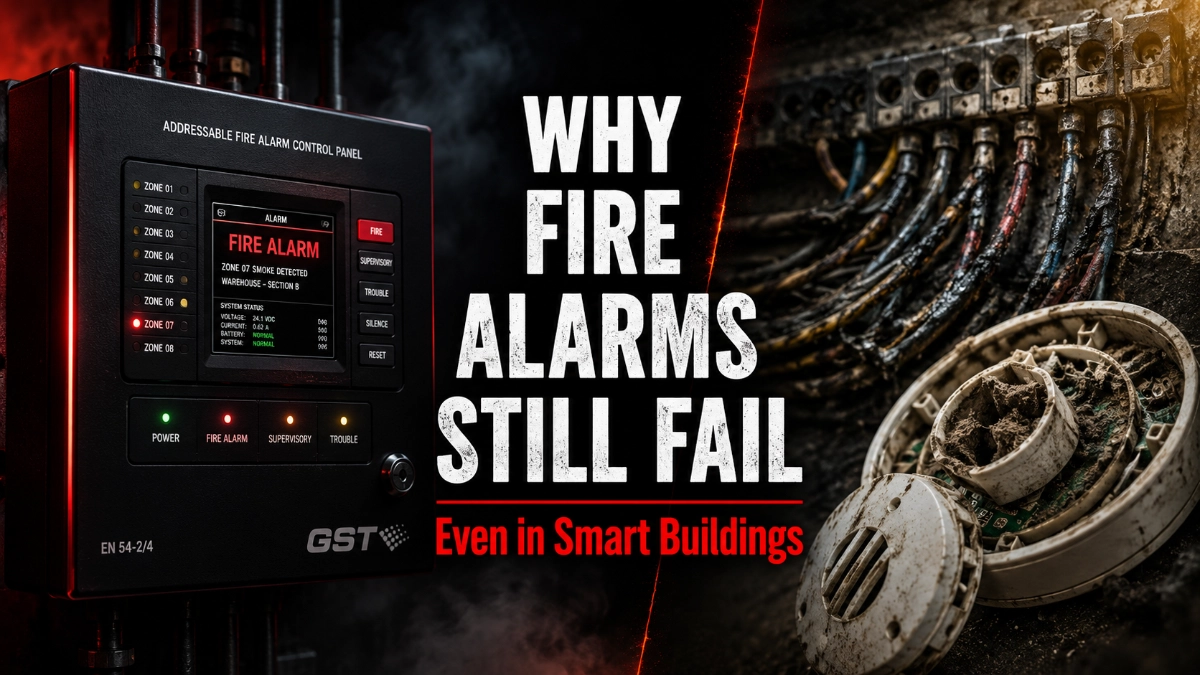
These failures are not always about the product itself. Most of the time, the system fails because of how it was designed, installed, commissioned, maintained, or simply how well it was matched to the actual environment in which it was deployed.
In India, where buildings range from century-old heritage structures to modern data centres and sprawling warehouses, the gap between system specification and real-world performance is wider than most people realise. This article breaks down why that gap exists and how to close it.
The Myth of the Fail-Proof Fire Alarm System
There is a widespread assumption in the industry that buying a premium fire alarm system means your building is protected. Procurement teams tick the compliance box. Installers hand over a commissioning report. The maintenance schedule sits in a folder somewhere, and the system is largely forgotten until something goes wrong.
The reality is different. Fire alarm systems are living safety ecosystems. They interact with the building environment, electrical infrastructure, human behaviour and dozens of external systems. A single weak link, a wrongly specified detector, a corroded loop wiring connection, or a poorly configured zone map can render an otherwise excellent system unreliable.
No fire alarm system is inherently fail-proof. Every system is only as reliable as the weakest element in its design, installation and maintenance chain.
Common Reasons Fire Alarm Systems Fail in Real Buildings
Fire alarm systems fail for a combination of technical, environmental and human reasons. Let us examine each category honestly.
1. Poor System Design and Zoning Errors
Many fire alarm failures begin long before the first device is installed. When designers do not walk the building, do not study occupancy patterns, or simply copy-paste a zone layout from a previous project, the resulting design is mismatched to reality.
- Oversized zones mean that a fire in one corner triggers an alarm that covers an entire floor, making evacuation harder, not easier.
- Incorrectly mapped zones confuse operators during an actual emergency, wasting precious response time.
- In hospitals and high-rise buildings, poor zoning can trigger mass panic in areas that are not even affected by fire.
2. Wrong Detector Selection for the Environment
Detector selection is not a generic decision. Installing smoke detectors in a bakery kitchen, a cement plant, or a chemical warehouse is a recipe for constant false alarms or worse, missed detections.
- Ionisation smoke detectors in dusty factory environments generate excessive nuisance alarms.
- Conventional heat detectors in cold storage facilities can fail to trigger because their fixed temperature thresholds are set too high for the ambient conditions.
- Optical detectors in areas with steam, condensation, or heavy vehicular exhaust will alarm constantly, training staff to ignore the system entirely, the most dangerous outcome possible.
3. Substandard Installation Practices
Even a world-class fire alarm control panel cannot compensate for poor installation. In India, many projects are awarded to the lowest bidder, and cost-cutting begins at the installation stage.
- Undersized cable cross-sections cause voltage drops, leading to device communication errors on long addressable loops.
- Improperly terminated junctions create intermittent faults that appear and disappear, making them extremely difficult to diagnose.
- Detectors installed near air conditioning vents, exhaust fans, or return air ducts never detect smoke accurately because airflow patterns constantly flush the detector chamber.
- In warehouses with racking systems up to 10 metres high, placing detectors only on the ceiling means fires smouldering at ground level are detected far too late.
4. Detector Contamination and Physical Damage
Over time, smoke detectors accumulate dust, insects, paint overspray and environmental contaminants inside their sensing chambers. This is a leading cause of both false alarms and detection failure.
- In textile mills and woodworking factories, fine airborne particles clog detector chambers within months.
- In food processing plants and commercial kitchens, grease and condensation coat detector internals, degrading sensitivity.
- Physical damage from construction activities, detectors painted over, covered with polythene sheets, or knocked off-centre during renovation, is incredibly common in India’s rapidly developing commercial and hospitality sectors.
5. Power Backup Failures
Fire alarm systems require uninterrupted power. When mains power fails, and in India’s industrial belt, power cuts are frequent, the system must transition flawlessly to battery backup. When that does not happen, the entire building is effectively unprotected.
- Ageing or undersized standby batteries fail to provide the mandatory 24-hour standby and 30-minute alarm capacity required by Indian fire standards.
- Batteries that have never been tested go unnoticed until an actual power failure reveals their condition far too late.
- In large-scale multi-panel installations, individual panel PSU failures can create dark zones in sections of the building where no detection is active.
6. Loop Faults and Device Communication Failures
In an addressable fire alarm system, each device on the loop has a unique address and communicates continuously with the fire alarm control panel. Any disruption to this communication creates a fault and in many cases, silently disables one or more devices.
- Short circuits on an addressable loop can take down an entire segment of devices if loop isolation modules are not installed at regular intervals.
- Open circuit faults caused by cable damage, pest intrusion, or physical breakage disconnect every device beyond the fault point.
- Electrical interference from variable frequency drives (VFDs), welding equipment and large motor starters can corrupt communication signals on conventional and addressable loops alike.
7. Software Configuration Mistakes
Modern fire alarm systems are sophisticated software platforms. They control cause-and-effect logic, integration outputs and evacuation sequencing. A misconfigured panel can behave entirely differently from how it was designed.
- Incorrect cause-and-effect programming can mean that a fire on Floor 3 fails to trigger HVAC shutdown or suppression release on that floor.
- Improperly set alarm delay timers may introduce long enough delays that a fast-growing fire bypasses the response window.
- Panel software that has not been updated can contain known bugs that affect loop polling speed or alarm processing times.
- In network-based fire alarm monitoring systems, incorrect IP configurations or network firewall rules can silently prevent alarm signals from reaching the monitoring station.
8. Integration Failures with PA, HVAC, Suppression and BMS
A fire alarm system in a modern building does not operate in isolation. It must coordinate with public address systems, HVAC smoke control, fire suppression, access control and building management systems. When these integrations fail, the result can be catastrophic.
- HVAC systems that continue to run during a fire actively spread smoke through the building, overwhelming detection and harming occupants.
- Access control doors that do not release on fire alarm prevent occupant evacuation, a documented cause of fatalities in commercial building fires.
- Suppression systems not properly interlocked with the alarm panel may release too early, too late, or not at all.
- In data centres and server rooms, where clean agent suppression is critical, a misconfigured hold-off timer can mean the difference between protecting assets and losing everything.
Design Errors vs Product Failures: Understanding the Real Difference
When a fire alarm fails, the instinctive response is to blame the product. In practice, post-incident investigations consistently show that the majority of fire alarm failures in India trace back to design errors, installation shortcuts, or maintenance neglect, not product defects.
Product failures where a certified detector, module, or panel fails to perform as specified under normal operating conditions are relatively rare. Genuine product failures typically appear during commissioning testing or early in the system’s life. When a fire alarm fails years after installation, the cause is almost always operational or maintenance-related.
This is an important distinction because it means that investing in better products alone will not solve the problem. It requires better engineering practices from design through to ongoing maintenance.
Why Installation Quality Matters More Than Features
A high-specification intelligent fire detection system installed poorly will consistently underperform a simpler, correctly installed system. This is a fundamental truth that the fire safety industry in India needs to acknowledge more openly.
What good installation practice actually looks like:
- Correct cable selection: Fire-rated FRLS cables of appropriate cross-section for the loop length and device count.
- Systematic device addressing: Each addressable detector, module, and sounder is correctly addressed and mapped before installation.
- Proper mechanical protection: For cables in vulnerable areas such as loading docks, machinery rooms and parking levels.
- Isolation module placement: At regular intervals is especially critical in large-loop addressable installations.
- Commissioning that validates every single device, not just a sample, before the system is handed over.
Industrial Environments Create Hidden Detection Challenges
Industrial environments are genuinely challenging for fire detection. Dust, humidity, vibration, heat, chemical vapours and electromagnetic interference are not exceptions; they are normal operating conditions. Yet many industrial fire alarm systems are specified as if they are being installed in a clean office block.
Real challenges in Indian industrial and warehouse environments:
- Cement plants and stone quarries produce extremely fine airborne dust that rapidly contaminates standard smoke detectors, triggering constant false alarms.
- Steel mills and foundries operate at ambient temperatures that exceed the comfort range of standard detectors, requiring high-temperature-rated devices.
- Chemical storage facilities require detectors that can reliably identify specific combustion products without being triggered by non-fire chemical vapours present during normal operations.
- Textile mills generate lint and fibre that block detector chambers within weeks of installation if the correct IP-rated or barrier-protected detectors are not used.
- High-bay cold storage facilities present a double challenge: sub-zero temperatures affect battery performance and detector response time simultaneously.
- Heavy electrical machinery creates electromagnetic interference that can corrupt addressable loop communication signals, generating ghost faults that waste maintenance hours.
For these environments, selecting the right industrial fire alarm system, one that addresses the specific detection challenges of the site, is not optional. It is the difference between a system that works and one that becomes a liability.
The Role of Addressable Fire Alarm Technology
Are addressable fire alarm systems more reliable than conventional ones? The honest answer is: yes, significantly, but only when properly implemented.
A conventional fire alarm panel operates on zone-based detection. When a detector triggers, the panel can only tell you which zone is affected, not which specific device. This means that fault diagnosis and fire location identification both require physical investigation, which takes time that a real fire emergency does not allow.
An addressable fire alarm panel, by contrast, communicates individually with every device on the loop. The panel knows the exact location, status and even the analogue sensitivity level of every connected detector at all times.
Key advantages of addressable systems in real-world operation:
- Precise fire location identification: The panel displays the exact address of the activated detector, not just the zone.
- Pre-alarm warnings: Addressable detectors report when their dust accumulation level is approaching the point where false alarms will occur, enabling proactive cleaning.
- Faster fault diagnosis: The panel identifies the exact device or cable segment in fault, rather than requiring engineers to trace the entire zone.
- Scalability: Additional devices can be added to an addressable loop without rewiring, making system expansion far more economical.
- Alarm verification logic: Intelligent fire detection systems can apply multi-detector confirmation before triggering an alarm, dramatically reducing false alarm rates in noisy environments.
How Smart Diagnostics Reduce Failure Risks
Modern intelligent fire detection systems do not just detect fire; they continuously self-monitor and report on the health of every component in the system. This transforms fire alarm maintenance from a reactive, breakdown-driven activity into a proactive, data-driven one.
Smart diagnostics capabilities include:
- Continuous analogue value monitoring for every detector flagging device, drifting towards alarm thresholds before they generate nuisance alarms.
- Loop integrity testing automated checks that confirm the complete signal path is intact on all addressable loops.
- Battery health monitoring reports on battery voltage, charge state, and projected runtime under load.
- Audit log and event history for every alarm, fault, test and operator action is time-stamped and stored, enabling post-event analysis and compliance reporting.
- Remote monitoring and alerts from fire alarm monitoring systems connected via network or cellular can push fault notifications to maintenance teams in real time, reducing response time from hours to minutes.
Why Preventive Maintenance Is Critical, Not Optional
In India, the single biggest gap in fire alarm system reliability is maintenance. Many building owners invest substantially in good systems and then effectively abandon them after commissioning. Annual maintenance contracts are signed but rarely executed with the rigour that fire safety demands.
What a genuine preventive maintenance programme looks like:
- Quarterly functional testing of every detector using calibrated smoke or heat test equipment, not just visual inspection.
- Annual full-system simulation test triggering every input device and verifying every output, including HVAC shutdown, PA activation, and suppression interlocks.
- Battery replacement on schedule, not on failure.
- Detector sensitivity testing, verifying that each detector is still responding within its factory-specified sensitivity window.
- Panel software review, ensuring firmware and configuration are up to date, and that no unauthorised changes have been made.
- Documentation update, maintaining an accurate as-built record of every device address, location, and zone mapping as the building evolves.
A fire alarm system that is never properly tested is, in effect, an untested system. In the event of a real fire, it may not perform as expected, and by then, it is too late to find out.
How GST Fire Alarm Systems Improve Real-World Reliability
GST fire alarm systems have earned credibility across India’s most demanding environments, from automotive assembly plants and pharmaceutical facilities to five-star hotels and critical infrastructure sites. This credibility is built on a combination of engineering quality, product depth and practical suitability for Indian conditions.
What sets GST apart in practice:
- The GST addressable fire alarm panel range supports large-scale loop configurations with robust loop isolation built in, reducing the impact of wiring faults on system availability.
- GST addressable detectors offer multi-criteria sensing in a single unit, combining smoke, heat, and CO detection, reducing detector count while improving detection quality.
- The GST intelligent fire detection system platform provides deep cause-and-effect programming capability, enabling complex integration with HVAC, BMS, access control, and suppression systems with native protocol support.
- GST conventional fire alarm panel options remain relevant for smaller facilities and renovation projects where conventional infrastructure is already in place, providing a reliable, cost-effective solution without unnecessary complexity.
- The GST fire alarm monitoring system architecture supports networked multi-panel installations, enabling centralised monitoring of large campuses, industrial estates, and high-rise residential towers from a single operator workstation.
- GST systems are designed with maintenance practicality in mind. Detectors are easy to remove for testing and cleaning without requiring specialised tools, which meaningfully improves the quality of routine maintenance activity.
Critically, GST’s product ecosystem is matched by strong technical support and a trained installer network across India, addressing the gap between product quality and field implementation that undermines so many fire safety projects.
Best Practices to Avoid Fire Alarm Failure
At the Design Stage:
- Conduct a formal fire risk assessment before specifying any system.
- Select detectors based on the specific hazards, occupancy, and environmental conditions of each area.
- Plan zone layouts that support efficient emergency response, smaller zones for critical areas, clearly labelled and intuitively mapped.
- Design integration points with HVAC, suppression, PA, and access control at the system design stage, not as afterthoughts.
At the Installation Stage:
- Use fire-rated, appropriately sized cables throughout FRLS or MICC for high-risk environments.
- Install loop isolation modules at least every 20–25 devices on addressable loops.
- Verify detector positioning against airflow, ceiling height, and obstruction data, not just drawing dimensions.
At the Commissioning Stage:
- Test 100% of installed devices, every detector, manual call point, sounder and relay output.
- Verify all integration outputs function correctly, confirm HVAC shutdowns, door release, PA activation and suppression interlocks each work as designed.
- Conduct battery discharge testing to verify backup power meets the design specification.
- Produce and hand over a full commissioning record, as-built drawings and a cause-and-effect matrix.
In Ongoing Operation:
- Execute preventive maintenance on a defined schedule, and quarterly detector testing as a minimum.
- Train facility staff to use the fire alarm control panel, understanding what normal, fault, and alarm states look like.
- Update the system documentation whenever building changes new partitions, new occupancies, or new equipment affect the detection layout.
Expert Takeaway
After two decades of fire safety engineering across commercial, industrial and critical infrastructure projects in India, one pattern stands out clearly: the buildings that suffer fire detection failures are rarely the ones with the cheapest systems. They are the buildings where the system was treated as a compliance checkbox rather than a living safety asset.
Fire alarm systems that genuinely protect buildings are designed with rigour, installed with discipline, commissioned with thoroughness and maintained with consistency. Technology, however advanced, only delivers its potential when these foundational practices are in place.
Invest in the system. Invest in the process. Invest in the people who maintain it. That combination is what actually protects life and property.
Reliability Is Built, Not Bought
Advanced fire alarm systems still fail in real scenarios, not because the technology has failed to advance, it has advanced remarkably, but because technology alone cannot compensate for design shortfalls, installation errors, poor commissioning, environmental challenges and neglected maintenance.
For building owners and facility managers across India’s commercial, industrial, healthcare, hospitality and infrastructure sectors, the message is clear. A reliable fire alarm system requires a reliable process from the first line of the design brief to the last quarterly maintenance report.
GST fire alarm systems provide the technical foundation for that reliability. The addressable fire alarm panel technology, intelligent detection capabilities, integration depth, and diagnostic tools that GST brings to the market are genuinely industry-leading. But they deliver their full value only when paired with the engineering rigour and maintenance discipline that every fire safety system deserves.
Choose your system thoughtfully. Install it properly. Maintain it consistently. That is how buildings stay safe.
Read Also: Why “Installed” Does Not Mean “Effective” in Fire Alarm Systems
Read Also: Failure of Smart Fire Systems: New Types of Risks