Picture this: A fire breaks out in the basement of a busy commercial building in Pune. The smoke rises steadily. But the fire alarm? Silence. The system had been installed two years ago, passed a basic inspection and had not been touched since. By the time the fire was detected manually and the alarm triggered, the damage was extensive, and the evacuation was dangerously delayed.
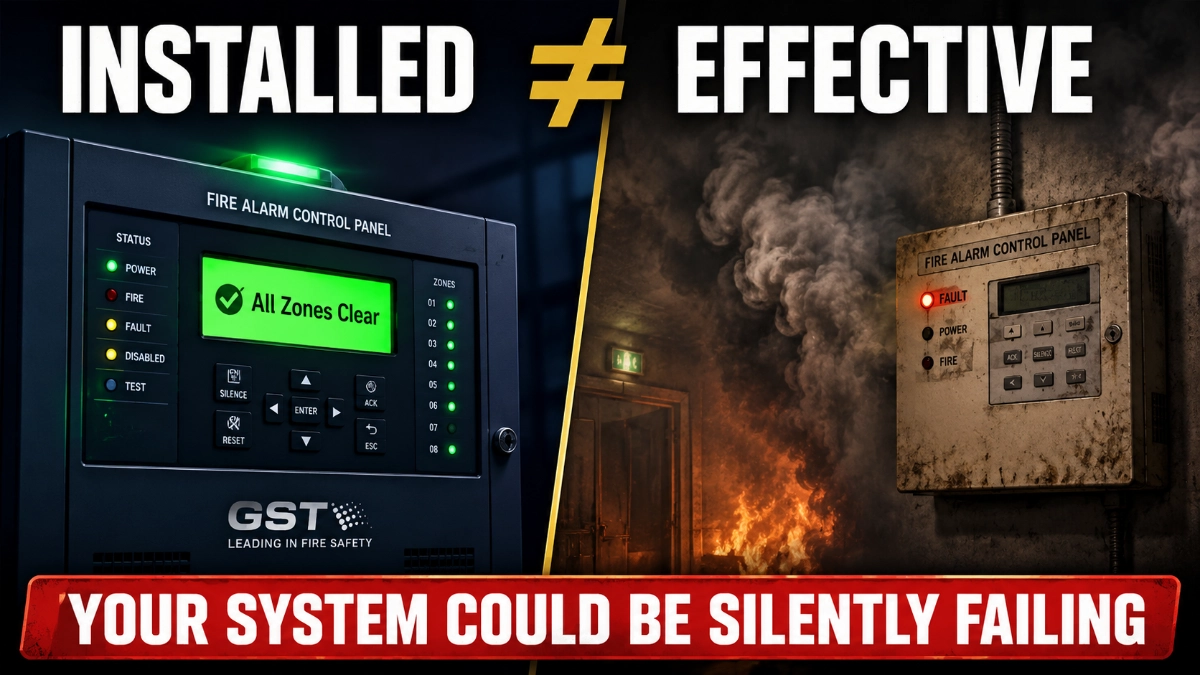
The system was installed. It simply was not effective.
This is not an isolated incident. Across factories, warehouses, hospitals, hotels and data centres in India, fire alarm systems are being installed every day, yet many of them do not truly protect the people and assets they were meant to safeguard. The gap between installation and effectiveness is wider than most building owners realise, and it carries serious consequences.
Installation is the starting line, not the finish line. A fire alarm system is only as good as its design, commissioning, maintenance and the intelligence behind it.
This article explores exactly why that gap exists, what fills it, and how facility managers and safety decision-makers in India can ensure their fire alarm systems are not just present but truly protective.
The Dangerous Comfort of a Green Light
When a fire alarm panel shows a steady green light and no fault indicators, it is easy to assume everything is fine. This false sense of security is one of the most common and costly mistakes in fire safety management.
The truth is, a fire alarm system can appear fully functional while being critically compromised. Detectors may be positioned in the wrong location. The panel may not be integrated with the sprinkler system or the building’s HVAC controls. Firmware may be outdated. Battery backups may have degraded. And in many older setups, a conventional fire alarm panel may be covering zones far too large to pinpoint the exact location of a fire.
None of these failures is visible to the untrained eye. But every single one of them can mean the difference between a contained incident and a catastrophe.
What Makes a Fire Alarm System Truly Effective?
Effectiveness in a fire alarm system is not a single feature; it is the result of multiple elements working together correctly. Here is what actually determines whether a system protects or merely occupies space:
1. Proper System Design
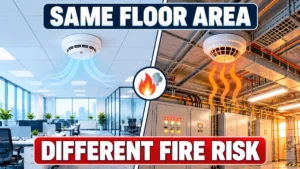
Every building has a unique risk profile. A hospital has different fire hazards than a textile factory. A data centre has different requirements than a hotel. Effective fire protection begins with a site-specific system design that accounts for the building layout, occupancy type, potential fire sources and regulatory requirements under NBC (National Building Code) 2016 and local fire NOC norms.
A generic system design applied across different facilities is a red flag. The number and type of detectors, the zoning strategy, the panel capacity and the alarm notification approach must all be tailored to the environment.
2. The Right Detector for the Right Environment
Not all fire detectors work the same way, and using the wrong type in a given environment is a common and critical mistake. The primary detector types include:
- Smoke detectors (ionisation or photoelectric): Suited for detecting smouldering fires.
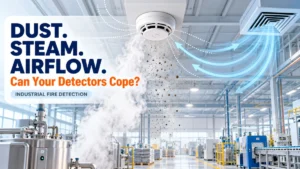
- Heat detectors: Ideal for environments with dust, fumes, or steam that would trigger false alarms from smoke detectors.
- Multi-sensor detectors: Combine smoke and heat sensing for more reliable detection.
- Beam detectors: Used in large open spaces like warehouses and atriums.
- Aspirating smoke detectors (ASD): Extremely sensitive, used in data centres and clean rooms.
- Flame detectors: Used in oil, chemical, and LPG environments.
Addressable detectors, which are the backbone of a modern intelligent fire detection system, go further; each device communicates its exact identity and condition back to the control panel, enabling precise localisation of a fire event. This is a fundamental advantage over conventional detectors, which only report which zone has triggered, not which specific device.
3. Correct Device Placement
Even the most sophisticated detector is useless if it is installed in the wrong location. Detectors placed too close to air conditioning vents may fail to detect smoke because airflow disperses it. Detectors on very high ceilings in a warehouse may not respond until a fire has already grown dangerously large. Detectors installed in kitchen environments without heat-rated specifications may generate constant false alarms, leading staff to disable or ignore them.
Placement must follow the AS 1603 or IS 2189 guidelines, factoring in ceiling height, airflow patterns, ambient temperature and fire hazard proximity.
4. System Integration
A standalone fire alarm panel that does not communicate with anything else in the building is a limited safety tool. Effective fire protection requires integration with:
- HVAC systems: To prevent smoke from spreading through the ventilation ducts.
- Elevator controls: To return lifts to the ground floor during an alarm.
- Access control systems: To release magnetic hold-open doors.
- Sprinkler systems: To enable coordinated response.
- Public Address (PA) system: For clear evacuation announcements.
- Security and BMS (Building Management Systems): For centralised monitoring.
Without this integration, a fire alarm system reacts in isolation. With it, the building responds as a coordinated safety system.
5. Commissioning and Testing
This is where a large number of Indian installations fall short. Commissioning is the process of systematically testing every device, every circuit, every integration point, and every notification pathway before a system is declared operational. It is not a checkbox; it is a rigorous technical process.
A fire alarm control panel that has not been properly commissioned may have wiring errors, incorrect zone assignments, or misconfigured alarm thresholds that prevent it from responding correctly in a real emergency.
6. Regular Maintenance and Testing
IS 2189 and NBC guidelines require periodic inspection and testing of fire alarm systems, typically quarterly for device testing and annually for full system verification. In practice, many facilities in India carry out a basic visual inspection once a year and call it done.
This approach is insufficient. Real maintenance includes detector sensitivity testing, battery health checks, panel diagnostic reviews and simulation of alarm scenarios to verify end-to-end system response.
Myth vs. Reality: What Most People Believe About Fire Alarms
| Myth | Reality |
| Once installed, a fire alarm system works automatically. | It requires regular commissioning, maintenance, and testing to function reliably. |
| Any smoke detector will work in any environment. | Detector type must match the environment — wrong type leads to missed alarms or excessive false alarms. |
| A conventional fire alarm panel is sufficient for large facilities. | Large or complex buildings require an addressable fire alarm panel for precise zone and device identification. |
| False alarms mean the system is sensitive and working well. | Frequent false alarms indicate incorrect detector selection or placement — and lead to alarm fatigue. |
| Compliance certificate means the system is effective. | Compliance confirms minimum code adherence, not operational effectiveness or system intelligence. |
| Battery backup means the system works during power cuts. | Batteries degrade over time and must be tested regularly — many fail silently. |
| One central panel is enough for a large industrial plant. | Networked panels and a scalable industrial fire alarm system are required for large, multi-zone facilities. |
Signs Your Fire Alarm System May Not Be Truly Effective
If you manage a facility in India, these are the warning signs that your installed system may not actually protect you:
- Frequent false alarms that staff have learned to ignore.
- Detectors that have never been individually tested since installation.
- No record of annual or quarterly maintenance visits.
- Panel showing zones but not specific device addresses (sign of a conventional, non-addressable setup in a large building).
- No integration with HVAC, elevator, or sprinkler systems.
- Battery backup never tested or replaced.
- Staff unaware of what to do when the alarm sounds.
- Detectors in dusty, humid, or chemically active environments without the right specification.
- No remote monitoring or fault notification capability.
- System installed over five years ago with no upgrade assessment.
If three or more of these apply to your facility, your fire alarm system needs a professional review immediately, not at the next annual audit.
Real-World Scenarios: When Installation Alone Was Not Enough
Factories and Industrial Plants
In heavy manufacturing environments, smoke and heat from normal operations can interfere with detection. A factory in Gujarat running metal fabrication operations found that standard smoke detectors were triggering during welding operations, leading the maintenance team to disable detectors in the production zone entirely.
The solution required replacing standard smoke detectors with rate-of-rise heat detectors and beam detectors calibrated for the industrial environment, combined with a GST fire alarm system that could distinguish between normal operational heat signatures and genuine fire events.
Warehouses
A logistics warehouse near Delhi NCR had installed a basic conventional fire alarm panel covering the entire storage area as a single zone. When a pallet fire started in aisle seven, the alarm activated, but the panel only showed ‘Zone 3 Alarm’ with no further information.
Firefighters had to search the entire zone before locating the fire, losing critical response time. An addressable fire alarm panel with addressable detectors would have identified the exact device and location within seconds.
Hospitals
Hospitals present unique challenges: critical patients cannot be evacuated rapidly, staff must be able to respond floor by floor, and smoke detection must be extremely sensitive without generating excessive false alarms that disrupt patient care.
Several hospital fires in India in recent years exposed the limitations of legacy systems that were installed decades ago and never upgraded. Modern intelligent fire detection systems with aspirating smoke detectors, addressable technology, and full integration with fire doors and nurse call systems are now the accepted standard.
Hotels
Guest safety in hotels requires alarm systems that can wake sleeping occupants, guide evacuation through PA integration, and allow the fire alarm control panel to be operated by trained staff 24×7.
A popular hotel chain in Mumbai found during a drill that their alarm notification was inaudible in several guest rooms due to incorrect speaker placement and volume settings that had never been tested post-installation.
Data Centres
In data centres, a fire suppression agent release can destroy equipment even if the fire is minor. This makes early detection absolutely critical. Very early smoke detection apparatus (VESDA) or aspirating smoke detectors, combined with a GST fire alarm system capable of staged alerts and suppression integration, are required. Standard ionisation detectors installed in a data centre are simply not sensitive enough for this environment.
Addressable vs. Conventional: Why the Technology Matters
One of the most significant decisions in fire alarm system effectiveness is the choice between an addressable fire alarm panel and a conventional fire alarm panel. Understanding the difference is essential for facility managers and building owners.
| Feature | Conventional Fire Alarm Panel | Addressable Fire Alarm Panel |
| Detection granularity | Zone-level only | Individual device-level |
| Fault identification | Zone fault only | Exact device and location |
| False alarm management | Limited | Advanced — per-device thresholds |
| Scalability | Limited | Highly scalable — 1 to 250+ devices per loop |
| Remote monitoring | Not standard | Built-in with network capability |
| Suitable for | Small buildings, basic applications | Commercial, industrial, large buildings |
| Compliance for large facilities | Not recommended | Recommended / required |
| Cost over time | Lower upfront, higher maintenance cost | Higher upfront, lower long-term cost |
For any facility beyond a basic small commercial space, an addressable system connected to an intelligent fire detection system is not a luxury; it is a safety necessity.
Why Industrial Environments Demand a Specialised Approach
Standard commercial fire alarm systems are designed for typical building environments: controlled temperatures, predictable smoke behaviour, and minimal interference. Industrial environments are fundamentally different.
In a chemical plant, a refinery, a pharmaceutical manufacturing facility, or a large power station, fire alarm systems must contend with:
- Explosive atmospheres require ATEX-rated detectors.
- High ambient temperatures affect detector response thresholds.
- Corrosive gases or dust that can damage or desensitise detectors.
- Large open spaces require linear heat detection or beam detectors.
- Critical process areas where false alarms trigger costly plant shutdowns.
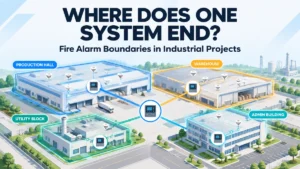
- Multi-building campuses require networked panel architecture.
An industrial fire alarm system for these environments must be engineered from the ground up with zone-specific detector selection, environmental protection ratings (IP65 or higher), redundant network paths, and real-time fault diagnostics that allow engineers to identify and address issues before they compromise safety.
GST fire alarm systems are designed to meet exactly these demands with a product range that covers everything from single-panel commercial applications to networked multi-panel industrial deployments, all within a scalable architecture that grows with the facility.
The Role of Professional Commissioning in System Effectiveness
Professional commissioning is not a formality; it is the validation step that confirms your installed system will actually work when it matters. A properly commissioned fire alarm system includes:
- Point-to-point wiring verification for every device on every loop.
- Individual device testing, triggering each detector and confirming panel response.
- Zone and address verification ensure the panel correctly identifies each device.
- Integration testing confirms that alarm signals trigger correct responses in HVAC, elevators, and access systems.
- Evacuation alarm testing, verifying audibility levels in all occupied areas.
- Fault simulation deliberately creates open-circuit and short-circuit faults to confirm panel diagnostics.
- Battery autonomy testing confirming backup duration meets IS/NBC requirements.
- Staff training ensures that building management knows how to operate and interpret the fire alarm control panel.
This process typically takes one to three days for a medium-sized commercial building and longer for industrial sites. Shortcuts here directly translate to system unreliability in an actual emergency.
Compliance Is a Floor, Not a Ceiling
Many facility managers in India view fire safety compliance as the end goal. Get the fire NOC. Pass the inspection. Move on. This approach fundamentally misunderstands what compliance is designed to do.
Compliance with IS 2189, NBC 2016, TAC (Tariff Advisory Committee) guidelines, and local fire authority requirements sets the minimum acceptable standard. It is not a guarantee of effectiveness. Compliance is the floor; genuine fire safety requires exceeding it.
A fire alarm system can be fully compliant and still:
- Use outdated technology that does not support real-time monitoring.
- Have detectors that have degraded in sensitivity over time.
- Lack of integration with critical building systems.
- Cover large zones without device-level addressability.
- Provide no remote fault notification capability.
Compliance tells you that a system met the standard at the time of inspection. Only a properly maintained, regularly tested, and intelligently designed system tells you that the system will work when a fire actually breaks out.
Expert Insights: What the Best System Integrators Know
Experienced fire safety engineers and system integrators in India consistently highlight several principles that separate truly effective fire alarm systems from merely installed ones:
Design Before Equipment
The best integrators spend significant time on system design before a single cable is pulled. They conduct site surveys, review fire risk assessments, and map detector placements on architectural drawings. Equipment selection follows design, not the reverse.
Total Cost of Ownership Over Upfront Cost
Facility managers who prioritise the lowest upfront cost frequently end up with systems that require expensive retrofits, generate excessive false alarms, or fail during critical events. A well-specified commercial fire alarm system or industrial fire alarm system costs more to install but dramatically less to maintain and operate over its life cycle.
Technology That Grows With the Facility
Buildings change. New wings are added. Processes change. Headcount grows. A fire alarm system designed without scalability in mind becomes a liability as the facility evolves. GST fire alarm systems, with their loop-based addressable architecture, allow new devices to be added without replacing existing infrastructure, a practical and cost-effective approach for growing businesses.
The Value of Real-Time Fault Diagnostics
One of the most underappreciated features of a modern addressable fire alarm panel is its ability to proactively identify faults, such as a detector going dirty, a loop showing resistance anomalies, or a battery approaching end-of-life, before those issues cause a failure. This moves fire alarm management from reactive to preventive, which is exactly where it should be.
Practical Recommendations for Facility Managers and Building Owners
If you are responsible for fire safety in any commercial or industrial facility in India, here are the actionable steps you should take:
- Commission an independent fire risk assessment of your facility, not just the alarm system, but the overall fire risk profile.
- Have your existing fire alarm system audited by a qualified fire safety engineer, specifically reviewing detector type, placement, system integration, and maintenance records.
- If your facility is using a conventional fire alarm panel for a large or complex building, plan for an upgrade to an addressable fire alarm panel with addressable detectors.
- Establish a quarterly maintenance contract with a qualified fire safety service provider, not just an annual inspection.
- Ensure your fire alarm control panel operators are trained, and that training is refreshed annually.
- Integrate your fire alarm system with your HVAC, elevator, and PA systems if not already done.
- Evaluate whether remote monitoring and fault notification are available for your system. If not, consider upgrading to an intelligent fire detection system with this capability.
- Document all maintenance visits, test results, and fault history. This is both a compliance requirement and an invaluable operational record.
Why System Choice Matters: The Case for Scalable, Intelligent Architecture
The fire alarm technology market in India has evolved significantly over the past decade. Building owners and facility managers now have access to sophisticated, intelligent systems that were previously available only in premium international projects.
GST fire alarm systems represent this evolution, offering a comprehensive range of products from single-loop addressable fire alarm panels suitable for medium commercial buildings to large-scale networked systems designed for industrial campuses, hospitals, and critical infrastructure. The GST architecture supports real-time monitoring, advanced fault diagnostics, scalable loop expansion, and seamless integration with third-party building systems.
For project stakeholders evaluating fire alarm solutions for new projects or upgrades, the key criteria should be:
- Addressable architecture with individual device identification.
- Support for a full range of addressable detectors for different environments.
- Networked panel capability for multi-building or multi-floor applications.
- Open integration protocols for BMS and third-party systems.
- Proven track record in Indian environmental conditions.
- Strong service and support network across India.
- Compliance with IS 2189 and relevant Indian standards.
Conclusion: The Installation Is Step One
Fire safety is not a project with a completion date; it is an ongoing commitment. The fire alarm system installed in your building or facility is only as effective as the expertise that went into designing it, the quality of the commissioning process, the rigour of its maintenance programme, and the intelligence of the technology at its core.
Across India’s factories, warehouses, hospitals, data centres, and commercial buildings, the gap between installed and effective fire alarm systems costs lives and livelihoods every year. Closing that gap requires facility managers and building owners to move beyond the completion certificate and engage with fire safety as a living, operational responsibility.
Whether you are evaluating a new installation, reviewing an ageing system, or planning a major facility upgrade, the questions to ask are not just ‘Is it installed?’, they are ‘Is it designed correctly? Is it the right technology for this environment? Is it properly commissioned? Is it maintained to a standard that guarantees performance? And is it connected to everything it needs to be connected to?’
When the answers to all of those questions are yes, you have a fire alarm system that is not just installed, it is effective.