Enterprise surveillance has crossed a turning point. Across manufacturing plants, corporate campuses, airports, warehouses, and data centres, security and infrastructure teams are reaching the same conclusion: legacy surveillance systems are no longer underperforming; they are actively becoming a liability.
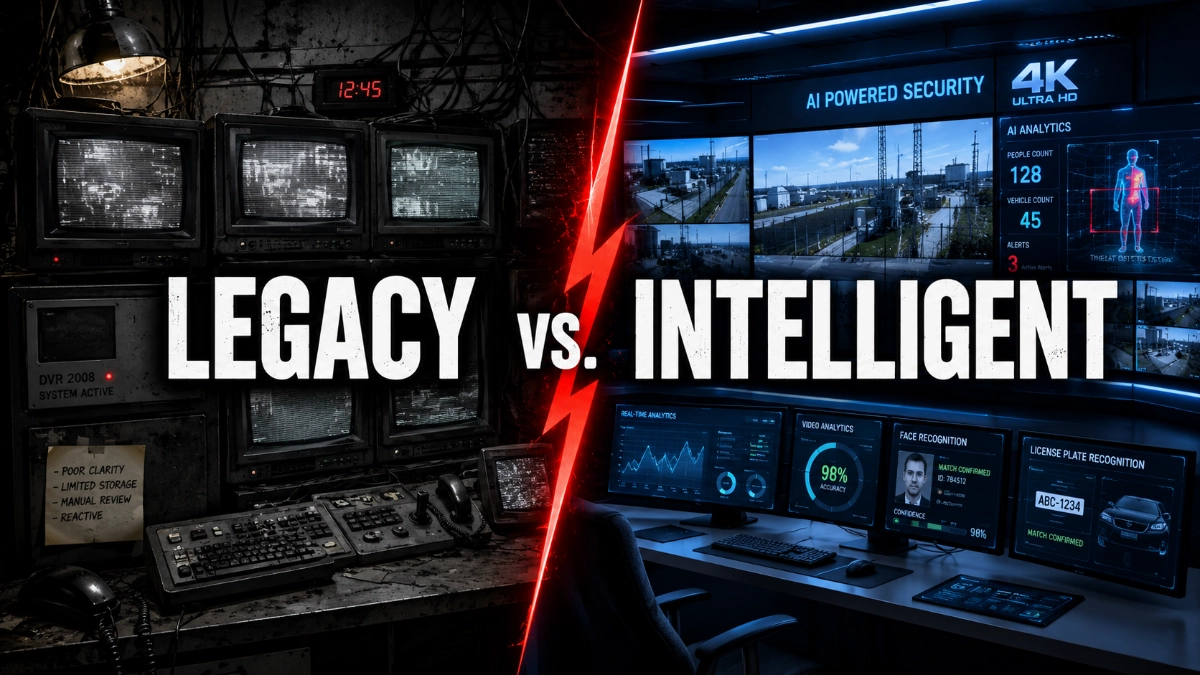
This is not about cameras that have stopped recording. The hardware may still be running. Feeds may still stream. But beneath the surface, legacy CCTV architectures are failing to meet what modern enterprise security actually demands: real-time AI analytics, cybersecurity compliance, multi-site centralised management, intelligent storage, and operational business intelligence.
Incremental upgrades no longer solve the problem. Organisations like those deploying Impact by Honeywell and working with certified Impact by Honeywell distributors in India are making the strategic decision to rebuild surveillance infrastructure from the ground up. This article explains precisely why.
What Legacy Surveillance Infrastructure Looks Like
Legacy systems typically include analogue CCTV or early IP cameras connected to DVR or NVR units, fixed on-premises storage, outdated VMS software past end-of-life support, and no integration with access control, building management, or IT security platforms. These systems were designed to record and retrieve. They were never built to analyse, predict, integrate, or scale.
Most were installed between 2008 and 2016 before AI video analytics became commercially viable, before cybersecurity frameworks required device-level authentication, and before enterprises expected surveillance infrastructure to serve operational intelligence purposes beyond basic security monitoring.
Why Legacy Systems Are Failing Enterprise Demands
1. No Path to AI Analytics
Modern enterprise surveillance requires deep learning-based detection: behavioural anomaly recognition, crowd density monitoring, PPE compliance verification, license plate identification, and predictive alerting. Legacy cameras are passive sensors that capture and transmit, but cannot process. Adding AI to a legacy architecture means installing separate hardware that creates latency, compatibility issues, and management overhead that defeats the purpose.
2. Cybersecurity Vulnerabilities
Legacy IP cameras and NVR units represent one of the most exploited attack surfaces in enterprise infrastructure. Most ships have default credentials that organisations never change. Many run firmware with known, unpatched vulnerabilities and communicate across enterprise networks without encryption. Enterprise CISOs increasingly flag legacy surveillance devices as non-compliant with NIST CSF, ISO 27001, and SOC 2 frameworks exposure that cannot be resolved through patching alone.
Security researchers have demonstrated repeatedly that unpatched legacy cameras can be compromised to gain broader enterprise network access, often without triggering any detection alerts.
3. Bandwidth and Storage Inefficiency
Legacy systems stream continuous, full-resolution video regardless of scene activity. A single 4K-equivalent stream can consume 25–50 Mbps continuously. Multiply that across hundreds of cameras, and legacy networks collapse. Storage architectures record at fixed bitrates even when cameras monitor empty spaces, burning through capacity while delivering minimal useful data. Modern systems write variable-bitrate footage and apply intelligent compression, reducing storage consumption by 60–80% while retaining high-resolution event footage.
4. Multi-Site Management Complexity
Enterprise operations span multiple facilities, manufacturing plants, retail stores, logistics hubs, and regional offices. Legacy surveillance requires per-site NVR management, per-site storage infrastructure, and per-site access credentials. Security teams waste hours navigating incompatible interfaces and fragmented footage archives during investigations. There is no unified command visibility and no centralised intelligence layer across sites.
5. No Compliance or Audit Trail Capability
Regulated industries, such as healthcare, finance, critical infrastructure, and logistics, require surveillance systems to generate tamper-proof audit trails, automated retention enforcement, and compliance reporting. Legacy systems produce raw footage with no metadata integrity, no access logs, and no automated archival. Meeting audit requirements means manual processes that are both time-consuming and legally fragile.
6. Isolation from the Enterprise Technology Stack
Modern facility operations integrate surveillance with access control, building management systems (BMS), fire detection, energy management, and SOC platforms. Legacy surveillance operates as a complete silo. There are no APIs, no integration pathways, and no mechanism to correlate video evidence with events from connected systems, a critical failure in enterprise security operations.
Signs Your Enterprise Surveillance Infrastructure Is Obsolete
Security leaders often delay rebuilding because existing systems still appear functional. These indicators signal that a full architectural rebuild is required:
- Your VMS platform is no longer receiving security patches or vendor support.
- You cannot deploy AI analytics without purchasing separate, incompatible hardware.
- Camera firmware cannot be updated remotely across your device fleet.
- Surveillance devices are not segmented from your primary enterprise network.
- You manage multiple incompatible NVR systems across different sites.
- Cybersecurity audits flag surveillance devices as non-compliant.
- Storage costs grow faster than your camera count due to inefficient recording.
- Investigation workflows require manual review across fragmented footage archives.
- You cannot integrate surveillance with your BMS, access control, or SOC platform.
What Modern Enterprise Surveillance Architecture Looks Like
Modern enterprise surveillance is a holistic, AI-native ecosystem, not an upgraded camera system. It is built on five interdependent pillars:
Edge AI Processing
Modern cameras process video locally using onboard neural processing units. They detect events, extract metadata, and transmit only relevant clips and alerts, reducing bandwidth consumption by up to 90% and enabling real-time response independent of network conditions.
Centralised Command Intelligence
All sites converge to a unified VMS platform where AI-assisted operators manage thousands of cameras through a single interface. Alert queues are prioritised by AI confidence scores. Investigations use natural language forensic search across full footage archives.
Intelligent Tiered Storage
High-speed SSDs serve immediate event access. On-premises NAS handles medium-term retention. Cloud platforms manage long-term archival and disaster recovery. Intelligent recording policies automate compliance-grade retention without manual intervention.
Hybrid Cloud Connectivity
Organisations access live and recorded footage from any authorised device without VPN complexity. Event clips upload automatically to secure cloud storage. Platforms like Impact by Honeywell support native hybrid cloud architectures that scale without additional on-premises infrastructure investment.
Zero-Trust Cybersecure Design
Every device authenticates via certificate-based mechanisms. All video streams are encrypted in transit using TLS and AES-256. Firmware updates deploy automatically across device fleets. Network segmentation isolates surveillance traffic from primary enterprise systems.
Legacy vs. Modern: Surveillance Infrastructure Comparison
| Feature | Legacy System | Modern Intelligent Ecosystem |
| Video Resolution | 720p–1080p, limited forensic value | 4K/8K multi-sensor, investigation-ready |
| AI Analytics | None or basic motion triggers | Deep learning: behaviour, anomaly, object detection |
| Cybersecurity | Default passwords, no encryption | Zero-trust, AES-256, certificate-based auth |
| Scalability | Fixed channels, costly expansion | Modular, unlimited horizontal scaling |
| Storage | Continuous fixed-bitrate, wasteful | Intelligent tiered: edge + on-prem + cloud |
| Multi-Site Management | Per-site silos, manual oversight | Single centralised command interface |
| Compliance | Manual logs, no audit trail | Automated retention, tamper-proof records |
| Operational Intelligence | Security-only function | Occupancy, safety, productivity analytics |
| Cloud Integration | None | Hybrid edge-cloud with disaster recovery |
| Maintenance | Reactive, hardware-failure driven | Predictive, OTA firmware, self-diagnostic |
Future-Ready Surveillance: What Is Already Being Built
For enterprises rebuilding today, the architecture must anticipate capabilities already emerging in advanced deployments globally:
- Predictive surveillance: AI models that analyse historical behaviour patterns to identify elevated-risk conditions before incidents occur.
- Autonomous monitoring: AI-driven alert management that filters, prioritises, and escalates events without continuous human operator attention.
- AI-assisted investigations: Natural language forensic search across terabytes of footage, reducing investigation timelines from hours to minutes.
- Digital twin integration: Surveillance feeds mapped to virtual facility replicas for contextual, spatially-aware security operations.
- GPU-accelerated analytics: Edge servers running simultaneous deep learning inference across hundreds of concurrent video streams.
- Smart city compatibility: Enterprise surveillance ecosystems designed with open API standards to connect with broader municipal intelligence frameworks.
Conclusion: Build It Right, or Build It Twice
The case for rebuilding enterprise surveillance infrastructure is not theoretical. It is operational, financial, and strategic. Organisations that continue patching legacy systems accumulate cybersecurity risk, compliance exposure, and technical debt that will eventually force a rebuild on emergency timelines and emergency budgets.
Enterprises working with certified deployment partners, including authorised Impact by Honeywell distributors in India, are building surveillance ecosystems designed not just for security, but for operational intelligence, business continuity, and scalable AI capability that will deliver measurable value for the next decade.
For enterprise security consultants, infrastructure planners, and security operations managers, the question is no longer whether to rebuild. It is about how to build it correctly for the first time.
Read Also: What Makes Industrial CCTV Different from Standard Surveillance
Read Also: The Hidden Engineering Behind Enterprise CCTV Infrastructure