Most security conversations begin with the same question: ‘How many cameras do we need?’ In commercial environments, offices, retail stores, and shopping complexes, this framing makes sense. The risks are manageable, the environment is controlled, and a basic network video recorder with a handful of HD cameras is usually sufficient.
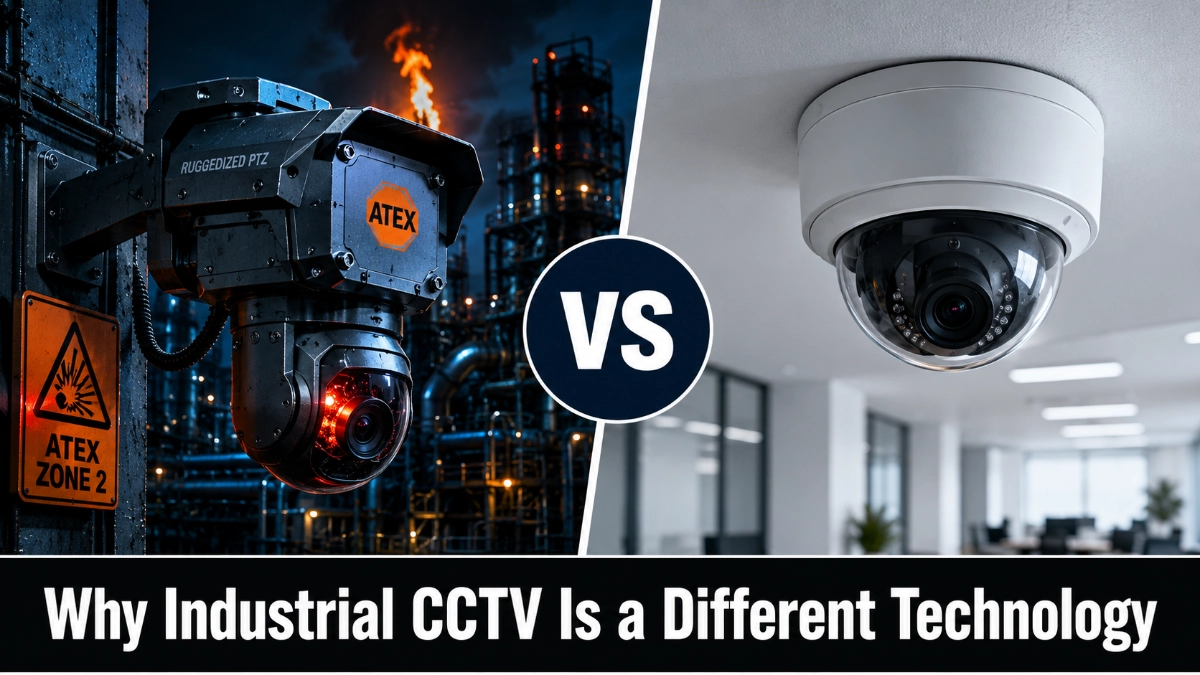
In industrial environments, that logic breaks down completely.
A refinery does not have the same security challenges as a bank branch. A mining site operates under conditions that would destroy a standard CCTV camera within weeks. A power plant’s perimeter extends over kilometres, demands 24/7 uninterrupted monitoring, and requires cameras to perform flawlessly at temperatures that would crack ordinary housing.
Industrial environments are hostile. They are dusty, wet, vibrating, chemically corrosive, electrically noisy, and in some cases, prone to explosion. The surveillance infrastructure that protects these environments must be designed for this reality, not adapted from office-grade solutions.
This article explains, in engineering and operational terms, exactly what sets industrial CCTV apart from standard surveillance, why the distinction matters, and how modern intelligent systems are raising the bar for industrial security monitoring.
What Is an Industrial CCTV System?
An industrial CCTV system is a purpose-built closed-circuit television infrastructure designed to operate continuously and reliably in harsh, high-risk, or safety-critical industrial environments. These systems go far beyond capturing video footage. They serve as the eyes and intelligence layer of an entire facility’s operational and security ecosystem.
Key capabilities of industrial CCTV systems include:
- Continuous perimeter and interior surveillance across large, complex sites.
- Integration with access control, fire and gas detection, and industrial automation systems.
- AI-powered analytics for safety compliance, intrusion detection, and production monitoring.
- Ruggedised cameras capable of operating in extreme temperatures, dusty atmospheres, and corrosive chemical environments.
- Redundant recording and failover architecture to ensure zero surveillance gaps.
- Long-range optical and thermal imaging for large outdoor perimeters.
- Cybersecurity-hardened network design aligned with industrial control system (ICS) security frameworks.
What Is a Standard Surveillance System?
Standard surveillance systems are designed for general commercial and residential environments. They typically consist of IP cameras, a network video recorder (NVR), and a viewing interface. These systems work well in controlled environments such as offices, retail stores, parking lots, banks, and educational institutions.
Standard surveillance infrastructure is generally designed for:
- Indoor or sheltered outdoor locations with minimal environmental stress.
- Short to medium-range monitoring (10–50 metres).
- Basic motion detection and event-triggered recording.
- Centralised video storage with limited redundancy.
- Consumer-grade or light commercial hardware with standard IP ratings.
Why the Two Cannot Be Treated as Identical Infrastructure
This is where many facility managers, procurement teams, and even some security integrators make a costly mistake. They assume that upgrading from analogue to IP cameras, or increasing camera resolution, makes a standard system suitable for industrial deployment.
It does not.
The difference between industrial CCTV and standard surveillance is not simply a matter of camera quality or resolution. It is a fundamental difference in engineering philosophy, hardware durability, system architecture, integration capability, and operational resilience.
Deploying standard surveillance infrastructure in an industrial environment is like installing a consumer GPS device on a military vehicle and expecting it to perform under combat conditions. The underlying technology may share some similarities, but the design philosophy, tolerance standards, and mission requirements are entirely different.
The Major Differences Between Industrial CCTV and Standard Surveillance
1. Environmental Durability and Ingress Protection
Industrial environments expose surveillance equipment to conditions that standard cameras cannot handle. Cement dust in a manufacturing plant, salt mist in a coastal refinery, fine particulates in a mining operation, and chemical vapours in a processing facility all create persistent threats to camera integrity.
Industrial CCTV cameras carry IP66, IP67, or IP68 ingress protection ratings, meaning they are fully protected against dust ingestion and can withstand powerful water jets or temporary immersion. Impact resistance ratings such as IK10 indicate the housing can withstand direct mechanical blows without failure.
Standard surveillance cameras typically carry IP44 or IP54 ratings adequate for light rain and general dust, but completely inadequate in industrial conditions. A standard camera in a quarry or concrete batching plant would likely fail within months due to particulate infiltration.
2. Thermal and Weather Resistance
Industrial facilities often operate at temperature extremes that standard cameras cannot tolerate. Outdoor installations in northern mining operations must function at -40°C. Cameras near furnaces, kilns, or casting lines may be exposed to radiant heat well above 60°C.
Industrial CCTV cameras are designed with wide operating temperature ranges, typically from -40°C to +75°C, with thermostatically controlled internal heaters and coolers to maintain optimal sensor and electronics performance across those extremes.
Standard cameras are typically rated for 0°C to 40°C operation. Deploying them outside this range causes lens fogging, housing distortion, circuit failure, and corrupted image sensors.
3. Explosion-Proof and Zone-Rated Hardware
This is perhaps the most non-negotiable difference for certain industrial sectors. Oil and gas facilities, petrochemical plants, offshore platforms, chemical processing units, and grain storage facilities all operate in environments where flammable gases, vapours, or combustible dust may be present.
Any electrical equipment used in these zones, including cameras, housings, and junction boxes, must carry recognised explosion-proof certifications such as ATEX (European standard) or IECEx (international standard). These certifications confirm that the equipment will not ignite the surrounding atmosphere even under fault conditions.
Standard surveillance cameras carry no such certification. Installing an uncertified camera in a Zone 1 or Zone 2 hazardous area is not just an engineering error; it is a legal violation and a serious safety risk.
4. Long-Range Perimeter Monitoring
An industrial site rarely has a perimeter that extends only 20–30 metres from a monitoring point. Refineries, power plants, logistics hubs, and mining sites often have perimeters measured in kilometres. Monitoring these effectively requires a fundamentally different optical approach.
Industrial CCTV systems deploy long-range pan-tilt-zoom (PTZ) cameras with powerful optical zoom (30x to 60x), laser illuminators that can project light 500–2,000 metres into darkness, and thermal imaging sensors that detect heat signatures at ranges where standard cameras would see nothing but blackness.
Standard PTZ cameras max out at relatively short effective ranges. Their illuminators are designed for 20–80 metres, and their optics are not engineered for the kind of precision required to identify an individual or vehicle at 500 metres.
5. Thermal and Low-Light Imaging Capabilities
Industrial sites operate continuously 24 hours a day, 7 days a week. Effective surveillance must operate in complete darkness, heavy smoke, dense fog, and across significant temperature contrast differentials.
Industrial CCTV systems deploy thermal imaging cameras that detect heat radiation rather than visible light. These cameras can see through smoke, fog, and darkness to identify personnel, vehicles, or equipment anomalies based purely on thermal signature. Thermal cameras are also invaluable for early fire detection, overheating equipment identification, and pipeline leak monitoring.
Standard IP cameras with IR LEDs can extend performance into low light, but they fail in complete darkness beyond their illuminator range, cannot see through smoke, and provide no thermal data. They are reactive rather than proactive surveillance tools.
6. Industrial-Grade Networking Infrastructure
Transmitting video data from hundreds or thousands of cameras across a large industrial site requires networking infrastructure built to industrial standards. Industrial Ethernet switches are rated for wide temperature ranges, resist electromagnetic interference (EMI) from heavy machinery, and support ring topologies that maintain connectivity even when a single cable or switch fails.
Fibre optic cabling is standard in large industrial CCTV deployments. It transmits data over long distances without signal degradation, is immune to EMI, and eliminates ground loop interference that plagues standard copper installations in electrically noisy industrial environments.
Standard surveillance systems typically run on standard commercial-grade network switches and Cat5e or Cat6 copper cabling. These infrastructure choices are cost-effective in office environments but create significant reliability and performance risks at an industrial scale.
7. AI-Powered Threat Detection and Video Analytics
Modern industrial CCTV is not simply about recording what happens; it is about understanding what is happening in real time and acting on that intelligence before incidents escalate.
Industrial AI video analytics platforms deliver capabilities such as:
- Perimeter intrusion detection with classification of person, vehicle, or animal.
- Personal protective equipment (PPE) compliance monitoring detects workers without helmets, vests, or harnesses.
- Crowd density analysis and controlled zone access management.
- Abandoned object and loitering detection.
- Smoke, flame, and early fire signature recognition.
- License plate recognition for vehicle access control.
- Operational anomaly detection identifies equipment behaving outside normal parameters.
These capabilities represent a qualitative leap beyond the basic motion detection algorithms available in standard surveillance systems. They turn passive recording infrastructure into an active operational intelligence platform.
8. Integration with Industrial Operations Technology
Industrial CCTV does not exist in isolation. It is a component of a broader operational and safety ecosystem that includes SCADA systems, distributed control systems (DCS), programmable logic controllers (PLC), access control systems, fire and gas detection, and emergency response platforms.
Deep integration allows a CCTV system to automatically respond to events triggered in other systems. When a gas detector triggers an alarm, the CCTV system can automatically swing PTZ cameras to cover the affected area, lock down access control points, and stream live footage directly to the emergency response team — all without operator intervention.
Standard surveillance systems typically lack the integration capability to participate in this kind of automated operational response. They remain passive recording tools rather than active components of industrial safety architecture.
9. Cybersecurity for Industrial Control Environments
As industrial CCTV systems become increasingly networked and integrated with operational technology, they also become potential entry points for cyber-physical attacks. A compromised camera feed can blind security operators. A breached CCTV network can provide a pathway into broader industrial control systems.
Industrial CCTV systems are designed with layered cybersecurity:
- Network segmentation through VLANs and DMZs, separating IT and OT networks.
- Encrypted video streams using TLS/SSL protocols.
- Zero-trust access models require multi-factor authentication.
- Regular firmware update management and vulnerability patching.
- Compliance with IEC 62443 standards for industrial cybersecurity.
Standard surveillance systems often ship with default credentials, minimal encryption, and no network segmentation security weaknesses that are manageable in a commercial environment but potentially catastrophic in an industrial control context.
10. Redundant Recording Architecture and High Uptime
In industrial environments, a surveillance gap is not an inconvenience; it can be a safety failure, a compliance violation, or a security breach. Industrial CCTV systems are designed for 99.9%+ uptime through redundant architecture.
This typically means edge recording at the camera or local node level, combined with centralised storage with RAID arrays and hot-swap drives. If the central server fails, edge storage continues capturing video. If a network segment fails, ring topology switches reroute data automatically.
Standard NVR-based systems centralise all recording. If the NVR fails or if the network path to it is interrupted, recording stops entirely. For industrial sites where continuous surveillance is a regulatory requirement, this is an unacceptable architecture.
Industrial CCTV in Practice: Deployment Examples
Manufacturing Plants: Monitoring production lines for worker safety compliance, quality control, and equipment status. Cameras track whether workers are using correct PPE, identify process anomalies, and support post-incident analysis for ISO certification requirements.
Oil & Gas Facilities: ATEX-certified cameras monitor wellheads, processing units, and storage tank farms. Thermal cameras detect hydrocarbon leaks and early fire signatures. Long-range PTZ cameras cover pipeline corridors and perimeter fencing.
Warehouses and Logistics Hubs: High-density camera arrays monitor inventory handling, vehicle movements, and dock access. AI analytics track pallet movements, flag unauthorised access, and support real-time dispatch verification.
Mining Sites: Ruggedised cameras with dust-proof and vibration-resistant housings monitor pit operations, conveyor systems, and explosive storage areas. Long-range surveillance covers remote perimeters inaccessible to regular security patrols.
Power Plants: Continuous monitoring of turbine halls, transformer yards, control rooms, and cooling systems. Integrated with SCADA for automated camera response to operational alerts. Thermal imaging monitors for overheating in electrical substations.
Data Centres: High-resolution cameras monitor server aisles, cooling systems, and access points. AI analytics verify that only authorised personnel have access to sensitive zones. Redundant recording ensures no footage gaps during maintenance windows.
Smart Industrial Campuses: Multi-site, multi-system integration brings together CCTV, access control, energy monitoring, and operational dashboards into a unified command centre. AI-driven analytics provide real-time situational awareness across the entire campus.
Why Standard Surveillance Systems Fail in Industrial Environments
Standard surveillance systems are not poorly designed; they are correctly designed for the environments they target. The failure occurs when these systems are incorrectly specified for environments they were never engineered to handle. Here is why the failures occur:
- Hardware failure due to environmental stress: Dust ingress, moisture, temperature cycling, and vibration degrade standard camera components rapidly. Sensor contamination, lens clouding, and housing failure are common outcomes within 12–24 months.
- Optical limitations: Standard cameras lack the zoom range, illumination power, and thermal sensitivity required for large industrial perimeters. Critical events at range become invisible.
- Recording gaps from centralised architecture: Single-point NVR failures create complete surveillance blackouts. In compliance-sensitive environments, these gaps carry legal and regulatory consequences.
- Network fragility: Standard commercial switches do not tolerate the EMI levels, vibration, and temperature extremes present on industrial sites. Network instability creates intermittent surveillance coverage.
- No OT integration: Standard CCTV cannot connect meaningfully with SCADA, DCS, or fire and gas systems. This isolation prevents automated safety responses and unified situational awareness.
- Cybersecurity exposure: Default credentials, unencrypted streams, and flat network architectures create attack surfaces that are unacceptable in critical industrial infrastructure.
- Analytics limitations: Basic motion detection cannot distinguish between a worker, an intruder, an animal, or a blowing plastic bag. False alarms cause operator fatigue; missed detections cause genuine incidents.
How Modern Industrial CCTV Is Becoming More Intelligent
The most significant transformation in industrial surveillance is the shift from passive recording to active intelligence. Modern industrial CCTV platforms are becoming genuinely predictive and prescriptive rather than simply archival.
Edge AI Processing
Rather than sending all video to a central server for analysis, edge AI processes video directly at the camera or local computing node. This dramatically reduces network bandwidth requirements, enables real-time responses without central server dependency, and allows surveillance to continue functioning even during network disruptions.
Predictive Surveillance and Anomaly Detection
AI models trained on historical operational data can identify deviations from normal patterns before they become incidents. A worker spending an unusual amount of time in a restricted area, a vehicle taking an uncharacteristic route through a facility, or a conveyor belt behaving outside its normal vibration profile, all of these can be flagged proactively.
Digital Twin Integration
Advanced industrial facilities are beginning to integrate CCTV streams with digital twin models, virtual replicas of the physical facility. Camera feeds populate the digital twin with real-time positional and operational data, allowing operators to monitor the entire facility through a unified spatial interface rather than a grid of disconnected video feeds.
Remote Command Centres
Modern industrial surveillance infrastructure supports centralised remote monitoring across multiple sites from a single command centre. Operators can monitor a network of refineries, power plants, or logistics hubs from a single control room, with AI prioritising alerts and directing operator attention to the highest-priority events across the estate.
Cyber-Physical Security Convergence
The convergence of IT security and physical security is a defining trend in industrial surveillance. CCTV systems increasingly share threat intelligence with cybersecurity platforms, detecting physical access events that correlate with network anomalies, or flagging video evidence of physical tampering with control systems.
Enterprise solutions available through Impact by Honeywell and leading Impact by Honeywell distributors in India represent this next generation of integrated, intelligent industrial surveillance where physical security, operational monitoring, and cyber resilience converge into a single, coherent infrastructure.
How Industrial CCTV Impacts Operations Beyond Security
Industrial CCTV delivers value well beyond traditional security monitoring:
- Worker Safety: Continuous PPE monitoring, restricted zone enforcement, and emergency response coordination reduce injury rates and support regulatory compliance.
- Operational Continuity: Real-time monitoring of production lines and critical equipment allows operators to identify and respond to operational anomalies before they cause downtime.
- Incident Investigation: High-resolution, continuously archived footage provides definitive forensic records for accident investigation, insurance claims, and regulatory audits.
- Perimeter Protection: Long-range cameras, thermal imaging, and AI intrusion detection create effective perimeter security across large, complex sites without requiring proportional increases in security staffing.
- Compliance Monitoring: Automated logging of safety behaviours, access events, and procedural compliance creates audit-ready records that reduce compliance management overhead.
- Asset Protection: Monitoring of high-value equipment, inventories, and infrastructure reduces theft, vandalism, and deliberate sabotage.
- Production Monitoring: Camera analytics can verify process adherence, monitor throughput, and flag quality deviations on production lines, adding measurable operational value beyond pure security applications.
- Emergency Response Coordination: Real-time feeds integrated with emergency response platforms allow incident commanders to direct response teams with accurate situational awareness.
Comparison: Standard Surveillance vs. Industrial-Grade CCTV Infrastructure
The table below summarises the core engineering and operational differences between standard commercial surveillance and industrial-grade CCTV systems:
| Feature / Parameter | Standard Surveillance | Industrial CCTV |
| Operating Temperature | 0°C to 40°C (typical indoor) | -40°C to +75°C (wide range) |
| Ingress Protection | IP44 / IP54 (basic) | IP66 / IP68 / IK10 (industrial) |
| Explosion-Proof Rating | ✗ Not rated | ✓ ATEX / IECEx certified |
| Imaging Technology | Standard HD / FHD | Thermal + Optical + IR combo |
| Camera Housing | Plastic/light aluminium | Stainless steel / ruggedised alloy |
| Network Infrastructure | Standard LAN / Wi-Fi | Industrial Ethernet, fibre, ring topology |
| Uptime Requirement | Best effort (90–95%) | Mission-critical (99.9%+) |
| Recording Architecture | Centralised NVR / DVR | Redundant edge + central with failover |
| AI Video Analytics | Basic motion detection | Advanced object, behaviour, anomaly AI |
| Perimeter Monitoring | Short-range (10–30m) | Long-range (100m–2km+) |
| Power Supply | Standard PoE | Industrial PoE+, dual redundant power |
| Cybersecurity | Basic password auth | Encrypted comms, VLAN, zero-trust |
| Compliance Integration | General safety | OSHA, ATEX, ISO, sector-specific |
| Integration with OT Systems | ✗ Rarely supported | ✓ SCADA, DCS, PLC integration |
| Maintenance Cycle | Annual check | Predictive maintenance with diagnostics |
| Scalability | Limited by NVR capacity | Enterprise-grade, thousands of cameras |
Practical Deployment Recommendations
For industrial security consultants, system integrators, and facility managers specifying industrial CCTV infrastructure, the following principles should govern design decisions:
- Conduct a thorough site environmental assessment before specifying hardware. Identify temperature ranges, particulate levels, chemical exposure risks, and zone classification requirements.
- Use zone-rated hardware in all certified hazardous areas. Non-compliance is a safety risk and a legal liability.
- Design network infrastructure first. Industrial-grade Ethernet switches, fibre backbone, and ring topology are prerequisites for reliable video transmission, not optional enhancements.
- Specify redundant recording architecture. Edge storage at every node, combined with central RAID-protected storage, eliminates single points of failure.
- Plan for OT integration from day one. CCTV systems should be specified and configured to integrate with SCADA, access control, and fire systems, not retrofitted later.
- Address cybersecurity as a core design requirement. Network segmentation, encrypted transmission, and access management must be specified alongside camera hardware.
- Implement AI analytics as a standard capability, not a premium add-on. The operational value of PPE detection, intrusion classification, and anomaly alerting justifies the investment across virtually all industrial deployment scenarios.
- Plan for scalability. Industrial facilities grow and change. Camera systems should be designed with spare network capacity and a management platform capable of scaling to thousands of cameras without architectural rework.
The Future of Industrial Surveillance: What Comes Next
Industrial CCTV is evolving rapidly. The next five to ten years will bring capabilities that were considered aspirational as recently as 2020:
- Fully autonomous surveillance systems that require no human monitoring for routine operations, escalating only genuine anomalies to human operators.
- 5G-connected camera networks enabling high-resolution streaming from remote and mobile deployment points without fixed infrastructure.
- Generative AI-powered incident reporting that automatically synthesises video evidence into structured incident reports for compliance and insurance purposes.
- Predictive maintenance integration, where camera systems monitor equipment condition alongside security events, feeding data into predictive maintenance platforms.
- Unified cyber-physical security dashboards that present physical and digital security posture in a single operational interface.
Industrial organisations that invest in intelligent, integrated surveillance infrastructure today are building the operational foundation for these capabilities. Those that continue to rely on standard commercial surveillance solutions will face increasing performance gaps as industrial AI surveillance matures.
Read Also: The Hidden Engineering Behind Enterprise CCTV Infrastructure
Read Also: Why CCTV Infrastructure Is Becoming a Strategic Business Asset