Imagine managing security across 12 warehouses, 3 manufacturing plants, and 2 corporate offices spread across different cities. Your team needs to monitor hundreds of cameras simultaneously, respond to incidents in real time, meet compliance requirements, and ensure zero downtime. A standard CCTV setup simply cannot handle that.
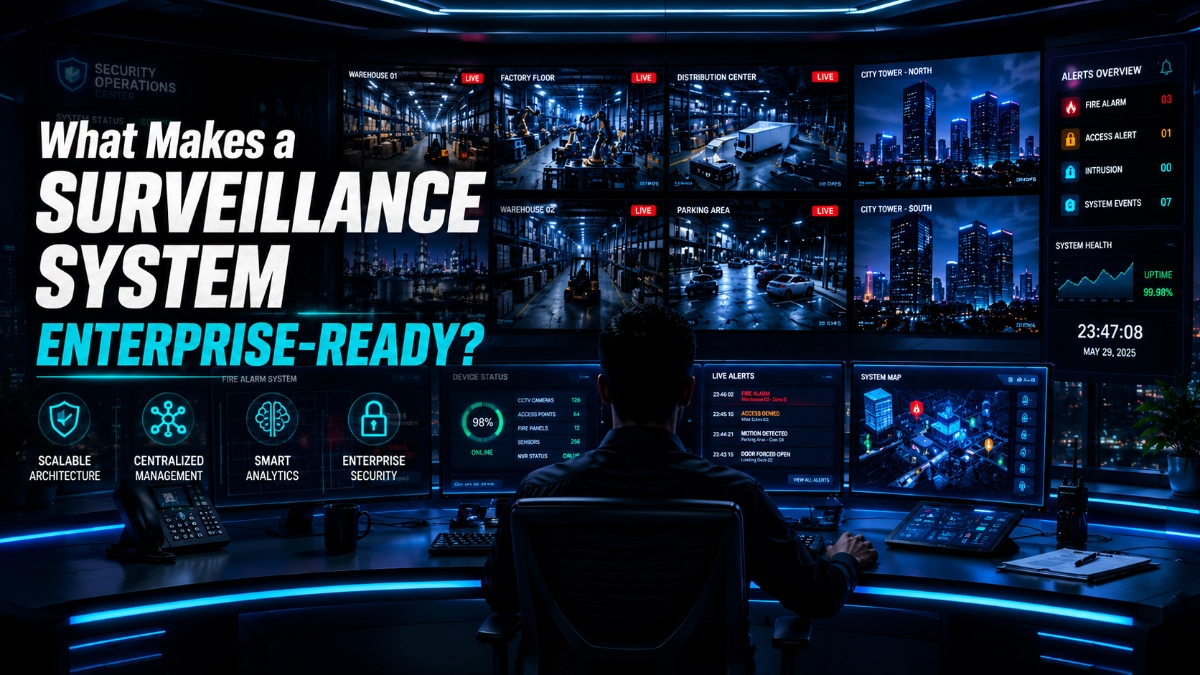
Is your surveillance system truly enterprise-ready?
This is where enterprise surveillance comes in. Enterprise-ready surveillance systems are built specifically for scale, complexity, and mission-critical environments. They go far beyond basic video recording to deliver centralised control, intelligent analytics, and robust cybersecurity, all from a unified platform.
This guide explains exactly what separates enterprise surveillance from standard CCTV and what features, architecture, and capabilities decision-makers must evaluate before investing.
What Is an Enterprise Surveillance System?
An enterprise surveillance system is a large-scale, centrally managed video security platform designed to support hundreds or thousands of cameras across single or multiple locations. It integrates hardware, software, storage, and analytics into one cohesive solution that security operations teams can manage from a single interface.
Unlike consumer or SMB-grade CCTV, enterprise systems are built for high availability, role-based access, advanced analytics, and compliance readiness. They typically include a Video Management System (VMS) as the central control layer, supported by IP cameras, storage infrastructure, and AI-powered analytics engines.
| Key Definition | A VMS (Video Management System) is the software backbone of an enterprise surveillance platform. It controls camera feeds, manages storage, enforces access policies, and provides the interface for monitoring and investigation. |
Enterprise Surveillance vs Traditional CCTV
The differences between standard CCTV and enterprise-grade surveillance go well beyond camera count. The table below captures the fundamental distinctions.
| Feature | Traditional CCTV | Enterprise Surveillance |
| Camera Count | Typically under 50 | Hundreds to thousands |
| Management | Local DVR/NVR | Centralized VMS platform |
| Multi-site Support | Limited or absent | Built-in, seamless |
| AI Analytics | Basic motion detection | Object, behavior, facial detection |
| Cybersecurity | Minimal | Encryption, MFA, segmentation |
| Storage | Local only | Local, cloud, and hybrid |
| Scalability | Hardware-bound | Software-defined, elastic |
| Compliance Tools | None | Audit logs, access controls |
| Integration | Standalone | Access control, BMS, IT systems |
Traditional CCTV works well for small, contained environments with limited needs. The moment your requirements include multi-site visibility, compliance documentation, or intelligent threat detection, you need an enterprise-grade platform.
Core Characteristics of an Enterprise-Ready Surveillance System
1. Scalability
An enterprise system must grow with your organisation. This means adding cameras, storage, or new locations without replacing existing infrastructure. Software-defined architectures and open platform VMS solutions make this possible.
Solutions like Impact by Honeywell CCTV are engineered for this kind of elastic growth, allowing system integrators to expand deployments incrementally while keeping total cost of ownership under control.
2. Centralised Management
Managing dozens of sites from a single dashboard is a defining feature of enterprise surveillance. Security operators can view any camera, trigger responses, run reports, and manage users from one platform regardless of geography.
3. Multi-Site Integration
Enterprise deployments span multiple buildings, campuses, or cities. A mature platform connects all sites under a unified VMS, enabling consistent policies, synchronised alerts, and cross-site investigation tools.
4. High Availability and Redundancy
Downtime in surveillance is unacceptable in critical environments. Enterprise systems include redundant servers, failover storage, and hot-standby configurations to ensure continuous operation. Look for platforms with 99.9% uptime guarantees and built-in disaster recovery.
5. Cybersecurity Architecture
A surveillance system is a network endpoint. Every camera, server, and storage device is a potential attack surface. Enterprise platforms address this with end-to-end encryption, multi-factor authentication (MFA), firmware lifecycle management, and network segmentation.
6. Role-Based User Access
Different users need different levels of access. A guard may view live feeds; a manager may review recordings; a compliance officer may generate audit reports. Enterprise VMS platforms allow administrators to configure granular, role-based permissions to enforce the principle of least privilege.
7. AI-Powered Intelligent Analytics
Modern enterprise surveillance goes beyond passive recording. AI analytics engines detect objects, track behaviours, recognise license plates, identify unusual patterns, and generate operational intelligence in real time.
8. Cloud and Hybrid Storage
Enterprise systems support local NAS/SAN storage, cloud archiving, and hybrid models. This provides flexibility for different compliance requirements, data retention policies, and disaster recovery needs.
9. Compliance and Audit Support
Industries such as finance, healthcare, and retail face strict surveillance regulations. Enterprise platforms include built-in audit logs, tamper-proof recording, data retention controls, and export tools to support GDPR, HIPAA, and other compliance frameworks.
Why Scalability Is Non-Negotiable
Organisations rarely deploy their full surveillance footprint on day one. Growth happens through acquisitions, facility expansions, or new compliance mandates. A system that cannot scale forces a costly rip-and-replace cycle.
Enterprise-ready platforms are built on open standards (like ONVIF) that allow camera models from different manufacturers to integrate seamlessly. They support distributed server architectures, so processing power grows with camera count.
When evaluating a surveillance platform, ask: Can this system support ten times my current camera count without replacing the core infrastructure?
| Expert Tip | Always validate scalability claims with real-world reference deployments. Ask vendors for case studies from organizations with similar camera counts and geographic spread. |
The Role of AI in Modern Enterprise Surveillance
Artificial intelligence transforms surveillance from reactive to proactive. Instead of waiting for an incident to review footage, AI continuously analyses video to surface anomalies, patterns, and threats in real time.
Key AI Capabilities in Enterprise Surveillance
- Object Detection: Identifies people, vehicles, packages, and restricted items automatically.
- Intrusion Detection: Triggers alerts when unauthorised individuals enter defined zones.
- Behavioural Analytics: Detects loitering, crowd surges, abandoned objects, or unusual movement patterns.
- Vehicle Monitoring: Reads license plates, tracks vehicle movement, and flags unauthorised vehicles.
- Smart Search: Enables investigators to search footage by object, colour, time, or behaviour rather than scrubbing through hours of video.
- Operational Intelligence: Counts footfall, measures dwell time, and provides data for facility management decisions.
Platforms distributed through Impact by Honeywell CCTV Distributor in India increasingly integrate these AI capabilities natively, reducing the need for separate analytics servers and simplifying system architecture.
Cybersecurity Requirements for Enterprise Deployments
In 2024 and beyond, unsecured surveillance cameras represent a serious organisational vulnerability. Attackers have compromised camera networks to gain access to internal infrastructure, intercept footage, or disrupt operations.
Enterprise-grade surveillance platforms must meet the following cybersecurity standards:
- End-to-End Encryption: Video streams and stored footage must be encrypted in transit and at rest using AES-256 or equivalent.
- Multi-Factor Authentication (MFA): All user logins, especially administrative access, must require MFA.
- Automated Firmware Management: Cameras and servers must support centralised, scheduled firmware updates to patch vulnerabilities quickly.
- Network Segmentation: Surveillance systems should operate on isolated VLANs, separate from corporate IT networks.
- Role-Based Access Controls: Limit who can view, export, or delete footage to reduce insider threat exposure.
- Penetration Testing and Vulnerability Disclosure: Prefer vendors with documented security testing programs and responsible disclosure policies.
Enterprise Surveillance Across Industries
Enterprise-grade surveillance serves a wide range of sectors, each with unique requirements.
Manufacturing
Monitors production floors, enforces safety zones, detects equipment anomalies, and protects against theft of raw materials and finished goods.
Warehousing and Logistics
Tracks inventory movement, monitors loading bays, verifies shipment accuracy, and prevents unauthorised access in high-value storage areas.
Retail Chains
Multi-site VMS platforms give loss prevention teams centralised visibility across all stores. AI analytics detect shoplifting behaviours and monitor queue lengths.
Healthcare
Protects sensitive areas, monitors patient safety, manages visitor access, and supports HIPAA-compliant video retention policies.
Education Campuses
Covers large perimeters, manages multiple buildings, monitors entry points, and integrates with access control systems to protect students and staff.
Critical Infrastructure
Power plants, water treatment facilities, and data centres require 24/7 surveillance with redundancy, AI threat detection, and strict access controls.
Smart Buildings
Integrates surveillance with building management systems (BMS) to create unified operational and security dashboards for facility managers.
Key Questions to Ask Before Choosing a Platform
Use this checklist when evaluating any enterprise surveillance system:
- How many cameras does the platform support, and what is the tested maximum capacity?
- Does the VMS support multi-site management from a single interface?
- What AI analytics capabilities are native vs. third-party add-ons?
- What cybersecurity certifications does the platform hold?
- How does the system handle failover and ensure business continuity?
- What storage options are supported: local, cloud, hybrid?
- Does the platform integrate with existing access control and IT systems?
- What is the total cost of ownership over five years?
- What SLA and enterprise support tiers are available?
- Does the vendor have reference deployments in your industry?
Common Mistakes Organisations Make
- Buying for today’s needs, not tomorrow’s scale: Underestimating future growth leads to expensive platform migrations.
- Ignoring cybersecurity in the procurement process: Many organisations treat surveillance as an IT-free zone, creating serious vulnerabilities.
- Choosing proprietary, closed systems: Lock-in prevents future flexibility and drives up costs.
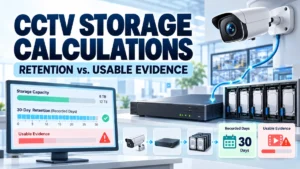
- Neglecting storage architecture planning: Insufficient storage leads to short retention windows and compliance failures.
- Overlooking end-user training: Even the best platform underperforms if operators do not know how to use it effectively.
Future Trends in Enterprise Surveillance
- Edge AI Processing: Analytics move to the camera itself, reducing bandwidth consumption and enabling faster local decisions.
- Cloud-Native Surveillance: More organisations will adopt cloud-based VMS platforms for reduced infrastructure overhead.
- Predictive Security: AI models will predict incidents before they occur based on behavioural patterns and environmental data.
- Unified Security Ecosystems: Surveillance, access control, cybersecurity, and building automation will converge into single platforms.
- Sustainability-Focused Hardware: Energy-efficient cameras and servers will become a procurement requirement as ESG mandates grow.
Conclusion
An enterprise surveillance system is not simply a larger version of a home CCTV setup. It is a mission-critical infrastructure layer that must be scalable, cybersecure, AI-capable, and built for continuous operation across multiple sites.
Organisations that invest in enterprise-grade platforms gain a significant operational advantage: faster incident response, stronger compliance posture, lower long-term costs, and the ability to turn security data into business intelligence.
Whether you are managing a single large campus or a national network of facilities, the principles are the same. Evaluate vendors on scalability, cybersecurity, analytics depth, and total cost of ownership. Demand reference deployments. And ensure your chosen platform can grow with your organisation for the next decade.
Platforms distributed through trusted partners like Impact by Honeywell CCTV Distributor in India bring proven enterprise architecture and global expertise to regional deployments, an important consideration for organisations scaling operations across India’s diverse geography.
Key Takeaways
- Enterprise surveillance systems support hundreds to thousands of cameras across multiple sites from a centralised VMS.
- Scalability, cybersecurity, redundancy, and AI analytics are non-negotiable features for enterprise deployments.
- AI capabilities, including behavioural analytics, smart search, and object detection, transform surveillance from reactive to proactive.
- Cybersecurity must be integrated into surveillance architecture, not treated as an afterthought.
- Always evaluate vendors on total cost of ownership, not just upfront hardware price.
- Use the enterprise readiness scorecard to objectively assess any platform before investment.
Read Also: Why Security Consultants Recommend Impact by Honeywell
Read Also: How Impact by Honeywell CCTV Systems Improves Operational Visibility