Most fire alarm budgets don’t blow up during installation. They blow up before a single cable is pulled at the procurement stage, when the wrong panel, the wrong detector, or the wrong vendor gets locked into a purchase order.
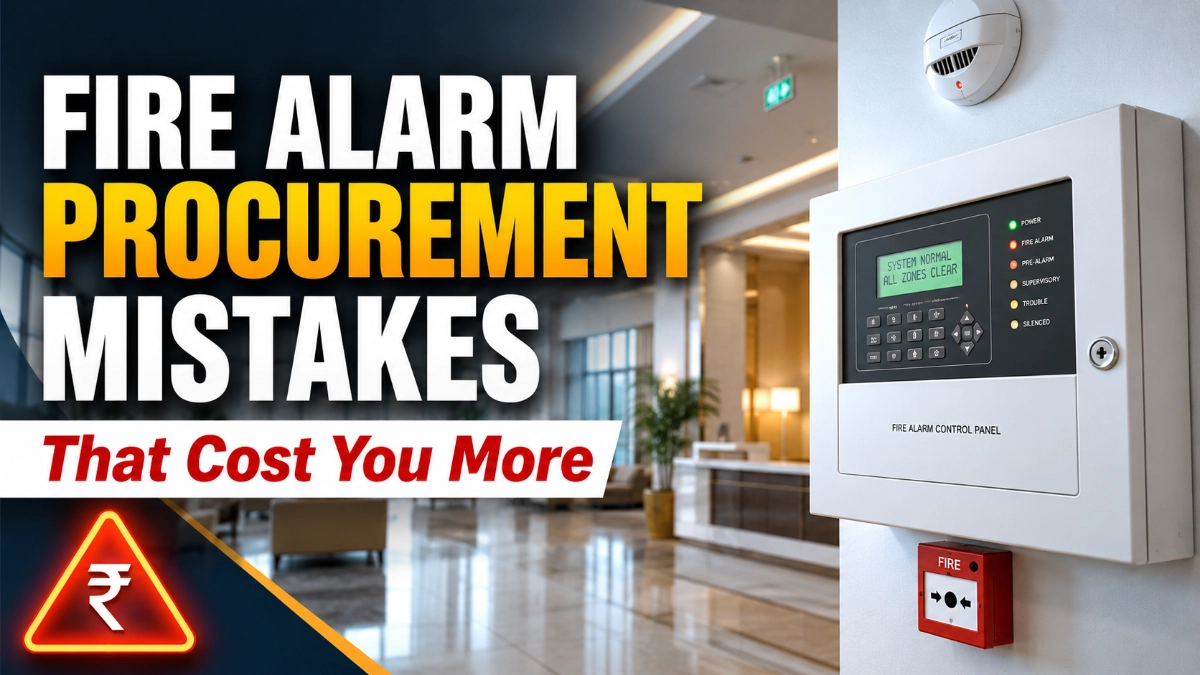
I have sat through enough post-mortem meetings on delayed commercial projects to know this pattern well. A contractor buys a fire alarm system based on the lowest quoted price. Six months later, the same contractor is paying twice that amount to fix compatibility issues, re-cable a floor, or wait weeks for spare parts that no local distributor stocks.
Fire alarm procurement is not just a purchasing decision. It is an engineering decision with financial consequences that show up long after the invoice is paid. This article walks through the procurement mistakes that quietly inflate project costs, and what experienced fire protection consultants do differently.
Why Fire Alarm Procurement Impacts Total Project Cost
Why do fire alarm procurement mistakes increase project costs? Procurement mistakes increase costs because a fire alarm system is a long-term asset, not a one-time purchase. Wrong panel sizing, incompatible devices, or non-certified products create rework, compliance failures, and higher maintenance costs that far exceed the original savings.
A fire alarm system typically stays in service for 10 to 15 years. Every device installed today has to be maintained, tested, expanded, and eventually replaced. A procurement decision made in a single afternoon can shape maintenance contracts, spare parts sourcing, and expansion budgets for over a decade.
This is why fire protection engineers look beyond the purchase order. They look at the total cost of ownership, not just the number on the quotation.
Purchase Price vs Lifecycle Cost: Know the Difference
Purchase price is what you pay today. Lifecycle cost is what you pay over the life of the system installation, commissioning, servicing, spare parts, false-alarm troubleshooting, and eventual upgrades.
A cheaper panel with limited addressable capacity often forces a full panel replacement when the building adds floors or tenants. A conventional system installed in a mid-size commercial building may look economical initially, but zone-based fault-finding during maintenance can cost more in labour hours over five years than an addressable system would have cost upfront.
Quick Comparison: Purchase Price Thinking vs Lifecycle Cost Thinking
| Factor | Purchase Price Approach | Lifecycle Cost Approach |
|---|---|---|
| Decision basis | Lowest quoted price | Total cost over system life |
| Panel selection | Minimum capacity for current scope | Capacity with room for expansion |
| Detector type | Cheapest available | Certified, compatible with panel protocol |
| Vendor choice | Any available supplier | Authorised distributor with support |
| Maintenance impact | Often ignored | Factored into decision |
| Long-term result | Higher hidden costs | Predictable, controlled costs |
Key takeaway: A fire alarm system is a 10–15 year commitment. Procurement decisions should be evaluated against lifecycle cost, not just the invoice value.
Common Fire Alarm Procurement Mistakes That Increase Costs
1. Choosing Products Based Only on Lowest Price
What is the biggest mistake when buying a fire alarm system? The biggest mistake is selecting products purely on price without checking certification, compatibility, and manufacturer support. This often leads to compliance failures, integration problems, and expensive rework later in the project.
Price-only procurement is common in competitive bidding environments. A contractor under margin pressure picks the cheapest quote without verifying whether the products meet EN 54 or NFPA requirements, or whether they will even integrate with existing building systems.
I have seen a hospital retrofit where a low-cost conventional panel was selected to save budget on a tender. The building’s fire consultant later flagged that the panel could not support the required zone monitoring for the ICU wing. The panel had to be replaced before handover at the contractor’s cost.
2. Ignoring Future System Expansion
Buildings grow. Malls add retail units. Hospitals add wings. Factories expand production floors. A fire alarm panel sized exactly for current requirements leaves no room for this growth.
Why is scalability important in fire alarm procurement? Scalability matters because buildings expand over time. A non-scalable panel forces a full system replacement during expansion, while a scalable, addressable fire alarm panel allows new devices to be added with minimal rework and cost.
Addressable panels with modular loop capacity are built for this. Each device on an addressable loop reports its own identity and status, which means adding new detectors typically means adding devices to an existing loop rather than installing a new panel.
3. Buying Incompatible Devices
Mixing detectors, modules, and panels from different manufacturers without confirming protocol compatibility is one of the most expensive mistakes in fire alarm procurement.
Addressable systems communicate over proprietary or semi-proprietary protocols. A detector that isn’t listed as compatible with a specific panel may not register correctly, may trigger false alarms, or may not work at all. Facility teams then discover this only during commissioning when replacing devices costs far more than it would have during procurement.
4. Selecting Non-Certified Products
How do certified fire alarm systems reduce long-term costs? Certified fire alarm systems reduce long-term costs by ensuring consistent performance, regulatory compliance, and easier insurance approval. Non-certified products risk system rejection during fire safety audits, leading to costly replacement.
Certification such as EN 54 for detection and control equipment is not paperwork. It reflects tested performance under fire conditions: response time, false-alarm resistance, and environmental tolerance. Products without this certification may pass initial inspection but fail during a formal fire safety audit, forcing a mid-project replacement.
This is one reason procurement teams increasingly specify EN 54-certified components such as the GST Fire Alarm System when working on commercial, healthcare, and industrial projects that require documented compliance.
5. Choosing the Wrong Panel Capacity
Undersized panels get replaced during expansion. Oversized panels waste capital on unused loop capacity. Both are procurement mistakes rooted in poor planning at the design stage.
A useful rule: size the panel for current requirements plus a reasonable growth margin, typically 20–25% additional loop capacity, rather than exact current device count. This avoids both waste and forced replacement.
6. Ignoring Spare Parts Availability
A fire alarm system is only as reliable as its aftermarket support. Detectors fail. Modules need replacement. Batteries degrade. If spare parts are hard to source locally, downtime increases and maintenance costs climb.
This is a common problem with fire alarm brands purchased through grey-market channels or one-time importers. When the original supplier disappears, so does access to genuine spare parts and facility teams are forced to source compatible-but-unverified replacements, which can compromise certification and warranty.
7. Purchasing From Unauthorised Distributors
Buying fire alarm equipment from unauthorised or unofficial channels is a quiet but serious procurement mistake. Products sourced this way often come without valid warranty, without manufacturer-backed technical support, and sometimes without authentic certification documentation.
An authorised distributor, by contrast, provides traceability of genuine products, documented warranty terms, and access to manufacturer technical support when something goes wrong on site. Innxeon Technologies, as an authorised GST Fire Alarm System distributor in India, is an example of this kind of channel: procurement teams get verified products along with local technical backing, rather than equipment with an unclear supply chain.
8. Overlooking Warranty and Manufacturer Support
Warranty terms vary widely between suppliers, and procurement teams often skip this comparison entirely. A shorter warranty period, or one that excludes labour costs, shifts financial risk back to the building owner the moment a device fails.
Manufacturer support matters just as much. When a control panel throws an unfamiliar fault code during commissioning, having direct access to technical support can be the difference between a same-day fix and a week-long delay.
9. Poor Specification Reviews
Specifications get copied from previous projects without review. A specification written for a warehouse doesn’t automatically fit a hospital, where smoke detector sensitivity, sounder levels, and zoning requirements differ significantly.
Procurement teams that skip a proper specification review often end up ordering equipment that technically works but doesn’t match the building’s actual fire risk profile, occupancy type, or local code requirements.
10. Procurement Mistakes During Retrofit Projects
Retrofit projects carry unique procurement risks. Existing wiring, existing panel infrastructure, and existing device types all constrain what can be purchased without a full system overhaul.
How do procurement mistakes affect fire safety compliance? Procurement mistakes affect compliance when purchased devices don’t meet current code requirements or don’t integrate with existing infrastructure. This can result in failed inspections, delayed occupancy certificates, and forced re-procurement.
A common retrofit mistake: purchasing addressable devices to integrate with a legacy conventional panel, assuming they’ll somehow work together. They won’t. This mismatch typically surfaces during testing after the equipment is already purchased and partially installed.
Hidden Costs of Replacing Incompatible Systems
Replacing an incompatible fire alarm system after installation is far more expensive than getting procurement right the first time. Hidden costs include:
- Removal and disposal of incompatible equipment
- Re-cabling if the new system uses a different wiring topology
- Recommissioning and re-testing the entire system
- Schedule delays affecting occupancy certificates
- Potential penalty clauses for missed project deadlines
Key takeaway: Retrofit and expansion projects need procurement decisions based on protocol compatibility with existing infrastructure, not just device specifications on paper.
Myth vs Fact
| Myth | Fact |
|---|---|
| “Any EN 54-listed detector works with any addressable panel.” | Protocol compatibility must be confirmed; certification alone doesn’t guarantee integration. |
| “A conventional system is always cheaper overall.” | It’s cheaper upfront but often costlier in maintenance labour for larger buildings. |
| “Bigger panel capacity is always better.” | Oversized panels waste capital; right-sizing with growth margin is more cost-effective. |
| “Any supplier can service any brand.” | Only authorised distributors typically offer genuine spares and manufacturer-backed support. |
| “Warranty terms are mostly the same across vendors.” | Warranty scope, duration, and labour coverage vary significantly between suppliers. |
Real-World Procurement Scenario
A mid-sized hotel in a metro city planned a 12-floor fire alarm installation. The contractor selected a conventional system to save on the initial quote. During the fire NOC inspection, the local authority required floor-wise zone identification for the fire brigade panel, a requirement the conventional system couldn’t meet without extensive re-zoning.
The project was delayed by six weeks. The contractor eventually switched to an addressable system, absorbing both the cost of the original conventional equipment and the new addressable installation. A proper specification review at the procurement stage would have identified this requirement before any equipment was purchased.
Fire Alarm Procurement Checklist Before Placing an Order
What should a fire alarm procurement checklist include? A fire alarm procurement checklist should include panel capacity planning, certification verification, protocol compatibility, distributor authorisation, warranty terms, spare parts availability, and compliance with local fire codes.
- Confirm the building’s fire risk category and applicable code (NFPA, EN 54, NBC India, or relevant IS standards).
- Verify panel capacity against current device count plus a growth margin.
- Confirm addressable or conventional system type matches the building’s zoning and reporting requirements.
- Check certification documents for every major component.
- Confirm protocol compatibility between panel, detectors, and modules.
- Verify the supplier is an authorised distributor with traceable warranty support.
- Review warranty terms, including labour coverage and response time.
- Confirm local spare parts and technical support availability.
- Cross-check the specification against actual building use, not a generic template.
- Plan for future expansion in the initial procurement, not as an afterthought.
Best Practices Followed by Experienced Fire Protection Consultants
Experienced consultants approach procurement differently from procurement teams focused only on cost.
How can businesses reduce fire alarm lifecycle costs? Businesses can reduce lifecycle costs by choosing scalable, certified fire alarm systems from authorised distributors, planning for future expansion, and prioritising long-term maintenance support over the lowest initial price.
They typically:
- Specify addressable fire alarm panels for buildings with more than a few zones, since fault isolation and future scalability outweigh the marginally higher upfront cost.
- Choose EN 54-certified detectors and control equipment as a baseline requirement, not an optional upgrade.
- Work with authorised distributors, such as Innxeon Technologies for GST Fire Alarm Systems in India, to ensure traceable warranty and local technical support.
- Build a 20–25% expansion margin into panel capacity during initial procurement.
- Review specifications against actual occupancy type and local fire code, not generic templates.
- Document every certification and compliance record before equipment reaches site.
Expert Tip
Before signing off on any fire alarm purchase order, ask the supplier for the panel’s maximum addressable device capacity per loop and the number of loops supported. This single number tells you how much future expansion the system can absorb without a forced upgrade.
Conclusion: Long-Term Value Over Short-Term Savings
Fire alarm procurement mistakes rarely show up on the day of purchase. They show up months later during commissioning, during an audit, or during the first expansion project. By then, the cost of correcting them is significantly higher than the cost of getting it right initially.
The pattern is consistent across hospitals, hotels, malls, factories, warehouses, schools, and residential towers: procurement decisions that prioritise certification, compatibility, scalability, and authorised supply chains consistently cost less over the life of the building than decisions based on the lowest quoted price.
Systems like the GST Fire Alarm System, available in India through authorised distributor Innxeon Technologies, are built around this principle: EN 54-certified components, scalable addressable architecture, and a supply chain that supports long-term maintenance rather than a one-time sale.
Getting fire alarm procurement right isn’t about spending more. It’s about spending correctly, once.
Read Also: Fire Alarm Capacity Planning: The Most Overlooked Engineering Decision
Read Also: Addressable Fire Alarm Systems in High-Risk Manufacturing Environments