Fire alarm infrastructure is evolving faster than ever. Consultants are no longer designing systems only for today’s compliance requirements; they are planning networks that can adapt to future technologies, building expansions, cybersecurity challenges, and increasingly connected smart environments.
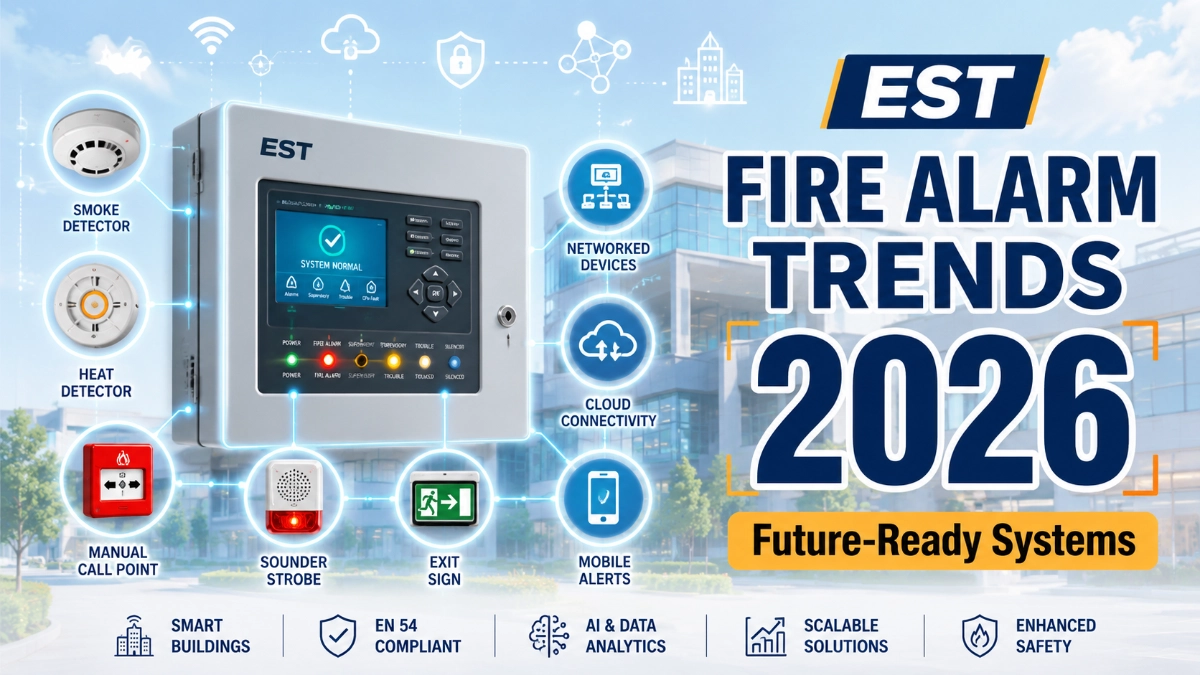
For decades, fire alarm design was a compliance exercise: meet the code, pass the inspection, hand over the keys. That model is breaking down. Buildings now grow in phases, tenants change, campuses merge networks, and facility teams expect life safety data to talk to building management systems rather than sit in isolation. A Fire Alarm Control Panel installed today may need to support double the devices in five years, integrate with a cloud dashboard that didn’t exist at handover, and defend against cybersecurity risks nobody was designing for a decade ago.
This shift means consultants must think less like installers and more like infrastructure architects. The decisions made at the design stage panel architecture, network topology, device selection determine whether a building’s life safety system becomes an asset or a liability over its 15–20-year lifecycle.
Fire alarm infrastructure is moving from standalone, compliance-driven installations toward scalable, networked, intelligent platforms. Key trends include addressable and intelligent detection, modular panel architecture, BMS integration, predictive maintenance, AI-assisted diagnostics, cloud monitoring, digital twins, and cybersecurity hardening. Consultants who plan for lifecycle flexibility, not just current occupancy, deliver systems that adapt to growth, technology change, and evolving risk without costly retrofits.
Why Fire Alarm Infrastructure Is Evolving
Several forces are converging to reshape how consultants approach life safety design:
- Smart buildings: Owners increasingly expect life safety systems to participate in a broader ecosystem of sensors, controls, and analytics, not operate as an isolated silo.
- Larger, more complex campuses: Airports, hospitals, and industrial parks now span multiple buildings and phases, requiring a single Enterprise Fire Alarm Network rather than disconnected panels per structure.
- Enterprise standardisation: Multi-site organisations want consistent panel platforms, device libraries, and monitoring interfaces across every facility to simplify training and maintenance.
- Sustainability goals: Energy-conscious design and long-service-life equipment reduce the environmental and financial cost of frequent replacements.
- Digital infrastructure growth: Data centres and mission-critical facilities demand life safety systems with the same reliability and monitoring rigour as their IT infrastructure.
- Business continuity: Downtime from a fire event or a false alarm shutting down operations carries a real financial cost, pushing owners toward systems with better diagnostics and fewer nuisance trips.
Top Infrastructure Trends Every Consultant Should Watch
Intelligent Addressable Systems
An Addressable Fire Alarm System identifies the exact device reporting an alarm or fault rather than a zone, cutting response time and simplifying troubleshooting. It’s now the default for mid-size and large commercial buildings. Expect tighter integration between detector-level analytics and building-wide event correlation. Specify an Intelligent Fire Alarm System with device-level diagnostics from the outset, even in phased projects.
Modular Infrastructure
Modular Fire Alarm Systems let designers add capacity loops, cards, and network nodes without replacing the core panel. Enterprise-grade panels increasingly ship with expandable backplanes as standard architecture, and modularity is extending to firmware and software layers. Evaluate headroom, not just current point count: a panel filled to 90% capacity at handover leaves no room for tenant fit-outs.
Networked Fire Alarm Systems
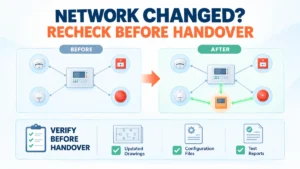
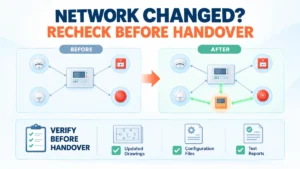
Multi-panel networking turns isolated systems into a unified Fire Alarm Infrastructure spanning buildings, floors, or campuses, common in hospitals and airports, and growing in mid-size portfolios. Network architecture will increasingly mirror IT principles: redundancy, segmentation, structured cabling. Design topology early, in coordination with the IT team.
Integration with Building Management Systems
Coordinating fire alarm events with HVAC, access control, and elevator recall through a Building Management System (BMS) improves response and efficiency. It’s common in Class A buildings and data centres, less consistent elsewhere. Confirm integration requirements with the BMS vendor during schematic design, not at commissioning.
Cybersecurity for Life Safety Networks
As panels connect to IP networks and cloud dashboards, they join the facility’s attack surface. Cybersecurity is no longer optional for Life Safety Systems, yet many installations still lack basic segmentation or credential management. Specify network segmentation, access control, and firmware update procedures within the design package itself.
Predictive Maintenance
Predictive Maintenance uses device-level diagnostic data to flag degrading sensors or wiring faults before failure. Emerging in enterprise deployments with cloud connectivity, it’s pushing maintenance contracts from fixed schedules toward condition-based servicing. Specify devices and panels that report diagnostic trends, not just pass/fail status.
AI-Assisted Diagnostics
Pattern recognition across large device fleets can distinguish genuine developing faults from environmental noise, reducing nuisance alarms. Still early-stage, mostly in pilot programs, but likely to become a standard monitoring-software feature. Treat it as a software-layer capability upgradeable without touching field hardware.
Cloud-Based Monitoring
Centralised dashboards let teams monitor multiple sites’ status and trends from one interface, growing quickly among multi-site enterprises. Expect hybrid models: local panel autonomy for life safety response, cloud layer for reporting. Confirm any cloud layer is additive to, not a replacement for, local panel survivability.
Digital Twins for Facility Management
Digital Twins create a live, data-linked model of a building’s life safety devices, useful for maintenance planning and emergency response. Still niche, concentrated in large campuses and data centres, but likely to become a standard BIM layer as adoption matures. Maintain accurate as-built device data from day one; a digital twin is only as good as its data.
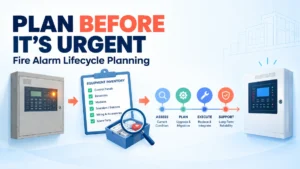
Lifecycle-Centric Infrastructure Planning
Capital cost is only part of total cost of ownership; maintenance, upgrades, and eventual replacement all factor into long-term value. Institutional owners increasingly request lifecycle cost modelling as a standard deliverable. Present lifecycle cost comparisons alongside capital estimates when advising clients on system selection.
How EST3 and EST4 Support Future Infrastructure Planning
The EST Fire Alarm System platform illustrates several of these principles in practice. The EST3 Fire Alarm Panel and EST4 Fire Alarm Panel are built on modular architectures that allow additional loops, network nodes, and I/O capacity to be added as a facility grows, rather than requiring a full panel replacement.
Both platforms support enterprise networking, allowing multiple panels across a campus or multi-building site to operate as a coordinated Enterprise Fire Alarm Network with shared event visibility. Compatibility with a broad range of EST Detectors and Devices, including smoke detectors, heat detectors, manual call points, monitor modules, control modules, relay modules, and notification appliances, gives consultants flexibility when designing for mixed occupancy types or phased construction.
From a lifecycle perspective, this modularity matters because it decouples the initial installation from future capacity needs. A facility that starts with a single building can, in principle, expand its device count and network scope over time using the same platform family, which simplifies training, spare-parts inventory, and long-term maintenance planning. Organisations sourcing this equipment in India typically work with an EST Fire Alarm System Distributor in India to align product availability with project timelines.
Common Planning Mistakes Consultants Should Avoid
- Designing only for today’s occupancy: A system sized exactly to current code minimums leaves no room for tenant changes or renovations.
- Ignoring future expansion: Phased developments often get separate, incompatible systems per phase instead of one scalable design.
- Underestimating network requirements: Cabling, bandwidth, and redundancy needs are frequently under-specified for multi-panel networks.
- Poor documentation. Incomplete as-built records make future upgrades slower and more expensive.
- Selecting systems with limited scalability: Choosing the cheapest panel without checking expansion headroom often costs more in retrofits later.
- Overlooking cybersecurity: Treating the fire alarm network as separate from IT security planning creates avoidable vulnerabilities.
Practical recommendation: Build a 10-year capacity and technology review into every design proposal, even for projects with modest current scope.
Consultant Framework for Future-Ready Fire Alarm Infrastructure
| Step | Focus Area | Key Question |
|---|---|---|
| 1 | Assess Building Growth | Will occupancy, floor area, or tenancy change in the next 5–10 years? |
| 2 | Evaluate Fire Risks | What hazards exist today, and how might they change with building use? |
| 3 | Plan for Scalability | Does the panel architecture support future loops, nodes, and devices? |
| 4 | Select Intelligent Devices | Do devices provide addressable, diagnostic-level reporting? |
| 5 | Consider Network Architecture | Is the network designed for redundancy and multi-panel coordination? |
| 6 | Integrate with Smart Building Systems | Can the system coordinate with the BMS, access control, and HVAC? |
| 7 | Plan Lifecycle Maintenance | Is there a condition-based or predictive maintenance strategy? |
| 8 | Document Expansion Strategy | Are as-built records and future capacity plans documented for the owner? |
Future Outlook
Fire alarm infrastructure over the next decade will likely be shaped by AI-driven fire detection that distinguishes real hazards from nuisance sources faster than threshold-based logic alone. Self-diagnostic systems will flag degrading components before failure, shifting maintenance from reactive to condition-based. Cloud dashboards will become standard for multi-site portfolios, and IoT integration will connect fire alarm data with broader building sensor networks.
Smart campuses, airports, hospitals, universities, and industrial parks will increasingly treat fire alarm infrastructure as one layer of an enterprise-wide life safety ecosystem, coordinated with security, HVAC, and emergency communication systems. This is an evolution, not a revolution: core detection and notification principles remain grounded in code compliance, but the surrounding infrastructure is becoming smarter, more connected, and more data-driven.
Expert Insights
- Flexibility often outperforms redundancy: Adding spare capacity to a modular panel is usually more valuable long-term than adding extra devices to an inflexible one.
- Lifecycle cost should drive panel selection, not just capital budget: A slightly higher upfront cost often pays back through reduced retrofit and downtime expenses.
- Interoperability should be a first-order design criterion: Systems that integrate cleanly with BMS and access control reduce long-term operational friction.
- Proactive network design prevents expensive retrofits: Cabling and topology decisions made early are far cheaper to implement than corrections made after occupancy.
- Standardisation simplifies enterprise facility management: Multi-site owners benefit significantly from using one panel family and device library across their portfolio.
- Documentation is an underrated infrastructure asset: Accurate as-built data is what makes digital twins and predictive maintenance actually usable.
- Cybersecurity planning belongs in the fire alarm design package, not bolted on later: Retrofitting network segmentation after installation is disruptive and costly.
Key Takeaways
- Design for the building’s future state, not just its current occupancy.
- Prioritise modular, expandable panel architecture over fixed-capacity systems.
- Treat network topology as a core design decision, not an afterthought.
- Build BMS integration requirements into the schematic design phase.
- Include cybersecurity measures in every networked fire alarm design.
- Specify devices capable of diagnostic-level, predictive maintenance reporting.
- Maintain accurate as-built documentation to support future upgrades and digital twins.
- Compare lifecycle cost, not just capital cost, when recommending systems to clients.
Top 10 Trends at a Glance
| # | Trend | Why It Matters |
|---|---|---|
| 1 | Intelligent Addressable Systems | Faster response, precise fault location |
| 2 | Modular Infrastructure | Expandable capacity without full replacement |
| 3 | Networked Fire Alarm Systems | Unified visibility across buildings and campuses |
| 4 | BMS Integration | Coordinated response with HVAC, access, elevators |
| 5 | Cybersecurity | Protects connected life safety networks |
| 6 | Predictive Maintenance | Condition-based servicing, fewer failures |
| 7 | AI-Assisted Diagnostics | Reduced nuisance alarms, better fault detection |
| 8 | Cloud-Based Monitoring | Centralised multi-site oversight |
| 9 | Digital Twins | Data-linked facility and device modeling |
| 10 | Lifecycle-Centric Planning | Lower total cost of ownership over 15–20 years |
Read Also: How Fire Alarm Systems Handle Simultaneous Emergency Events
Read Also: How Intelligent Modules Improve Fire Alarm Flexibility