Managing fire safety across multiple buildings becomes increasingly difficult when every facility operates independently. Modern enterprises are moving toward networked fire alarm systems that provide centralised visibility, faster decision-making, simplified maintenance, and greater operational control, all while supporting long-term infrastructure growth.
Introduction
For decades, fire alarm control panels were treated as isolated, building-specific devices. Each facility had its own panel, its own maintenance schedule, and its own record of alarms and faults. This worked reasonably well when organisations operated a single building with a dedicated facilities team on-site around the clock. It works far less well today.
Enterprises now operate hospital campuses with dozens of buildings, manufacturing plants with multiple production halls, universities with hundreds of structures, and commercial portfolios spread across cities. In this environment, standalone fire alarm panels create blind spots. A fault in Building C may go unnoticed for days. A technician may need to physically visit five sites to confirm that detectors are functioning correctly. Reporting for compliance audits becomes a manual, error-prone exercise of collecting logs from disconnected systems.
Operational visibility the ability to see, in real time, the status and health of every life safety device across an organisation has become a strategic priority rather than a technical nice-to-have. This is the driving force behind the shift from standalone panels to intelligent, networked fire alarm systems.
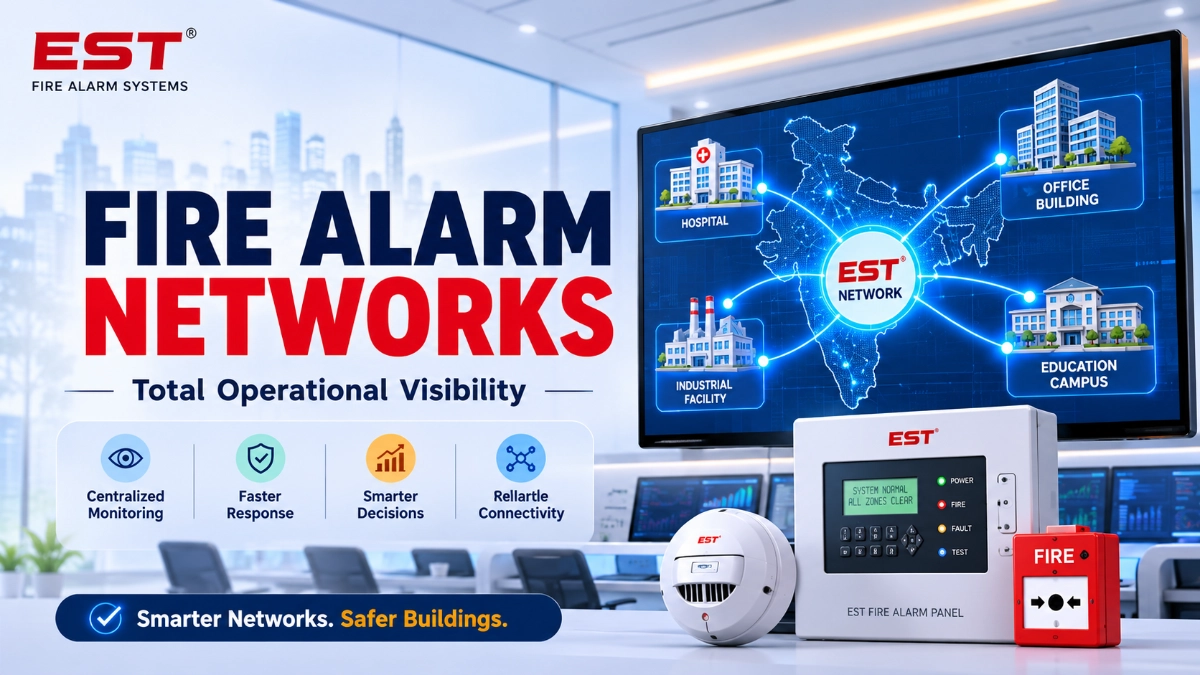
A networked fire alarm system connects multiple fire alarm control panels, addressable devices, and monitoring points into a single, coordinated communication architecture. Platforms built on architectures such as the EST Fire Alarm System, using panels like the EST3 Fire Alarm Panel and EST4 Fire Alarm Panel, illustrate how enterprise-grade networking is engineered in practice. This article explains the engineering principles behind that shift, independent of any single vendor’s marketing.
A networked fire alarm system links multiple fire alarm control panels and field devices through a structured communication architecture, allowing a single monitoring location to view alarms, faults, and device status across every connected building. This improves operational visibility by centralising event data, accelerating fault diagnosis, simplifying maintenance scheduling, and supporting consistent life safety reporting across an enterprise without requiring staff to be physically present at each facility.
What Is a Fire Alarm Network?
A fire alarm network is a communication architecture that connects multiple fire alarm control panels, whether in one building or across a multi-building campus, so that alarm, supervisory, and trouble signals from every connected panel can be monitored, managed, and reported from a centralised location.
Think of a standalone fire alarm panel as a single sensor reporting only to itself. A fire alarm network turns that sensor into a node on a larger system, similar to how individual computers become far more useful once connected into a corporate network rather than operating offline.
In practical terms, a fire alarm network consists of:
- Fire alarm control panels at each building or zone, each managing local detection and notification.
- Network controllers or gateways that carry signals between panels.
- Communication loops, whether fibre, copper, or a combination, that physically carry data.
- Addressable devices: smoke detectors, heat detectors, manual call points, monitor modules, and relay modules, each with a unique identity on the loop.
- A central monitoring workstation or software layer that aggregates events from every connected panel.
This is the architecture reflected in enterprise-class platforms such as the EST Fire Alarm System, where panels like the EST3 and EST4 are designed from the ground up to operate as network nodes rather than isolated units. The EST Detectors and Devices family extends this addressability down to the device level, so operational visibility is not limited to “which panel has a problem” but extends to “which exact detector, on which loop, in which building.”
What Does Operational Visibility Mean?
Operational visibility in fire protection refers to the depth and immediacy of information available about the health, status, and activity of every life safety device in a system. It goes beyond simply knowing that an alarm has activated.
A system with strong operational visibility provides:
- Real-time monitoring of alarm, supervisory, and trouble conditions as they occur, not after a manual site check.
- Event awareness that distinguishes between a genuine alarm, a pre-alarm condition, and routine system activity.
- Device health data, including battery status, loop integrity, and communication status for individual detectors and modules.
- Fault identification that pinpoints the specific device or circuit segment causing a trouble condition, rather than a generic panel-level fault.
- Maintenance insights drawn from historical performance, helping teams anticipate device replacement before failure.
- Performance analytics that reveal patterns, such as recurring faults in a specific zone or building.
- Decision support for facility managers and safety officers who need to prioritise response and resource allocation across an entire portfolio.
Without networking, each of these capabilities exists in isolated fragments, if at all. Networking is what turns fragmented data points into a coherent operational picture.
How Fire Alarm Networks Improve Operational Visibility
Centralised Event Monitoring
Instead of monitoring staff reviewing separate panels in separate buildings, every alarm, trouble, and supervisory signal is routed to a single monitoring interface. A hospital campus with twelve buildings, for example, can have all fire events displayed on one console at the central plant, with building and floor identification attached to every event.
Device-Level Diagnostics
Networked systems typically preserve addressability across the entire enterprise, not just within a single panel’s loop. This means a fault can be traced to an individual smoke detector or monitor module rather than requiring a technician to manually test an entire zone to locate the problem.
Faster Fault Identification
When a device reports a trouble condition, a networked system flags it immediately at the central monitoring point, along with its exact location. This reduces the average time between fault occurrence and technician dispatch, which matters directly for code compliance and for minimising periods where detection coverage is degraded.
Improved Incident Response
During an active alarm, responders benefit from knowing not just that an alarm occurred, but where, what type of device triggered it, and whether related devices in adjacent zones are also reporting activity. This contextual detail supports faster, more accurate emergency response decisions.
Enterprise-Wide Monitoring
A single security or facilities operations centre can oversee fire alarm status across an entire portfolio of buildings, including those in different cities, provided the network architecture supports wide-area communication. This is a significant operational shift for organisations that previously required on-site monitoring personnel at every location.
Historical Event Analysis
Networked systems retain event logs centrally, making it possible to analyse trends over months or years: which devices generate repeated trouble signals, which zones experience the most nuisance alarms, and where maintenance investment would have the greatest impact.
Better Maintenance Planning
With visibility into device-level performance data across every building, maintenance teams can move from reactive repair to planned, prioritised maintenance. This reduces emergency service calls and extends the useful life of field devices.
Key Components of a Networked Fire Alarm System
| Component | Role in Operational Visibility |
|---|---|
| Fire Alarm Control Panels | Local processing of detection and notification; the entry point for device data into the network |
| EST3 Fire Alarm Panel | Mid-to-large enterprise panel supporting networked operation and addressable loops |
| EST4 Fire Alarm Panel | Advanced enterprise panel architecture designed for large, distributed, multi-building networks |
| Smoke Detectors | Primary detection devices providing early warning and status reporting |
| Heat Detectors | Detection devices suited to environments where smoke detectors are impractical, such as kitchens or dusty industrial areas |
| Manual Call Points | Human-activated alarm initiation points, each individually addressable on the network |
| Monitor Modules | Interface points that bring signals from other systems (e.g., sprinkler flow switches) into the fire alarm network |
| Relay Modules | Output devices that trigger auxiliary functions such as door releases or HVAC shutdown |
| Notification Appliances | Horns, strobes, and speakers that alert occupants; status and supervision are reported back to the network |
| Communication Loops | The physical and logical pathways (fibre, copper, or both) carrying signals between devices and panels |
| Network Controllers | Hardware or software layers that aggregate and route data between multiple panels and the monitoring workstation |
Each component contributes a layer of visibility. Detectors and modules provide device-level data. Panels aggregate that data locally. Network controllers and communication loops carry it enterprise-wide. The monitoring workstation presents it in a form operators can act on.
Standalone vs Networked Fire Alarm Systems
| Factor | Standalone System | Networked System |
|---|---|---|
| Visibility | Limited to a single panel, viewed on-site | Enterprise-wide, viewed from a central location |
| Scalability | Difficult to expand beyond original design | Designed to accommodate additional panels and buildings |
| Fault Diagnostics | Manual investigation required, often panel-level only | Device-level fault location reported automatically |
| Multi-Building Management | Requires separate staff or visits per building | Single team can monitor multiple buildings simultaneously |
| Maintenance | Reactive, based on periodic site inspection | Proactive, based on continuous device health data |
| Reporting | Manual compilation from individual panel logs | Centralised, consistent reporting across the portfolio |
| Expansion Capability | Often requires panel replacement | Typically supports incremental network growth |
| Lifecycle Management | Managed independently per building | Managed holistically across the enterprise |
| Operational Efficiency | Lower, due to duplicated effort across sites | Higher, due to shared monitoring and maintenance resources |
Industries That Benefit Most
Hospitals
Hospital campuses combine high occupant vulnerability with sprawling, multi-building layouts. Centralised visibility allows safety staff to monitor patient wings, laboratories, and support buildings from one location without disrupting clinical operations for routine testing.
Manufacturing Plants
Industrial facilities often include multiple production halls, warehouses, and utility buildings with harsh environmental conditions. A networked system helps distinguish genuine alarms from environmental nuisance conditions and tracks device health in areas with heat, dust, or vibration.
Airports
Airports operate terminals, hangars, cargo facilities, and administrative buildings simultaneously. Centralised monitoring supports coordinated evacuation procedures and consistent life safety oversight across a complex, high-traffic environment.
Universities
A university campus may include academic buildings, dormitories, laboratories, and athletic facilities, each with different occupancy patterns. Networking allows a single campus safety office to maintain oversight across all of them.
Warehouses
Large storage facilities benefit from early fault detection, since undetected device failures in a warehouse can go unnoticed for long periods due to low staff presence.
Hotels
Hotels require rapid, accurate alarm location reporting given high transient occupancy and complex floor layouts. Centralised visibility supports faster, more targeted response.
Data Centers
Data centres require extremely high reliability and minimal false activations, since unnecessary suppression discharge or evacuation can be costly. Device-level diagnostics help operators verify genuine conditions before initiating a response.
Commercial Campuses
Multi-tenant office campuses benefit from centralised reporting that supports both life safety obligations and facility management efficiency across shared infrastructure.
Integration with Smart Building Systems
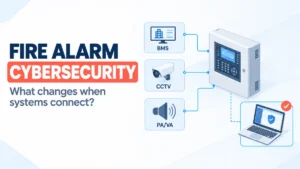
Operational visibility increases further when fire alarm networks integrate with other building systems rather than operating in isolation.
- Building Management Systems (BMS): Fire alarm events can trigger coordinated responses such as HVAC shutdown or damper control, and BMS platforms can display fire alarm status alongside other building data.
- HVAC: Integration allows smoke control sequences to be triggered automatically based on detector activation location.
- Access Control: Door release sequences can be coordinated with alarm zones to support safe egress.
- Video Surveillance: Operators can visually verify alarm conditions before dispatching response teams, reducing false-alarm response costs.
- Voice Evacuation: Networked systems support zone-specific voice instructions rather than generic building-wide alarms.
- Emergency Communication: Mass notification systems can be coordinated with fire alarm events for a unified emergency response.
- Facility Management Software: Maintenance work orders can be generated automatically from device-level fault data.
This is where fire alarm networking intersects with the broader concept of smart buildings: life safety data becomes one input among several in a coordinated building operations strategy, rather than a siloed system monitored separately from everything else.
Design Considerations for Enterprise Fire Alarm Networks
Engineers designing enterprise-scale fire alarm networks should evaluate:
- Network architecture: Star, loop, or hybrid topologies, chosen based on building layout and redundancy requirements.
- Scalability: Whether the architecture can accommodate additional buildings or devices without a full system redesign.
- Redundancy: Backup communication paths so a single point of failure does not eliminate visibility into an entire segment of the network.
- Device addressing: A consistent, documented addressing scheme across all buildings to avoid confusion during expansion or troubleshooting.
- Cyber resilience: Network segmentation and access control, since fire alarm networks increasingly share infrastructure with IT systems.
- Documentation: As-built records maintained centrally and updated with every change, not left to individual building files.
- Future expansion: Spare capacity built into panels and network controllers at design time, rather than assumed to be added later.
- Maintenance planning: A defined schedule and responsibility matrix for network-wide testing, not just individual panel testing.
Common Mistakes Organisations Make
- Poor network planning: Treating networking as an afterthought once individual buildings are already equipped with standalone panels, leading to costly retrofits.
- Underestimating growth: Designing network capacity for current building count only, without headroom for future facilities.
- Inconsistent documentation: Different buildings maintaining different addressing conventions or record formats, undermining centralised reporting.
- Limited redundancy: Relying on a single communication path between buildings, creating a single point of failure for enterprise-wide visibility.
- Ignoring lifecycle costs: Focusing on initial installation cost while underestimating long-term maintenance, software licensing, and device replacement costs.
- Lack of centralised monitoring: Installing networked hardware but failing to establish a genuinely centralised monitoring workflow or trained staff to operate it.
Future Trends
- AI-assisted monitoring: Pattern recognition applied to historical alarm and fault data to flag anomalies before they become failures.
- Predictive maintenance: Moving from scheduled inspection to condition-based maintenance driven by device health trends.
- Cloud-based dashboards: Remote access to enterprise fire alarm status without requiring dedicated on-site monitoring infrastructure at every location.
- Digital twins: Virtual models of building fire safety systems used for design validation, training, and incident simulation.
- IoT integration: Broader connectivity between fire alarm networks and other building sensors for richer contextual data.
- Enterprise analytics: Portfolio-wide reporting that supports capital planning and compliance auditing across all facilities simultaneously.
- Smart campus management: Unified dashboards combining fire safety, security, and facility data for large, multi-building organisations.
Expert Recommendations
- Design the network architecture before selecting individual panels hardware choices should follow the topology, not the other way around.
- Standardise device addressing conventions across the entire enterprise from day one, even if only one building is being installed initially.
- Budget for redundant communication paths between buildings; the cost of a backup path is almost always lower than the cost of a monitoring blackout.
- Treat central monitoring workstation training as seriously as panel programming visibility is only useful if operators know how to interpret it.
- Build a documented device replacement schedule based on manufacturer life expectancy data, not just reactive fault response.
- Segment fire alarm network traffic from general IT traffic where possible to reduce cyber exposure without sacrificing monitoring capability.
- Review historical fault data quarterly, not just during code-mandated inspections, to catch recurring issues early.
- When integrating with BMS or access control, define clear priority rules so life safety signals always take precedence over other building automation logic.
- Include spare loop and network capacity in every new installation, since retrofitting capacity later is consistently more expensive than designing it in initially.
- Treat commissioning documentation as a living asset, updated with every device addition, not a one-time deliverable filed away after installation.
Key Takeaways
- Operational visibility means real-time awareness of alarm, fault, and device health data across an entire organisation, not just a single building.
- Networked fire alarm systems connect multiple control panels into a single, centrally monitored architecture.
- Device-level addressability is what allows faults to be traced to a specific detector rather than an entire zone.
- Centralised monitoring reduces the time between fault occurrence and technician response.
- Historical event data enables predictive, rather than purely reactive, maintenance planning.
- Multi-building organisations hospitals, universities, airports, and industrial campuses see the greatest operational gains from networking.
- Integration with BMS, access control, and video surveillance extends visibility beyond fire alarm data alone.
- Redundant communication paths are essential to prevent single points of failure in enterprise networks.
- Poor planning, inconsistent documentation, and underestimated growth are the most common causes of costly network retrofits.
- Platforms such as the EST Fire Alarm System, including the EST3 and EST4 panels, illustrate how enterprise-grade architecture supports these visibility goals in practice.
Read Also: Understanding Cause-and-Effect Programming in Enterprise Fire Alarm Systems
Read Also: Why Large Organizations Standardize on One Fire Alarm Platform