When most business owners think about CCTV, they think about one thing: catching thieves. It’s an understandable assumption, but it’s also an expensive one because it causes organisations to evaluate surveillance investments using the narrowest possible lens.
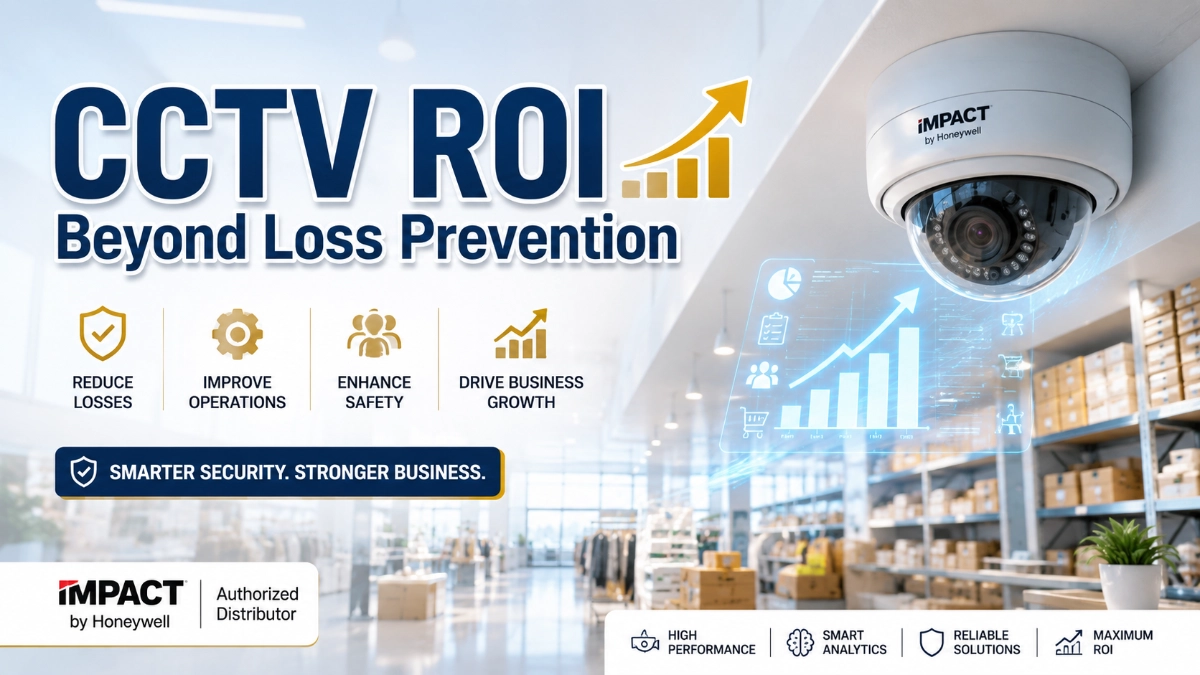
After years of specifying, installing, and auditing surveillance systems across warehouses, retail chains, and commercial buildings, a consistent pattern emerges: the businesses that get the most value from CCTV are rarely the ones chasing shoplifters. They’re the ones using video data to run tighter, safer, more accountable operations.
This article breaks down what CCTV ROI actually means, why so many businesses underestimate it, and how to measure it the way a finance team would, not just a security team.
Why Businesses Often Miscalculate CCTV ROI
What is CCTV ROI? CCTV ROI is the measurable financial and operational return a business gains from its surveillance investment, calculated against both the direct costs (hardware, installation, maintenance) and the value generated through loss reduction, efficiency gains, risk mitigation, and informed decision-making.
Most ROI miscalculations happen for one simple reason: businesses only track what CCTV prevents, not what it enables.
A facility manager who only logs theft incidents avoided is missing:
- Reduced insurance premiums from documented risk controls.
- Faster incident investigation and reduced liability exposure.
- Fewer workplace accidents due to behavioural accountability.
- Operational bottlenecks identified through footage review.
- Improved staff performance from passive supervision effects.
Insurance underwriters, workplace safety regulators referenced in OSHA guidance, and frameworks like ISO 27001 all treat surveillance as part of a broader risk management posture, not a standalone loss-prevention tool. Businesses that align their ROI thinking with this broader view tend to make smarter procurement decisions.
Pro Tip: Before installing or upgrading a CCTV system, define what “value” means for your business beyond security. Is it faster dispute resolution? Lower insurance costs? Better SOP compliance? Set the metric first, then design the camera placement around it.
Direct vs Indirect Business Benefits
Understanding CCTV ROI requires separating two categories of value.
| Category | Description | Examples |
|---|---|---|
| Direct Benefits | Immediately measurable financial impact | Theft reduction, reduced shrinkage, fraud detection, insurance discounts |
| Indirect Benefits | Operational and strategic value, harder to quantify but often larger | Process optimisation, safety compliance, dispute resolution, staff accountability, customer experience insights |
Direct benefits are easy to justify in a budget meeting. Indirect benefits are what actually compound over time, and they’re the reason mature security programs treat CCTV as infrastructure, not just protection.
Financial Benefits Beyond Theft Prevention
Insurance and Liability Cost Reduction
Does CCTV reduce insurance costs? In many cases, yes. Insurers often factor documented risk-control measures including surveillance coverage, retention periods, and monitored access points into commercial premium assessments. The exact discount varies by insurer and policy, so businesses should verify current terms directly with their provider or broker rather than assuming a fixed percentage.
Incident Investigation and Dispute Resolution
Slip-and-fall claims, delivery disputes, workplace incident reports, and customer complaints all take time and money to resolve. Recorded footage can shorten investigation cycles from days to minutes, reducing administrative overhead and limiting exposure to fraudulent claims.
Reduced Operational Losses
Beyond theft, footage regularly surfaces vendor short-deliveries, equipment mishandling, process deviations that cause waste, and unauthorised access to restricted zones quantifiable costs that traditional “security-only” ROI models ignore entirely.
Did You Know? Many organisations that review footage only after an incident are underusing their system. Scheduled, proactive footage audits even 15 minutes a week often surface recurring issues before they escalate into losses.
Operational Improvements Enabled by CCTV
Can CCTV improve employee productivity? Indirectly, yes. Visible, well-communicated surveillance tends to reinforce adherence to standard operating procedures, reduce time theft, and improve accountability on tasks like loading, quality checks, and safety compliance, provided it’s implemented transparently and in line with local workplace privacy regulations.
Operational gains typically show up in three areas:
1. Process Verification: Supervisors can confirm SOP adherence in packing, quality control, and equipment handling without needing to be physically present at every station.
2. Workflow Bottleneck Identification: Footage of loading docks, production lines, or checkout counters often reveals inefficiencies that go unnoticed during manual observation; a recurring five-minute delay at one checkpoint compounds into significant labour cost over a year.
3. Remote Oversight Across Multiple Sites: For businesses managing several locations, remote monitoring reduces the need for physical site visits, cutting travel costs and speeding up response to operational issues.
AI Video Analytics and Business Intelligence
Can AI CCTV improve operational efficiency? Yes, this is where surveillance shifts from a passive recording tool to an active business intelligence layer. AI-powered video analytics can automatically detect patterns, anomalies, and trends that would be impractical to identify through manual footage review.
Common applications include people counting and dwell-time analysis for retail layout optimisation, queue length detection to trigger staffing adjustments, PPE and safety compliance detection in manufacturing zones, heat mapping to understand movement patterns, and anomaly detection for unusual after-hours activity.
This is also where hardware quality starts to matter for ROI, not just image clarity. A system like Impact by Honeywell CCTV, for example, is built around this shift toward analytics-ready infrastructure where camera performance, video management integration, and long-term reliability directly influence how much operational data a business can actually extract from its surveillance investment.
Expert Insight: AI analytics are only as reliable as the camera placement and lens quality feeding them. Poor field-of-view planning is the single most common reason analytics systems underperform their potential; no amount of software can compensate for a badly positioned camera.
Measuring ROI Using Practical KPIs
How do businesses measure CCTV return on investment? A structured approach combines direct cost savings with operational KPIs tracked over a defined period, typically 12 to 24 months.
A Practical ROI Framework
Step 1: Calculate Total Investment: Hardware, installation, licensing, storage, maintenance, and monitoring costs over the evaluation period.
Step 2: Quantify Direct Savings: Reduced shrinkage, lower insurance premiums (if confirmed with insurer), reduced claims payouts.
Step 3: Quantify Operational Value: Time saved on investigations, reduced downtime from faster incident resolution, labour efficiency gains identified through footage review.
Step 4: Compare Against Baseline: Measure performance against a pre-installation baseline period to isolate the system’s actual contribution.
Sample ROI Scenario (Illustrative Only)
| Metric | Before CCTV | After CCTV (12 months) |
|---|---|---|
| Average incident investigation time | 3 days | 4 hours |
| Insurance claim disputes | Higher frequency | Reduced, pending insurer confirmation |
| Unplanned downtime from process errors | Untracked | Reduced through footage-based root-cause analysis |
| Staff SOP compliance audits | Manual spot checks | Continuous passive verification |
Note: This scenario illustrates the structure of an ROI comparison. Businesses should build their own baseline using internal data rather than industry averages, since operational context varies significantly by sector and site size.
How long does it take for CCTV systems to pay for themselves? Payback periods vary widely based on business size, risk exposure, and how actively the footage and analytics are used. Businesses that only use CCTV reactively (reviewing footage after incidents) typically see slower payback than those using it proactively for operational insight and compliance verification.
Industry Examples
- Warehouses: Loading dock cameras combined with access control verify shipment accuracy and reduce disputes with logistics partners, while motion analytics flag unauthorised after-hours entry.
- Manufacturing: Production-line cameras support quality assurance, safety compliance monitoring under frameworks referenced by OSHA, and root-cause analysis for equipment downtime.
- Retail: People-counting and dwell-time analytics inform store layout, staffing schedules, and conversion optimisation, extending CCTV’s role from loss prevention into merchandising strategy.
- Commercial Offices: Access verification, visitor management integration, and after-hours monitoring support both physical security and building compliance documentation.
- Hospitals: Surveillance supports patient and staff safety, incident documentation for liability protection, and monitoring of restricted areas such as pharmacies and equipment storage.
- Educational Campuses: Campus-wide monitoring supports student safety protocols, incident response documentation, and access control across buildings, often integrated with a centralised monitoring station.
Common Mistakes That Reduce CCTV ROI
- Treating CCTV as a one-time purchase rather than a managed system — without regular maintenance, firmware updates, and storage audits, performance degrades over time.
- Poor camera placement planning — prioritising camera count over strategic coverage reduces both security and analytics value.
- Ignoring video management system (VMS) integration — disconnected systems limit the ability to correlate footage with access control or point-of-sale data.
- No defined review process — footage that’s never analysed proactively delivers only reactive value.
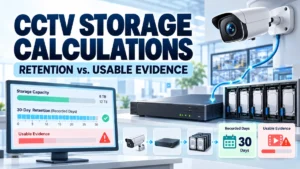
- Underinvesting in storage and retention planning — insufficient retention periods can eliminate footage needed for delayed claims or investigations.
- Choosing hardware based on price alone — inconsistent image quality or unreliable recording undermines evidentiary value and analytics accuracy, which is why integrators increasingly weigh options like Impact by Honeywell bullet cameras and Impact by Honeywell dome cameras for consistent coverage rather than defaulting to the lowest-cost unit.
Future of ROI with Intelligent Surveillance
The next phase of CCTV ROI is being shaped by predictive surveillance systems that don’t just record events but flag risk patterns before incidents occur. This includes behavioural anomaly detection, integration with building management systems, and analytics that feed directly into operational dashboards used outside the security department entirely.
As storage and processing infrastructure evolves, the backbone supporting these capabilities matters more than ever. Reliable recording infrastructure, such as Impact by Honeywell NVRs, plays a foundational role here, determining how much historical data a business can retain, search, and cross-reference for both compliance and business intelligence purposes.
For organisations sourcing this kind of infrastructure, working with an established Impact by Honeywell CCTV distributor in India can also influence long-term ROI, since consistent access to genuine hardware, warranty support, and technical service directly affects system uptime and total cost of ownership.
Security consultants and system integrators evaluating vendors should reference recognised frameworks including guidance from ASIS International, NFPA for fire and life-safety integration, and IFSEC industry standards when assessing whether a proposed system architecture will scale with future analytics needs. Businesses are encouraged to verify current statistics and benchmarks through sources such as Deloitte, PwC, Gartner, or the IBM Cost of a Data Breach report series, as figures in this space are updated regularly and should not be assumed static.
Final Takeaways
Is CCTV an operational investment or security expense? Increasingly, it’s both and businesses that classify it purely as a security line item are undervaluing its contribution to operations, compliance, and decision-making.
What factors influence CCTV ROI? Camera placement strategy, integration with analytics and VMS platforms, storage and retention planning, staff training on footage use, and how proactively the organisation reviews and acts on video data.
Key principles worth remembering:
- CCTV ROI extends across financial, operational, safety, and compliance dimensions.
- Indirect benefits often outweigh direct loss-prevention savings over time.
- AI analytics transform footage from passive records into active business intelligence.
- Hardware quality and system architecture directly influence long-term ROI.
- ROI should be measured against a defined baseline, not industry assumptions.
Conclusion
The real value of a CCTV system isn’t measured only in thefts prevented or losses avoided; it’s measured in faster decisions, safer workplaces, stronger compliance posture, and operations that run with fewer blind spots.
Businesses that treat surveillance as strategic infrastructure, rather than a reactive security expense, consistently extract more value from the same investment. That shift in thinking from “what did CCTV stop?” to “what did CCTV help us understand and improve?” is ultimately what separates organisations that see CCTV as a cost centre from those that see it as a genuine business asset.
Read Also: Why CCTV Infrastructure Should Be Planned Like IT Infrastructure
Read Also: AI vs Human Monitoring: Finding the Right Balance