Modern video surveillance has moved far beyond simple recording. Today, AI-powered analytics detect threats in real time, count footfall, identify safety breaches, and trigger automated alerts all from camera feeds. But where that intelligence lives matters enormously.
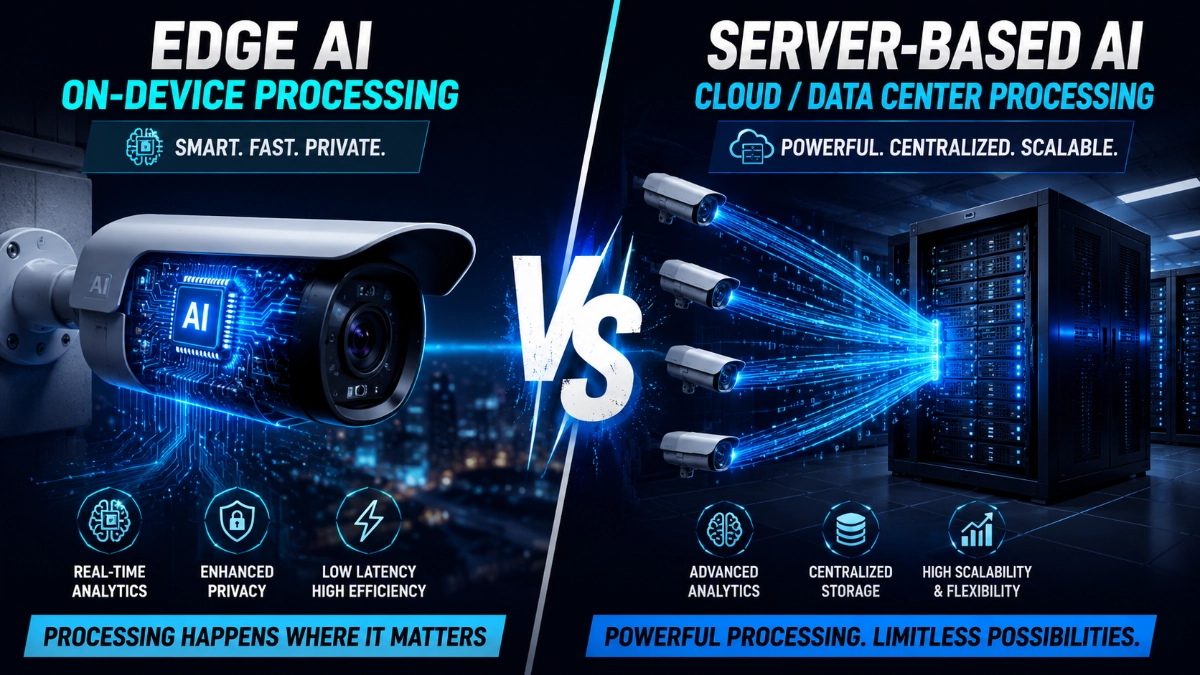
Two architectures dominate the market: edge analytics, where processing happens inside the camera itself, and server-based analytics, where footage is sent to a central system for analysis. Each has genuine strengths. Each has real limitations. And the wrong choice can mean wasted capital, poor performance, or a security gap you cannot afford.
This article cuts through the noise. Whether you manage a manufacturing plant, a retail chain, a logistics hub, or critical infrastructure, you will find a clear, technically grounded guide to choosing the right analytics architecture for your environment.
What Is Edge Analytics?
Edge analytics refers to video intelligence that runs directly on the camera or on a small local device attached to it. The camera captures footage, analyses it using an onboard processor or AI chip, and generates metadata, alerts, or decisions without sending raw video to a central server.
The term ‘edge’ comes from network architecture. The camera sits at the edge of the network, far from centralised infrastructure. By processing data at the point of capture, edge analytics eliminates the need to transmit high-bandwidth video streams across the network.
| Expert Insight: Edge analytics cameras essentially act as intelligent sensors. They do not just see, they understand. A well-configured edge camera can detect a person crossing a boundary line, count vehicles entering a zone, or identify a worker without a hard hat, all independently of any server connection. |
How Edge Analytics Works
Edge analytics cameras contain dedicated AI accelerator chips often called NPUs (Neural Processing Units) or VPUs (Vision Processing Units) alongside standard image processors. These chips run deep learning models trained to recognise specific events or objects.
The processing pipeline works as follows:
- The camera sensor captures raw footage at full resolution.
- The onboard AI chip runs inference on each frame or a subset of frames.
- The model generates structured metadata: object type, location, timestamp, and event classification.
- Only the metadata, not the full video stream, is transmitted to the network management system.
- The raw video may be stored locally on an SD card or NVR for evidentiary purposes.
This architecture means the camera operates as a self-contained intelligence unit. It can function even during a network outage, making it particularly valuable in remote or bandwidth-constrained locations.
Key Advantages of Edge Analytics
1. Dramatically Reduced Bandwidth
Transmitting HD or 4K video streams consumes enormous bandwidth. A single 4K camera can generate 15–25 Mbps of continuous data. Edge analytics replaces this stream with lightweight metadata packets, often less than 1 Kbps per camera. This reduction transforms network planning for large-scale deployments.
2. Near-Zero Latency
Because analysis happens on the device, response times drop to under 50 milliseconds in many implementations. This matters in access control, automated gate systems, and perimeter security, where a one-second delay can mean a genuine threat passes undetected.
3. Resilient Offline Operation
Edge cameras continue analysing and alerting even when the network fails. For remote substations, construction sites, or transport infrastructure, this resilience is not optional; it is a core requirement.
4. Enhanced Data Privacy
Personal data, including facial recognition data in some jurisdictions, never leaves the device. This simplifies GDPR and data protection compliance considerably. In healthcare facilities, legal offices, and financial institutions, keeping sensitive footage on-device significantly reduces data governance risk.
5. Lower Infrastructure Cost for Dispersed Sites
A warehouse network spanning multiple remote sites does not need a high-capacity server room at each location. Edge cameras bring intelligence to the site without the infrastructure overhead.
Limitations of Edge Analytics
Edge analytics is not universally superior. It carries trade-offs that disqualify it for certain scenarios.
- Processing power per camera is finite. Complex multi-object tracking, crowd analytics, or forensic search across weeks of footage exceeds what most edge devices can handle.
- AI models are baked into the firmware. Updating algorithms requires a firmware upgrade across every camera, a logistical challenge in large deployments.
- Per-unit cost is higher. Edge AI cameras carry a significant price premium over standard IP cameras, sometimes two to four times the cost.
- Vendor lock-in risk is real. Proprietary AI chips and SDKs make it difficult to change algorithms or integrate with third-party analytics platforms.
- Compute limitations restrict model complexity. A server with dedicated GPUs can run far more sophisticated models than the constrained hardware inside a camera housing.
| Common Mistake: Organisations frequently deploy edge analytics cameras expecting them to replicate the analytical depth of server-based systems. They cannot. An edge camera excels at simple, well-defined detection tasks. It struggles with complex behavioural analytics that require contextual reasoning across multiple camera feeds simultaneously. |
What Is Server-Based Analytics?
Server-based analytics centralises the intelligence. Standard IP cameras stream video to a server on-premises, hybrid, or cloud-hosted, where specialised software and hardware (typically GPU-accelerated servers) perform analysis.
The server runs video analytics platforms that can process dozens or hundreds of simultaneous streams. Because the compute resource is not constrained by camera hardware, server-based systems support significantly more sophisticated AI models and cross-camera analysis.
Major video management software (VMS) platforms, including enterprise-grade systems favoured by distributors such as Impact by Honeywell CCTV, integrate server-based analytics engines that operate across large camera estates from a single management console.
How Server-Based Analytics Works
The processing pipeline differs fundamentally from edge architecture:
- IP cameras stream encoded video (H.264/H.265) continuously to a network video recorder (NVR) or video management server.
- The analytics server decodes video streams in real time.
- GPU-accelerated inference engines run AI models across all streams simultaneously.
- The system correlates events across multiple cameras, tracking a person across an entire building, for example.
- Alerts, reports, and metadata are fed to operators and integrated systems.
- Retrospective analysis allows forensic search across historical footage at high speed.
Cloud-based variants follow the same logic but offload processing to remote data centres, introducing latency but removing on-premises hardware costs and enabling rapid model updates.
Key Advantages of Server-Based Analytics
1. Superior Analytical Depth
GPU-powered servers run models that are orders of magnitude more complex than anything feasible on an edge chip. Multi-object tracking, behavioural analysis, license plate recognition (LPR) at high accuracy, and facial recognition across a population all demand server-class compute.
2. Cross-Camera Intelligence
Server systems correlate events across the entire camera estate. A retail loss prevention team can track a suspect from the car park through every floor of a shopping centre. A logistics hub can trace a missing item through the entire facility timeline.
3. Centralised Model Management
Updating an AI model on a server changes the behaviour of every connected camera instantly. There are no firmware rollouts, no per-device scheduling, and no version fragmentation. This is operationally critical for large deployments.
4. Lower Camera Unit Cost
Standard IP cameras cost significantly less than edge AI variants. Organisations with existing camera estates can often add server-based analytics without replacing hardware, protecting capital investment.
5. Forensic Retrospective Search
Server-based systems can re-analyse historical footage using new algorithms. If a new threat pattern is identified, the system can search months of archived footage automatically, a capability that edge cameras fundamentally cannot replicate.
Limitations of Server-Based Analytics
- High bandwidth demand: Continuous HD/4K streams from dozens of cameras saturate networks rapidly. Infrastructure investment in network switches, cabling, and WAN links can be substantial.
- Single point of failure: If the server fails, analytical coverage across the entire estate drops to zero. Redundancy is essential but adds cost.
- Latency: Video must travel from the camera to the server before analysis occurs. In time-critical applications, this delay, even if measured in milliseconds, can matter.
- No offline operation: Remote sites without reliable connectivity cannot depend on server-based analytics for real-time alerting.
- Data governance complexity: Centralising footage from multiple sites onto shared servers increases data breach surface area and complicates regulatory compliance.
| Implementation Tip: Before deploying server-based analytics, model your bandwidth requirements carefully. A 64-camera deployment with 4K streams at 15 fps can consume over 1.5 Gbps of sustained network throughput. Plan your core switching and NAS/SAN storage architecture around this figure from the outset. |
Edge Analytics vs Server-Based Analytics: Comparison Table
| Factor | Edge Analytics | Server-Based | Hybrid |
| Processing Location | On the camera/device | Central server/cloud | Both |
| Bandwidth Usage | Very low | High | Moderate |
| Latency | Near real-time (<50ms) | Higher (100ms–1s+) | Low to moderate |
| Scalability | Per-device cost | Cost-efficient at scale | Flexible |
| Upfront Cost | Higher per camera | Lower per camera | Moderate |
| AI Model Updates | Complex/manual | Centralised, easy | Centralised |
| Data Privacy | Data stays on-site | Data leaves device | Configurable |
| Offline Operation | Yes | No | Partial |
| Analytics Complexity | Limited/fixed | Highly complex | Full range |
| Maintenance | Distributed effort | Centralised | Mixed |
| Best For | Remote/bandwidth-limited sites | Large multi-camera deployments | Enterprise-scale sites |
Bandwidth and Network Considerations
Bandwidth is frequently the decisive factor in architecture selection. Edge analytics transmits metadata only, often reducing per-camera data throughput by 95% or more compared to raw video streaming. For sites connected via cellular 4G/5G, satellite, or constrained WAN links, this difference is the difference between feasible and infeasible deployment.
Server-based analytics requires full video streams to be transmitted, decoded, and processed. Even with modern H.265 compression, a 2MP camera at 25 fps generates 2–4 Mbps. Scale this to 100 cameras, and your core network must sustain 200–400 Mbps of sustained video traffic alongside all other business systems.
The practical implication: edge analytics suits distributed sites with limited connectivity; server-based analytics suits dense camera deployments on well-provisioned LAN infrastructure.
Processing Power and Performance Analysis
The AI chips inside modern edge cameras, typically running at 2–6 TOPS (Tera Operations Per Second), handle straightforward detection tasks with high accuracy. Object detection, basic counting, and simple event classification operate reliably within these constraints.
Server-based systems with enterprise GPU cards, NVIDIA A-series or similar, operate at thousands of TOPS. They process complex scenes, multi-person tracking, micro-expression analysis, and behavioural prediction in real time across large camera arrays.
For context: a single modern edge camera might run one to three AI models simultaneously. A server with four GPU cards can run hundreds of model instances, correlating data across every camera on site.
Scalability Considerations
Scaling edge analytics means adding cameras. Each camera adds its own processing capability alongside its capture capability. There is no bottleneck at a central server. This makes edge architectures naturally horizontally scalable, adding the 50th camera is as straightforward as adding the first.
Server-based analytics scales differently. Adding cameras requires additional server compute, either upgrading hardware or adding server nodes. This introduces a planning overhead but also an efficiency opportunity: a single well-specified server handles 64 or 128 cameras more cost-effectively per channel than equipping each camera with its own AI processor.
For very large deployments, smart cities, major airports, and national infrastructure, server-based or hybrid architectures almost always win on total cost of ownership. The per-channel compute cost of GPU servers drops dramatically at scale.
Cybersecurity and Data Privacy Factors
Edge analytics presents a distributed attack surface. Each camera is a network endpoint. Poorly secured edge devices with default credentials, unpatched firmware, or insecure local storage represent individual vulnerabilities. A large edge deployment multiplies this attack surface proportionally.
Server-based analytics concentrates the attack surface but also concentrates the risk. A compromised analytics server exposes all connected footage simultaneously. However, a well-hardened server with enterprise security controls, network segmentation, role-based access, encryption at rest and in transit, and regular patching is often easier to secure than hundreds of distributed cameras.
From a data privacy perspective, edge analytics keeps personal data closer to the point of capture. For organisations subject to GDPR, PDPA, or other personal data regulations, this architecture can simplify data flow mapping and consent management.
| Security Checklist: Regardless of architecture: (1) Change all default credentials immediately on deployment. (2) Segment camera networks from corporate IT networks using VLANs. (3) Encrypt video streams in transit using TLS. (4) Establish a firmware and software patching schedule. (5) Conduct annual penetration testing on your surveillance infrastructure. |
Storage Requirements Comparison
Edge analytics cameras can store event-triggered clips locally on onboard SD cards or attached NAS devices. Because only relevant events trigger storage, retention periods extend significantly without increasing storage capacity. A camera that previously filled a 256 GB card in four days might retain 30 days of event clips on the same hardware.
Server-based analytics typically records full continuous video to centralised NAS or SAN storage. Storage requirements are substantially higher, but so is the retrospective analytical value that full streams allow forensic re-analysis using new AI models after the fact.
Hybrid approaches use edge cameras to pre-filter footage, sending only flagged clips to the server. This reduces server storage costs while preserving the analytical depth of centralised infrastructure for relevant events.
Real-World Use Cases for Edge Analytics
Manufacturing Plants
Edge cameras on production lines detect personal protective equipment (PPE) compliance, hard hats, high-visibility vests, and safety goggles in real time without requiring a server connection on the factory floor. Alerts trigger instantly when a worker enters a hazardous zone without proper PPE.
Remote Infrastructure
Oil pipelines, electricity substations, and telecommunications towers typically have limited or satellite-only connectivity. Edge analytics cameras detect intrusion and generate alerts via SMS or low-bandwidth data links without depending on a video stream reaching a central server.
Retail Environments
Edge cameras at store entrances perform people counting and queue length measurement locally, feeding dashboards with footfall data without transmitting raw video. This approach satisfies privacy regulations in many jurisdictions while delivering the business intelligence retailers need.
Construction Sites
Temporary deployments on construction sites where permanent network infrastructure does not exist use edge cameras on 4G connections to monitor site access, vehicle movements, and safety compliance without requiring dedicated server infrastructure.
Real-World Use Cases for Server-Based Analytics
Smart Buildings and Commercial Facilities
Large office complexes with 100-plus cameras use server-based analytics to track occupancy across every floor, integrate with access control, and enable cross-zone forensic tracking when a security incident occurs. The ability to search hours of multi-camera footage in seconds is operationally transformative.
Warehouses and Logistics Hubs
Server-based analytics in distribution centres tracks pallet movements, identifies process bottlenecks, monitors loading bay occupancy, and generates exception reports from hundreds of camera feeds, tasks requiring the cross-camera correlation that only centralised processing enables.
Retail Chain Headquarters
Retailers operating multiple stores benefit from cloud-based server analytics that aggregate data from all locations. Heat mapping, conversion rate analysis, and loss prevention alerts are managed from a central platform without local server infrastructure at each branch.
Critical Infrastructure
Airports, data centres, and major transport hubs operate server-based analytics with multi-redundant architecture, enabling full behavioural analysis, perimeter monitoring, and access control integration across estates that may involve thousands of cameras. Leading solutions distributed through channels such as Impact by Honeywell CCTV Distributor in India serve these high-stakes environments across the Asia-Pacific region.
Hybrid Analytics: Combining Both Approaches
The most sophisticated deployments combine edge and server analytics in a layered architecture. Edge cameras perform first-pass filtering, detecting motion, classifying object types, generating preliminary alerts, and transmitting only flagged events to the server.
The server then applies deeper analysis to these pre-filtered streams: cross-camera correlation, identity matching, behavioural analysis, and forensic indexing. This hybrid model delivers the bandwidth efficiency of edge processing with the analytical depth of server infrastructure.
For enterprise deployments, hybrid architectures increasingly represent best practice. They are resilient (edge cameras continue operating during server outages), efficient (bandwidth consumption is manageable), and analytically powerful (server-side AI handles complex tasks).
| Decision Point If your site has more than 50 cameras, inconsistent connectivity, and requires both real-time alerting and forensic capability, design for hybrid from the outset. It is significantly harder to retrofit a hybrid architecture than to design one initially. |
Future Trends in AI-Powered Video Surveillance
The boundary between edge and server analytics continues to blur. Several trends will reshape the decision framework over the next three to five years:
- On-device large language models (LLMs): Next-generation edge chips will run natural language interfaces locally, enabling operators to query camera footage conversationally without server dependency.
- Federated learning: Edge cameras will contribute to AI model improvement without sharing raw footage centrally, addressing privacy concerns while enabling continuous model refinement.
- 5G-enabled edge-cloud hybrid: Low-latency 5G networks will reduce the performance gap between edge and cloud-based analytics, making cloud-first architectures viable for a wider range of real-time applications.
- Standardised AI frameworks: Open standards for video analytics APIs (such as ONVIF Profile M) will reduce vendor lock-in, making it easier to mix edge and server analytics from different vendors.
- Energy-efficient edge AI: Advances in neuromorphic computing and low-power AI chips will reduce the power consumption of edge analytics cameras, making large-scale edge deployments more sustainable.
How to Choose the Right Analytics Architecture
There is no universally correct answer. The right architecture depends on your specific operational context. Use the following decision framework:
Choose Edge Analytics When:
- Sites have limited or unreliable network connectivity.
- Real-time alerting with sub-50ms latency is required.
- Regulatory requirements mandate that personal data not leave the premises.
- The deployment is geographically dispersed with relatively few cameras per site.
- Detection tasks are well-defined and do not require cross-camera correlation.
Choose Server-Based Analytics When:
- Dense camera deployments (50+ cameras) on a well-provisioned LAN.
- Forensic search and retrospective analysis are operationally important.
- AI model updates need to be deployed rapidly and centrally.
- Complex cross-camera analytics (person tracking, crowd behaviour) are required.
- Total cost of ownership over five years is a primary decision factor.
Choose Hybrid When:
- You need real-time resilience at remote sites plus deep analytics at headquarters.
- Bandwidth constraints exist at some sites but not others.
- Your existing camera estate is a mix of legacy and AI-capable devices.
- Enterprise-scale deployment with diverse use cases across the estate.
Conclusion
Edge analytics and server-based analytics are complementary technologies, not competing ones. The organisations that deploy surveillance infrastructure most effectively understand the strengths of each and design architectures that match the technology to the operational requirement.
Edge analytics delivers resilience, privacy, and bandwidth efficiency, essential properties for remote sites, distributed infrastructure, and privacy-regulated environments. Server-based analytics delivers analytical depth, cross-camera intelligence, and centralised manageability properties that define enterprise-grade surveillance at scale.
As AI chips grow more powerful and 5G networks mature, the capabilities of edge devices will expand. But the fundamental advantage of centralised compute its ability to correlate data across an entire camera estate in real time, which will ensure server-based analytics remains essential for complex, high-camera-count deployments.
The practical recommendation: Assess your connectivity, camera density, analytical requirements, and regulatory obligations. Design for the hybrid model if your estate is large enough to justify it. And resist the temptation to select an architecture based on vendor preference rather than operational reality.
Key Takeaways
- Edge analytics processes video on the camera; server analytics processes it centrally. Both have distinct strengths.
- Edge analytics is best for remote sites, bandwidth-limited environments, and privacy-sensitive deployments.
- Server-based analytics is best for dense camera estates requiring cross-camera tracking, forensic search, and centralised management.
- Hybrid architectures combine the resilience of edge with the depth of server processing, best practice for enterprise-scale deployments.
- Bandwidth savings from edge analytics can reach 95%+ per camera compared to streaming full video.
- Server-based systems enable retrospective analysis, re-examining historical footage with new AI models, a capability edge cameras cannot match.
- Cybersecurity hygiene, credential management, network segmentation, encrypted transport, and regular patching are non-negotiable for both architectures.
- Total cost of ownership, not upfront unit price, should drive architecture decisions for deployments over five years.
Read Also: The Evolution of CCTV Technology Over the Last Two Decades
Read Also: Industrial CCTV vs Commercial CCTV: Know the Difference