A smoke detector is going off in an empty stairwell. Sprinklers activate with no one aware until damage is already done. Evacuation was delayed because no one knew which floor triggered the alarm. These are not hypothetical failures; they are real consequences of relying on disconnected fire detection in modern buildings.
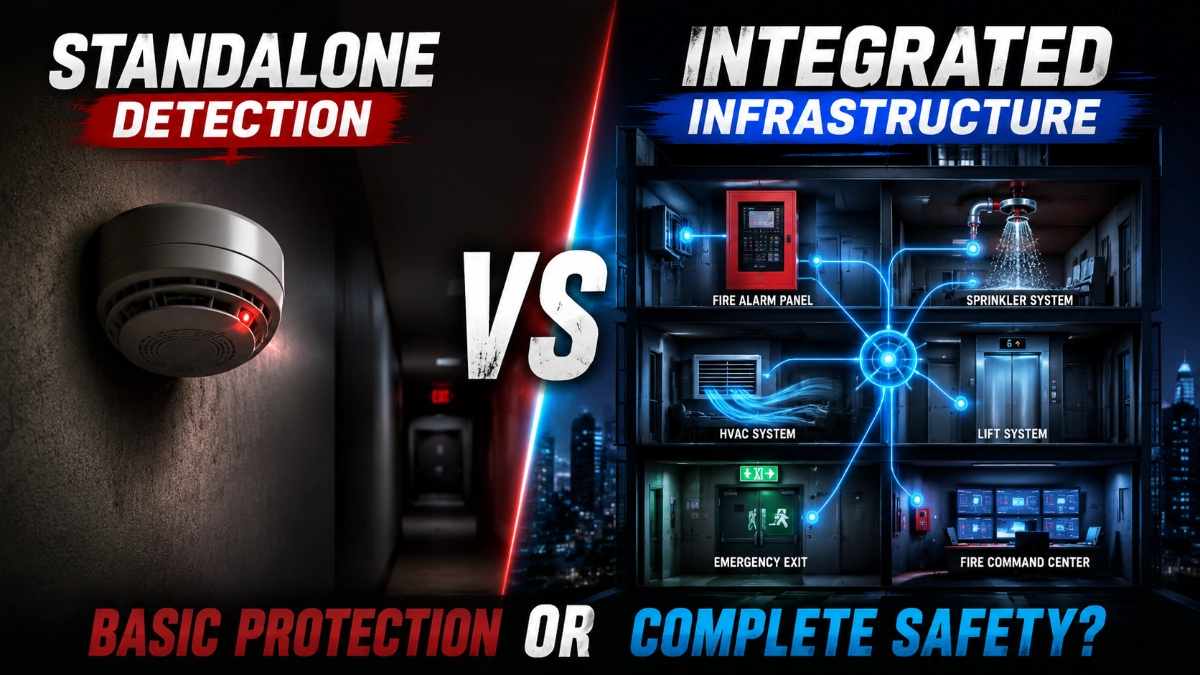
Fire safety expectations have changed significantly. Regulators, insurers, and building codes now demand more than a device that beeps when it detects smoke. Today’s standards call for coordinated detection, notification, suppression, and evacuation working as a single, intelligent system.
This guide helps facility managers, building owners, architects, and fire safety consultants understand the difference between a standalone fire detection system and an integrated fire safety infrastructure and make the right choice for their building.
What Is a Standalone Fire Detection System?
A standalone fire detection system is an independent fire alarm setup that detects smoke, heat, or gas and triggers a local alarm. It operates without connection to other building systems.
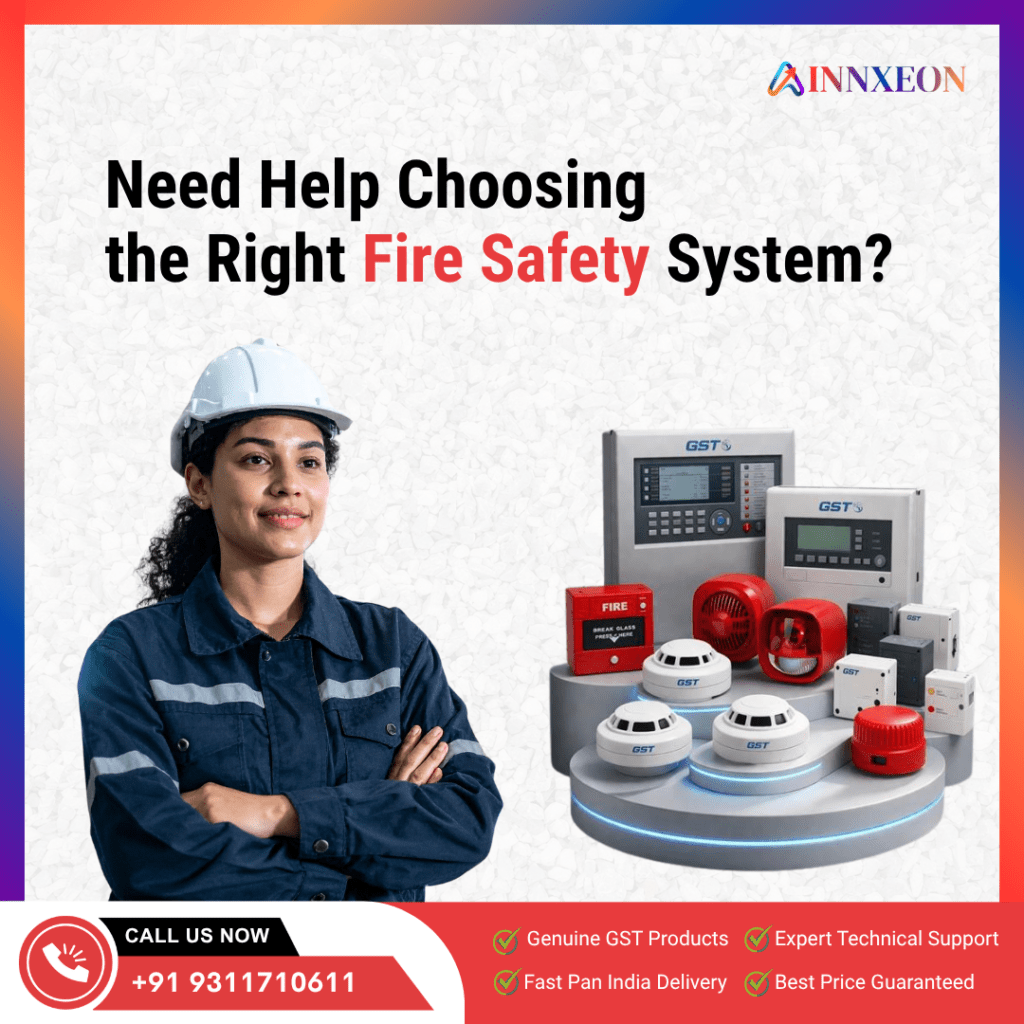
Core Components
- Smoke or heat detectors (ionisation or optical)
- A control panel (conventional or addressable)
- Sounders and visual indicators
- Manual call points
- Battery backup power supply
How It Works
When a detector senses a trigger condition, it sends a signal to the control panel. The panel activates the alarm sounders. Occupants respond manually by calling emergency services, initiating evacuation, and attempting suppression. The system does not communicate with sprinklers, lifts, HVAC, or access control.
A conventional fire alarm panel zones the building into areas. An addressable fire alarm panel identifies the exact device that triggered the alarm, making it easier to locate and respond to an incident.
Common Use Cases
- Small offices and retail stores
- Residential buildings and hostels
- Standalone warehouses with simple layouts
- Low-occupancy commercial premises
Advantages
- Lower upfront installation cost
- Simple to install and maintain
- Suitable for buildings with basic safety requirements
- Easy to understand for building managers
Limitations
- No automated response relies entirely on human action
- No integration with sprinklers, lifts, or access control
- Limited scalability for growing or multi-site facilities
- Manual monitoring only, no remote visibility
- Higher risk of delayed response in large or complex buildings
What Is Integrated Fire Safety Infrastructure?
An integrated fire safety infrastructure connects fire detection with suppression, evacuation, communication, and building management systems into a unified platform. Every component shares data and triggers coordinated actions automatically.
Connected Fire Safety Ecosystem
- Addressable detectors linked to a central fire management platform
- Automatic sprinkler and suppression system activation
- Smoke control and pressurisation systems
- Emergency lighting and exit sign activation
- Lift recall to the ground floor upon alarm
- Access control door releases for evacuation routes
- Public address and voice evacuation systems
- BMS (Building Management System) integration for HVAC shutdown
- Remote monitoring via cloud or a central alarm receiving centre
A GST fire alarm system, for example, can serve as the detection core of an integrated infrastructure with its addressable panels communicating with suppression, evacuation, and monitoring platforms to enable a fully coordinated emergency response.
Side-by-Side Comparison
| Feature | Standalone System | Integrated Infrastructure |
| Installation Cost | Lower (₹1.5L–₹5L typical) | Higher (₹8L–₹30L+ typical) |
| Scalability | Limited | Highly scalable |
| Monitoring | On-site only | Remote + centralised |
| Maintenance | Simple, periodic | Planned, system-wide |
| Detection Accuracy | Zone-level or device-level | Device-level + event analysis |
| Emergency Response | Manual | Automated + coordinated |
| Compliance Readiness | Basic compliance | Advanced NBC/NFPA/IS compliance |
| Future Expansion | Limited | Easy modular expansion |
| Remote Monitoring | Not available | Cloud or ARC monitoring |
| BMS Compatibility | None | Full integration |
How Standalone Systems Perform During Emergencies
The effectiveness of a standalone system depends heavily on human response time. In small offices with few occupants and a clear evacuation plan, standalone detection may perform adequately. A retail store in a single-storey building, for instance, can often evacuate quickly once an alarm sounds.
However, performance degrades in complex scenarios. In a multi-floor warehouse, a standalone alarm on Level 3 may not be audible in the loading bay. In a school, teachers must determine which zone triggered the alarm before deciding on evacuation routes. In a hospital, there is no mechanism to prevent lifts from moving to the alarm floor.
Standalone systems are reactive, not proactive. They detect and alert, nothing more.
How Integrated Infrastructure Improves Emergency Response
Integration eliminates the gap between detection and response. When a detector triggers an alarm, the system does not wait for a human decision.
- Sprinklers activate in the affected zone automatically
- Smoke dampers are closed to prevent the spread through HVAC ducts
- Lifts recall to the ground floor and lock out the alarm floor
- Emergency lighting switches on, and exit signs illuminate
- Access doors in evacuation routes unlock automatically
- A voice evacuation message broadcasts with zone-specific instructions
- The central monitoring team receives instant notification with device-level location
This sequence can begin within seconds of detection, far faster than any manually coordinated response. For high-occupancy buildings or facilities with vulnerable populations, this speed difference can be the difference between a controlled evacuation and a fatality.
Industry-Specific Recommendations
| Building Type | Recommended Approach | Key Reason |
| Small Office / Retail | Standalone (conventional or addressable) | Low occupancy, simple layout |
| Commercial Building (5+ floors) | Integrated infrastructure | Multi-zone coordination required |
| Manufacturing Plant | Integrated (with suppression) | High fire risk, chemical hazards |
| Warehouse / Logistics | Addressable standalone or integrated | Depends on size and occupancy |
| Hospital / Healthcare | Fully integrated | Vulnerable occupants, 24/7 operation |
| Educational Institution | Integrated with PA system | Mass occupancy, zoned evacuation |
| Hotel / Hospitality | Integrated with BMS | Sleeping occupants, room access |
| Data Centre | Integrated with clean agent suppression | Asset protection, no water damage |
Cost Analysis: Investment vs Long-Term Value
A standalone system costs less upfront. But the comparison changes when you account for total lifecycle cost.
Upfront Costs
Standalone systems for a 5,000 sq ft office may cost ₹2–4 lakhs for supply and installation. A comparable integrated system with addressable detectors, BMS integration, and remote monitoring may run ₹12–20 lakhs.
Maintenance and Expansion
Standalone systems are cheaper to maintain in isolation. But retrofitting integration later, adding suppression, BMS connections, or remote monitoring, typically costs more than building it in from the start.
Downtime and Liability
A delayed response in a poorly equipped building carries a different cost: property loss, insurance claims, regulatory penalties, and, in the worst case, loss of life. Integrated infrastructure reduces both the severity of incidents and the liability exposure that follows.
Compliance Benefits
Many insurance providers now offer premium reductions for buildings with integrated fire safety. Regulatory bodies in India increasingly reference NBC (National Building Code) and NFPA standards that favour integrated, monitored systems for commercial and public buildings.
Compliance and Fire Safety Regulations
India’s National Building Code (NBC) 2016 specifies fire detection and alarm requirements based on building occupancy, height, and use. The NBC mandates automatic detection systems for buildings above 15 metres and integrated fire suppression for high-risk occupancies.
A conventional fire alarm panel may satisfy basic detection requirements for smaller facilities. However, hospitals, hotels, educational institutions, and high-rise commercial buildings must meet more stringent standards, typically requiring addressable systems, monitored alarms, and integration with sprinkler systems and emergency communication systems.
Organisations working with a qualified GST fire alarm system distributor in India can access compliance guidance specific to their building type and state-level regulations, ensuring their system design meets both national codes and insurance requirements.
Future Trends in Fire Protection Systems
- IoT-enabled detectors that report status, battery health, and environmental readings in real time.
- Cloud-based monitoring platforms are replacing traditional alarm receiving centres.
- AI-assisted event analysis that distinguishes genuine fires from nuisance alarms using multi-sensor data.
- Predictive maintenance alerts are triggered by detector performance trends rather than scheduled intervals.
- Integrated life-safety platforms that combine fire, security, access control, and building automation in a single dashboard.
- Wireless addressable systems enabling retrofits in heritage buildings where cabling is impractical.
Buildings designed today should account for these trends. An integrated infrastructure is inherently future-ready, modular, networked, and capable of incorporating new technologies as they emerge.
Expert Buying Guide
When Standalone Systems Make Sense
- Buildings under 500 sq metres with low occupancy
- Single-storey premises with simple layouts
- Temporary structures or short-term facilities
- Budget-constrained projects with basic regulatory requirements
When Integrated Infrastructure Is Necessary
- Multi-floor commercial, industrial, or institutional buildings
- Facilities with vulnerable or sleeping occupants
- High-risk environments (chemicals, data centres, server rooms)
- Buildings subject to NBC, NFPA, or IS 2189 compliance requirements
- Any facility where a delayed evacuation carries a serious risk
Key Questions to Ask Before Implementation
- What occupancy type and headcount does this building serve?
- What are the applicable fire safety regulations for this structure?
- Does the facility require suppression, not just detection?
- Is remote or 24/7 monitored alarm reporting required?
- What is the planned life of the building and the likelihood of expansion?
Key Takeaways
| # | Takeaway |
| 1 | Standalone systems are cost-effective for simple, low-occupancy buildings but rely entirely on human response. |
| 2 | Integrated fire safety infrastructure automates detection, suppression, evacuation, and communication. |
| 3 | Integration dramatically reduces response time and human error in emergencies. |
| 4 | High-risk and high-occupancy buildings, such as hospitals, hotels, and data centres, require integrated systems. |
| 5 | The NBC 2016 and IS 2189 increasingly require addressable, integrated systems for commercial buildings. |
| 6 | Upfront cost is higher for integration, but lifecycle value and compliance benefits justify the investment. |
| 7 | Modern fire safety platforms support IoT, cloud monitoring, and AI-assisted analysis. |
Conclusion
There is no single right answer for every building. A standalone fire detection system remains a practical, code-compliant choice for small, simple facilities with limited budgets and low occupancy. For everything else, integrated fire safety infrastructure is the standard that modern buildings need to meet.
The gap between detection and response is where fires become disasters. Integrated systems close that gap with automation, coordination, and real-time monitoring that no standalone system can match.
Before specifying any fire safety solution, engage a qualified fire safety consultant or a reputable GST fire alarm system distributor in India to assess your building’s specific requirements, regulatory obligations, and risk profile. The right system is not the cheapest to install; it is the one best suited to protect occupants, assets, and operations when it matters most.
Read Also: Intelligent Fire Detection vs Traditional Fire Detection
Read Also: A Step-by-Step Fire Risk Assessment Framework for Industrial Buildings