E-commerce has transformed global logistics. Fulfilment centres now operate 24 hours a day, process millions of orders weekly and store vast inventories ranging from electronics to household goods. This scale creates a fire risk environment that conventional detection approaches were never designed to handle.
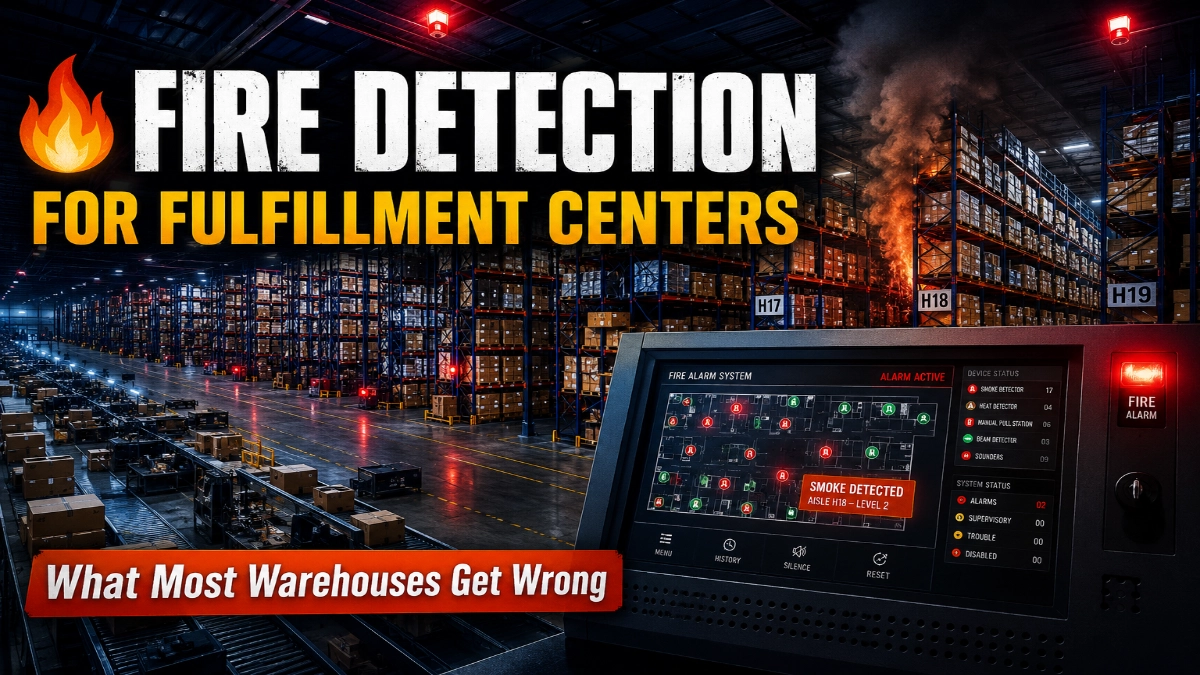
A single fire incident in a major fulfilment centre can result in inventory losses exceeding millions of dollars, prolonged operational downtime and serious risk to employee safety. Beyond the immediate damage, the reputational impact and supply chain disruption can affect a business for months. Fire detection is not a compliance checkbox; it is a fundamental operational safeguard.
This guide examines the key fire detection considerations specific to e-commerce fulfilment centres and explains how intelligent fire alarm systems can help operators protect their people, property, and business continuity.
Understanding Fire Risks in Fulfilment Centres
Modern fulfilment centres carry a combination of fire hazards that rarely exist together in other commercial environments. Understanding these risks is the starting point for any effective fire detection strategy.
High-Density Storage and Large Inventory Volumes
Fulfilment centres use vertical racking systems that can reach 12 metres or more in height, storing thousands of SKUs in proximity. This density means fire can spread rapidly through stacked goods before ground-level detection responds.
Combustible Packaging Materials
Cardboard, foam, plastic wrap, and bubble packaging are highly combustible. These materials are present in every area of a fulfilment centre in storage, on conveyor lines, at packing stations, and in dispatch areas.
Lithium-Ion Battery Hazards
Consumer electronics, power tools, and electric mobility products containing lithium-ion batteries present a specific and serious fire risk. Lithium-ion battery fires can ignite with minimal warning, burn at extremely high temperatures, and are notoriously difficult to suppress. They can also reignite hours after appearing extinguished. Any fulfilment centre storing or charging these products requires dedicated detection strategies for battery storage zones.
Automated Conveyor Systems and Electrical Equipment
High-speed conveyor belts, sortation systems, and robotic picking equipment generate friction, heat, and electrical load. Motor overheating and conveyor belt jams are known ignition sources in large warehouse environments. Charging stations for electric forklifts and AGVs add further electrical risk.
Why Traditional Fire Detection Often Falls Short
Many older fulfilment facilities were built with conventional detection systems that were adequate for the facility at the time. As operations expanded, detection infrastructure often did not keep pace.
- Large ceiling heights dilute smoke before it reaches ceiling-mounted detectors, causing significant detection delays.
- Powerful HVAC and ventilation systems disperse smoke rapidly, preventing reliable smoke concentration at any single detector point.
- Conventional zone-based systems cannot identify which specific detector has activated, slowing emergency response in large facilities.
- False alarms from dust, exhaust fumes, and forklift emissions are common in warehouse environments, leading staff to disregard alerts.
- Warehouse expansions are often not matched with proportional fire detection coverage, leaving new areas under-protected.
Key Fire Detection Considerations for Modern Fulfilment Centres
1. Facility Size and Layout
Large floor plates require careful zoning so that alarms can identify the affected area quickly. A facility covering 50,000 square metres cannot function with a single detection zone. Effective system design divides the facility into logical zones aligned with operational areas, storage, packing, dispatch, offices, and charging zones, each warranting separate detection management.
2. Ceiling Height and Detection Coverage
Detection coverage planning must account for ceiling height. Standard smoke detectors are typically rated for ceiling heights up to 9 metres. Where ceilings exceed this, beam detectors, aspirating smoke detection (ASD), or specially positioned detectors are necessary. Beam detectors project an infrared beam across the width of a space and trigger an alarm when smoke interrupts the beam, making them well-suited for wide, high-ceiling warehouses.
3. Inventory Type and Fire Load
The fire load of a space, the total amount of combustible material present, directly determines how quickly a fire can develop. A fulfilment centre storing plastic goods, foam packaging, and battery-powered electronics carries a significantly higher fire load than one storing non-combustible products. Detection sensitivity and system response speed should be calibrated to the fire load present.
4. Rack Storage Configurations
In-rack fire detection places detectors within the racking system at multiple levels. This is particularly important where rack heights prevent smoke from reaching ceiling detectors in time. In-rack detectors provide earlier warning at the source of ignition and are increasingly required by insurers for high-bay storage facilities.
5. High Airflow Environments
HVAC, cooling systems, and loading dock doors create significant airflow throughout fulfilment centres. High airflow dilutes and redirects smoke, reducing the effectiveness of point detectors. Aspirating smoke detection systems actively draw air through a sampling pipe network and test it in a central detection chamber, making them far more effective in high-airflow environments than passive detectors.
6. Battery Storage and Charging Zones
Lithium-ion battery charging areas require dedicated detection coverage with increased sensitivity. Multi-sensor detectors combining smoke, heat, and CO sensing provide more reliable early detection for battery-related fires. These zones should be treated as high-risk areas within the detection system design, with shorter alarm response times and direct linkage to suppression systems where possible.
7. Loading Docks and Dispatch Areas
Loading docks present specific challenges: they are frequently open to the outside, experience vehicle exhaust emissions, and operate with high foot and vehicle traffic. Detectors in these areas must be resilient to false alarms from diesel exhaust while remaining sensitive to actual fire conditions. Heat detectors or multi-sensor devices are often more appropriate here than standard optical smoke detectors.
8. Staff Occupancy Patterns
Fulfilment centres often operate with large workforces on rotating shifts, including periods of minimal staffing overnight. Detection systems must function reliably at all occupancy levels, with automated monitoring and alerting rather than relying on staff observation.
Addressable vs Conventional Fire Detection Systems
Choosing between an addressable and a conventional fire alarm system is one of the most consequential decisions in fulfilment centre fire protection design.
| Feature | Addressable System | Conventional System |
| Detector identification | Exact device location displayed | Zone only — no specific device |
| Fault isolation | Precise — single device identified | Zone-level only |
| Scalability | Highly scalable, loop-based | Limited; new zones require new wiring |
| Installation cost | Higher initial cost | Lower initial cost |
| Large facilities | Strongly recommended | Impractical above the basic scale |
| Maintenance efficiency | High — pinpoint faults remotely | Low — manual zone investigation required |
Addressable Fire Alarm Panels
An addressable fire alarm panel communicates individually with every detector and device on its network. Each device carries a unique address, so when it activates or develops a fault, the panel displays the exact location. In a fulfilment centre covering tens of thousands of square metres with hundreds of detectors, this capability is operationally critical.
GST fire alarm systems offer addressable fire alarm panels designed for complex, large-scale environments. These panels support multiple detection loops, allowing a single panel to manage hundreds of addressable devices across different zones and buildings within a campus facility.
Addressable Detectors
Addressable detectors communicate status back to the panel continuously, not just when they activate. This means the system can identify a detector that is drifting toward a fault condition due to dust contamination, for example, before it causes a false alarm or fails to respond. Addressable detectors also support sensitivity adjustment from the panel, allowing facilities to fine-tune detection thresholds for different operational areas.
In high-bay warehouse aisles, battery storage zones, and conveyor system areas, addressable detectors provide the precise, device-level information needed for rapid emergency response.
Conventional Fire Alarm Panels
A conventional fire alarm panel divides a building into detection zones, with multiple detectors wired per zone. When a detector activates, the panel identifies the zone but not the specific device. Conventional fire alarm panels remain suitable for smaller, single-zone facilities such as ancillary offices, guard rooms, or small standalone warehouses where the simplicity and lower cost of the technology are appropriate.
Conventional Detectors
Conventional detectors are straightforward devices suitable for environments where zone-level identification is sufficient. While conventional detectors are cost-effective for smaller applications, they are generally unsuitable as the primary detection method across a large fulfilment centre floor where exact location data is essential for a rapid and targeted emergency response.
Designing a Future-Ready Fire Detection Strategy
Risk Assessment
Every fire detection design should begin with a formal fire risk assessment that evaluates the facility layout, occupancy, inventory types, fire load, ignition sources, and existing suppression systems. This assessment should be reviewed whenever the facility changes operationally, new product categories, expanded storage areas, or changes in automation equipment all affect fire risk.
System Zoning and Integration
Zones should align with physical and operational boundaries within the facility. Detection systems should integrate with building management systems (BMS), suppression systems, access control, and emergency lighting to enable a coordinated response. GST fire alarm systems support open-protocol integration, allowing connection to third-party suppression, CCTV, and BMS platforms.
Remote Monitoring
24-hour remote monitoring through a central monitoring station ensures that alarms are responded to regardless of occupancy levels. Remote monitoring is particularly important for fulfilment centres operating overnight with reduced staffing.
Maintenance Planning
Fire detection systems in high-dust, high-traffic warehouse environments require regular maintenance. Detectors accumulate dust and contamination that can cause false alarms or reduced sensitivity. Addressable systems simplify maintenance by identifying devices that are drifting out of calibration before they fail.
Expansion Readiness
Fulfilment centres grow. A fire detection system should be specified with capacity for expansion of additional detector loops, panel capacity for new zones, and cabling infrastructure that supports future coverage without complete system replacement.
Common Mistakes Facility Managers Should Avoid
- Installing detectors at ceiling level only in high-bay racks, without in-rack detection at lower levels.
- Using standard optical smoke detectors in loading dock areas where vehicle exhaust causes repeated false alarms, leading staff to disable or ignore the system.
- Selecting a conventional system for a large facility based on initial cost savings, without accounting for the operational cost of false alarm investigation and the risk of delayed response.
- Failing to update fire detection coverage when extending the warehouse footprint or adding new operational areas.
- Not accounting for HVAC airflow patterns during system design results in detectors being placed in areas where smoke is dispersed before it reaches them.
- Neglecting battery charging areas as a high-risk zone requiring dedicated, enhanced detection.
Conclusion
E-commerce fulfilment centres are complex, high-value environments where fire incidents carry serious consequences for business continuity, employee safety, and regulatory compliance. Standard fire detection approaches designed for simpler commercial buildings are often inadequate for the scale, ceiling heights, airflow conditions, and mixed hazard profiles found in modern fulfilment operations.
Effective fire detection in these environments depends on selecting the right system architecture, placing detection at the right points in the facility, and ensuring the system can identify exact alarm and fault locations quickly. An addressable fire alarm panel paired with addressable detectors provides the precision, scalability, and monitoring capability that large fulfilment operations require. Conventional fire alarm panels and conventional detectors remain appropriate for smaller, simpler areas within the same campus.
GST fire alarm systems offer scalable, addressable solutions designed for demanding industrial and logistics environments. As fulfilment centres continue to grow in scale and complexity, investing in intelligent, future-ready fire detection is not just good practice; it is a core element of responsible facility management.
Read Also: The Growing Importance of Early Fire Detection in Industrial Operations
Read Also: The New Rules of Fire Detection and Surveillance Planning