When a logistics company scales from two warehouses to twenty, its security infrastructure rarely keeps pace. Cameras installed for a single depot don’t stretch across a regional hub. Cabling laid for thirty loading bays can’t serve three hundred. And the blind spots left behind at dock doors, sorting lines, and parking yards become exactly the spots where theft, accidents, and liability claims happen.
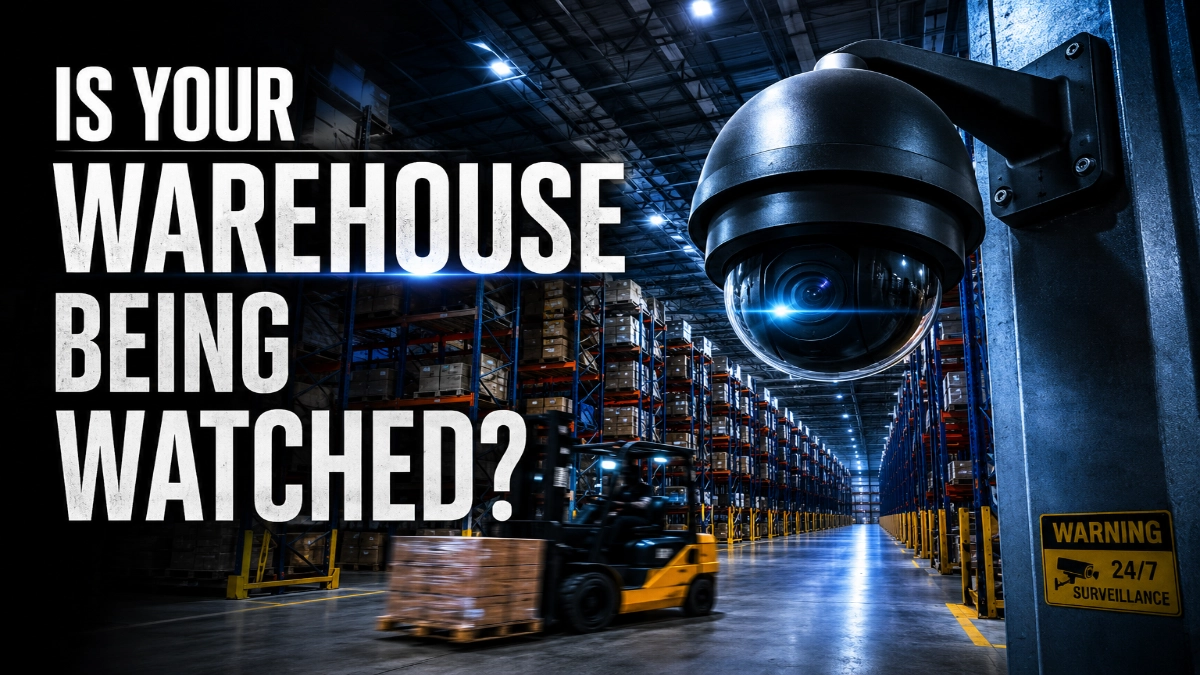
CCTV planning for logistics networks is not a one-time project. It is a living system that must grow alongside your operations. This guide lays out a practical, expert-backed framework for getting it right, whether you’re commissioning your first enterprise CCTV infrastructure or retrofitting surveillance across an existing network of sites.
Why Logistics Networks Need a Different CCTV Strategy
Most security guides treat CCTV as a static installation problem. In logistics, it’s a dynamic operational challenge.
A standard retail or office deployment covers defined zones with predictable foot traffic. A logistics facility is different. Goods move. Staff rotate. Shift patterns change. External contractors, drivers, and vendors pass through daily. Vehicles cross between outdoor yards and indoor bays. The environment itself, dust, vibration, wide temperature variance, and loading bay noise stress equipment in ways most commercial CCTV systems aren’t designed for.
Industrial CCTV systems built for logistics need to handle these realities. That means ruggedised hardware, wider fields of view, longer retention cycles (often 30 to 90 days for dispute resolution), and integration with access control, WMS platforms, and fire systems.
The business case is also different. In logistics, CCTV isn’t just a security tool; it directly protects SLA performance, reduces insurance premiums, speeds up claims investigation, and gives operations managers visibility over process efficiency. A well-designed warehouse surveillance system can flag a bottleneck at a conveyor line or verify a disputed delivery timestamp, adding value far beyond loss prevention.
Security Challenges in Expanding Logistics Operations
As logistics networks grow, so does the attack surface for security incidents. The most common risks fall into four categories:
- Cargo theft: Both opportunistic and organised. High-value goods in transit or in temporary storage are a persistent target, particularly at inbound and outbound points.
- Internal shrinkage: One of the most significant sources of inventory loss, often harder to detect without granular camera coverage at pick-and-pack stations and staff exit points.
- Vehicle and asset damage: Unreported collisions between forklifts, racking, and dock infrastructure create hidden maintenance costs and liability exposure.
- Compliance and HSE failures: Manual handling violations, PPE non-compliance, and restricted zone breaches are difficult to audit without consistent visual records.
| Real-World Scenario: A regional 3PL operator in India, expanding from 4 to 12 facilities, deployed warehouse surveillance systems at each new site but used different camera brands and no central management software. When a high-value electronics shipment went missing in transit, investigators couldn’t pull footage from three of the sites because the systems used incompatible recording formats. A standardised enterprise CCTV infrastructure, including Impact by Honeywell CCTV across all sites, would have prevented that gap and accelerated the investigation. |
Critical Areas That Must Be Covered
Before specifying camera counts or models, logistics security planners must map coverage zones. The minimum non-negotiable areas include:
- Perimeter and access gates: All vehicle entry and exit points, with licence plate recognition (LPR) capability.
- Loading and unloading bays: High-resolution cameras covering dock doors with timestamp overlays for proof-of-delivery disputes.
- Inbound and outbound staging areas: Wide-angle cameras to track goods movement and identify staging errors.
- Picking and packing lines: Overhead cameras to verify pick accuracy and detect internal shrinkage.
- High-value storage zones: Dedicated coverage with motion alerts and restricted access integration.
- Staff entrances and exits: Full body view cameras aligned with access control for reconciliation.
- Parking yards and truck waiting areas: Wide-area PTZ cameras or multi-sensor units for vehicle monitoring.
- Server rooms and control areas: Fixed cameras for physical security of the IT infrastructure.
For a mid-size warehouse of around 50,000 to 100,000 square feet, a typical enterprise deployment requires between 40 and 80 cameras, depending on layout, ceiling height, and activity density. Larger multi-level distribution centres often require 150 or more devices, with a combination of fixed, PTZ, and fisheye units.
Warehouse CCTV Planning Framework
Step-by-Step Deployment Process
- Site survey and risk assessment: Map the facility, identify blind spots, flag high-risk zones, and document lighting conditions by time of day.
- Define coverage objectives: Distinguish between surveillance (general monitoring) and evidentiary (dispute-grade) coverage zones.
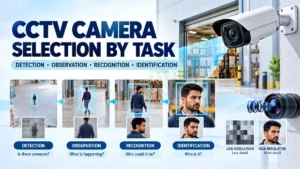
- Select camera types per zone: Fixed domes for internal aisles, IR-enabled bullet cameras for dock exteriors, LPR cameras at gates, PTZs for yards.
- Plan cabling and power infrastructure: Fibre backbone for large sites, PoE switches for flexible deployment, UPS backup for critical zones.
- Design NVR/VMS architecture: Central management with multi-site access, role-based user permissions, and redundant storage.
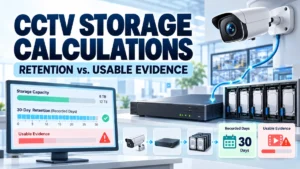
- Define retention policy: 30 days minimum for operational disputes, 90 days for compliance-sensitive or high-value storage zones.
- Test, commission, and train: Verify camera angles before sign-off; train security, operations, and HR teams on access protocols.
- Schedule maintenance cycles: Quarterly lens cleaning, firmware updates, and storage health checks.
CCTV Design for Multi-Site Logistics Networks
Single-site deployments are straightforward. Multi-site networks introduce coordination complexity that trips up even experienced operators.
The most common mistake is procuring different camera systems for each new site, driven by local pricing or contractor preference. Within two years, the business will be managing five different VMS platforms, three storage formats, and no unified dashboards. Remote investigation becomes slow. Upgrades become costly. Insurance audits become nightmares.
The answer is enterprise CCTV infrastructure standardisation. That means selecting one camera ecosystem, one VMS platform, and one storage architecture that scales from a single 10,000 sq ft facility to a network of 50 distribution centres.
Solutions such as Impact by Honeywell CCTV available through authorised Impact by Honeywell CCTV Distributors in India offer a standardised, enterprise-grade portfolio designed for exactly this challenge. The platform supports central remote monitoring, consistent image standards, and unified management across geographically distributed logistics operations.
Key considerations for multi-site CCTV design:
- Use the same camera manufacturer and VMS across all sites to enable unified management and consistent image quality.
- Deploy a cloud-hybrid architecture with local NVRs for low-latency access, cloud aggregation for cross-site visibility.
- Implement centralised health monitoring, automated alerts for camera offline events, storage failures, or network drops.
- Design for bandwidth efficiency H.265 compression, smart coding, and edge-based event detection reduce network load significantly.
Role of AI Video Analytics in Logistics Security
Modern CCTV for logistics networks increasingly integrates AI video analytics, and the operational value goes well beyond intrusion detection.
In a high-throughput warehouse, AI-powered video analytics can:
- Detect and alert on unattended packages in restricted zones.
- Identify queue build-up at dock doors or sorting stations in real time.
- Flag PPE violations, missing helmets, high-vis vests, or safety footwear automatically and without human monitoring.
- Count vehicles and correlate with booking systems to flag discrepancies.
- Identify individuals in high-value storage zones outside authorised hours.
- Trigger automatic lockdowns or intercom alerts when perimeter breaches are detected.
Supply chain security cameras equipped with onboard AI reduce the burden on control room staff while dramatically increasing detection accuracy. The result is fewer missed events, faster response times, and far more actionable video data.
When evaluating AI analytics for logistics facilities, look for solutions that can be trained on your specific operational environment rather than generic pre-trained models because a logistics dock at night looks very different from a retail car park.
Bandwidth, Storage, and Scalability Planning
One of the most overlooked elements of CCTV planning for warehouses is infrastructure capacity. Camera counts are easier to plan than storage growth, and underprovision leads to expensive retrofits.
A practical rule of thumb: a 4MP camera recording at 15fps in H.265 generates approximately 1.2TB of storage per month. A 60-camera facility needs around 70TB of storage for a 30-day retention cycle. At 90 days, that’s over 200TB, and that’s before any redundancy overhead.
Scalable CCTV logistics solutions should include:
- RAID-protected NVR storage with hot-swappable drives.
- Automated alerts when storage utilisation exceeds 80%.
- Remote health monitoring of all recording infrastructure.
- A clear upgrade path, rack space, power headroom, and network ports for adding cameras as operations expand.
Common CCTV Planning Mistakes Logistics Companies Make
- Buying cheap cameras for low-light dock environments, thermal or low-lux cameras cost more upfront, but avoid months of useless footage.
- Ignoring cable management, shoddy cabling in high-vibration loading areas, is the top cause of camera failures in logistics environments.
- No coverage of goods receiving inbound cargo disputes is among the most frequent, yet many facilities have no camera at the receiving bay.
- Using consumer-grade storage hardware, NAS drives not rated for 24/7 recording fail prematurely in enterprise deployments.
- No defined retention policy, footage recorded over before it’s needed is footage that never existed.
- Failing to train operations staff if site managers can’t access or export footage, the system fails at the critical moment.
CCTV Planning Checklist for Logistics Facilities
| Pre-Deployment Checklist: Use this checklist before signing off on any new warehouse CCTV deployment. |
- Site survey completed with lighting assessment.
- All coverage zones mapped and risk-scored.
- Camera types specified per zone (fixed, PTZ, LPR, thermal).
- Cabling route and conduit plan approved.
- Network bandwidth and switch capacity calculated.
- Storage capacity sized for a defined retention period.
- VMS is selected and compatible with all camera types.
- Multi-site management capability confirmed.
- AI analytics requirements defined.
- UPS and failover power are specified for critical zones.
- User access roles and permissions are documented.
- Staff training plan in place pre-go-live.
- Maintenance schedule and SLA agreed with the installer.
Future Trends in Logistics Surveillance
The logistics security landscape is evolving fast. Several trends are reshaping how enterprise CCTV infrastructure is designed and deployed:
- Edge AI processing: Cameras with onboard inference chips that process video locally, reducing latency and bandwidth consumption.
- 5G-connected mobile cameras: Deployable surveillance for temporary storage sites, construction logistics, and pop-up fulfilment centres.
- Digital twin integration: CCTV feeds mapped onto 3D facility models for spatial operations monitoring.
- Predictive security analytics: Systems that correlate shift patterns, cargo types, and historical incident data to predict and prevent incidents before they occur.
Questions Decision-Makers Should Ask Before Deployment
- Does the camera specification match the actual lighting conditions in each zone, including night-time and seasonal variations?
- Can the VMS be accessed remotely across all sites from a single login?
- What happens to footage if the on-site NVR fails? Is there a cloud backup layer?
- Is the installation contractor certified for the camera brand being deployed?
- How does the system scale when we add a new facility in 12 months?
- Are the AI analytics models trained for industrial and logistics environments?
- What is the process for exporting evidence-grade footage for insurance claims?
Expert Recommendations for Long-Term Growth
Treat surveillance infrastructure as a core operational system, not a facilities afterthought. Budget for it accordingly and review it on the same cycle as your WMS or TMS platforms.
Standardise early. The cost of ripping out and replacing three incompatible systems at year five far exceeds the small savings made by buying cheaper equipment, site by site.
Partner with a certified enterprise CCTV distributor who understands logistics environments. For operations across India, working with an authorised Impact by Honeywell CCTV Distributor ensures access to the right technical support, a spare parts supply chain, and upgrade roadmaps for logistics-grade deployments.
Finally, don’t treat AI analytics as a future upgrade. Design your camera infrastructure to support it from day one, the right resolution, the right placement, the right processing architecture, even if you activate the analytics layer later. Retrofitting cameras to support AI is far more expensive than specifying correctly upfront.
Key Takeaways
| Summary for Decision-Makers |
- Logistics CCTV planning is an operational system, not a one-time security project.
- Multi-site networks require standardised infrastructure: one camera ecosystem, one VMS, one storage architecture.
- AI video analytics deliver operational value beyond security: process efficiency, PPE compliance, and dispute resolution.
- Storage and bandwidth planning are as critical as camera specifications.
- The most expensive CCTV mistake is buying cheap and retrofitting expensive.
- Work with enterprise-grade partners who specialise in logistics environments.
Conclusion
Fast-growing logistics networks face a security infrastructure gap that compounds with every new site added. The companies that close that gap early with standardised, scalable, AI-ready CCTV logistics solutions gain measurable operational advantages: faster dispute resolution, lower insurance costs, better compliance records, and real-time visibility across their entire supply chain.
The technology to do this is available now. The challenge is planning it correctly from the start. Use the frameworks, checklists, and recommendations in this guide as your starting point and ensure every deployment decision is built for the network you’re going to be, not just the one you are today.
Read Also: What Makes a Surveillance System Enterprise-Ready?
Read Also: Why Security Consultants Recommend Impact by Honeywell