From Tape to Intelligence: How Surveillance Became a Strategic Business Tool
Introduction: Why CCTV Technology Matters More Than Ever
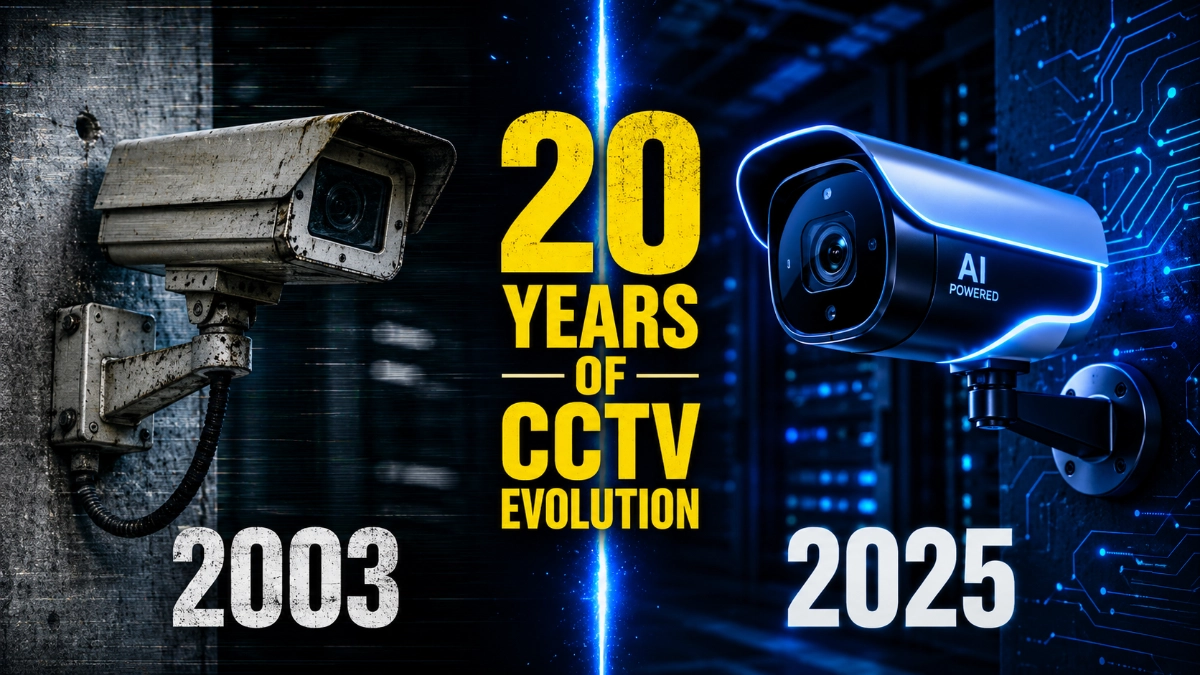
Twenty years ago, a CCTV system meant grainy footage stored on magnetic tape, reviewed only after an incident occurred. Today, surveillance systems are intelligent platforms that detect threats in real time, integrate with building automation, and generate actionable business intelligence. This transformation has reshaped how security professionals design deployments, how facility managers operate buildings, and how businesses protect assets and people.
Understanding this evolution is essential for anyone planning a surveillance upgrade, evaluating vendors, or advising clients on security infrastructure. This article traces that journey from analogue DVRs to AI-powered edge cameras and highlights what the next wave of innovation holds.
20-Year CCTV Technology Timeline
| Period | Key Development | Impact |
| 2003–2006 | DVR replaces VHS; coaxial infrastructure is dominant | Extended storage, basic remote playback |
| 2006–2009 | IP cameras emerge; PoE networking is adopted | Network-based surveillance, scalable deployments |
| 2009–2012 | HD CCTV (720p/1080p) becomes mainstream | Improved forensic quality, wider coverage angles |
| 2012–2015 | VMS platforms standardise multi-site management | Centralised monitoring, multi-vendor compatibility |
| 2015–2017 | 4K ultra-HD cameras and video analytics introduced | Facial recognition, LPR, behavioural detection |
| 2017–2019 | Cloud-based CCTV and VSaaS gain traction | Remote access, off-site storage, reduced CapEx |
| 2019–2021 | AI and edge computing are integrated into cameras | Real-time threat detection, reduced bandwidth load |
| 2021–2024 | Generative AI, predictive analytics, IoT convergence | Proactive security, smart building integration |
The Early 2000s: The Analogue Era
In the early 2000s, CCTV meant analogue cameras connected via coaxial cable to a Digital Video Recorder (DVR). This was a significant leap from VHS tapes, but the limitations were substantial. Resolution rarely exceeded D1 quality (720×480 pixels), night vision was poor, and storage was measured in days, not weeks.
Key characteristics of this era:
- DVRs replaced tape but still required physical media management.
- Coaxial cable runs are limited in scalability and have increased installation costs.
- No remote access footage review required on-site presence.
- Motion-triggered recording was primitive, generating high false-alarm rates.
Despite these limits, DVR-based systems established the habit of continuous recording, a foundation that every subsequent generation has built upon.
The IP Camera Revolution (2006–2012)
The shift from analogue to IP (Internet Protocol) cameras was the single most transformative event in surveillance history. IP cameras transmitted video as digital data over standard Ethernet networks, enabling integration with IT infrastructure and unlocking capabilities that were simply impossible with coaxial systems.
What Changed with IP Surveillance
- Resolution jumped dramatically. Early IP cameras offered 1–3 megapixels, far exceeding analogue D1.
- Power over Ethernet (PoE) eliminated dedicated power runs, reducing installation costs.
- Network Video Recorders (NVRs) replaced DVRs, enabling centralised management.
- Remote viewing via web browsers and early mobile apps became standard.
- Multi-site management from a single interface became practical.
The scalability advantage was decisive. Adding cameras to an IP system required only a network port and a license, not new cable infrastructure. This made large enterprise and multi-site deployments economically viable for the first time.
The HD Revolution: Seeing Clearly for the First Time
Between 2009 and 2015, high-definition surveillance became mainstream. HD (720p), Full HD (1080p), and eventually 4K cameras transformed what investigators and operators could actually see on screen.
The forensic impact was immediate. License plates are readable at 30 metres. Facial recognition possible without zooming to a single pixel. A single wide-angle 4K camera could replace three or four standard-definition units, reducing hardware costs while improving coverage density.
Wide dynamic range (WDR) technology addressed the perennial problem that backlighting cameras could now capture clear images in scenes with simultaneous bright sunlight and deep shadow. For retail entrances, parking structures, and building lobbies, this was a game-changer.
The Rise of Intelligent Video Analytics
Video analytics transformed surveillance from a passive recording tool into an active detection system. Early analytics focused on motion detection, rudimentary algorithms that triggered recording when pixels changed. Modern analytics operate at a completely different level of sophistication.
Core Analytics Capabilities in 2024
- Object classification: Distinguishing people, vehicles, and animals with high accuracy.
- Facial recognition: Identifying known individuals in real time against watch lists.
- License plate recognition (LPR): Capturing vehicle data for access control and investigation.
- Behavioural analytics: Detecting loitering, perimeter breaches, crowd density changes.
- Heatmapping: Visualising foot traffic patterns for retail and facility optimisation.
Analytics moved surveillance beyond security into operational intelligence. A retailer can now measure dwell time at product displays. A transit authority can monitor platform crowding and dispatch staff proactively. A hospital can track patient flow and identify bottlenecks all from the same camera infrastructure.
Cloud-Based CCTV and Video Surveillance as a Service (VSaaS)
Cloud connectivity changed the economics of surveillance fundamentally. Video Surveillance as a Service (VSaaS) models allow businesses to pay monthly subscription fees rather than large upfront capital expenditures on NVR hardware and on-premise servers.
Practical advantages of cloud-based CCTV:
- Remote access from any device, anywhere, with appropriate credentials.
- Automatic firmware updates reduce vulnerability exposure.
- Scalable storage retains 30, 60, or 90 days of footage without hardware upgrades.
- Disaster recovery: footage survives on-site incidents like fire or theft.
- Reduced on-premise IT footprint for smaller organisations.
However, cloud surveillance introduces network dependency and cybersecurity considerations that analog and early IP systems never faced. Bandwidth planning, encryption standards, and data sovereignty regulations require careful attention during system design.
AI-Powered Surveillance and Edge Computing
The integration of artificial intelligence, particularly deep learning and computer vision, marks the current frontier of CCTV evolution. AI-powered cameras do not merely record: they interpret, classify, and act.
Edge AI is particularly significant. Rather than sending raw video to a central server for analysis, edge cameras process video locally on the camera’s own processor. This approach delivers three critical advantages: reduced bandwidth consumption, faster real-time response, and continued operation if network connectivity is interrupted.
What AI Surveillance Systems Can Do Today
- Detect abandoned objects in public spaces and trigger alerts within seconds.
- Identify weapons or aggressive postures in crowd scenes.
- Count occupancy in real time for compliance with capacity limits.
- Recognise emotional distress or unusual movement patterns.
- Correlate events across multiple cameras autonomously.
Modern enterprise solutions like Impact by Honeywell CCTV exemplify this shift, combining high-resolution optics with onboard AI analytics and seamless integration into broader security ecosystems, delivering the kind of comprehensive situational awareness that was previously available only to government and critical infrastructure operators.
Cybersecurity and Privacy: The New Battleground
Every networked camera is a potential entry point into an organisation’s IT infrastructure. The 2016 Mirai botnet attack, which recruited hundreds of thousands of compromised IP cameras to execute a massive distributed denial-of-service attack, demonstrated that surveillance devices can be weaponised if left unsecured.
Essential Cybersecurity Practices for Modern Surveillance
- Change all default manufacturer passwords immediately upon installation.
- Segment CCTV networks using dedicated VLANs isolated from primary business networks.
- Apply firmware updates promptly, and treat cameras like any other networked endpoint.
- Use TLS/SSL encryption for all video streams and management interfaces.
- Conduct regular penetration testing of surveillance infrastructure.
Privacy compliance adds another layer of complexity. GDPR in Europe, India’s Digital Personal Data Protection Act, and various sector-specific regulations impose obligations on how footage is stored, accessed, and retained. Organisations must establish clear data governance policies and ensure their surveillance vendors support compliance requirements.
Integration with Smart Buildings and IoT
Modern surveillance does not operate in isolation. CCTV systems now integrate with access control, fire safety, HVAC, building management systems (BMS), and IoT sensor networks to create unified security and operational platforms.
A practical example: when an access control system detects an unauthorised badge attempt, it can automatically direct the nearest PTZ camera to focus on that entry point, trigger a recording clip, and send an alert to security personnel, all without human intervention. This level of integration compresses response times and reduces the cognitive load on security operators monitoring multiple screens.
Smart city applications extend this logic to urban infrastructure. Traffic cameras analyse vehicle flow and trigger signal adjustments. Public safety cameras feed data to emergency response centres. Retailers in managed shopping centres share anonymised foot traffic data with property managers for leasing decisions.
For organisations evaluating vendors capable of delivering these integrated solutions in the Indian market, working with an authorised Impact by Honeywell CCTV Distributor in India ensures access to certified products, local technical support, and compliance with relevant standards.
Then vs. Now: CCTV Technology Comparison
| Aspect | Then (2003–2008) | Now (2020–2025) |
| Camera Type | Analog CCD cameras | IP megapixel / AI-edge cameras |
| Resolution | D1 (720×480) | 4K UHD (3840×2160) and beyond |
| Storage | DVR with limited HDD | NVR, cloud, and hybrid storage |
| Analytics | None (passive recording) | AI: facial ID, crowd detection, LPR |
| Access | On-site only | Mobile app, web, anywhere globally |
| Integration | Standalone systems | IoT, access control, fire, BMS |
| Cybersecurity | Minimal (closed-loop) | Encrypted, zero-trust architecture |
| Cost Model | High CapEx, physical infra | Flexible OpEx, VSaaS subscriptions |
Emerging Trends Shaping the Future of Surveillance
Generative AI and Predictive Security
Generative AI models are beginning to move beyond reactive detection toward predictive analysis. By learning patterns from weeks or months of historical footage, systems can flag anomalies that precede incidents, unusual access patterns, behavioural changes in known individuals, or environmental indicators associated with prior events.
Autonomous Monitoring
PTZ cameras with AI tracking can autonomously follow subjects of interest across overlapping camera views without operator direction. In large facilities like airports, stadiums, or logistics centres, this dramatically extends effective coverage without increasing staffing costs.
Sustainability in Surveillance
Energy consumption is entering the procurement conversation. Solar-powered edge cameras with local storage are viable for remote sites. Compression improvements (H.265, H.266) reduce bandwidth and storage requirements by up to 50% compared to older codecs, lowering both operational costs and carbon footprint.
Thermal and Multi-Spectral Imaging
Thermal cameras detect heat signatures regardless of lighting conditions and are increasingly affordable. Combined with visible-light sensors in bi-spectral cameras, they deliver reliable perimeter detection in complete darkness, through smoke, and in adverse weather environments where standard cameras fail.
Key Takeaways
- CCTV has evolved from passive analogue recording to active AI-powered intelligence platforms over 20 years.
- IP cameras unlocked scalability, remote access, and integration that analogue systems could not provide.
- HD and 4K resolution transformed forensic capability and reduced camera count requirements.
- AI analytics expanded surveillance value into operations, retail, and public safety beyond security alone.
- Cloud and edge computing together enable flexible, resilient, and scalable architectures.
- Cybersecurity is now a core design requirement, not an afterthought, for any surveillance deployment.
- IoT and smart building integration make camera nodes in a broader operational intelligence network.
- Future systems will be increasingly predictive, autonomous, and energy-efficient.
Expert Recommendations for Businesses Planning Upgrades
For organisations evaluating or upgrading surveillance infrastructure, these principles reflect current best practices:
- Audit existing infrastructure before selecting technology: Identify coaxial vs. IP cabling, NVR capacity, and network bandwidth availability
- Prioritise analytics capability alongside resolution: A 2MP camera with excellent AI analytics often outperforms a 4K camera without them.
- Plan for cybersecurity from day one: Network segmentation, strong credentials, and updated policies should be in the project specification.
- Consider total cost of ownership, not just purchase price: cloud and VSaaS models shift costs from CapEx to OpEx but offer long-term flexibility
- Verify vendor compliance with local data protection regulations before committing to a platform.
- Engage certified integrators with manufacturer accreditation to ensure proper configuration and warranty support.
Conclusion
The two-decade journey of CCTV technology reflects a broader trend across all infrastructure: the convergence of physical and digital systems into intelligent, connected platforms. What began as a simple tool for reviewing incidents after the fact has become a proactive system capable of preventing incidents, optimising operations, and delivering measurable business value.
For security professionals, system integrators, and business decision-makers, the challenge is no longer access to technology; it is making informed choices about which capabilities to deploy, how to secure them, and how to extract maximum value from the investment. The organisations that approach this strategically will be significantly better protected and more operationally efficient than those treating surveillance as a compliance checkbox.
The next chapter, driven by generative AI, predictive analytics, and deeper IoT integration, promises systems that do not merely watch but understand. And in security, understanding is everything.
Read Also: Industrial CCTV vs Commercial CCTV: Know the Difference
Read Also: The Biggest Misconceptions About Industrial CCTV Systems