Walk into the control room of any large hospital, airport, or manufacturing plant, and you’ll notice something: fire safety isn’t managed from one panel anymore. It’s managed from a network.
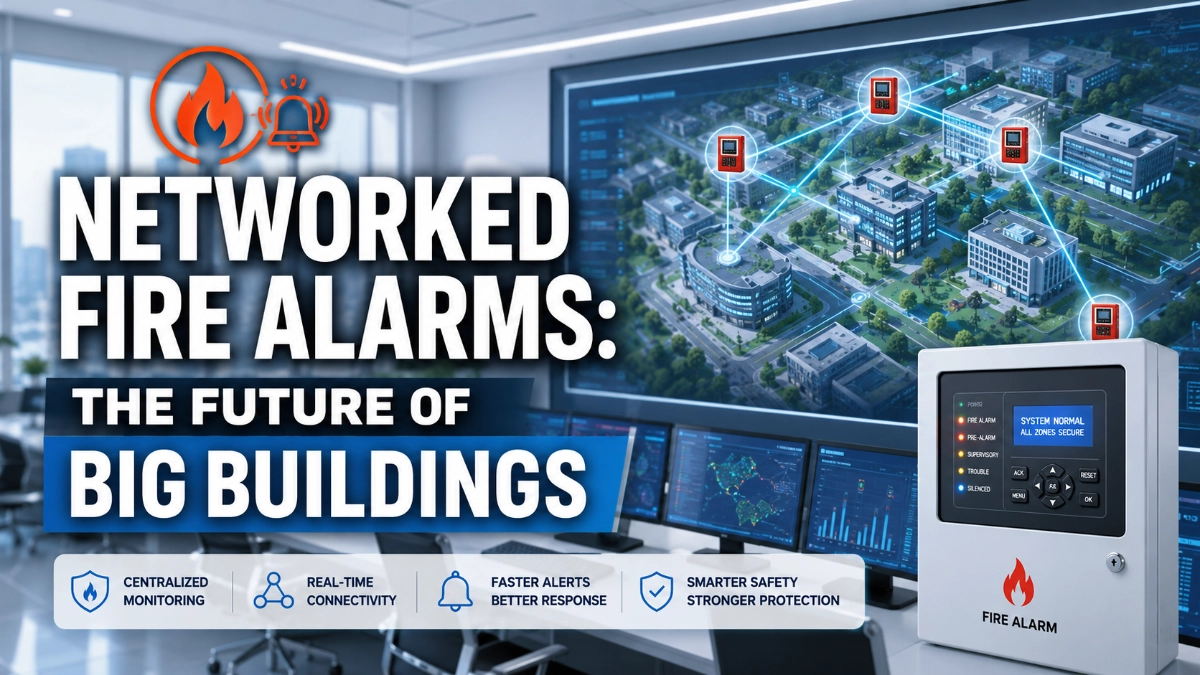
That shift didn’t happen overnight, and it didn’t happen because of marketing. It happened because standalone fire alarm panels run out of road once a facility grows past a certain size. I’ve walked enough plant rooms and reviewed enough as-built drawings to say this with confidence: the buildings that struggle most during fire drills and real incidents are almost always the ones still running isolated, unconnected panels across a sprawling footprint.
This article breaks down why networked fire alarm systems have become the practical standard for large facilities, how the technology actually works, where it delivers the most value, and what to consider before specifying one for your next project.
Why Traditional Fire Alarm Systems Struggle in Large Facilities
A standalone fire alarm panel is designed to protect a single building, or sometimes just a single zone within a building. That’s fine for a single-story retail unit or a small office. It becomes a liability once you’re dealing with a 40-acre hospital campus or a 12-story mixed-use tower.
Here’s what typically goes wrong:
- Blind spots between buildings: A standalone panel in Block A has no idea what’s happening in Block B. If a fire starts in one wing, security and facility staff in another wing may not find out until someone physically radios them.
- Fragmented monitoring: Facility teams end up walking between panels to check status, silence alarms, or review event logs. In an emergency, those extra minutes matter.
- Inconsistent maintenance records: Each panel keeps its own history. When a fire consultant needs a facility-wide compliance report, someone has to manually stitch together data from a dozen separate systems.
- Delayed emergency response coordination: Fire brigades responding to a large campus need a single, unified point of information, not five different panels showing five different pictures.
- Higher long-term cost of ownership: Every standalone panel needs its own servicing schedule, its own spare parts inventory, and its own technician visit. That adds up fast across a large site.
These aren’t hypothetical problems. They’re the recurring findings in post-incident reviews and fire audits across multi-building facilities worldwide.
What Is a Networked Fire Alarm System?
Definition: A networked fire alarm system connects multiple addressable fire alarm panels across one building or several buildings, into a single, unified communication network. Every panel can share alarm signals, fault conditions, and status data with every other panel in real time, and the entire network can be monitored from one or more central workstations.
Think of it as the difference between a set of walkie-talkies that only work within one room, and a shared radio channel that reaches the entire site.
In a networked setup, panels aren’t just detecting fire; they’re talking to each other. A signal from a smoke detector on the 9th floor of Tower B can trigger a coordinated response across Tower A’s evacuation system, the site’s central control room, and even an off-site monitoring station, all within seconds.
This is fundamentally different from an addressable fire alarm panel working in isolation. Addressability tells you exactly which device triggered an alarm. Networking tells every other panel on the site about it, instantly.
How Networked Fire Alarm Systems Work
At a technical level, a networked fire alarm system relies on three things working together: communication protocols, network topology, and centralised software.
1. Communication backbone: Panels are linked using dedicated fire-rated network cabling, fibre optics, or in some modern installations, secure IP-based connections. Fibre is increasingly preferred for large campuses because it resists electromagnetic interference and supports longer distances between buildings.
2. Network topology: Most large installations use a loop or ring topology rather than a simple daisy chain. This means if one section of cable is damaged, the network can reroute communication the other way around the loop, so no panel gets isolated.
3. Centralised software and graphics: A network of panels usually feeds into graphical mapping software at a central workstation. Operators see a live floor-plan view of the entire site, with alarm points highlighted exactly where they occur, not just a zone number on a small LCD screen.
4. Peer-to-peer or master-slave logic: Some networks operate on a peer-to-peer basis, where every panel has equal authority and can trigger cause-and-effect actions across the site. Others use a master-slave configuration, where one panel oversees the network. Peer-to-peer designs are generally more resilient, since there’s no single point of failure.
Core Components of a Networked Architecture
A typical networked fire alarm architecture for a large facility includes:
- Addressable Fire Alarm Panels at each building or major zone, each capable of standalone operation if disconnected from the network
- Network interface cards or modules that allow panels to exchange data
- Fire-rated network cabling or fibre optic backbone connecting all panels
- Addressable Detectors (smoke, heat, multi-sensor) reporting individual device IDs back to their local panel
- Graphic annunciator or command centre software giving a facility-wide overview
- Voice evacuation systems, where applicable, integrated into the same network for zone-specific announcements
- Remote monitoring gateways for connection to a central station or fire brigade interface
Each panel remains fully functional on its own; this is a critical design principle. Networking adds coordination; it should never create a single point of total failure.
Major Benefits of Networked Fire Alarm Systems
1. Facility-wide visibility
Security and facility management teams get one live picture of the entire site, instead of piecing together information from multiple panels.
2. Faster, coordinated response
An alarm in one building can automatically trigger appropriate actions elsewhere, closing fire doors, shutting down HVAC systems, or activating evacuation messaging in adjacent structures.
3. Centralised maintenance and diagnostics
Technicians can review fault history, battery status, and device health for the entire campus from one workstation, cutting down on physical site walks.
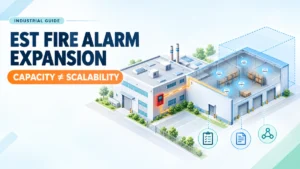
4. Scalability
Adding a new building or wing typically means adding another panel to the existing network loop, not redesigning the whole fire safety infrastructure.
5. Better compliance reporting
Facility owners can generate a single, consolidated event log and maintenance record for audits, insurance reviews, and code inspections.
6. Reduced false alarm disruption
Networked systems with intelligent addressable detection can apply site-wide alarm verification logic, reducing unnecessary full-building evacuations triggered by isolated nuisance alarms.
7. Long-term cost efficiency
While the upfront investment is higher, the reduced maintenance overhead, fewer redundant components, and lower long-term service costs generally offset it within a few years for large sites.
Expert Tip: When specifying a networked system, always confirm each panel can operate independently if network communication is lost. This “fail-safe” design is what separates a well-engineered network from a fragile one.
Standalone vs Networked Fire Alarm Systems (Comparison Table)
| Factor | Standalone Fire Alarm System | Networked Fire Alarm System |
|---|---|---|
| Coverage | Single building or zone | Multiple buildings or entire campus |
| Visibility | Local panel only | Centralized, site-wide monitoring |
| Scalability | Limited; often requires new standalone panels | High; new panels join existing network loop |
| Maintenance | Individual schedules per panel | Centralised diagnostics and reporting |
| Reliability | Single point of monitoring; no cross-building failover | Loop topology allows rerouting if a cable segment fails |
| Cost (upfront) | Lower per building | Higher initial investment |
| Cost (long-term) | Higher cumulative servicing cost across many panels | Lower cumulative cost at scale |
| Emergency Response | Manual coordination between buildings | Automated cross-building cause-and-effect |
| Ideal Applications | Small offices, single retail units, standalone warehouses | Hospitals, campuses, airports, malls, industrial plants |
Quick Summary: Standalone systems suit small, single-structure buildings. Networked systems become the practical and often code-driven choice once a facility spans multiple buildings, floors, or high-occupancy zones.
Industries That Benefit the Most
- Hospitals: Patient safety depends on precise, zone-specific alarm response. A networked system lets staff know exactly which ward or wing needs evacuation, without disrupting unaffected patient areas unnecessarily.
- Airports: Terminals, control towers, cargo zones, and maintenance hangars often sit under one operational umbrella but function as separate structures. Networking ties them into one command view for airport fire and safety officers.
- Universities: Campuses with dozens of buildings, dormitories, labs, lecture halls, and libraries benefit enormously from centralised monitoring, especially during off-hours when security staff are limited.
- Manufacturing and Industrial Plants: Process areas often have specific hazard zones. A networked system allows targeted shutdown sequences (like isolating gas lines or stopping conveyor systems) tied to the exact location of an alarm.
- Shopping Malls: With dozens of tenant spaces, all needing independent operation but centralised oversight, networked systems let mall management maintain safety without micromanaging every retailer’s fit-out.
- Data Centres: Fire risk here is tied closely to equipment value and uptime. Networked systems integrated with early-warning aspirating smoke detection and suppression triggers protect both life safety and business continuity.
- Hotels: Guest safety across multiple floors and wings requires fast, floor-specific evacuation messaging, something a networked voice evacuation system handles far better than isolated panels.
- High-Rise Buildings: Vertical evacuation strategy depends on knowing exactly which floor is affected and coordinating stairwell pressurisation, elevator recall, and phased evacuation, all network-dependent functions.
Real-World Example
Consider a mid-sized university campus with 14 buildings: dormitories, a library, science labs, an administration block, and a sports complex.
Before networking, each building ran its own conventional or standalone addressable panel. Campus security had to physically visit whichever building triggered an alarm just to confirm what was happening, because the local panel display gave no useful information remotely.
During a small kitchen fire in one dormitory, it took nearly six minutes for security to confirm the alarm’s location and initiate the correct evacuation zone, since two other unrelated fault signals were also active elsewhere on campus that same evening.
After a network upgrade connecting all 14 buildings via a fibre optic backbone to a single graphic workstation in the security office, the same type of event was diagnosed within seconds. Staff could see exactly which detector activated, in which room, on which floor, and could initiate the correct localised response immediately, without evacuating unaffected buildings.
This is the practical, unglamorous value of networking: not flashy technology, just faster and more accurate decisions when it matters.
Common Challenges and How to Overcome Them
Challenge: High upfront cost: Networked systems cost more initially than a set of standalone panels. The solution is to plan the network architecture at the design stage, not retrofit it later; retrofitting is far more expensive than building it in from day one.
Challenge: Cabling and infrastructure complexity: Running fire-rated network cable or fibre between buildings requires careful route planning, especially on existing campuses. Engaging a system integrator early, during civil works planning, avoids costly rework.
Challenge: Integration with legacy panels: Older conventional fire alarm panels often can’t join a modern network directly. In these cases, a phased upgrade replacing conventional zones with addressable fire alarm panels first is usually more practical than a single “rip and replace” project.
Challenge: Staff training: A networked system is only as good as the people operating it. Facility teams need training on the graphic interface, not just the individual panels, to get full value from the investment.
Challenge: Cybersecurity of IP-based networks: As more fire alarm networks move toward IP connectivity, they inherit some of the same cybersecurity considerations as any other building network. Segmenting the fire alarm network from general IT infrastructure is a growing best practice.
Did You Know? Many large facility fire audits flag “inconsistent panel-to-panel communication” as a top finding not because the technology failed, but because the network wasn’t properly commissioned or tested as a whole system.
Future Technologies
Networked fire alarm systems are evolving quickly. A few developments worth watching:
- Cloud-connected monitoring, allowing facility managers to check system status remotely from a phone or laptop, not just an on-site workstation
- AI-assisted fault prediction, analysing detector sensitivity trends over time to flag devices likely to fail before they actually do
- Integration with building management systems (BMS), so fire alarm data feeds directly into HVAC, access control, and elevator systems for a unified emergency response
- Wireless mesh networking for retrofit projects where running new cable is impractical
- Digital twin modelling, where a live 3D model of the facility reflects real-time alarm and fault status for more intuitive operator response
None of these replaces sound engineering fundamentals. They enhance a well-designed network; they don’t substitute for one.
How GST Fire Alarm Systems Support Networked Installations
Among the addressable and networked fire alarm platforms available today, GST Fire Alarm System solutions are commonly specified in large commercial and industrial projects across India and Asia, largely because their addressable panels are designed with network expansion in mind from the outset.
GST’s addressable panel architecture supports multi-loop configurations that can be linked into a wider network as a facility grows, which matters for phased construction projects where not every building comes online at once. For facility owners working with a GST Fire Alarm System Distributor in India, this typically means the initial installation in Phase 1 of a project can be extended cleanly when Phase 2 or Phase 3 construction begins, without re-engineering the existing panels.
That said, GST is one of several credible platforms in this space. The right choice for any project depends on site-specific factors: occupancy type, code jurisdiction, integration requirements, and long-term maintenance support from the local distributor network.
Expert Recommendations Before Choosing a System
Before specifying a networked fire alarm system, work through this decision framework:
- Map the facility’s growth plan: Will more buildings or floors be added in the next 5–10 years? If yes, design the network with spare capacity now.
- Confirm local fire code requirements: Some jurisdictions specify minimum requirements for multi-building fire alarm coordination; check with your local fire authority before finalising design.
- Choose loop or ring topology over daisy chain: wherever budget allows, for better fault tolerance.
- Verify standalone fail-safe operation for every panel on the network.
- Plan cabling routes during civil design, not after construction.
- Select a platform with local distributor and service support, since long-term maintenance quality often matters more than the panel brand itself.
- Budget for staff training, not just hardware and installation.
- Request a full network commissioning test, not just individual panel testing, before sign-off.
Key Takeaway: The best networked fire alarm system isn’t necessarily the one with the most features, it’s the one engineered to match your facility’s actual growth, occupancy risk, and long-term maintenance capacity.
Final Thoughts
Networked fire alarm systems aren’t a trend; they’re a practical response to how large facilities actually operate today. Hospitals don’t run as single buildings anymore. Campuses keep expanding. Industrial sites keep adding process areas. Standalone panels were never designed for that scale of complexity, and stretching them past their limits creates real safety gaps.
If you manage or design fire safety for a large or growing facility, the question isn’t really whether to network your fire alarm system; it’s how to plan that network so it scales cleanly as the facility grows.
Start with a clear-eyed assessment of your facility’s current layout and future expansion plans. Confirm your local code requirements. Choose addressable panels built with network expansion in mind; platforms like GST Fire Alarm System are one credible option among several worth evaluating, particularly where a strong local distributor network can support long-term maintenance. Then invest properly in commissioning, testing, and staff training, because a networked system is only as strong as how well it’s set up and understood by the people running it day to day.
Fire safety engineering has always been about reducing uncertainty when it matters most. Networked systems don’t eliminate that uncertainty, but they give facility teams something standalone panels never could: a complete, real-time picture of the entire site, right when they need it.
Read Also: How Fire Alarm Panels Coordinate Complex Emergency Responses
Read Also: The Five Layers of a Future-Ready Fire Alarm System