A fire alarm panel installed in 2010 will still power on today. It will still sound a bell when smoke reaches a detector. But ask it to send an alert to a facility manager’s phone, log a fault trend before it becomes a failure, or integrate with a building management system, and it simply cannot. That gap between “functioning” and “future-ready” is where most fire safety risk quietly accumulates.
This is the core problem facing engineers, consultants, and facility owners today. Fire alarm systems are not failing because they stop detecting smoke. They are failing because they were never designed to evolve. Buildings change tenants, floor plans, occupancy loads, and technology stacks every few years. A fire alarm system that cannot adapt becomes a liability long before it becomes non-functional.
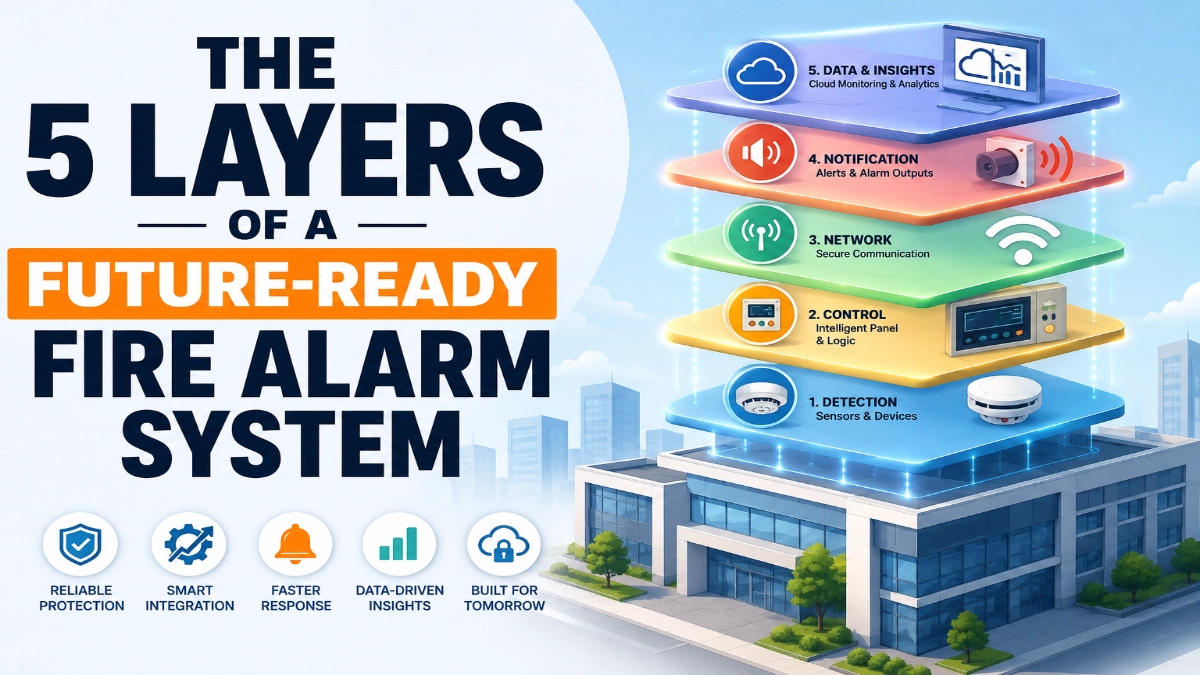
This article breaks down the five architectural layers that define a genuinely future-ready fire alarm system, why each layer matters from an engineering standpoint, and how to avoid the mistakes that turn a modernisation project into a compliance headache.
Table of Contents
- Why Fire Alarm Systems Need to Evolve
- Layer 1: Reliable Detection Layer
- Layer 2: Intelligent Control & Decision Layer
- Layer 3: Network Communication Layer
- Layer 4: Notification & Emergency Response Layer
- Layer 5: Data, Monitoring & Future Expansion Layer
- Comparison Table: Traditional vs Future-Ready Fire Alarm Systems
- Common Upgrade Mistakes
- Emerging Technologies
- Frequently Asked Questions
- Expert Conclusion
Why Fire Alarm Systems Need to Evolve
What is a future-ready fire alarm system? A future-ready fire alarm system is a layered architecture of detection, control, communication, notification and data designed to scale, integrate with digital infrastructure, and remain serviceable as buildings and regulations change, rather than a fixed installation built only to meet a single code checklist.
Traditional systems were engineered around one assumption: that a building’s risk profile stays static. In reality, occupancy patterns shift, floor layouts get reconfigured, new equipment gets added, and cybersecurity expectations for connected buildings keep rising. Conventional fire alarm panels, wired point-by-point with no addressability, cannot absorb these changes without a costly rip-and-replace.
Engineering Note: Under standards like NFPA 72 and EN 54, compliance is a minimum floor, not a design ceiling. A system can be fully code-compliant on installation day and still be operationally obsolete within five years if it lacks scalability.
Why are layered fire alarm architectures important? Layered design isolates functions: detection, decision-making, communication, notification and data so that each layer can be upgraded, expanded, or repaired independently. This reduces downtime, extends system lifespan and lowers the total cost of ownership compared to monolithic, single-purpose panels.
Layer 1: Reliable Detection Layer
Purpose: This is the sensory layer of the system, the layer responsible for identifying a fire condition accurately, quickly, and with minimal false alarms.
Components involved
- Addressable smoke, heat, and multi-criteria detectors
- Conventional detectors (for smaller zones or legacy retrofits)
- Beam detectors for atriums and warehouses
- Aspirating smoke detection (ASD) for cleanrooms and data centres
- Flame detectors for high-hazard industrial zones
Real-world example: In a multi-tenant commercial tower, an addressable detector network can pinpoint the exact device that triggered an alarm down to the floor and room instead of just the zone, cutting response time significantly during an actual event.
Design considerations
- Match detector technology to the hazard type (photoelectric for smouldering fires, ionisation for fast-flaming fires, multi-criteria for reduced nuisance alarms)
- Account for ceiling height, airflow, and HVAC patterns during spacing calculations
- Plan for addressable detectors where diagnostic granularity and scalability matter
Key Takeaway: Detection accuracy is the foundation of every other layer. If detection is unreliable, faster networks and smarter panels only speed up a false response.
Benefits
- Reduced false alarm rates
- Faster, more precise fault isolation
- Easier compliance with detector spacing and sensitivity requirements
Common implementation mistakes
- Using conventional detectors purely to cut upfront cost in buildings that will expand
- Ignoring environmental factors (dust, humidity, vehicle exhaust) that cause nuisance alarms
- Failing to document detector addresses, complicating future maintenance
Future upgrades: Multi-sensor detectors with onboard analytics, capable of distinguishing dust, steam, and actual combustion particles, are becoming standard in addressable detector lines, reducing false alarms without reducing sensitivity.
Layer 2: Intelligent Control & Decision Layer
Purpose: This layer is the brain of the system. The fire alarm control panel (FACP) interprets detector inputs, applies programmed logic and decides what action to trigger.
Components involved
- Addressable fire alarm panel with programmable logic
- Sub-panels or network nodes for large or multi-building sites
- Cause-and-effect programming modules
- Battery backup and power supervision circuits
Real-world example: In a hospital, an intelligent panel can be programmed so that a fire on one floor triggers stairwell pressurisation and door releases only on that floor and the floor above, rather than a blanket building-wide response that could cause unnecessary panic in unaffected wards.
Design considerations
- Programming should follow a documented cause-and-effect matrix, not ad-hoc logic
- Panels should support phased evacuation logic for high-rise or healthcare occupancies
- Redundant power supervision is essential per NFPA 72 and EN 54 panel requirements
Expert Insight: An addressable fire alarm panel is not simply a “smarter” version of a conventional panel; it is a different category of system, built around individually addressable devices rather than zone-based wiring loops.
Benefits
- Precise, occupancy-aware emergency logic
- Centralised diagnostics reduce technician time on-site
- Easier integration with elevators, HVAC and access control
Common implementation mistakes
- Copy-pasting cause-and-effect logic from a previous project without re-validating against the new building’s egress plan
- Under-sizing panel capacity, forcing a full panel replacement during future expansion
- Skipping documented commissioning tests for programmed logic
Future upgrades: Panels with edge-processing capability can now run basic pattern recognition locally, flagging drifting sensor sensitivity before it causes a fault an early form of predictive maintenance.
Layer 3: Network Communication Layer
Purpose: This layer carries information between detectors, panels, sub-panels, and monitoring stations reliably, and with fault tolerance built in.
Components involved
- Signalling line circuits (SLC) and network loops
- Fibre or redundant copper backbone for multi-building campuses
- Gateway devices for BMS/IoT integration
- Network supervision modules
Real-world example: A university campus with twelve buildings can run each building’s addressable loop back to a networked panel architecture, so a single monitoring station shows real-time status across the entire campus instead of requiring staff to check each building individually.
Design considerations
- Class A (loop) wiring provides fault tolerance that Class B (single path) does not, this distinction matters under NFPA 72 circuit classifications
- Network segmentation should isolate fire alarm traffic from general IT traffic where possible
- Bandwidth and latency requirements grow with the number of networked panels
Did You Know? Under NFPA 72, circuit pathway survivability requirements determine how a system continues functioning even if part of the wiring is damaged during a fire, a factor often overlooked when specifying cabling in early design stages.
Benefits
- Single-pane-of-glass monitoring across large or multi-site facilities
- Fault isolation without total system loss
- Easier future integration with building management systems (BMS)
Common implementation mistakes
- Running fire alarm network cabling alongside high-interference electrical lines
- Treating network communication as an afterthought instead of a designed layer
- Failing to segment fire alarm network traffic from general building IT networks, creating cybersecurity exposure
Future upgrades: Hybrid wired-wireless mesh networks are increasingly used for heritage buildings or difficult retrofit sites, where full rewiring is impractical, but addressable coverage is still required.
Layer 4: Notification & Emergency Response Layer
Purpose: This layer converts a detected and processed fire event into clear, actionable instructions for occupants and responders.
Components involved
- Horns, strobes, and voice evacuation speakers
- Mass notification system (MNS) integration
- Digital signage and wayfinding displays
- Mobile alert integration for facility staff and first responders
Real-world example: In a shopping mall, a voice evacuation system can deliver pre-recorded, zone-specific instructions directing shoppers near the fire zone to one exit while calmly guiding other zones through standard procedures, reducing the crowd-crush risk that generic alarm tones can create.
Design considerations
- Voice intelligibility requirements (STI ratings) must be verified during commissioning, not assumed from speaker spec sheets
- Notification appliance circuits need candela and decibel calculations specific to ambient light and noise levels
- Mass notification integration should follow a documented priority scheme, so fire alarm messages always override non-emergency announcements
Best Practice: Always commission notification systems with real intelligibility testing on-site. A design that passes on paper can still fail in a space with unusual acoustics, like an atrium or parking structure.
Benefits
- Faster, calmer, more organised evacuations
- Reduced liability from unclear or generic alerts
- Better outcomes for occupants with visual or hearing impairments when systems are properly zoned
Common implementation mistakes
- Relying on horn/strobe-only notification in large or acoustically complex spaces where voice evacuation would perform better
- Not testing intelligibility after furniture, partitions, or renovations change a space’s acoustics
- Failing to integrate notification with mobile alerts for after-hours facility staff
Future upgrades: Integration with digital wayfinding and dynamic signage allows evacuation routes to change in real time based on which zone triggered the alarm, guiding occupants away from the affected area automatically.
Layer 5: Data, Monitoring & Future Expansion Layer
Purpose: This layer turns the fire alarm system from a reactive device into a monitored, analyzable asset supporting compliance reporting, predictive maintenance, and long-term scalability.
Components involved
- Cloud or on-premise monitoring dashboards
- Remote diagnostics and fault-trend logging
- Integration APIs for BMS, IoT platforms, and CMMS (maintenance software)
- Cybersecurity controls for remote-accessible systems
Real-world example: A logistics warehouse operator managing multiple sites can use centralised monitoring to see that one location’s detectors are showing a rising pattern of low-level faults, scheduling maintenance before an actual failure occurs, instead of finding out during the next annual inspection.
Design considerations
- Any remote-accessible fire alarm monitoring must include cybersecurity safeguards, encrypted communication, access control, and audit logging
- Data retention policies should align with local fire safety compliance and insurance documentation requirements
- Systems should be selected with open integration standards to avoid vendor lock-in as the building’s technology stack grows
Benefits
- Predictive maintenance reduces unplanned downtime
- Simplified audit and compliance documentation
- Long-term scalability without full system replacement
Common implementation mistakes
- Deploying remote monitoring without a cybersecurity review
- Storing fault and event data with no structured reporting format
- Choosing a closed, proprietary platform that cannot integrate with future building technologies
Future upgrades: AI-based trend analysis is beginning to appear in fire alarm monitoring platforms, flagging detectors with degrading sensitivity or panels showing early signs of power supply stress well before a fault code appears.
Systems such as the GST fire alarm system (Gulf Security Technology) illustrate this layered approach in practice, offering addressable detection, networked panel architecture, and monitoring integration designed to scale across single buildings or multi-site portfolios, rather than a single fixed configuration. In India, organisations evaluating such platforms typically work through an authorised GST fire alarm system distributor in India, such as Innxeon, for product sourcing and specification support, while engaging licensed local fire protection contractors for installation and servicing.
Comparison Table: Traditional vs Future-Ready Fire Alarm Systems
| Aspect | Traditional Fire Alarm System | Future-Ready Fire Alarm System |
|---|---|---|
| Detector addressing | Zone-based (conventional) | Individually addressable |
| Fault diagnostics | Manual, on-site only | Remote, real-time monitoring |
| Scalability | Requires major rewiring | Modular expansion via network layer |
| Notification | Generic horn/strobe | Zoned voice evacuation, mass notification |
| Integration | Standalone system | Integrates with BMS, IoT, CMMS |
| Maintenance approach | Reactive (fix after failure) | Predictive (flag before failure) |
| Cybersecurity | Not typically considered | Built into remote monitoring design |
| Compliance reporting | Manual documentation | Automated report generation |
Common Upgrade Mistakes
Common Mistake: Treating a fire alarm upgrade as a like-for-like panel swap instead of a full architectural review across all five layers.
Organisations frequently make the same avoidable errors when modernising fire alarm infrastructure:
- Upgrading the panel but not the detection layer, leaving legacy detectors that limit the new panel’s diagnostic capability.
- Ignoring cybersecurity when adding remote monitoring or cloud dashboards.
- Skipping a proper cause-and-effect re-validation after occupancy or layout changes.
- Choosing the cheapest conventional detectors for a building that will expand within a few years.
- Failing to document the “as-built” addressable device list, making future service calls slower and costlier.
- Not verifying voice evacuation intelligibility after interior renovations.
Design Tip: Before specifying any component, map the building’s five-year growth plan against the proposed system’s expansion limits. A fire alarm system should outlast at least one renovation cycle.
Emerging Technologies
Several trends are reshaping how fire alarm systems are specified and monitored:
- AI-assisted false alarm reduction, where detector algorithms learn to distinguish cooking smoke, dust, or steam from genuine combustion particles.
- Cloud-based centralised monitoring, enabling multi-site facility teams to manage fire safety status from a single dashboard.
- Predictive maintenance analytics, using fault-trend data to schedule service before failure rather than after.
- IoT integration with building management systems, linking fire alarm status with HVAC shutdown, elevator recall, and access control in real time.
- Cybersecurity-hardened remote access, an increasingly non-negotiable requirement as more panels become network-connected.
Engineering Note: None of these technologies replaces the fundamentals of good detector placement, correct circuit classification, or proper commissioning. They extend a well-designed system’s capability; they do not substitute for one.
Expert Conclusion
A fire alarm system is not a single product decision. It is five interdependent layers, each with its own design logic, failure modes, and upgrade path. Detection without intelligent control just generates noise. Control without reliable networking cannot scale across a campus. Notification without proper commissioning fails exactly when it matters most. And none of it is auditable, improvable, or defensible without a data layer behind it.
The organisations that get this right treat fire alarm design the way they treat any other critical infrastructure: as a system that must evolve alongside the building it protects, not a fixed installation frozen at the moment of commissioning.
Read Also: What Makes GST Fire Alarm Systems So Popular in Industries?
Read Also: The Hidden Connection Between Risk Reduction and Business Growth