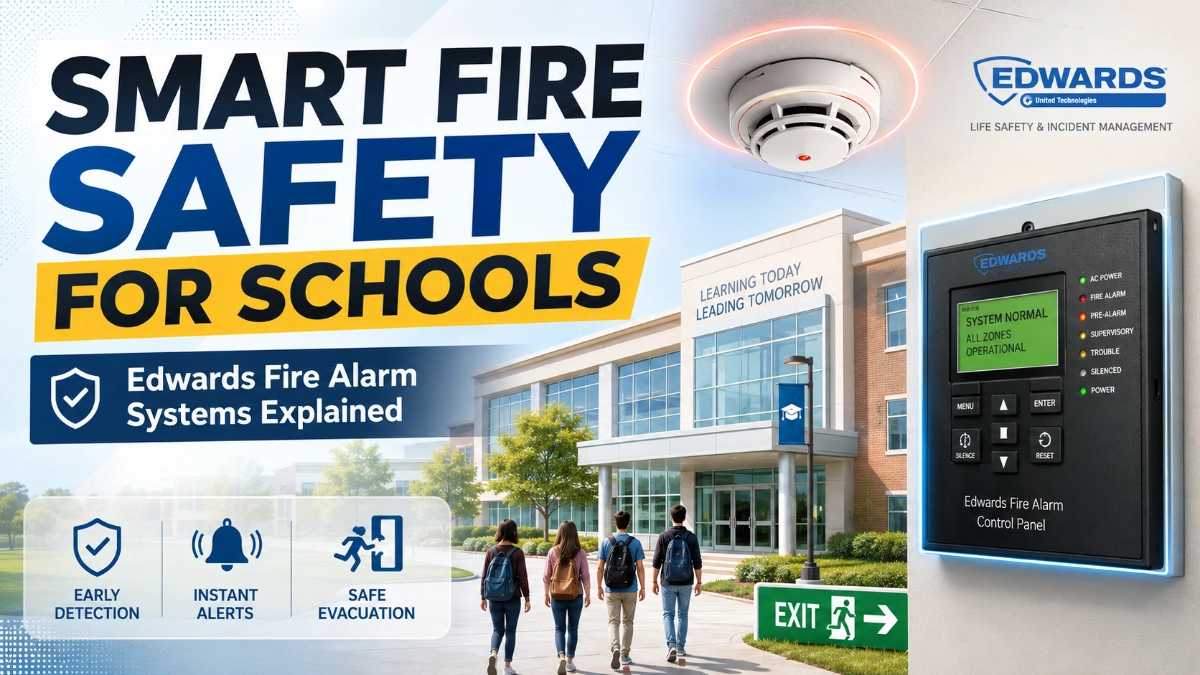
Modern educational campuses are evolving into large, multi-building environments with classrooms, laboratories, libraries, hostels, auditoriums, and sports complexes. Protecting thousands of students, faculty members, and visitors requires more than basic fire detection; it requires an intelligent life safety strategy that can see across an entire campus at once, not just inside a single building.
Introduction
Fire safety in educational institutions carries a weight that few other building types share. A single campus can house young children, teenagers, and adults simultaneously, often across buildings built in different decades, with different occupancy patterns and different levels of supervision. A kindergarten classroom, a chemistry lab, a hostel dormitory, and a 500-seat auditorium may all sit within a few hundred meters of each other, each with distinct fire risks and evacuation needs.
This complexity is exactly why conventional fire alarm systems, while still found in older buildings, are increasingly being replaced with intelligent, addressable fire detection infrastructure. Conventional systems can tell you that a zone has a problem. They cannot tell you which device triggered, where exactly it is, or what kind of fault occurred. On a sprawling campus with dozens of buildings, that distinction matters enormously during an actual emergency.
Educational institutions also face a scalability problem that most commercial buildings don’t: campuses grow. New academic blocks, hostels, and research facilities get added over years or decades. A fire alarm system installed for a single building in year one needs to expand into a campus-wide network by year ten, often without ripping out existing infrastructure.
This is where enterprise-grade fire alarm ecosystems such as Edwards Fire Alarm Systems become relevant as a reference point for what a scalable, intelligent, addressable architecture looks like in an educational setting. This article is written to help administrators, facility managers, and consultants understand the underlying principles of campus fire detection, independent of any single vendor.
Understanding Fire Safety Requirements in Educational Institutions
Every educational facility type carries its own fire risk profile, and a one-size-fits-all approach to detection rarely holds up in practice.
- Schools typically have high occupant density relative to floor area, with corridors that fill quickly during an evacuation. Young children may not respond to alarms the way trained adults do, which puts a premium on clear, audible, and visible notification.
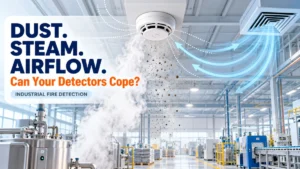
- Colleges and universities combine classrooms with specialised spaces such as chemistry and physics labs, workshops, server rooms, and libraries with dense combustible loads (paper, archives, electronics). These spaces often need detection technology tuned to their specific risk, such as heat detection in kitchens or workshops where smoke detectors would false-alarm from dust or steam.
- Hostels and residential blocks introduce a night-time occupancy risk. Fires that start while residents are asleep are statistically more dangerous, which is why hostel fire alarm design leans heavily on early smoke detection and reliable notification appliances that can wake occupants.
- Libraries carry high fuel loads from paper and archival material, often in spaces with limited compartmentation between floors.
- Laboratories may involve flammable chemicals, gas lines, and specialised ventilation environments where standard smoke detectors can be prone to nuisance alarms, and where heat detectors or multi-criteria sensing are often more appropriate.
- Auditoriums and assembly halls present the classic life-safety challenge of large occupant loads in a single space with limited exit points, making rapid, campus-wide notification critical.
- Sports facilities and gymnasiums often have high ceilings and open volumes, which affect detector spacing and type selection.
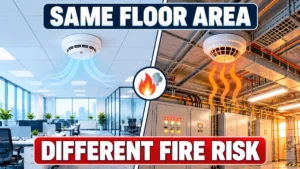
The common thread across all of these building types is that fire risk in an educational campus is not uniform. Detection and notification strategy has to be designed room-by-room and building-by-building, then unified under a single monitoring architecture.
Why Intelligent Fire Alarm Systems Are Better for Campuses
Conventional fire alarm systems divide a building into zones. If a detector in Zone 3 activates, the panel tells you Zone 3 has a problem but not which of the twenty devices in that zone triggered it. On a single-building conventional system, that’s a minor inconvenience. Across a multi-building campus, it can cost precious minutes during an emergency response.
- Addressable architecture solves this by giving every device every smoke detector, heat detector, manual call point, and module its own unique address on the system. When a device activates, the fire alarm control panel reports the exact device location, not just the zone. Facility staff and emergency responders can go directly to the specific room or corridor rather than searching an entire wing.
- Intelligent detection goes a step further. Intelligent addressable detectors continuously report their status, not just alarm or normal, but also degrees of smoke obscuration, sensitivity drift, and device health. This allows the system to distinguish between an actual fire condition and a developing fault, such as a detector accumulating dust, well before it becomes a nuisance alarm or, worse, a failed device during a real emergency.
- Faster fault identification is a direct operational benefit. If a detector goes offline or a circuit develops a ground fault, an intelligent system pinpoints the exact device and location instantly. On a campus with hundreds of devices spread across multiple structures, this can reduce troubleshooting time from hours to minutes.
- Easier maintenance follows naturally. Maintenance teams can run diagnostics from a central control panel or workstation, identify which specific devices need cleaning or replacement, and schedule work proactively rather than reactively.
- Scalability is arguably the most important factor for educational institutions specifically. Addressable systems are designed to be expanded; new devices, new loops, and new buildings can be added to an existing network architecture without replacing the entire system.
- Centralised monitoring ties everything together. A single monitoring point, whether a security office, facilities control room, or campus operations centre, can oversee fire alarm status across every building on campus, rather than staff having to physically check individual building panels.
Practical example: Consider a university with a main academic block, two hostels, a library, and a newly constructed research centre. With a networked addressable system, a single control room operator can see that a heat detector in the research centre’s second-floor chemistry lab has gone into alarm, dispatch response teams directly to that room, and simultaneously confirm that notification appliances have activated in the correct building, all from one screen, without phone calls to four separate building supervisors.
Essential Components of a Modern Campus Fire Alarm System
A campus-wide fire detection system is built from several distinct categories of equipment, each serving a specific role.
Fire Alarm Control Panels
The fire alarm control panel is the brain of the system. It receives signals from every connected device, processes alarm and fault conditions, and triggers notification appliances. On larger campuses, control panels are often networked together; for example, an Edwards EST4 fire alarm panel can serve as a large-scale networked platform connecting multiple buildings, while an Edwards EST3 fire alarm control panel is commonly deployed for mid-sized facilities, and an Edwards IO1000 fire alarm panel suits smaller standalone buildings or as an expansion point within a larger network. The right panel selection depends on building size, device count, and how many structures need to be tied together.
Smoke Detectors
Smoke detectors are the primary early-warning device in most occupied spaces: classrooms, corridors, hostel rooms, and libraries. Intelligent addressable smoke detectors, such as those in the Edwards SIGA smoke detector line, report analogue sensitivity data back to the panel, which helps distinguish genuine smoke conditions from environmental interference like dust or humidity.
Heat Detectors
Heat detectors are better suited to environments where smoke detectors are prone to false activation: kitchens, workshops, laboratories with fumes, and mechanical rooms. Edwards SIGA heat detectors are typically specified in these higher-risk, higher-nuisance-alarm environments where fixed-temperature or rate-of-rise detection is more reliable than smoke sensing.
Manual Call Points
Manual call points allow occupants to trigger an alarm manually when they observe a fire before automatic detection activates. Placement near exits and along evacuation routes is critical, particularly in high-traffic areas like main corridors and assembly points.
Monitor Modules
Monitor modules interface the fire alarm system with other building devices such as sprinkler flow switches, tamper switches, or external detection systems, translating their status into a signal the addressable panel can interpret.
Control Modules
Control modules perform the reverse function: they let the fire alarm panel operate other building systems, such as shutting down air handling units, releasing magnetic door holders, or activating elevator recall during an alarm condition.
Notification Appliances
Notification appliances horns, strobes, and voice evacuation speakers alert occupants that evacuation is required. In educational settings with hearing-impaired students or staff, visual strobes alongside audible alarms are not optional extras; they’re a core accessibility requirement.
Emergency Communication
Voice evacuation and mass notification capability allow campus security or emergency responders to issue specific instructions directing one building to evacuate while advising another to shelter in place, for example, rather than relying on a single generic alarm tone across the entire campus.
How Edwards Fire Alarm Systems Support Educational Campuses
Looking at Edwards as a reference example of an enterprise fire alarm ecosystem helps illustrate what a genuinely scalable campus solution should offer, independent of brand preference.
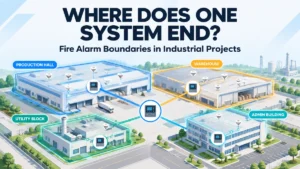
- Multi-building networking is central to campus applications. Panels can be linked over a network so that a hostel block, a main academic building, and a library all report to a shared monitoring point, while each building retains its own local detection loop.
- Intelligent diagnostics allow facilities teams to see device-level health data, sensitivity levels, dirty detector warnings, and wiring faults rather than discovering a problem only when a device fails to respond during an actual fire.
- Expansion flexibility matters because educational institutions rarely build out their full campus in one phase. A system architecture that supports adding loops, panels, and devices over time without a full system replacement protects the institution’s long-term investment.
- Reliable emergency response depends on notification appliances and voice evacuation systems reaching every occupied space clearly, including outdoor areas like sports grounds and assembly points where students may gather during a drill or actual evacuation.
- Simplified maintenance comes from centralised diagnostic reporting, which reduces the burden on facility staff who are rarely fire safety specialists and need clear, actionable information rather than a wall of blinking indicator lights.
Choosing the Right Fire Alarm Platform for Different Educational Facilities
The right system architecture depends heavily on institution size, building count, and growth plans. The table below outlines general considerations; actual system design should always be confirmed with a licensed fire protection engineer or consultant based on local code requirements.
| Facility Type | Typical Building Profile | Recommended Approach | Key Consideration |
|---|---|---|---|
| Small Schools | Single or few buildings, limited floors | Standalone addressable panel (e.g., entry-level panel such as IO1000-class) | Cost-efficient coverage without unnecessary complexity |
| Large Schools | Multiple blocks, single campus | Mid-size networked addressable panel (e.g., EST3-class) | Room for future expansion within one campus |
| Colleges | Several academic buildings, some specialised labs | Networked addressable system with heat detection in labs/workshops | Mixed detection types by room function |
| Universities | Multiple buildings, hostels, libraries, research centers | Large-scale networked platform (e.g., EST4-class) with centralized monitoring | Scalability and multi-building visibility |
| Hostels | Residential blocks, night occupancy | Addressable smoke detection with reliable notification appliances | Early warning during sleeping hours |
| Research Laboratories | High-risk chemical/technical spaces | Heat detectors, specialized sensing, control modules for HVAC shutdown | Minimizing nuisance alarms while maintaining sensitivity |
| Multi-campus Institutions | Geographically separate campuses | Networked panels per campus with centralized reporting infrastructure | Standardized architecture across sites for easier management |
Common Fire Safety Planning Mistakes in Educational Institutions
Even well-intentioned fire safety upgrades can fall short if a few recurring mistakes go unaddressed.
- Poor detector placement is one of the most common issues: detectors installed too close to HVAC vents, or spaced according to generic guidelines rather than actual room use, leading to either false alarms or detection delays.
- Lack of scalability shows up when institutions install a system sized exactly for current needs, with no spare loop capacity or panel addressing room for future buildings.
- Ignoring future campus expansion compounds the scalability problem; a five-year master plan for new buildings should inform fire alarm system selection today, not be treated as a separate future project.
- Inadequate notification coverage occurs when audible and visual notification appliances don’t reach outdoor assembly areas, gymnasiums, or large open spaces where ambient noise is higher.
- Delayed maintenance is a silent risk. Detectors accumulate dust, batteries degrade, and wiring faults develop gradually. Without proactive diagnostic monitoring, these issues often go unnoticed until a scheduled inspection or worse, an actual emergency.
- Incomplete evacuation planning happens when the fire alarm system design doesn’t account for how different occupant groups young children, mobility-impaired students, night-shift staff will actually respond to and move during an alarm.
Campus Fire Alarm Planning Checklist
Use this checklist as a starting point when planning a new installation or evaluating an existing system. It is not a substitute for a formal fire risk assessment by a qualified engineer.
For School Administrators
- Confirm current system type (conventional vs. addressable) and its age
- Identify buildings not yet covered by the fire alarm network
- Review last inspection and maintenance records
- Confirm notification appliances are accessible for hearing-impaired occupants
For Facility Managers
- Map detector locations against actual room usage (labs, kitchens, storage)
- Verify spare capacity on existing control panels for future devices
- Check that monitor and control modules are integrated with HVAC and door hardware where required
- Establish a routine testing and preventive maintenance schedule
For Consultants
- Assess whether a single-building or networked multi-panel architecture fits the institution’s growth plans
- Recommend detector types by room risk profile, not a blanket specification
- Evaluate voice evacuation needs for large assembly spaces
- Confirm compliance with applicable local fire and building codes
For Architects
- Coordinate fire alarm device placement early in design, not as a late-stage addition
- Plan cable pathways and panel locations with future building phases in mind
- Ensure assembly points and evacuation routes are reflected in notification appliance coverage
Future Trends in Educational Fire Safety
Fire alarm technology in educational settings is steadily converging with broader smart-building trends.
- Smart campuses are increasingly treating fire detection as one data layer within a larger digital infrastructure, alongside access control, energy management, and security systems.
- AI-assisted diagnostics are beginning to analyse detector performance trends over time, flagging devices likely to develop faults before they actually fail, rather than only responding to faults after they occur.
- IoT-enabled monitoring allows facility teams to check system status remotely, which is particularly useful for multi-campus institutions where staff can’t be physically present at every building.
- Cloud-based reporting gives administrators and safety officers access to inspection history, alarm logs, and maintenance records from a browser rather than paper files, supporting compliance documentation and audits.
- Building Management System (BMS) integration is becoming a baseline expectation rather than a premium feature; fire alarm systems increasingly need to communicate with HVAC, access control, and elevator systems to coordinate a full emergency response.
- Digital campus infrastructure more broadly is pushing institutions toward unified platforms where fire safety data sits alongside other operational systems, giving administrators a single point of visibility rather than fragmented, building-by-building oversight.
Expert Recommendations
- For educational institutions: Treat fire alarm infrastructure as a long-term capital investment tied to your campus master plan, not a one-time compliance purchase. Budget for a system architecture that can absorb the next decade of construction.
- For consultants: Design detection strategy around actual room function and occupancy patterns, not generic zone-based templates. A chemistry lab and a classroom next door to each other may need entirely different detector types.
- For facility managers: Prioritise systems with device-level diagnostics. The ability to identify a failing detector before it triggers a false alarm or fails silently saves both maintenance cost and risk exposure.
- For infrastructure planners: When evaluating vendors or platforms, ask specifically how the system scales across multiple buildings and future construction phases. Addressable, networkable architectures such as those built around Edwards fire alarm control panels, or comparable intelligent addressable platforms like GST fire alarm systems, are worth evaluating on this basis specifically.
Read Also: Why Mission-Critical Facilities Choose Intelligent Fire Detection Platforms
Read Also: Why Small and Medium Facilities Choose Edwards IO1000 Panels