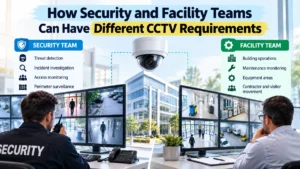
Most business owners think of CCTV the same way they think of a fire extinguisher: something you install, forget about, and only think of again after something goes wrong. That mental model made sense a decade ago, when cameras did one job: record footage in case of theft or vandalism.
That’s no longer how surveillance technology works, and it’s no longer how the smartest operators use it.
Walk into a well-run distribution centre, a busy hospital ward, or a hotel lobby today, and there’s a good chance the overhead camera system is doing far more than just watching for intruders. It’s tracking how long trucks sit at a loading dock. It’s flagging when a production line slows down. It’s telling a facility manager which entrance nobody uses anymore, or which aisle in a retail store causes shoppers to turn around and leave.
This shift from passive security tool to active operational asset is quietly changing how businesses run. Here’s what that actually looks like in practice, and why treating your camera system as “just security” might be leaving real value on the table.
Why Businesses Now Use CCTV Beyond Traditional Security
The technology changed first, and business thinking is catching up. Modern CCTV runs on IP networks, ties into video management software, and increasingly includes AI-based analytics rather than simple motion detection. That combination means a camera isn’t just capturing images anymore; it’s generating structured data about movement, time, behaviour, and patterns.
Once footage becomes data, it becomes useful to more than just a security guard reviewing incidents. Operations managers, HR teams, compliance officers, and even marketing departments can pull insights from the same infrastructure that was originally installed to stop shoplifting or catch break-ins.
This is the core idea worth sitting with: the camera hasn’t changed as much as what happens to the footage afterwards.
CCTV as an Operational Management Tool
CCTV improves business operations by turning routine footage into measurable data on staff activity, customer flow, equipment use, and process bottlenecks insights that were previously invisible or required manual observation.
A facility manager overseeing three buildings used to rely on walk-throughs and staff reports to understand what was actually happening on-site. Now, a single dashboard pulling from strategically placed cameras can show occupancy patterns, unusual after-hours activity, or maintenance issues like a door that’s been propped open for hours.
This doesn’t replace human judgment. It replaces guesswork with observation, which is a meaningful difference for anyone responsible for a physical space they can’t watch all day personally.
Real-World Example: Commercial Office Building
A property manager overseeing a mixed-use commercial building noticed recurring complaints about elevator wait times during morning rush hours. Reviewing lobby camera footage over several weeks revealed the actual bottleneck wasn’t elevator speed; it was a poorly placed turnstile creating a queue before people even reached the elevator bank. Reconfiguring the entry flow solved a complaint that had nothing to do with security.
Employee Productivity and Workflow Optimisation
Can CCTV increase employee productivity? Not by watching over shoulders; that approach tends to backfire and damage trust. The more useful application is workflow analysis: understanding how work actually moves through a space compared to how it’s assumed to move.
CCTV supports productivity indirectly, by revealing workflow inefficiencies, unnecessary movement, and process delays that managers can then correct, not by monitoring individual employees for performance scoring.
In a manufacturing plant, footage might reveal that operators are walking back and forth between two stations because tools were placed inconveniently during initial setup. That’s not an employee problem. It’s a layout problem the camera happened to expose.
Real-World Example: Manufacturing Plant
A mid-sized manufacturer noticed unexplained delays on one production line. Camera footage showed that a shared tool cart was being used by two adjacent stations, creating a bottleneck every time both stations needed it simultaneously. A second cart, costing very little, resolved a delay that had been misattributed to staff performance for months.
Warehouse Efficiency and Inventory Movement Tracking
Warehouses are among the clearest beneficiaries of operational CCTV, simply because so much of warehouse performance depends on movement of people, forklifts, and inventory that’s hard to track manually at scale.
Cameras positioned along racking aisles and loading docks can help verify that inventory moves through the facility as expected, flag when pallets sit idle longer than they should, and confirm that safety zones around forklifts remain clear. None of this requires facial recognition or invasive monitoring; it’s about spatial and time-based patterns.
Real-World Example: Logistics Company
A logistics company handling third-party fulfilment used dock-area cameras to resolve a recurring dispute with a shipping partner over damaged goods. Footage confirmed that damage was occurring during a specific handling step at the dock, not during transit as the partner had assumed. The recorded evidence resolved the dispute and led to a process change at that exact handling point.
Retail Analytics and Customer Behavior
Does CCTV improve customer experience? In retail, often yes, through queue management, layout testing, and understanding how customers actually move through a store versus how the store was designed assuming they would move.
Retail CCTV improves customer experience by identifying congestion points, slow checkout lines, and underused store areas, allowing managers to adjust staffing and layout in response to real behaviour rather than assumptions.
Heat mapping, a visual representation of where customers spend the most time, has become a common analytics feature in retail-focused CCTV platforms. A store might discover that a promotional display placed near the entrance is being walked past entirely because it competes with a more visually dominant fixture nearby.
Real-World Example: Retail Store
A clothing retailer used queue-length data from checkout-area cameras to adjust staffing schedules. Rather than assigning the same number of registers throughout the day, the store began opening additional registers only during the specific hourly windows when footage showed queues consistently forming, reducing both wait times and unnecessary labour costs.
Parking Management and Delivery Verification
For businesses with loading docks, parking structures, or frequent deliveries, cameras solve a very practical problem: confirming what actually happened, and when.
Delivery verification through timestamped footage settles disputes about whether a shipment arrived on time, whether it was left in the correct location, or whether goods were damaged before or after handoff. Parking-area cameras help facility teams manage turnover in limited spaces and identify unauthorised use.
Real-World Example: Hotel
A hotel operations team used loading-dock footage to confirm that a supplier’s delivery times consistently fell outside the agreed contract window. The documented pattern supported a renegotiation of the delivery contract, something that would have been a case of “he said, she said” without recorded timestamps.
Workplace Safety and Incident Investigation
How does AI-powered CCTV improve decision-making around safety? By flagging near-misses and hazardous conditions before they become injuries, not just documenting incidents after the fact.
Smart alert systems can now detect specific conditions a spill in a walkway, a restricted area being entered, equipment left running unattended and notify the relevant team in real time. This shifts safety management from reactive to preventive.
Real-World Example: Hospital
A hospital facilities team used corridor cameras with AI-based fall-detection alerts to reduce response time when elderly patients or visitors experienced falls in less-monitored hallways. Staff could respond within moments rather than relying on someone happening to walk by.
Real-World Example: School
A school administration used entrance and hallway cameras not for punitive monitoring, but to verify visitor check-in compliance and to quickly account for students during fire drills and emergency procedures an operational use case as much as a security one.
Regulatory Compliance and Audits
Can CCTV data support compliance audits? Increasingly, yes. Industries with strict regulatory requirements food processing, pharmaceuticals, healthcare, financial services often need to demonstrate that specific procedures were followed, not just that a security incident didn’t occur.
CCTV supports compliance by providing timestamped, verifiable video records that confirm procedures such as safety checks, handling protocols, or access restrictions were actually carried out as required.
A food processing facility, for example, may need to prove that hygiene protocols were followed at specific checkpoints. Recorded footage, paired with timestamps, provides an audit trail that’s far more defensible than a paper checklist alone.
Remote Business Management
For owners or managers overseeing multiple locations, cloud-connected CCTV has become a practical management tool rather than just a security feature. Checking in on a warehouse in another city, confirming a store opened on schedule, or reviewing an incident report without travelling on-site- these are now routine uses of the same infrastructure originally installed for security.
Solutions like Impact by Honeywell CCTV reflect this shift, combining traditional surveillance with cloud access and analytics features designed for multi-site operational oversight rather than security alone.
AI Video Analytics, Smart Alerts, and Heat Mapping
How does video analytics help businesses? By converting raw footage into structured, searchable information, counting people, measuring dwell time, detecting specific objects or behaviours, and generating alerts without requiring a person to watch every camera feed constantly.
This is where CCTV shifts from a recording tool to a business intelligence tool. Heat maps show movement density. Object detection can flag unattended bags or blocked emergency exits. License plate recognition can automate gate access at logistics yards. None of this requires additional cameras; it’s largely a software layer added to existing infrastructure.
Cost Reduction and Risk Management
How do CCTV systems reduce operational costs? Primarily through fewer disputes, faster incident resolution, better resource allocation, and reduced liability exposure savings that accumulate quietly rather than showing up as one dramatic line item.
Insurance claims settle faster with clear footage. Staffing decisions based on actual customer flow reduce unnecessary labour hours. Equipment monitoring catches maintenance issues before they cause costly downtime. None of these savings is as visible as “we caught a thief,” but collectively they often matter more to the bottom line.
Common Mistakes Businesses Make When Using CCTV Only for Security
The most common mistake is installation without a data strategy: cameras placed purely for perimeter coverage, footage stored but rarely reviewed unless an incident occurs, and no integration with the software layers that turn video into operational insight.
A second common mistake is over-monitoring employees in a way that damages trust without producing useful operational data. Effective operational CCTV focuses on processes, spaces, and patterns, not individual surveillance for its own sake.
How Organisations Should Plan CCTV Deployment Strategically
A strategic deployment starts with a simple question: what decisions do we want this system to help us make? Security is one answer, but so are staffing, layout, compliance, and vendor accountability.
From there, camera placement, storage duration, analytics software, and access permissions should all map back to those intended uses. Working with an experienced integrator such as an Impact by Honeywell CCTV distributor in India familiar with both security and operational deployment can help businesses avoid the common trap of buying hardware first and figuring out its operational value later.
Future Trends in Intelligent Surveillance
Surveillance technology is moving toward deeper integration with other business systems: inventory software, access control, HR platforms, and building management systems. As AI analytics become more accurate and affordable, expect operational use cases to expand further, with cameras contributing data to dashboards that have little to do with traditional security at all.
Closing Thought
CCTV was never really “just” a security tool that was simply the first application businesses noticed. The cameras were already capturing movement, timing, and behaviour across warehouses, stores, offices, and facilities all along. What’s changed is the ability to turn that footage into decisions.
Businesses that continue to treat surveillance purely as a loss-prevention line item are leaving a genuinely useful data source underused. Those that view it as part of their broader operational and business intelligence strategy tend to find that the same investment pays for itself many times over, not because it caught a single incident, but because it quietly informs better decisions every day.
Read Also: Why Camera Quality Alone Doesn’t Define Surveillance Performance
Read Also: Has Surveillance Technology Advanced Faster Than Surveillance Strategy?