A camera in a Chicago warehouse flagged an intruder at 2 a.m. last year. The alert fired correctly. The footage was crisp, the AI detection was accurate, and the system worked exactly as designed.
Nobody was watching the monitor. The alert sat in a queue for six hours.
This is not a story about bad hardware. It is a story about a gap that has been quietly widening across the security industry for the better part of a decade: the distance between what surveillance systems can do and what organisations actually do with them.
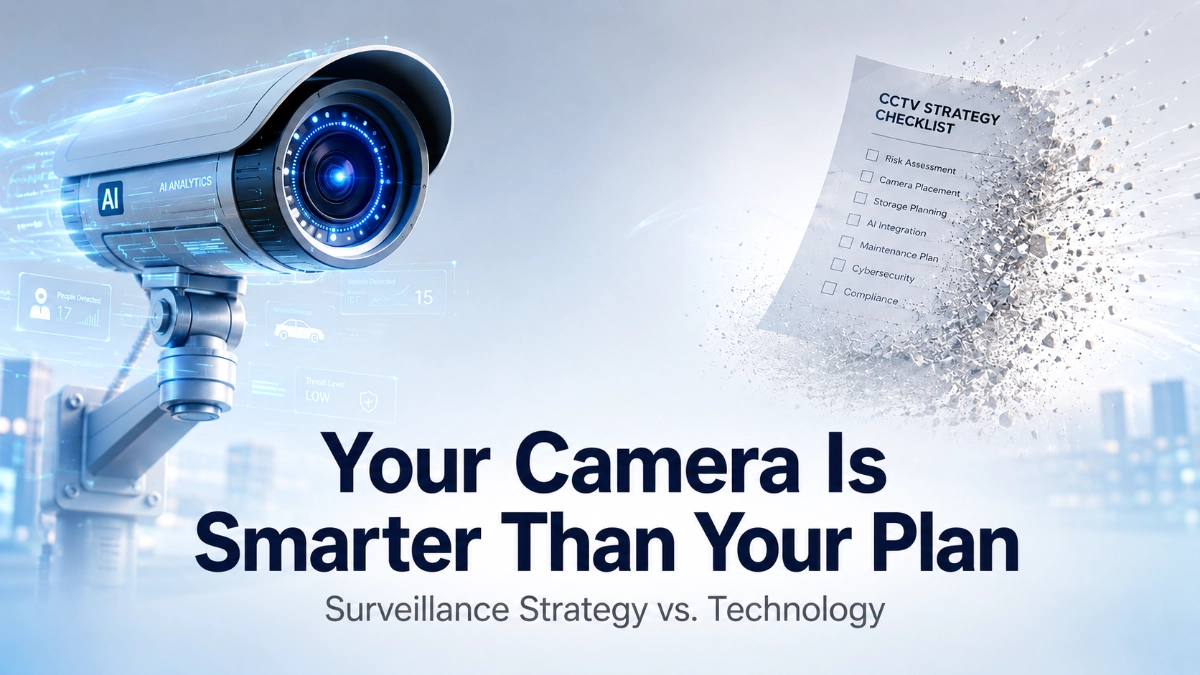
Cameras have gotten smarter. Cloud platforms have gotten faster. Artificial intelligence can now recognise faces, count vehicles, and predict loitering behaviour before it becomes a problem. Yet ask most facility managers how their surveillance data ties into incident response, compliance reporting, or business continuity planning, and the answer often trails off into vague gestures at “we’re working on it.”
That gap is the real story. Not whether the technology is good enough, but whether the people and processes around it have caught up.
What Is Surveillance Technology?
Surveillance technology refers to the physical and digital tools used to capture, analyse, store and transmit visual or sensor-based security data.
This includes CCTV cameras, video management systems (VMS), AI-powered analytics engines, edge computing devices, cloud storage platforms, and the network infrastructure that connects them. Over the past ten years, this category has transformed from passive recording to active interpretation.
A modern camera does not just capture footage. It can classify objects, detect anomalies, read license plates, and trigger automated responses, often without a human ever reviewing the raw video.
What Is Surveillance Strategy?
Surveillance strategy is the organisational framework that determines why, where, and how surveillance technology is deployed, governed, and used to support security and business objectives.
Strategy covers things technology cannot decide on its own: which risks matter most to a specific facility, who is authorised to view footage, how long data should be retained, how alerts get escalated, and how the system integrates with access control, incident response, and legal compliance.
Technology answers the question “what can we capture?” Strategy answers the much harder question, “what should we do with it, and why?”
Did You Know? A 2023 industry survey found that a majority of mid-sized enterprises had video analytics capability sitting unused or only partially configured more than a year after installation, largely because no internal process existed to act on the alerts being generated.
Why Technology Has Evolved So Quickly
Three forces have pushed surveillance hardware and software forward at a pace few other security categories can match.
- Cheaper compute power: Edge AI chips that once cost thousands of dollars now ship inside consumer-grade cameras. This made on-device analytics financially viable for small and mid-sized organisations, not just large enterprises with dedicated security operations centres.
- Cloud-first architecture: Surveillance no longer requires a server room. Footage can be stored, searched, and shared across locations through cloud platforms, which lowered the barrier to entry for distributed businesses with multiple sites.
- Competitive vendor pressure: Manufacturers compete heavily on feature lists. AI-based motion filtering, facial recognition, license plate reading, and predictive analytics have become standard talking points in sales conversations, pushing the entire market toward faster feature releases.
None of this is inherently bad. The problem is that vendors sell capability, not outcomes. A camera that can detect loitering does not guarantee anyone responds to a loitering alert at 3 a.m. on a Sunday.
Where Strategy Has Failed to Keep Pace
Several specific areas illustrate the gap clearly.
- Alert fatigue and operator burnout: As analytics capabilities expanded, so did the volume of alerts. Without tuned thresholds and clear escalation protocols, security operators face a flood of notifications, most of them false positives. Over time, this trains staff to ignore alerts altogether, defeating the purpose of the system.
- Data retention without a data policy: Cloud storage made it easy to keep months or years of footage. Few organisations have a documented retention policy that balances investigative needs against storage costs and privacy regulations, leaving them exposed when audits or legal discovery requests arrive.
- Privacy governance as an afterthought: Facial recognition and behavioural analytics raise real privacy and regulatory questions, particularly in jurisdictions with strict data protection laws. Many deployments proceed without a privacy impact assessment, creating legal risk that surfaces only after an incident.
- Disconnected integration: Surveillance, access control, and IoT sensors are frequently purchased and installed as separate projects, on separate timelines, by separate vendors. The result is a patchwork of systems that do not share data, undermining the value of having intelligent components in the first place.
- No defined ownership: In many organisations, IT owns the network, facilities owns the cameras, and security owns the response plan, but no single role owns the overall surveillance strategy. Decisions get made piecemeal, and nobody is accountable for the gaps between departments.
Common Organisational Mistakes
A few patterns show up repeatedly across industries.
- Buying technology based on feature comparisons rather than a documented risk assessment.
- Skipping a needs analysis and defaulting to “more cameras, more coverage”.
- Treating installation as the finish line instead of the starting point.
- Failing to train staff on how to interpret and act on AI-generated alerts.
- Leaving cybersecurity for the surveillance network as a secondary concern, even though cameras are common entry points for network intrusions.
- Not budgeting for ongoing system maintenance, firmware updates, or analytics retraining.
Each of these mistakes is fixable. None of them requires new technology. They require planning discipline that often gets skipped under budget or timeline pressure.
Real-World Examples of Strategic Gaps
Consider a regional retail chain that deployed AI-based people-counting cameras across forty locations to optimise staffing. The technology worked precisely as advertised. But store managers were never trained on how to interpret the dashboards, and the data sat unused for over a year before a new operations director discovered it and built a staffing model around it.
Or consider a logistics company that installed license plate recognition at every gate to streamline check-in. The cameras performed well, but the company had no policy for how long plate data should be retained or who could access it, which became a serious compliance issue when a regional privacy regulator opened an inquiry.
In both cases, the technology was not the failure point. The absence of a plan for using, governing, and maintaining that technology was.
AI Surveillance: Opportunity or Distraction?
AI video analytics genuinely can reduce false alarms, speed up investigations, and flag patterns a human reviewer would miss across hours of footage. That much is well supported by deployment data across the industry.
But AI is not a replacement for strategic planning. It is a tool that amplifies whatever strategy already exists. A well-planned deployment with clear escalation rules becomes faster and more accurate with AI. A poorly planned deployment becomes a faster, more expensive way to generate alerts that nobody acts on.
Can AI replace surveillance planning? No. AI can support decision-making and reduce manual review time, but it cannot determine an organisation’s risk priorities, legal obligations, or operational workflows. Those require human judgment and documented strategy.
The honest framing is this: AI surveillance is an opportunity when paired with mature governance, and a distraction when treated as a standalone fix for unresolved planning gaps.
Technology vs Strategy: A Comparison Table
| Dimension | Surveillance Technology | Surveillance Strategy |
|---|---|---|
| Core question | What can we capture and detect? | What should we do with what we capture? |
| Pace of change | Fast — new features released yearly | Slow — built through planning and governance |
| Ownership | Often IT or facilities | Should sit with a defined security leadership role |
| Failure mode | Hardware malfunction, false positives | Unused data, unclear accountability, compliance risk |
| Fix | Vendor update or replacement | Policy development, training, cross-team alignment |
| Measured by | Resolution, uptime, detection accuracy | Response time, incident outcomes, audit readiness |
Emerging Trends Shaping the Next Decade
A few developments will widen the technology-strategy gap further unless organisations plan.
- Predictive monitoring is moving from detecting events after they start to forecasting likely incidents based on behavioural patterns, which raises new questions about false positives and proportional response.
- Edge AI processing reduces bandwidth needs and improves response speed, but pushes more decision-making to the device level, requiring stronger device security and firmware management practices.
- Centralised security operations centres, even for mid-sized organisations, are becoming more common as a way to consolidate alerts from surveillance, access control, and IoT systems into a single response workflow.
- Tighter privacy regulation is likely across more regions, meaning retention and consent policies will need regular review rather than a one-time setup.
Organisations that build governance structures now will adapt to these shifts far more smoothly than those still catching up on basic strategy.
Expert Recommendations
Experienced security consultants generally agree on a few non-negotiables.
Treat surveillance as an operational program, not a one-time capital project. Budget for training, policy review, and system tuning every year, not just the initial purchase.
Involve legal and compliance teams before deployment, not after an incident forces the conversation.
Pilot new analytics features on a small scale before rolling them out facility-wide, to calibrate thresholds and avoid alert fatigue.
Choose integrators and suppliers who ask about your operational workflow, not just your camera count. A vendor like Impact by Honeywell CCTV illustrates this approach well, since enterprise-grade deployments typically pair hardware capability with structured commissioning and support, rather than treating installation as the end of the engagement. Organisations evaluating suppliers, including an Impact by Honeywell CCTV Distributor in India, should ask specifically about post-installation governance support, not just product specifications.
Conclusion
Surveillance technology will keep advancing. Better sensors, faster processing, and smarter analytics are not going away, and organisations that ignore them will fall behind on detection capability.
But capability without a plan is just expensive noise. The organisations getting real value from modern surveillance are not necessarily the ones with the newest cameras. They are the ones that took the time to define ownership, write escalation procedures, and build governance before flipping the switch.
The technology is ready. The question every organisation needs to ask honestly is whether their strategy is ready too.
Read Also: How to Secure Your CCTV Network from Cyber Threats
Read Also: How AI Is Transforming Surveillance from Observation to Decision-Making