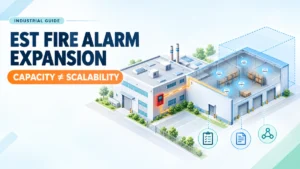
Modern buildings are expected to operate for decades, yet many fire alarm systems are still selected based only on today’s requirements. As facilities expand, technologies evolve, and operational demands increase, long-term infrastructure planning has become just as important as the initial system design.
A hospital wing built today may double in size within ten years. A manufacturing plant may add three new production lines before its fire alarm system reaches the midpoint of its service life. A university campus may add hostels, laboratories, and research buildings faster than its original fire safety infrastructure was designed to handle. In each of these cases, the fire alarm system either becomes a constraint on growth or a platform that absorbs it.
This is the core argument for treating fire detection as strategic infrastructure rather than a piece of standalone safety equipment. A fire alarm control panel installed in 2026 will likely still be in service in 2046. The question consultants, facility owners, and infrastructure planners should be asking is not just “does this system meet code today,” but “will this system still make sense in twenty years?”
Edwards Fire Alarm Systems are a useful example of how intelligent, addressable fire alarm platforms are designed with this longer time horizon in mind. Built around networked, modular architecture, these systems are engineered to accommodate growth without requiring a full replacement every time a facility changes. This article examines what long-term infrastructure planning actually means for fire alarm systems, why it matters across different industries, and how consultants and facility managers can build a framework for future-ready fire detection.
Why Long-Term Infrastructure Planning Matters
Every commercial or industrial building has a lifecycle that extends well beyond its opening day. Facilities are renovated, expanded, repurposed, and occasionally merged with adjacent structures. A fire alarm system that cannot adapt to these changes becomes an obstacle rather than a safeguard.
- Facility lifecycle: Buildings typically operate for 30 to 50 years, but the systems inside them are replaced or upgraded multiple times during that span. Fire alarm infrastructure sits in an unusual position: it must remain continuously functional while also being flexible enough to evolve.
- Expansion planning: New wings, additional floors, or entirely new buildings on a campus all place demands on existing fire detection infrastructure. Systems planned only for current square footage often run out of addressable device capacity or network bandwidth within a decade.
- Operational continuity: Facilities that cannot afford downtime hospitals, data centres, manufacturing plants need fire alarm systems that can be serviced, expanded, or partially upgraded without shutting down entire zones of operation.
- Asset protection: A fire alarm system protects far more than life safety compliance. It protects the physical asset itself, along with the equipment, inventory, and operations housed inside it.
- Technology evolution: Detection technology, diagnostics, and monitoring capabilities have advanced significantly over the past two decades. Facilities locked into rigid, non-upgradable systems miss out on improvements that reduce false alarms and improve response times.
- Risk management: Infrastructure decisions made today directly affect the risk profile of a facility for years afterwards. A system that cannot be maintained, expanded, or diagnosed efficiently introduces long-term operational risk, even if it meets minimum code requirements at installation.
The Evolution of Fire Alarm Systems
Understanding where fire alarm technology is headed requires understanding where it has been.
- Conventional systems divide a building into zones, with each zone reporting only a general area of alarm activation. These systems are inexpensive but offer no device-level information, making troubleshooting slow and expansion difficult, since each zone has a fixed wiring capacity.
- Addressable systems assign a unique address to every detector, call point, and module on the circuit. This allows the fire alarm control panel to identify the exact device in alarm or fault, dramatically reducing response and maintenance time. Addressable architecture also supports far more devices per circuit than conventional wiring.
- Intelligent platforms build on addressable architecture by adding onboard analytics to each detector. Devices can self-report sensitivity drift, contamination, or wiring faults before they cause a false alarm or, worse, a missed detection. This is the foundation of systems such as Edwards EST4 and Edwards EST3, which use intelligent, addressable detection to give facility teams device-level visibility across an entire building or campus.
- Networked fire alarm ecosystems extend intelligent platforms across multiple panels, buildings, and sites, unified under a single monitoring and reporting structure. This is where long-term infrastructure planning becomes most relevant, since networked systems are specifically designed to grow alongside a facility rather than being replaced when a facility outgrows them.
The Five Pillars of Future-Ready Fire Alarm Infrastructure
Consultants evaluating fire alarm platforms for long-term use can apply a five-pillar framework to assess how well a system will hold up over a facility’s operational life.
| Pillar | What It Means | Why It Matters Long-Term |
|---|---|---|
| Scalability | Ability to add devices, loops, or panels without replacing existing infrastructure | Facilities rarely stay the same size; systems must grow with them |
| Intelligent Detection | Device-level diagnostics and addressable identification | Reduces false alarms and speeds up maintenance across large facilities |
| Network Connectivity | Ability to link multiple panels and buildings into one monitoring structure | Supports multi-building campuses, phased construction, and centralised oversight |
| Lifecycle Flexibility | Modular hardware and firmware that can be updated incrementally | Avoids full system replacement when technology or code requirements change |
| Operational Resilience | Continued function during partial faults, maintenance, or expansion work | Keeps critical facilities protected during renovation or growth phases |
A system that performs well on all five pillars is generally better positioned to remain useful, serviceable, and code-compliant over a multi-decade timeline than one optimised purely for lowest initial cost.
How Edwards Fire Alarm Systems Support Long-Term Infrastructure Planning
Intelligent, addressable platforms illustrate several of the design principles that make fire alarm systems suitable for long-term infrastructure planning.
- Modular architecture: Panels such as Edwards EST4 are built around a modular design, allowing additional loops, network cards, and input/output modules to be added as a facility expands. This means a facility does not need to forecast its entire future size at the time of initial installation.
- Expansion capability: Devices such as Edwards SIGA smoke detectors, Edwards SIGA heat detectors, and Edwards SIGA manual call points share a common addressable protocol, which simplifies adding new detection points to an existing loop rather than requiring a parallel system.
- Networked communication: Multiple panels across different buildings can be linked into a single network, giving facility managers centralised visibility of alarm and fault status across an entire campus or industrial site rather than monitoring each building in isolation.
- Intelligent diagnostics: Addressable devices report their own status, including sensitivity drift and contamination, which allows maintenance teams to service specific detectors proactively instead of relying on blanket inspection cycles.
- Simplified maintenance: Because faults are reported at the device level, technicians can diagnose and resolve issues without manually testing every detector on a circuit, which becomes increasingly valuable as a facility’s device count grows.
- Operational continuity: Modular panels such as Edwards IO1000 can be deployed as smaller standalone systems or integrated into a larger networked structure, which supports phased construction projects without leaving partially built areas unprotected.
- Integration readiness: Addressable fire alarm platforms are generally designed to interface with Building Management Systems (BMS), supporting a broader move toward centralised building operations and monitoring.
These characteristics are not unique to a single manufacturer. Other intelligent addressable platforms, such as GST fire alarm systems, follow similar architectural principles, and consultants should evaluate any platform against the same scalability and lifecycle criteria described above.
Infrastructure Planning Across Different Industries
Long-term planning needs vary considerably depending on the type of facility.
Hospitals
Hospitals operate continuously and cannot tolerate extended system downtime. Long-term planning here focuses on redundancy, phased upgrades that avoid disrupting patient care areas, and network architecture that can isolate faults to a single zone rather than an entire wing.
Universities
University campuses grow incrementally over many years, often adding new academic buildings, hostels, and research facilities. A networked, addressable fire alarm control panel structure allows new buildings to be added to an existing monitoring network rather than operating as isolated systems.
Manufacturing Plants
Industrial facilities frequently reconfigure production lines and expand floor space. Fire alarm systems here need heat detection suited to industrial environments, along with the flexibility to relocate or add devices as layouts change.
Airports
Airports combine large open terminal spaces, retail areas, and operational back-of-house zones, each with different detection requirements. Long-term planning must account for continuous expansion of terminals and gates without disrupting live operations.
Data Centres
Data centres require early-warning detection and minimal false alarm rates, since even brief unplanned shutdowns carry high cost. Scalability matters as server capacity and floor space expand over time.
Warehouses
Large, open warehouse floors benefit from addressable systems that can pinpoint the exact location of an alarm across vast square footage, which becomes more important as storage racking and floor layouts change.
Commercial Campuses
Office campuses with multiple buildings benefit from networked fire alarm ecosystems that provide centralised monitoring while still allowing each building to operate independently when necessary.
Mixed-Use Developments
Developments combining retail, residential, and office space have varied occupancy patterns and code requirements. Long-term planning must accommodate different notification and evacuation strategies within a single, unified fire detection infrastructure.
Common Infrastructure Planning Mistakes
Even experienced teams make planning errors that limit a fire alarm system’s long-term usefulness.
- Planning only for current occupancy: Sizing a system to exactly match present-day device counts, leaving no room for growth.
- Ignoring future expansion: Failing to account for master-planned additions already on a facility’s roadmap.
- Choosing systems with limited scalability: Selecting a panel or protocol that caps out well before the facility’s projected growth.
- Delaying modernisation: Continuing to patch ageing infrastructure long past the point where an upgrade would be more cost-effective.
- Underestimating maintenance requirements: Overlooking the long-term labour cost of systems that require manual, device-by-device testing.
- Focusing only on initial cost: Prioritising the lowest upfront quote without evaluating total lifecycle cost, including future expansion and maintenance.
A Consultant’s Framework for Future-Proof Fire Alarm Planning
Consultants can apply a structured, step-by-step model when advising clients on long-term fire alarm infrastructure.
| Step | Focus Area | Key Questions |
|---|---|---|
| 1. Risk Assessment | Occupancy type, hazard classification, code requirements | What are the current and anticipated fire risks for this facility? |
| 2. Facility Growth Analysis | Master plans, expansion timelines, future buildings | What is the facility expected to look like in 10–20 years? |
| 3. Device Capacity Planning | Loop capacity, addressable device limits, spare capacity | Does the system have headroom for 20–30% additional devices? |
| 4. Network Design | Panel networking, multi-building connectivity | Can additional panels and buildings be added to the network later? |
| 5. Integration Requirements | BMS integration, monitoring software, third-party systems | Will this system need to communicate with other building systems? |
| 6. Lifecycle Budgeting | Total cost of ownership over 15–25 years | What is the realistic cost of maintenance, upgrades, and expansion? |
| 7. Maintenance Planning | Inspection schedules, diagnostic capabilities, service access | How easily can this system be serviced as it ages and grows? |
Working through each step during the planning phase rather than after installation significantly reduces the likelihood of costly retrofits later.
Future Trends in Infrastructure Planning
Several trends are shaping how fire alarm systems will fit into infrastructure planning over the next decade.
- Smart buildings: Facilities increasingly treat fire alarm systems as one node within a broader network of building intelligence rather than a standalone safety system.
- AI-assisted diagnostics: Pattern recognition is beginning to help distinguish genuine fire conditions from nuisance sources, reducing false alarms in complex environments.
- Predictive maintenance: Device-level diagnostics are moving toward predicting component failure before it happens, rather than relying solely on scheduled inspection cycles.
- Cloud-based monitoring: Remote access to system status allows facility teams and service providers to monitor multiple sites without being physically present at each panel.
- IoT integration: Fire alarm devices are increasingly capable of exchanging data with other connected building systems, supporting more coordinated emergency response.
- Digital twins: Virtual models of building infrastructure, including fire alarm device locations and status, are being used for planning, training, and emergency response simulation.
- Enterprise-wide safety management: Large organisations with multiple facilities are consolidating fire safety monitoring into centralised platforms that span entire portfolios rather than individual buildings.
- Sustainable infrastructure planning: Facility owners are increasingly factoring long-term serviceability and reduced replacement frequency into sustainability goals, since fewer full system replacements mean less material waste over a building’s life.
Expert Recommendations
- For consultants: Build lifecycle cost modelling into every fire alarm recommendation, not just upfront installation pricing. A system with a higher initial cost but lower 20-year total cost of ownership is often the better recommendation, even if it is a harder sell in the moment.
- For facility managers: Maintain a device inventory and capacity log for your fire alarm network. Knowing exactly how much spare loop capacity exists prevents last-minute surprises when a new wing or department needs to be added.
- For architects: Involve fire alarm planning early in the design phase of any facility with a phased construction plan. Retrofitting network infrastructure after a building is occupied is significantly more disruptive than designing for it upfront.
- For EPC contractors: Specify addressable, networkable panels even when a project’s initial scope is small. The incremental cost difference is often minor compared to the cost of replacing a conventional system when a facility expands.
- For procurement teams: Evaluate vendor documentation for expansion pathways, not just current specifications. A platform’s product roadmap and backward compatibility matter as much as its present-day feature set.
- For building owners: Treat fire alarm infrastructure as a capital asset with a defined lifecycle, and budget for periodic modernisation the same way you would for HVAC or electrical systems.
A note on original insight: One pattern that often goes unaddressed in vendor documentation is the gap between code-minimum compliance and lifecycle-ready design. A system can pass inspection on day one while still being poorly positioned for the facility’s five-year growth plan. Consultants who specifically model future device counts rather than only current ones consistently identify capacity shortfalls that would otherwise surface as expensive change orders during a later expansion phase.
Read Also: Why Edwards Fire Alarm Systems Are Trusted for Critical Infrastructure
Read Also: Edwards Fire Alarm Systems for Educational Institutions: What to Know