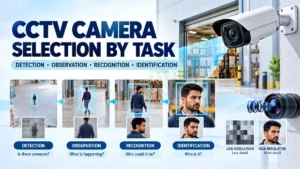
A 4K camera can show you exactly what happened. It cannot tell you what is happening right now. That single gap explains why so many security teams feel disappointed after upgrading their cameras but not their thinking.
For years, the surveillance industry chased one metric above all others: resolution. More pixels, sharper images, better zoom. But a sharp image of a break-in that nobody noticed for six hours is not a security win. It is a missed opportunity.
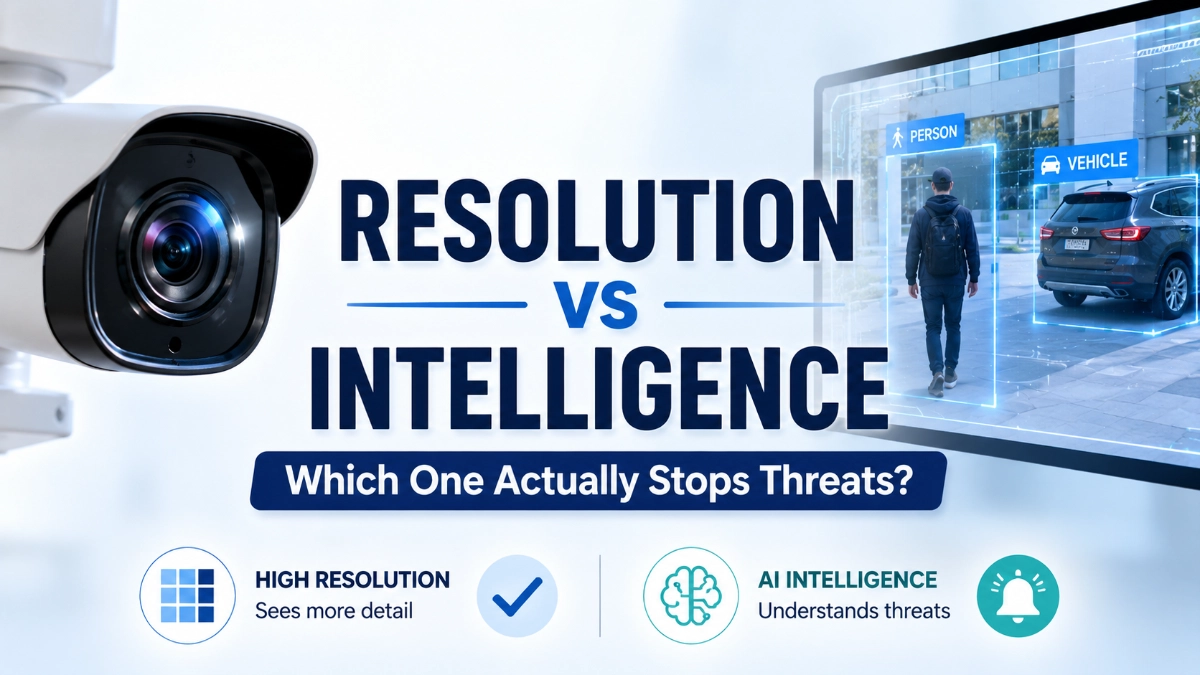
Intelligent video analytics changes that equation. Instead of just recording events, AI-powered systems detect, interpret, and alert on them in real time. This article explains why intelligence, not just image clarity, is becoming the real differentiator in modern surveillance and what that means for security professionals, integrators, and facility managers planning their next investment.
Why Higher Resolution Alone Doesn’t Solve Security Problems
Higher resolution improves image detail. It does not improve decision-making speed. A security operator watching sixteen 4K feeds at once is not more alert than one watching sixteen 1080p feeds; they are just staring at bigger files.
Resolution helps after an incident, when investigators need to zoom into a license plate or a face. But most security failures happen before an incident is reviewed, in the seconds when nobody was watching the right screen.
There are three practical limits that higher resolution cannot solve on its own:
- Human attention span: Studies on vigilance tasks consistently show operator attention drops sharply after 20–30 minutes of continuous monitoring, regardless of image quality.
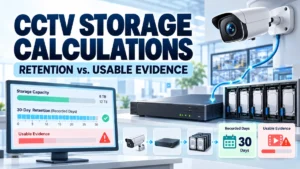
- Storage and bandwidth costs: Higher resolution footage consumes significantly more storage and network bandwidth, often forcing shorter retention periods.
- Alert fatigue: Traditional motion-based alerts triggered by rain, shadows, or animals overwhelm operators, causing them to ignore notifications altogether, including real ones.
In short, resolution answers “What did we see?” Intelligence answers “What do we need to act on, right now?”
Higher Resolution vs Intelligent Video Analytics
| Factor | Higher Resolution | Intelligent Video Analytics |
|---|---|---|
| Image Quality | Great detail, sharper zoom | Standard detail, focused on interpretation |
| Event Detection | None — requires human review | Automatic, real-time detection |
| Real-Time Alerts | Not supported natively | Core capability |
| Storage Requirements | High, grows with resolution | Optimised via event-based recording |
| Bandwidth Usage | High, especially for live streaming | Lower, especially with edge processing |
| Operational Efficiency | Limited without added tools | Significantly improved |
| Incident Response | Slower, reactive | Faster, proactive |
| Human Monitoring | Heavily dependent | Reduced dependency |
| Cost Effectiveness | Higher long-term storage/bandwidth costs | Better long-term ROI |
| Scalability | Costly across multiple sites | Easier to scale with cloud/edge models |
What Intelligent Video Analytics Actually Means
Intelligent video analytics refers to software, often powered by computer vision and deep learning, that automatically interprets video content to identify people, objects, behaviours, and events without requiring constant human observation.
Instead of passively recording, the system actively understands context. It can distinguish a person from a vehicle, recognise when someone crosses a virtual boundary, or flag a bag left unattended for too long.
Core capabilities typically include:
- Object detection: Identifying people, vehicles, and specific items within a frame
- Motion analytics: Filtering out irrelevant movement like foliage or lighting changes
- Behavioural analytics: Recognising patterns such as loitering, running, or crowd formation
- Intrusion detection and perimeter protection: Triggering alerts when defined zones are breached
- License plate recognition: Automatically reading and logging vehicle plates at entry points
- Facial recognition: Matching faces against watchlists, used selectively and with strict privacy safeguards given the sensitivity of biometric data
These capabilities can run at the edge, directly on the camera or a local processing unit, or in the cloud, depending on latency, bandwidth, and scalability needs.
Resolution vs Intelligence: What’s the Difference?
Resolution measures image clarity in pixels. Intelligence measures a system’s ability to understand and act on what the camera captures. They serve different purposes, and confusing them leads to poor investment decisions.
A helpful way to frame it: resolution is the eye, intelligence is the brain. One captures light; the other interprets meaning. A security system needs both, but only one of them can actually reduce response time.
Many facilities already own high-resolution cameras that sit on legacy Network Video Recorders (NVRs) with no analytics layer. The footage is crisp, but the alerts are still manual, delayed, or nonexistent. Adding intelligent analytics, sometimes even as a software upgrade layered on existing hardware, often delivers a bigger operational improvement than replacing cameras outright.
Real-World Examples Where Analytics Outperforms Resolution
- Warehouse intrusion: A perimeter breach at 2 a.m. in a poorly lit warehouse yard is easier to catch with an infrared-capable camera running intrusion analytics than with a high-resolution camera nobody is watching at that hour.
- Manufacturing plant monitoring: Behavioural analytics can flag a worker entering a restricted zone without protective equipment, triggering an immediate alert something resolution alone cannot detect.
- Retail theft detection: Analytics that recognise concealment behaviour or unusual dwell time near high-value shelves catch shoplifting patterns that a static high-definition feed would only reveal during a manual, after-the-fact review.
- School perimeter protection: Virtual tripwires around fences alert staff the moment someone climbs over, rather than relying on a guard noticing it on a monitor among dozens of others.
- Office building security: Facial recognition-assisted access logging (used with clear privacy policies) can flag unauthorised entry attempts far faster than manual badge checks paired with passive video review.
- Parking management: License plate recognition automates vehicle entry, exit, and violation tracking across large lots, a task that would be impractical to do manually even with the sharpest cameras.
- Logistics hub surveillance: Analytics can track dwell times at loading docks and flag unscheduled vehicle activity, improving both security and operational efficiency simultaneously.
- Healthcare facilities: Motion and behavioural analytics near restricted areas like pharmacies or NICUs add a layer of protection that pure image quality cannot provide, especially during high-traffic shifts.
How AI Detects Events Before Humans Notice Them
AI-powered video analytics processes every frame continuously, without fatigue, distraction, or shift changes. It applies trained models to recognise patterns that would take a human operator far longer to consciously register, if they register them at all.
Here is a simplified version of how it typically works:
- Capture: The camera records a continuous video stream.
- Detect: Computer vision models identify objects (people, vehicles, packages) within each frame.
- Classify: The system determines what type of object or behaviour is present.
- Correlate: The event is checked against predefined rules (restricted zone, time window, object type).
- Alert: If a match occurs, the system sends a real-time notification to the operator or security operations centre.
This entire sequence often happens in under a second, well before a human eye moving across a bank of monitors would even land on the relevant frame. That speed advantage is the core reason intelligent event detection is reshaping situational awareness in modern facilities.
Business Benefits of Intelligent Video Analytics
Beyond security outcomes, intelligent analytics deliver measurable operational value:
- Faster incident response through immediate, targeted alerts instead of delayed manual review
- Lower staffing pressure on security operations centres, since analytics pre-filter what deserves attention
- Reduced storage costs through smarter retention policies, such as archiving only flagged events at full resolution
- Better forensic accuracy, since analytics can quickly locate relevant clips
- Operational insights, such as foot traffic patterns or dock utilisation, that extend value beyond security
These benefits compound for organisations managing multiple sites, where consistent, scalable monitoring matters more than any single camera’s image quality.
Industries That Benefit the Most
While intelligent video analytics adds value almost everywhere, certain sectors see outsized returns:
- Retail: Theft prevention, queue management, and customer behaviour insights
- Manufacturing and industrial facilities: Safety compliance and perimeter protection
- Logistics and warehousing: Dock monitoring, intrusion detection, and asset tracking
- Education: Perimeter protection and access control for student safety
- Healthcare: Restricted-area monitoring and patient safety support
- Commercial real estate and offices: Access control, tailgating detection, and parking management
- Critical infrastructure: Intrusion detection and behavioural analytics around sensitive assets
Edge AI vs Cloud-Based Analytics
Both edge AI and cloud analytics have a place in modern surveillance, and the right choice depends on latency, bandwidth, and scale.
- Edge AI processes video directly on the camera or a local device. It reduces bandwidth usage, lowers latency, and keeps working during network outages, ideal for time-sensitive alerts like intrusion detection.
- Cloud-based analytics centralises processing across sites, making it easier to update models and scale without upgrading hardware everywhere. It depends on stable connectivity and ongoing subscription costs.
Many organisations now adopt a hybrid model: edge AI handles immediate alerts, while the cloud manages long-term reporting and system-wide intelligence.
Reducing False Alarms with AI
False alarms are one of the most persistent problems in traditional CCTV systems, and they are also one of the clearest areas where intelligent analytics outperform resolution improvements alone.
Traditional motion detection cannot distinguish between a falling leaf, a shadow, and an actual intruder; it just reacts to pixel changes. Intelligent analytics apply object classification first, so an alert only fires when the system confirms a relevant object, like a person or vehicle, is present in a defined zone.
This filtering dramatically reduces false alarm rates, which in turn reduces alert fatigue and rebuilds operator trust in the system. When operators trust their alerts, they respond faster and more consistently, a direct, measurable improvement in overall security posture.
Challenges and Best Practices
Intelligent video analytics is powerful, but it is not a plug-and-play guarantee of success. Common challenges include:
- Environmental conditions: Poor lighting, weather, or camera placement can affect detection accuracy
- Integration complexity: Analytics must work smoothly with existing VMS and NVR infrastructure
- Privacy and compliance: Facial recognition and biometric features require clear policies and adherence to local regulations
- Model tuning: Analytics rules need periodic calibration to match site-specific conditions
Best practices include starting with a clear use case, piloting on a small number of cameras before scaling, and involving both IT and security teams early, since analytics platforms increasingly sit at the intersection of both departments.
Future of Intelligent Surveillance
The next phase of surveillance technology is not about sharper images; it is about deeper understanding. Expect continued growth in multi-camera behavioural correlation, where analytics track a person or vehicle across multiple feeds to build a complete situational picture.
Integration between video analytics and other building systems access control, alarm systems, and occupancy sensors is also accelerating, moving surveillance toward a broader smart building intelligence layer.
As edge AI hardware becomes more powerful and affordable, more processing will happen on-camera, reducing dependency on bandwidth while keeping response times near-instant.
Expert Recommendations
For organisations evaluating their next surveillance investment, a few practical guidelines help clarify priorities:
- Treat resolution as a baseline requirement, not a competitive differentiator. 1080p to 4K is generally sufficient for most use cases once paired with strong analytics
- Prioritise analytics capabilities that map directly to your top risk: intrusion, theft, safety compliance, or access control
- Evaluate false alarm reduction performance during any product trial, since this directly affects operator trust and long-term system usage
- Ask integrators, such as those offering solutions like Impact by Honeywell CCTV, how their analytics platform handles edge cases like low light, crowding, or partial occlusion
- Plan for scalability from day one, especially if managing multiple sites, so analytics models and camera additions do not require a system redesign later
Key Takeaways
- Higher resolution improves image clarity but does not, by itself, improve detection speed or reduce false alarms.
- Intelligent video analytics uses computer vision and deep learning to detect, classify, and alert on events in real time.
- Real-world use cases across retail, manufacturing, healthcare, and logistics show analytics consistently outperforming resolution-only upgrades.
- Edge AI and cloud analytics each offer distinct advantages, and many organisations benefit from a hybrid approach.
- False alarm reduction is one of the clearest, most measurable benefits of intelligent analytics adoption.
- The future of surveillance is centred on situational awareness and system integration, not just sharper pixels.
Conclusion
Resolution will always matter for the moments when you need to zoom in and confirm a detail. But security is fundamentally about time, the time between an event happening and someone knowing about it. Intelligent video analytics closes that gap in ways that sharper pixels alone never will.
For system integrators, consultants like those working with an Impact by Honeywell CCTV Distributor in India, and facility managers planning upgrades, the lesson is consistent: invest in intelligence first, and let resolution support it, not replace it.
Read Also: Beyond Security: How CCTV Supports Business Operations
Read Also: Why Camera Quality Alone Doesn’t Define Surveillance Performance