Modern buildings are expected to operate for decades, yet many fire alarm systems are still selected based only on today’s requirements. As facilities expand, technologies evolve, and operational demands increase, long-term infrastructure planning has become just as important as the initial system design. A system sized for current occupancy can quietly become the bottleneck that slows down a renovation, a tenant fit-out, or a campus expansion ten years later.
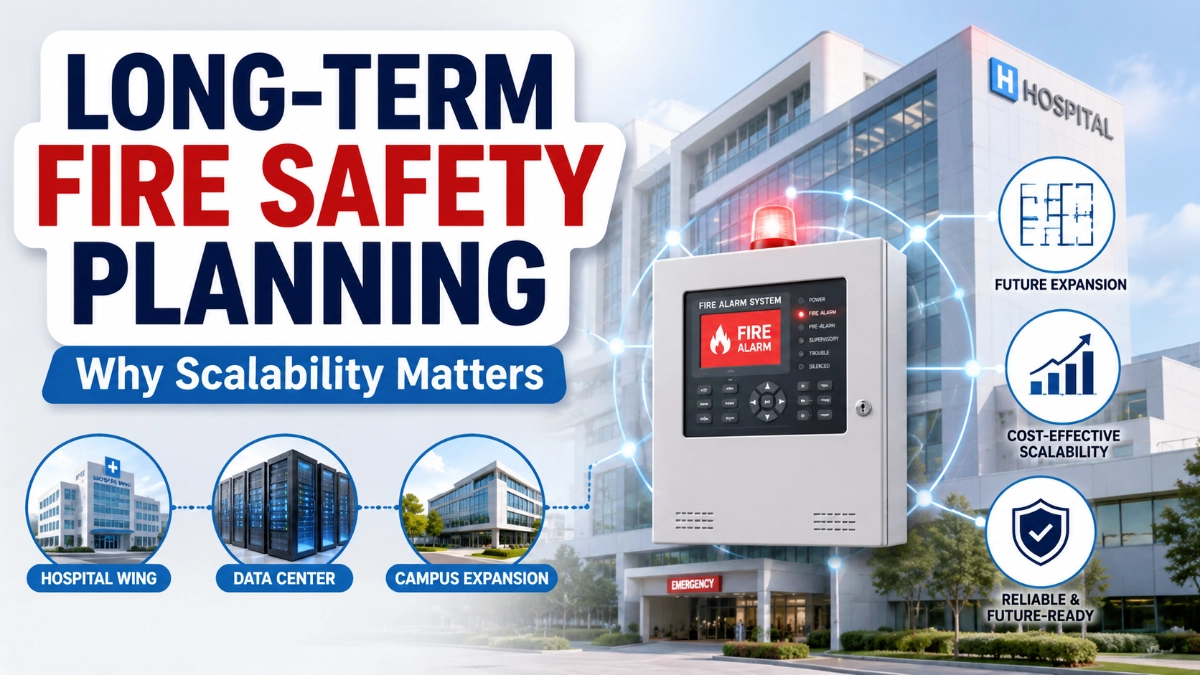
Commercial and industrial buildings rarely stay static. Hospitals add wings. Universities build new academic blocks. Manufacturing plants reconfigure production lines. Data centres expand capacity in phases. Every one of these changes touches the life safety system in some way: new zones, new devices, new integration points, new compliance requirements.
This is why fire alarm systems deserve to be evaluated the same way a facility evaluates its electrical distribution, its structured cabling, or its building management system: as long-term infrastructure, not as a one-time purchase tied to a single occupancy certificate.
Intelligent, addressable platforms of which Edwards Fire Alarm Systems are a widely deployed example were built around this idea. Addressable architecture, modular panel design, and networked communication give a fire detection platform room to grow alongside the building it protects, rather than requiring a full replacement every time the facility changes.
This article is written for the engineers, consultants, and facility owners who make that decision. It is not a product pitch. It is a planning framework a way of thinking about fire alarm infrastructure across a 20- to 30-year building lifecycle, using Edwards fire alarm control panels and detection devices as a concrete, real-world reference point throughout.
Long-term infrastructure planning treats fire alarm systems as evolving assets rather than fixed installations. Because buildings expand, occupancy changes, and technology advances, a fire alarm platform needs scalable device capacity, modular hardware, and networking capability built in from day one. Intelligent addressable systems, such as those built on Edwards fire alarm control panels like the EST4, EST3, and IO1000, are structured around expansion cards, networked nodes, and Signature Series device compatibility. This lets facilities add zones, buildings, or capabilities over time without discarding the core investment, reducing disruption, cost, and compliance risk at each stage of the building’s life.
Why Long-Term Infrastructure Planning Matters
A commercial or industrial building typically operates for 30 to 50 years, sometimes longer. The fire alarm system installed at handover is rarely the same in place at year 25, but whether that transition happens through incremental upgrades or full replacement depends almost entirely on decisions made at the design stage.
Facility Lifecycle
Every building moves through phases: initial fit-out, stabilisation, expansion, renovation, and eventually major retrofit or repositioning. A fire alarm platform that can’t track these phases forces owners into disruptive rip-and-replace cycles instead of incremental upgrades.
Expansion Planning
Hospitals add diagnostic wings. Campuses add dormitories and research buildings. Warehouses expand floor area. If the original fire alarm control panel has no spare loop capacity or networking headroom, expansion means a second, disconnected system or a costly early replacement of the first.
Operational Continuity
Fire alarm systems cannot go offline for long during upgrades. Life safety code enforcement and insurance requirements mean any modernisation has to happen with minimal disruption to occupied space. Systems designed for phased upgrades reduce this operational risk considerably.
Asset Protection
A fire alarm system protects the building’s other assets: people, inventory, equipment, and structure. Underinvesting in its scalability effectively puts a ceiling on how well those other assets are protected as the facility grows.
Technology Evolution
Detection technology, networking standards, and integration protocols change faster than building shells do. A platform with a modular architecture can absorb new detector generations or communication cards without a full panel swap.
Risk Management
From a risk standpoint, an undersized or inflexible fire alarm system is a liability that compounds over time. Every expansion becomes an exception to manage rather than a planned extension of the existing design.
The Evolution of Fire Alarm Systems
Understanding why intelligent platforms matter for planning requires a quick look at how fire alarm technology got here.
- Conventional systems wired detection zones directly to a panel, with no individual device identification. A fault or alarm told you which zone, not which device; adequate for small, static buildings, but difficult to scale or diagnose.
- Addressable fire alarm systems changed this by giving every detector, module, and call point its own electronic address. This allows a fire alarm control panel to pinpoint the exact device in alarm or trouble, which improves both response time and maintenance efficiency, and it is the foundation that makes scalable design possible in the first place.
- Intelligent fire alarm systems went a step further, embedding processing capability into the detectors themselves. Intelligent detection allows a smoke or heat sensor to analyse its own signal pattern, compensate for dust or drift, and communicate a calibrated status rather than a raw reading, reducing nuisance alarms while giving facility teams earlier, more reliable warning.
- Networked fire alarm ecosystems are the current stage of this evolution. Multiple panels, across buildings or floors, share a common fire alarm networking backbone, giving a campus or enterprise a single, unified view of life safety status. This is the layer that makes multi-building infrastructure planning realistic, since it removes the need to treat each building as an isolated fire safety island.
Each of these stages didn’t replace the one before it in the market; many buildings still run conventional zones in older wings, but for anyone planning new infrastructure or a major retrofit today, addressable and intelligent platforms are the practical starting point.
The Five Pillars of Future-Ready Fire Alarm Infrastructure
Fire alarm platforms that hold up over a multi-decade building lifecycle tend to share five structural characteristics. These aren’t marketing features; they’re the technical properties that determine whether a system can absorb change without being torn out.
| Pillar | What It Means | Why It Matters for Long-Term Planning |
|---|---|---|
| Scalability | Ability to add devices, loops, or panels beyond initial installed capacity | Avoids forced replacement when occupancy or floor area grows |
| Intelligent Detection | Devices that self-diagnose, compensate for environmental drift, and communicate detailed status | Reduces nuisance alarms and extends detector service life through condition monitoring |
| Network Connectivity | Panels can be linked across floors, buildings, or campuses on a common backbone | Enables centralised monitoring and phased, building-by-building expansion |
| Lifecycle Flexibility | Modular cards, backwards-compatible device lines, and firmware upgrade paths | Lets a facility modernize components without discarding the entire panel |
| Operational Resilience | Redundant communication paths, supervised circuits, and diagnostic reporting | Maintains life safety coverage during maintenance, expansion, or partial outages |
A platform strong in only one or two of these pillars will eventually create a planning bottleneck. A hospital, for example, might have excellent detection intelligence but no networking headroom, which becomes a problem the moment a second building needs to report to the same monitoring station.
How Edwards Fire Alarm Systems Support Long-Term Infrastructure Planning
Edwards Fire Alarm Systems are a useful reference point for this framework because the product line spans small buildings through enterprise campuses using a shared architectural logic, rather than a series of disconnected products.
Modular Architecture
Edwards fire alarm control panels are built around card-based, modular hardware. Loop controller cards, network interface cards, and I/O modules can be added to an installed panel rather than requiring a new enclosure. The Edwards IO1000, for instance, ships with a single intelligent device loop supporting up to 250 addresses, and can be expanded in 250-point increments up to 1,000 addresses through additional loop controller modules, a structure that lets a small-building installation grow into a larger one without a panel replacement.
Expansion Capability
At the larger end of the range, the Edwards EST3 platform supports multi-node networking up to eight nodes on an EST3X configuration, or as many as 64 nodes on a full EST3 network, which is the kind of headroom that matters for a hospital or university campus adding buildings over several years. The newer Edwards EST4 platform continues this logic with an updated network architecture designed for fire alarm, mass notification, and building integration on a single backbone.
Networked Communication
Fire alarm networking across Edwards panels allows multiple buildings or floors to report into a shared monitoring and annunciation structure. For a facility team managing several structures on one site, an airport terminal complex or a manufacturing campus, for example, this means alarm status, trouble conditions, and maintenance data can be reviewed centrally rather than building by building.
Intelligent Diagnostics
Devices in the Signature Series line used across Edwards panels report calibrated, addressable status information rather than a simple alarm/no-alarm signal. This supports condition-based maintenance planning, flagging a detector accumulating dust or drifting out of calibration before it becomes a nuisance-alarm source or a compliance issue.
Simplified Maintenance
Because devices and modules are individually addressed, service teams can isolate a fault to a specific point rather than a broad zone. Over a multi-decade lifecycle, this reduces the labour cost of troubleshooting and shortens the time a facility spends in a degraded monitoring state during repairs.
Operational Continuity
Modular expansion means new devices or zones can typically be commissioned without taking the entire panel offline for extended periods, an important consideration for occupied hospitals, campuses, and industrial facilities where continuous life safety coverage is a code requirement, not a convenience.
Integration Readiness
Edwards panels are commonly integrated with Building Management Systems (BMS) for functions like HVAC shutdown, damper control, and elevator recall on alarm. Planning this integration path at the infrastructure design stage rather than retrofitting it later is one of the more consistent gaps consultants encounter in older buildings.
It’s worth noting that Edwards is not the only vendor built around this addressable, networked logic. GST fire alarm systems are another example of an intelligent addressable platform used in commercial and industrial projects, and consultants evaluating vendors will typically compare scalability, networking capacity, and device ecosystem breadth across several manufacturers before specifying one for a long-term project.
Infrastructure Planning Across Different Industries
Scalable fire alarm infrastructure isn’t a generic requirement; the planning priorities shift by building type.
Hospitals
Hospitals expand in phases: new wings, diagnostic imaging suites, expanded ICUs, often while the existing facility stays fully occupied. Fire alarm infrastructure here needs networking capacity to bring new buildings onto an existing monitoring backbone without disrupting life safety coverage in occupied wards, plus tight integration with smoke control and HVAC systems.
Universities
Campus infrastructure grows a new dormitory one year, unevenly, a research building the next. Fire alarm networking across dozens of buildings, on a common standard, prevents a campus from ending up with a patchwork of incompatible legacy panels that can’t share monitoring data.
Manufacturing Plants
Industrial fire protection has to account for process changes, equipment relocation, and harsh environmental conditions. Addressable devices that can be relocated and re-commissioned on the same loop, rather than rewired from scratch, reduce downtime during production-line reconfiguration.
Airports
Airport authorities manage sprawling, multi-structure sites: terminals, concourses, cargo facilities that expand continuously. Centralised, networked fire alarm monitoring across these structures is less about convenience and more about the practical reality of coordinating emergency response across a large, occupied site.
Data Centres
Data centre expansions are frequent, and modular new server halls come online in phases. Fire detection infrastructure needs to scale in the same modular increments, along with tight integration to suppression and BMS systems that shut down power and cooling zones precisely.
Warehouses
Warehousing footprints change with throughput demand. Detection infrastructure that can extend into newly built or reconfigured storage bays without a parallel, disconnected system keeps monitoring unified as the facility grows.
Commercial Campuses
Multi-tenant commercial campuses need fire alarm infrastructure that can accommodate tenant fit-out changes without requiring landlord-level system redesign every time a floor changes hands.
Mixed-Use Developments
Mixed-use sites combine residential, retail, and office occupancies with different code requirements under one fire alarm ecosystem. Scalable, zone-flexible architecture makes it possible to manage these different occupancy types without separate, siloed systems.
Common Infrastructure Planning Mistakes
Consultants see the same planning gaps repeat across projects, regardless of building type:
- Planning only for current occupancy: Sizing a panel to exactly today’s device count leaves no room for even a modest future addition.
- Ignoring future expansion: Master plans for phased construction often don’t get shared with the fire protection engineer, so the system design misses known future phases.
- Choosing systems with limited scalability: Selecting a panel based purely on lowest upfront cost, without checking loop and node expansion limits, creates an expensive early replacement.
- Delaying modernisation: Deferring upgrades until a system is obsolete increases both cost and compliance risk, since spare parts and support for legacy platforms shrink over time.
- Underestimating maintenance requirements: Long-term operating cost inspection labour, device replacement cycles, and false-alarm troubleshooting are often left out of the initial investment case entirely.
- Focusing only on initial cost: The lowest bid on installation day is not necessarily the lowest cost across a 25-year facility lifecycle once expansion and maintenance are factored in.
A Consultant’s Framework for Future-Proof Fire Alarm Planning
A structured planning sequence helps translate these principles into a specific project scope.
| Step | Focus Area | Key Questions |
|---|---|---|
| 1. Risk Assessment | Occupancy type, hazard classification, code jurisdiction | What life safety code and occupancy risk govern this facility? |
| 2. Facility Growth Analysis | Master plan, phased construction, occupancy trends | What expansion is already planned, and over what timeframe? |
| 3. Device Capacity Planning | Current and projected device counts by zone | What loop and panel capacity is needed at year 1, year 10, year 20? |
| 4. Network Design | Single-panel vs. multi-node vs. multi-building network | Does the site need centralised monitoring across structures now or later? |
| 5. Integration Requirements | BMS, suppression, access control, mass notification | Which systems must the fire alarm platform communicate with? |
| 6. Lifecycle Budgeting | Capital cost vs. maintenance, upgrade, and replacement cost | What is the realistic total cost of ownership over 20–30 years? |
| 7. Maintenance Planning | Inspection frequency, spare parts, service contracts | Who maintains the system, and how is device health tracked over time? |
This sequence is deliberately front-loaded on questions rather than product selection. Vendor and panel choice whether an Edwards EST4 fire alarm panel, an EST3 fire alarm control panel, or an IO1000 fire alarm panel for a smaller facility should follow from these answers, not precede them.
Future Trends in Infrastructure Planning
Several developments are reshaping how consultants and facility owners think about fire alarm infrastructure over the next decade:
- Smart buildings are increasingly designed with fire alarm data feeding into a broader building intelligence layer, rather than sitting as an isolated system.
- AI-assisted diagnostics are beginning to appear in device and panel software, helping flag abnormal detector behaviour before it triggers a fault or nuisance alarm.
- Predictive maintenance models use device-level status history to schedule cleaning or replacement based on actual condition rather than fixed calendar intervals.
- Cloud-based monitoring is extending centralised oversight to portfolios of buildings, not just single campuses, which matters for owners managing multiple sites.
- IoT integration is connecting fire alarm data with occupancy sensors, environmental monitoring, and energy systems for a more complete operational picture.
- Digital twins of buildings increasingly include fire alarm device locations and status as a live data layer for facility management teams.
- Enterprise-wide safety management platforms are consolidating fire, security, and mass notification data for organisations with many sites under one compliance umbrella.
- Sustainable infrastructure planning is pushing toward longer device service life and modular upgrades over full replacement, reducing electronic waste tied to fire safety systems.
None of these trends eliminates the fundamentals; they raise the bar for what “scalable” needs to mean going forward.
Expert Recommendations
- For Consultants: Request the client’s 10- and 20-year facility master plan before finalising panel selection. A system sized against a static occupancy count, without visibility into future phases, is the single most common source of costly rework.
- For Facility Managers: Track device-level diagnostic data over time, not just alarm and trouble events. A rising pattern of “dirty detector” flags across a zone is often the earliest indicator of a maintenance or environmental issue worth addressing before it affects reliability.
- For Architects: Coordinate fire alarm infrastructure early with structured cabling and BMS design, since panel and network locations affect both device wiring runs and integration points that are expensive to relocate later.
- For EPC Contractors: Build spare loop and network node capacity into the as-built documentation handover, so future contractors aren’t guessing at available headroom when a client requests an expansion.
- For Procurement Teams: Evaluate total cost of ownership including spare parts availability, service contract terms, and device replacement cycles rather than comparing installed cost alone across bids.
- For Building Owners: Treat fire alarm modernisation as a capital planning line item on the same multi-year cycle as roofing, HVAC, or elevator modernisation, rather than an unplanned emergency expense.
Original Insights for Infrastructure Planning Teams
A few observations from project experience that go beyond standard manufacturer documentation:
- Network node capacity is consumed faster than device capacity in campus settings: Facilities often run out of network nodes for new buildings well before they run out of device addresses on existing loops. Plan node headroom as its own line item, separate from device count.
- Diagnostic data is an underused planning input: Trend data on detector drift and dirty-device flags, collected over several years, gives a far more accurate picture of when a detection generation needs replacing than the manufacturer’s stated service life alone.
- Integration debt compounds: Every year a fire alarm system runs without a defined BMS integration path, the eventual integration project gets more expensive, because building automation platforms evolve independently and drift further from compatibility.
- Phased commissioning reduces downtime risk more than panel capacity does: A facility with generous spare capacity but no commissioning plan for adding zones without disrupting occupied space still experiences the same operational risk as an undersized system.
- Legacy platform end-of-life dates should be checked at the design stage, not the replacement stage: Specifying a panel on a platform already nearing the end of its manufacturer support lifecycle, as has happened with EST3 giving way to EST4, shortens the useful planning horizon before the project even starts.
- Multi-building sites benefit from a shared device standard even more than a shared panel standard: Standardising on one detector and module ecosystem across buildings, even where panel models differ by building age, keeps spare parts and technician training manageable.
- Maintenance staffing turnover is a hidden infrastructure risk: Systems that rely on deep institutional knowledge of a specific legacy configuration become fragile when the one technician who understands them retires or leaves; clear documentation and standard architecture reduce this exposure.
Read Also: How Edwards Fire Alarm Systems Support Long-Term Infrastructure Planning
Read Also: Why Edwards Fire Alarm Systems Are Trusted for Critical Infrastructure