The fire alarm installation is substantially complete. Panels are operational, and most devices are tested. Still, handover is close, and four issues remain: an interface has not been verified, a drawing conflicts with the installed condition, a device label is wrong, and a test record is missing.
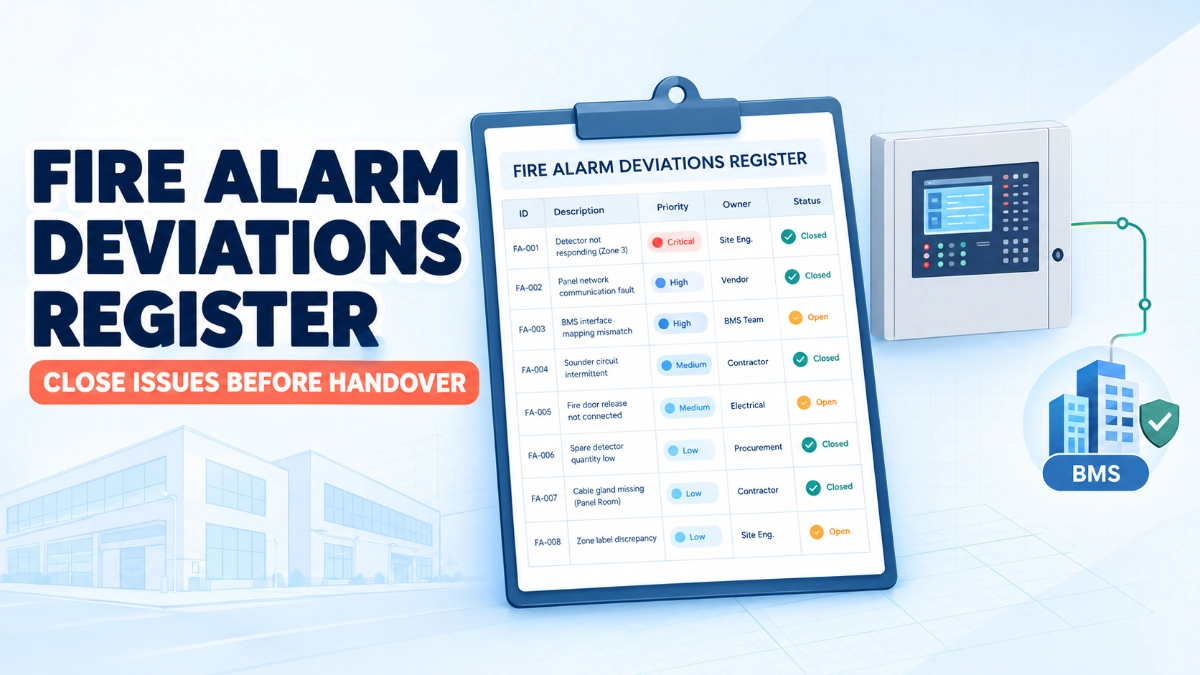
These four items do not carry equal weight. The label and the missing record are documentation gaps. The drawing conflict creates uncertainty about the installed condition. The unverified interface may affect a required function. Verbal assurances and an unstructured pending list cannot show those differences.
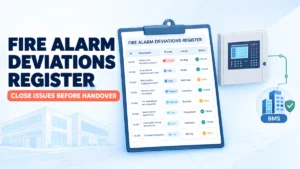
A fire alarm deviations register is the controlled mechanism for this. It establishes ownership, assesses impact, tracks corrective actions, records evidence, and supports an informed handover decision. An open item does not make the whole system unsafe, but every open item needs a classification and a route to closure.
A fire alarm deviations register is a controlled record of departures from approved design, specification, installation, testing, or documentation requirements. Each entry captures location, description, governing requirement, risk rating, owner, corrective action, verification method, and evidence reference. Closure means more than “complete”: the correction must be verified, evidence retained, and closure accepted by the appropriate person or authority.
What Is a Fire Alarm Deviations Register?
It is a project record for managing departures from design intent, specified requirements, installation details, testing criteria, or agreed documentation. It links each issue to its technical impact, owner, evidence, and acceptance status. That linkage is what separates it from a punch list.
Terminology varies by organisation and contract. These practical distinctions are not universal legal definitions:
- Deviation: A departure from an approved requirement, design, or agreed specification.
- Defect: A confirmed deficiency against an applicable requirement or acceptance criterion.
- Observation: A condition needing review, not yet confirmed as a deviation or defect.
- Punch-list item: An outstanding task, which may or may not be a technical deviation.
- Non-conformance: A documented failure to meet a specified requirement, handled under the project’s quality process.
Which Fire Alarm Issues Belong in the Register?
| Issue Category | Example | Potential Impact | Evidence Needed for Closure |
|---|---|---|---|
| Design/drawing discrepancies | Drawing shows a device location that conflicts with the installed condition | Uncertain installed condition; maintenance errors | Approved revised drawing or design clarification |
| Installation/workmanship | Unsecured cable support; incomplete termination | Reliability concerns | Inspection record; rectification sign-off |
| Addressing/labelling | Label does not match the programmed device address | Misidentification during an event or maintenance | Verified label schedule; device-by-device check |
| Panel configuration/cause-and-effect | Programmed output differs from the approved matrix | Required sequence may not operate as intended | Configuration comparison; functional test against matrix |
| Interfaces (BMS, HVAC, access control, smoke control, PAVA) | Signal to the connected system not demonstrated | Dependent response unverified | End-to-end test record with both parties’ sign-off |
| Device/circuit/communication faults | Intermittent loop fault | Possible impaired detection or signalling | Fault diagnosis; corrective action; retest results |
| Incomplete commissioning/testing | Test scope not completed in an area | Unproven function | Completed, witnessed test records |
| Missing records/certificates/as-builts | No as-built drawings for a modified zone | Unreliable maintenance and acceptance | Issued, reviewed as-built documents |
| Training/handover deliverables | Operator training not delivered | Operational readiness gap | Training record and attendance |
| Unresolved approvals/change requests | Site change without design approval | Installed work not authorised | Approved change record |
A missing document and a confirmed functional failure both belong in the register, but they differ in priority and closure method. A missing certificate closes when the correct document is issued and reviewed. A functional failure closes only after correction and retesting.
How to Build a Useful Fire Alarm Deviations Register
| Register Field | What It Should Capture | Why It Matters |
|---|---|---|
| Unique ID | Non-repeating reference | Traceability across reports and meetings |
| Date identified | Raising date and source | Ageing and escalation |
| Location reference | Building, floor, zone, panel, or device | Precise localisation |
| Description | Factual observed condition | Removes ambiguity |
| Governing requirement | Drawing, specification, or requirement | Establishes the departure |
| Classification/risk rating | Deviation, defect, or observation; preliminary priority | Drives response |
| Potential functional impact | Affected detection, notification, or sequence | Supports escalation |
| Interim control | Authorised temporary measure, if any | Manages exposure |
| Responsible party | Named person or organisation | Accountability |
| Target date | Agreed resolution date | Schedule control |
| Corrective action | Specific work required | Defines scope |
| Verification method | Inspection, test, or document review | Sets the closure standard |
| Evidence reference | Report or record number | Auditability |
| Status/revision history | Open, in progress, verified, closed; changes | Shows progress |
| Reviewer/approver | Who verified and accepted | Independence |
| Acceptance/escalation record | Final decision or escalation route | Handover decision basis |
Descriptions must be factual and specific.
- Poor: “BMS issue.”
- Better (hypothetical): “Panel A output to BMS fire status point not observed on BMS graphics during the agreed integrated test on Level 2. Approved interface schedule rev. B, line 14 applies.”
How to Prioritise Open Deviations Before Handover
Prioritise by potential effect on required functions, not by how loudly an item is chased. Ask:
- Could a required detection or alarm function be impaired?
- Is occupant notification or an approved cause-and-effect sequence affected?
- Does an interface or emergency response dependency remain unverified?
- Does the issue create uncertainty about the installed system’s condition?
- Does a documentation gap prevent reliable maintenance or acceptance?
- Is the item cosmetic or administrative, and manageable separately?
These labels are illustrative project-management categories, not statutory classifications.
| Priority | Typical Example | Expected Management Response |
|---|---|---|
| Critical | Required alarm function or sequence not operating as approved | Immediate escalation; assess interim controls; no closure without retest |
| High | Interface unverified; unresolved design approval affecting function | Prompt owner action; defined test plan; management visibility |
| Medium | Missing as-builts; labelling mismatch | Scheduled correction; documented verification |
| Low | Minor cosmetic or administrative item | Track separately; close in normal workflow |
Any issue potentially affecting required life safety functions must be escalated promptly to the responsible project and safety authorities. This guide sets no universal closure deadlines. Those come from the contract, project procedures, and applicable requirements.
Ownership and Accountability: Who Must Close Each Issue?
Four roles are often blurred and should stay separate: identifying an issue, implementing the correction, verifying the result independently, and accepting closure.
| Deviation Type | Identifies | Resolves | Verifies | Accepts |
|---|---|---|---|---|
| Design discrepancy | Contractor/commissioning/QA | Design consultant | Consultant/QA | Client/consultant |
| Installation defect | QA/QC, commissioning | Fire alarm contractor | QA/QC | Main contractor/client |
| Configuration mismatch | Commissioning | Integrator | Commissioning/consultant | Consultant/client |
| Interface issue | Commissioning | Both contractors | Commissioning, witnessed | Consultant/client; AHJ if required |
| Missing records | QA/handover team | Responsible contractor | QA/consultant | Client/facility representative |
This matrix is typical, not universal. Actual responsibility depends on the contract, approved procedures, scope boundaries, and regulations. The authority having jurisdiction (AHJ) is involved only where applicable.
Temporary Controls for Unresolved Life Safety Issues
When an unresolved issue may affect a required function before permanent correction is possible:
- Escalate immediately to the responsible project and facility authorities.
- Assess the affected area and required function.
- Document interim measures and obtain approval from the appropriate authority.
- Assign clear ownership and review intervals.
- Inform affected operations and maintenance personnel.
- Define the plan for permanent correction and verification.
- Record the decision and its eventual closure.
Temporary measures are not substitutes for compliant permanent work, formal acceptance, or statutory requirements. Never use improvised bypasses, disable protection, or make unapproved changes to alarm logic.
How to Verify and Close a Fire Alarm Deviation
- Confirm the original issue and the requirement it affects.
- Approve the corrective action where required.
- Implement it through authorised personnel.
- Inspect the affected installation or configuration.
- Test the affected function and related dependencies.
- Record results, observations, and remaining limitations.
- Update drawings, device schedules, and configuration records.
- Obtain technical review and acceptance.
- Update the register with traceable evidence references.
Verification scope must match the change. A corrected label may need a physical check against the schedule. A modified alarm sequence or interface needs functional testing of the sequence and its dependencies. Testing one device does not prove an entire system or interface works.
A Practical Example: Closing an Unverified Fire Alarm Interface
This is a hypothetical example and does not describe any specific manufacturer product behaviour.
During integrated commissioning, the panel reports the expected event locally, but the corresponding BMS indication was not demonstrated during the agreed test.
- Record: Log DEV-027 with the test reference and the interface schedule line.
- Define: State the intended signal and expected BMS result.
- Assign: Name responsible parties in both the fire alarm and BMS contractors.
- Assess: Determine whether any required function depends on this signal. Not every BMS interface is safety-critical.
- Agree: Set the corrective action and test scope.
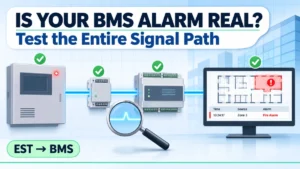
- Verify: Test the complete signal path, from initiating condition through panel output and interface to BMS indication, and not only one side.
- Retain: Keep test results and updated interface documentation.
- Approve: Obtain closure from the designated reviewer.
“BMS checked” is not closure evidence. It does not say what was tested, which signal, or what was observed.
Common Deviations Register Mistakes That Delay Handover
| Common Mistake | Why It Causes Problems | Better Practice |
|---|---|---|
| Vague descriptions | Action and verification are unclear | Record location, condition, and requirement |
| No named owner | Nobody acts | Assign a person or organisation |
| Everything low priority | Critical items are buried | Apply a risk-based framework |
| Closing on verbal confirmation | No auditable record | Require documented evidence |
| Missing test evidence | Closure cannot be shown | Link each closure to a record |
| Extending dates without escalation | Hidden schedule risk | Escalate after set review points |
| Mixing observations and defects | Unclear status | Classify and reclassify explicitly |
| Not updating as-builts | Records misrepresent the system | Make documentation part of closure |
| Testing one side of an interface | Signal path unproven | Verify end-to-end, both parties |
| Handing over open items undocumented | Obligations unclear | Record acceptance or a management plan |
Handover Readiness Checklist
- Every deviation has a unique reference.
- The issue and affected location are clear.
- Priority reflects potential impact.
- Owners and target dates are assigned.
- Corrective actions are documented.
- Potentially impaired life safety functions are escalated.
- Temporary measures are formally controlled.
- Closure evidence is traceable.
- Required testing is completed and recorded.
- Drawings and records reflect verified changes.
- Outstanding items have a documented acceptance or escalation route.
- The client or authorised representative understands remaining limitations and obligations.
This checklist supports project governance. It does not replace commissioning, formal acceptance testing, statutory inspection, or contract and AHJ requirements.
Key Takeaways
- A deviations register is a control record, not a spreadsheet.
- Distinguish deviations, defects, observations, and punch-list items.
- Write factual, specific entries tied to a governing requirement.
- Prioritise by potential effect on required functions.
- Separate identification, correction, verification, and acceptance.
- Escalate potentially impaired life safety functions promptly.
- Treat temporary controls as authorised, documented, time-bound arrangements.
- Match verification scope to the change; verify interfaces end to end.
- Never close items on verbal confirmation.
- Handover decisions rest on documented acceptance, not assumptions.
Read Also: EST Fire Alarm Configuration Governance: Keep Records Aligned
Read Also: Standardising EST Across Buildings: Benefits and Risks