One Organisation, Multiple Buildings, Different Fire Alarm Realities
A corporate engineering team asks every site to submit fire alarm documentation in one standard format. Three buildings respond. The oldest has an earlier installation and hand-revised drawings. The newest has an addressable system with exported device lists. The third is a process facility with a different occupancy profile and fire strategy.
The submissions do not match. Device descriptions differ, drawings follow different naming conventions, configuration records sit on a contractor’s laptop or a site engineer’s drive, and each maintenance team follows its own approval routine.
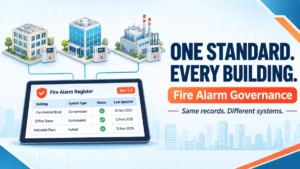
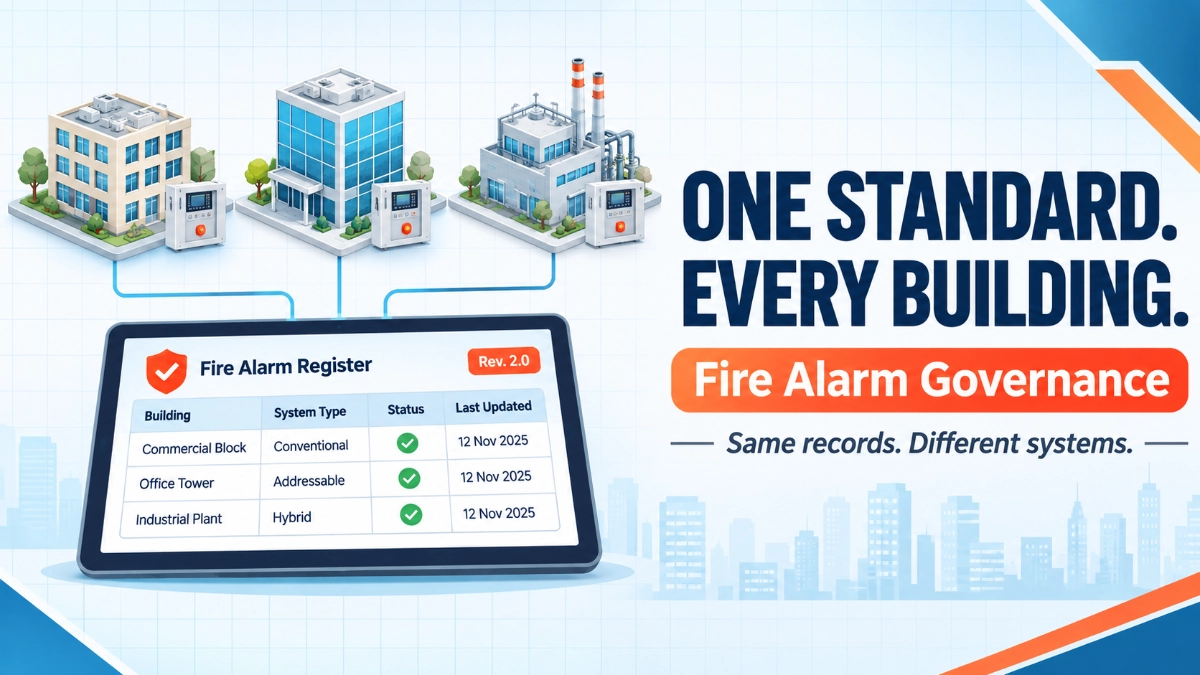
The instinct is to demand identical systems. That is rarely practical, because each building carries different risks. The real task is to standardise how information, responsibilities, changes, and records are controlled. Organisations operating multiple facilities need a consistent governance approach for their EST fire alarm systems, particularly when technical documentation and maintenance responsibilities are distributed across different sites. That approach is enterprise fire alarm governance.
What Is Enterprise Fire Alarm Governance?
Enterprise fire alarm governance is the organisation-wide framework for managing technical documentation, system information, configuration changes, approval responsibilities, asset records, and maintenance evidence across multiple facilities. Its objective is consistent management and traceability. It does not require identical equipment, architecture, or fire alarm designs in every building. Common rules control the records; competent engineers still design each system for its own building.
Why Multi-Building Fire Alarm Documentation Becomes Inconsistent
Inconsistency rarely comes from negligence. It accumulates through different contractors and integrators, separate project completion dates, mixed panel generations, site-level maintenance habits, unclear ownership of configuration backups, and building modifications that never reach approved records.
| Documentation problem | Why it happens | Enterprise-level consequence |
|---|---|---|
| Conflicting device names | Each contractor applies its own convention | Faults cannot be matched to drawings quickly |
| Unrevised drawings | Changes made without central notification | Audits rely on outdated information |
| Scattered configuration backups | No named owner or storage rule | Recovery depends on individuals |
| Mixed drawing formats | Projects handed over at different times | Upgrade planning needs re-survey |
| Site-specific maintenance reports | Local contractor templates | Estate-wide trends cannot be compared |
The cost is practical: slower fault response, harder audits, unreliable upgrade budgets, and a weak picture of what is actually installed.
What Should Be Standardised Across Every Building?
Set minimum information requirements and consistent templates. Accurate records of EST devices and detectors help maintenance teams connect installed equipment with approved drawings, asset information, and inspection history, but only if every site records them in the same structure.
| Governance element | Standardisation requirement | Why it matters |
|---|---|---|
| Document naming | One identification scheme | Documents are found and traced |
| Drawing revision control | Common revision rules and status | Current versions are unambiguous |
| Device naming | Defined fields, plus mapping to legacy names | Records are comparable across sites |
| Asset register | One structure and minimum fields | Estate-wide visibility |
| Panel identification | Platform, location, and ownership recorded | Correct technical references |
| Configuration backups | Named owner, controlled access, version identification | Protects controlled information |
| Maintenance records | Common record structure | Comparable evidence |
| Change approval | One workflow | Traceable modifications |
| Commissioning and handover | Required evidence list | Complete baseline records |
| Ownership and access | Defined roles and permissions | Accountability |
What Should Remain Different Between Buildings?
Governance must not force identical technical arrangements. Occupancy and evacuation strategy, fire risk and process conditions, structural constraints, detection and notification needs, existing architecture, panel generations, interfaces with BMS, PAVA, lifts, and access control, local regulatory and project requirements, and operating hours all legitimately differ.
| Area | What should be standardised | What may remain site-specific |
|---|---|---|
| Device records | Common data fields | Device types and quantities |
| Drawings | Revision and naming rules | Building layouts |
| Panel information | Identification and documentation format | Panel architecture and capacity |
| Maintenance | Record structure and reporting | Site-specific maintenance schedules |
| Interfaces | Documentation and approval process | Actual interface requirements |
| Fire strategy | Governance and review process | Building-specific strategy |
Standardised governance does not mean identical engineering design.
EST3 and EST4 Panels: Why Platform Differences Matter in Enterprise Governance
Long-running estates often hold more than one fire alarm generation, because buildings are delivered and refurbished at different times. EST3 and EST4 Panels illustrate the point.
Records must identify the installed platform accurately. Panel-specific configuration, device records, drawings, and maintenance information should be retained for each installation. A shared brand name is not evidence of compatibility, so any compatibility or migration assumption must be verified against manufacturer documentation and by competent, authorised personnel. EST3 and EST4 Panels should not be treated as interchangeable.
Governance supplies the common documentation rules. The system-specific technical record stays specific to the system.
Building an Enterprise Fire Alarm Documentation Framework
Layer 1: Enterprise standards. Common templates, naming conventions, minimum data fields, and revision rules.
Layer 2: Building-level records. Site drawings, panel identification, device schedules, and building fire strategy information.
Layer 3: Configuration and technical records. Verified configuration information, approved changes, system-specific records, and controlled backup identification and access.
Layer 4: Operational records. Maintenance history, faults and impairments, inspection and testing evidence, and restoration records.
Layer 5: Governance and accountability. Document ownership, approval responsibilities, review cycles, audit trails, and escalation.
Layer 1 sets the rules, Layers 2 to 4 hold the evidence, and Layer 5 keeps the evidence trustworthy.
How to Manage Documentation Changes Across Multiple Sites
The same workflow should cover a relocated detector, a modified panel configuration, a new building, a renovation, a system upgrade, or a change of maintenance contractor:
- Raise a change request.
- Identify the affected building and system.
- Assess technical and operational impact.
- Obtain appropriate approvals.
- Implement the approved modification.
- Complete required verification and testing.
- Update drawings, asset records, and technical documentation.
- Record the revision and close the change.
The central register should reflect approved, verified changes, not assumptions. Contractor changeovers deserve particular care: require a documented handover of records, backups, and open impairments.
Common Enterprise Fire Alarm Governance Mistakes
| Mistake | Consequence | Better practice |
|---|---|---|
| Forcing identical designs | Unsuitable for building risk | Standardise records, not architecture |
| Different device names, no mapping | Cross-site confusion | Maintain a mapping table |
| Drawings kept separately | Hidden outdated revisions | Central revision visibility |
| Not identifying EST3 and EST4 installations | Wrong technical references | Record platform per panel |
| Contractor changes not recorded | Records diverge from reality | Make record update a closure condition |
| Configuration data without an owner | Recovery uncertainty | Assign owner and access control |
| Commissioning documents treated as permanent | Records go stale | Maintain living operational records |
| No device-to-register reconciliation | Missing or phantom assets | Reconcile on a scheduled basis |
| One generic maintenance template | Technical differences ignored | Common core, site-specific sections |
| Collecting rather than checking documents | Inaccurate but complete files | Verify against the installed system |
Practical Example: Standardising Fire Alarm Records Across Three Buildings
This scenario is illustrative, not a real customer case study.
An enterprise operates Building A, an older commercial facility with an EST3 installation; Building B, a newer office building using EST4 Panels; and Building C, an industrial facility with a different risk profile and its own requirements.
It introduces one document identification standard, one asset register structure, consistent device naming fields, centralised revision tracking, and one change approval process. Each building keeps its own technical records, and system-specific configuration documentation is held separately for the EST3 and EST4 Panels installations.
Building C’s process-driven strategy is documented as an approved site-level exception. All three buildings now report in a common structure, yet none was redesigned to match another.
Enterprise Fire Alarm Governance Checklist
- Documentation: Common templates established; drawing revision rules defined; device naming conventions established; building-level records maintained.
- Technical governance: Panel platform identified; device and panel information verified; system-specific configuration records maintained; interfaces documented.
- Change management: Approval responsibilities assigned; change requests recorded; testing evidence retained; revised documents approved.
- Enterprise control: Document ownership assigned; central register maintained; site-level exceptions documented; periodic reviews conducted.
When planning new installations, upgrades, or standardised procurement across multiple facilities, organisations may also evaluate an experienced EST fire alarm system distributor in India for product availability and project-level technical coordination. Always confirm requirements against local regulations, project specifications, and manufacturer documentation.
Key Takeaways
- Standardise governance, not system architecture.
- Define minimum data fields and templates for every site.
- Map legacy device names rather than overwriting them.
- Identify each panel platform accurately.
- Treat configuration backups as controlled information.
- Update central records only from approved, verified changes.
- Document site-level exceptions deliberately.
- Reconcile installed devices against the asset register.
- Document standardisation alone does not ensure compliance.
Read Also: Fire Alarm System Impairment Management: What Should Happen Before a Device or Loop Is Isolated?
Read Also: EST System Testing After Building Modifications: What Must Be Revalidated?