Introduction: A Small Isolation Can Create a Larger Protection Gap
A maintenance supervisor at a manufacturing plant has had three unwanted alarms from the same smoke detector in a week. The quickest way to stop the disruption is to disable the address from the fire alarm control panel. Elsewhere, a contractor modifying a partition needs to disconnect part of a loop for a few hours. Both jobs look routine, and both can be done in minutes.
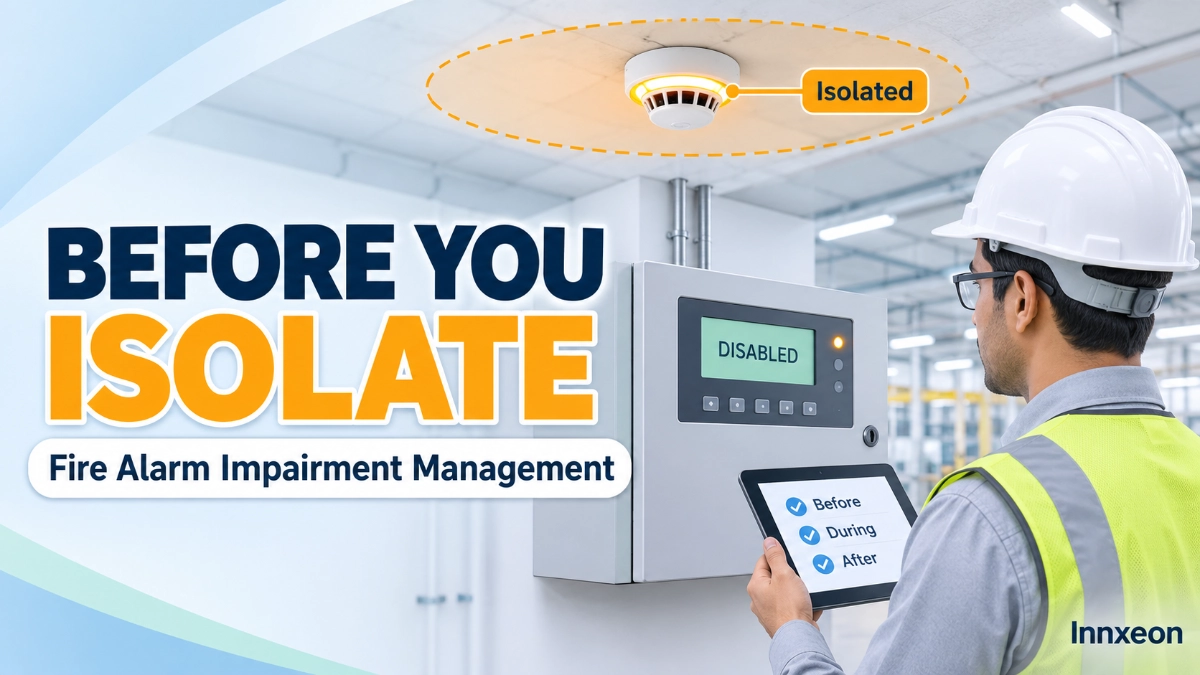
The concern is what the isolation removes. The detector, the loop segment, or the notification circuit may be the only protection serving a storage bay, an electrical room, or a production line. Devices downstream of a disconnected loop section may also lose their path to the panel, and a linked interface may no longer execute its sequence.
Impairment management is the controlled process that prevents these isolations from becoming forgotten, uncommunicated, or open-ended. It protects people, assets, operations, and accountability by making sure reduced protection is assessed, approved, compensated for, tracked, and verified as restored.
What Is Fire Alarm Impairment Management?
Fire alarm impairment management is the planned process of assessing, authorising, controlling, monitoring, documenting, and restoring fire alarm protection that is temporarily unavailable. It covers isolated devices, disabled loops or circuits, and impaired panel functions. The controls required depend on the extent of the impairment, the risk in the affected area, applicable codes and authority requirements, insurer conditions, and the site’s own impairment procedure.
What Is a Fire Alarm System Impairment?
A fire alarm system impairment is any condition in which part or all of the system cannot perform its intended detection, notification, control, or signalling function. It may be planned, such as a maintenance isolation, or unplanned, such as a fault, a failed power supply, or a damaged cable.
An isolated device does not mean the whole system is unavailable. It does create a local protection gap, and the size of that gap depends on what the device or circuit does and what depends on it.
| Impairment type | Example | Potential operational impact |
|---|---|---|
| Single device isolated | Smoke detector disabled after repeated unwanted alarms | Loss of detection at one location; adjacent coverage may not be equivalent |
| Loop or circuit disabled | Loop section opened during cable repair or area modification | Multiple detectors and modules unavailable; possible loss of devices beyond the break if the loop is not fed from both ends |
| Notification appliance or circuit unavailable | Sounder circuit disabled during ceiling work | Occupants in the area may not receive audible or visual warning |
| Panel or network function impaired | Network node offline, output group disabled, or remote signalling disconnected | Loss of cause-and-effect execution, remote monitoring, or alarm transmission to the control room or monitoring service |
| Partial or complete system outage | Panel shutdown for upgrade or power loss without adequate standby | Wide or total loss of detection and warning across the affected buildings or zones |
Two points follow from this table. First, impairments are not only about detectors: outputs, interfaces, and signalling paths are part of the protection. Second, the impact should be assessed from the device’s role in the overall design, not from the number of addresses on the panel’s disablement list.
Why Are Fire Alarm Devices or Loops Isolated?
Common reasons include:
- Detector replacement or cleaning
- Recurring unwanted alarms requiring investigation
- Cable repair
- Loop fault investigation
- Building renovation
- Ceiling or partition modifications
- Device relocation
- Panel maintenance
- System upgrades
- Testing and commissioning activities
The distinction that matters is between planned maintenance isolation and unplanned impairment. A planned isolation has a defined scope, a reason, a duration, an approver, and compensatory measures decided in advance. An unplanned impairment, such as a loop fault or an open circuit, appears without warning and has to be assessed, escalated, and managed with the same discipline, usually under more time pressure.
Isolation should never become a substitute for diagnosing a recurring fault. Disabling a detector that keeps alarming removes the symptom and the protection. The underlying cause, which may be dust, steam, process emissions, airflow, device placement, detector type, or a degraded sensor, remains unresolved. Where a site treats repeated disablement as the normal answer to unwanted alarms, the impairment log itself becomes evidence that the design or maintenance approach needs review.
What Must Be Evaluated Before Isolation?
A pre-isolation assessment should be short enough to complete quickly and structured enough to catch the gaps that cause trouble later. Four areas need attention.
A. Identify the exact affected equipment
- Device address and description
- Loop or circuit identification
- Panel and network location
- Building, floor, room, and operational zone
- Associated notification or control functions
Panel descriptions and field reality often differ. Address labels, zone text, and device schedules should be cross-checked before anything is disabled, particularly on sites with older or modified systems.
B. Understand the protection impact
- Which detection coverage may be lost?
- Which occupants or operational areas may be affected?
- Are adjacent devices or circuits dependent on the affected equipment?
- Could an interface or automatic sequence be affected?
- Is the impairment localised or wider than initially expected?
Loop topology is the usual source of surprises. Opening a loop at one point may leave devices fed from one end only, and a second fault would then isolate further devices. Isolating a module can also disable the output it controls, such as a damper, door holder, fan shutdown, or gas release interlock.
C. Review the operational risk
- Occupancy and activity in the affected area
- Presence of combustible materials or hazardous processes
- Critical operations
- Existing fire protection arrangements
- Duration and timing of the proposed work
- Availability of alternative detection or notification arrangements
The same detector isolation carries very different risk in an empty office corridor and in a battery charging room, a high-bay warehouse, or a switch room during a shutdown. The timing also matters: isolating overnight or over a weekend, when fewer people are present to notice a fire, changes the picture.
D. Confirm the work scope
- Why is isolation required?
- What work will be performed?
- Who will perform it?
- How long is the isolation expected to last?
- What happens if the work takes longer than planned?
The last question is often left unanswered. A defined review point or escalation trigger for overruns prevents an approved four-hour isolation from quietly becoming a four-day one.
Pre-isolation assessment table
| Check | Key question | Evidence or output |
|---|---|---|
| Equipment identification | Are the address, loop, panel, and physical location confirmed against drawings and device schedules? | Verified device list and location |
| Protection impact | What detection, notification, and control functions are lost, including dependent devices? | Documented impact statement |
| Interfaces and sequences | Will any shutdown, release, door, damper, or signalling function be affected? | Cause-and-effect review |
| Operational risk | What is in the area, who is present, and what hazards or processes are active? | Risk assessment or review record |
| Alternatives | Can temporary detection or notification cover the gap? | Decision on alternative arrangements |
| Work scope and duration | What, who, how long, and what if it overruns? | Work description, start and end time, escalation contact |
| Compensatory measures | What temporary controls are needed? | Defined measures and assigned owners |
Who Should Approve a Fire Alarm System Impairment?
Approval is a risk decision, not an administrative step. The person requesting the isolation is focused on completing the work, so they should not automatically be the only person authorising it. Independent review helps catch impacts the requester has not considered, such as an interface, a hot work permit in the same area, or a critical production run.
The parties usually involved include:
- Facility or building management
- Fire safety officer
- Maintenance team
- Fire alarm contractor or system integrator
- EHS/HSE team
- Operations team
- Security or control-room personnel
A simple responsibility matrix illustrates how the roles can fit together:
| Activity | Responsible party | Required evidence |
|---|---|---|
| Raise impairment request with scope and duration | Maintenance team or contractor | Completed request form |
| Confirm affected devices, loops, and dependencies | Fire alarm contractor or system integrator | Verified device list, loop and interface impact |
| Assess fire risk and define compensatory measures | Fire safety officer, EHS/HSE | Risk review and measures record |
| Authorise the impairment | Facility management or designated site authority | Signed or recorded approval |
| Inform operations and affected occupants | Operations team | Notification record |
| Acknowledge impairment and adjust response | Security or control room | Logged acknowledgement |
| Verify restoration and close the record | Contractor with fire safety officer or designated authority | Test results, panel status, closure sign-off |
This matrix is an example, not a universal hierarchy. Actual authority must follow the site’s impairment procedure, contractual responsibilities, and the requirements that apply to the building and jurisdiction. Insurers and authorities having jurisdiction may also set notification requirements for impairments of defined size or duration.
What Compensatory Measures May Be Needed During an Impairment?
Which measures apply depends on the risk assessment and site requirements. Options may include:
- Temporary fire watch
- Increased patrol frequency
- Temporary detection arrangements
- Restrictions on hot work
- Control of ignition sources
- Additional housekeeping
- Temporary occupancy or area restrictions
- Communication to affected personnel
- Emergency response readiness
These measures are not automatically interchangeable, and none of them is an equivalent replacement for an operational fire alarm system. A patrol has gaps between visits. A temporary detector may not cover the same hazard or reach the panel in the same way. Reducing ignition sources lowers the likelihood of a fire without improving detection of one.
Fire watch requirements, including whether one is needed, its duration, the number of personnel, the training they need, and the means of raising the alarm, must be determined by applicable codes, authority requirements, insurance conditions, and site procedures. A fire watch also needs a defined way to communicate: someone observing a fire in an area with disabled notification must be able to alert occupants and call the response team immediately.
The Impairment Management Workflow: Before, During and After Isolation
The workflow below keeps responsibilities and records connected across the life of the impairment.
Before isolation
- Raise an impairment request.
- Identify the affected equipment and area.
- Assess protection impact and risk.
- Obtain required approval.
- Define compensatory measures.
- Inform affected stakeholders.
- Record the planned start time and expected restoration time.
The request should state the reason, the scope, and the duration in specific terms. “Isolate loop 2” is not a scope. “Disable loop 2 addresses 14 to 38 for ceiling works in Bay C, 08:00 to 16:00” is. Stakeholder notification should reach the control room, security, operations, and any monitoring or response service that may otherwise treat a lack of signals as normal.
During isolation
- Apply only the approved isolation.
- Verify the actual equipment and affected area.
- Confirm the panel indication and impairment status.
- Maintain agreed compensatory measures.
- Monitor the work and impairment duration.
- Escalate delays or any change in scope.
Two checks matter most. The panel should show exactly the devices approved for isolation, no more and no fewer, and the physical area affected should match the one assessed. If the work uncovers extra faults or needs more equipment disabled, the scope has changed, and the assessment and approval should be revisited rather than extended informally.
After isolation
- Complete the repair or modification.
- Reinstate the device, loop, or circuit.
- Verify normal panel status.
- Perform required functional tests.
- Confirm affected interfaces and sequences.
- Remove temporary controls only after authorised verification.
- Close the impairment record.
Compensatory measures should remain in place until restoration is verified, not until the work crew leaves the area. Closing the record is the point at which everyone who was told about the impairment is told it has ended.
Fire Alarm Restoration: Why Removing the Disablement Is Not Enough
Clearing a disablement on the panel only shows that the panel is no longer ignoring a device. It does not show that the device is correctly installed, communicating, or capable of alarming, or that the work did not disturb something else. Restoration must be verified, not assumed.
Useful checks include:
- Correct device or circuit reinstatement
- Normal panel status
- No unexpected faults or disablements
- Device communication
- Functional testing appropriate to the work performed
- Notification appliance operation where affected
- Verification of cause-and-effect functions where relevant
- Updated drawings, device schedules, and maintenance records
- Formal closure and stakeholder notification
Testing must reflect the actual scope of work and the system’s applicable requirements. Replacing a single detector calls for a different test from re-terminating a loop section, relocating devices, or modifying a panel configuration. Where addresses, programming, or cause-and-effect logic changed, the relevant sequences should be re-verified, and where devices moved, the coverage should be reconsidered against the design basis. Record test results, not just a statement that testing was done.
Common Impairment Management Mistakes
- Isolating equipment without formal approval. The impairment exists, but nobody with authority knows about it.
- Disabling more devices than necessary. Isolating a whole loop or zone for convenience widens the protection gap.
- Failing to identify the exact affected zone. Misread labels or outdated schedules mean the wrong area is assessed.
- Not informing control-room or security teams. Responders and monitoring staff cannot adjust to a gap they were never told about.
- Using isolation instead of investigating recurring unwanted alarms. The detector stays disabled while the cause stays unresolved.
- Leaving the impairment open-ended. No end time, no review point, and no escalation when work runs over.
- Treating compensatory measures as optional or interchangeable. A fire watch with no communication means, or a temporary arrangement with no assessment, gives false comfort.
- Restoring without testing. Panel status looks normal, so the device is assumed healthy.
- Failing to update records. Drawings, device schedules, and impairment logs no longer match the installation.
- Letting hot work or other high-risk activities proceed in an impaired area without coordination. The ignition risk rises just as detection falls.
Conclusion: Treat Isolation as a Controlled Reduction in Protection
Isolating a detector or loop is a routine task technically, but it changes the level of protection a building has until restoration is verified. The risk usually comes less from the isolation itself than from the gaps around it: unclear scope, missing approval, uninformed responders, no end point, and restoration that is assumed rather than tested.
A clear impairment management procedure, applied consistently, addresses these gaps. It identifies what is affected, ensures independent approval, sets compensatory measures proportionate to the risk, keeps stakeholders informed, and treats restoration as a verification step with records. Facilities that review their impairment logs periodically for repeat isolations and long-running disablements also gain an early view of design or maintenance problems before they become failures.
For project-specific requirements, consult the applicable fire alarm standards, local authority requirements, insurer conditions, and your own risk assessment.
Read Also: EST System Testing After Building Modifications: What Must Be Revalidated?
Read Also: EST Alarm Investigation: How to Separate Device Events, Wiring Faults and Configuration Issues