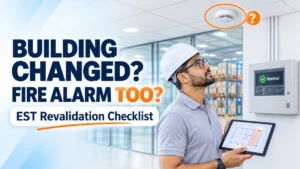
Introduction – The Building Has Changed. Has the Fire Alarm System?
A warehouse has been divided into new storage sections. Office partitions are in, production equipment has moved, and a new access area is open. The contractor has handed over, yet the Edwards EST drawings and device descriptions still describe the previous layout.
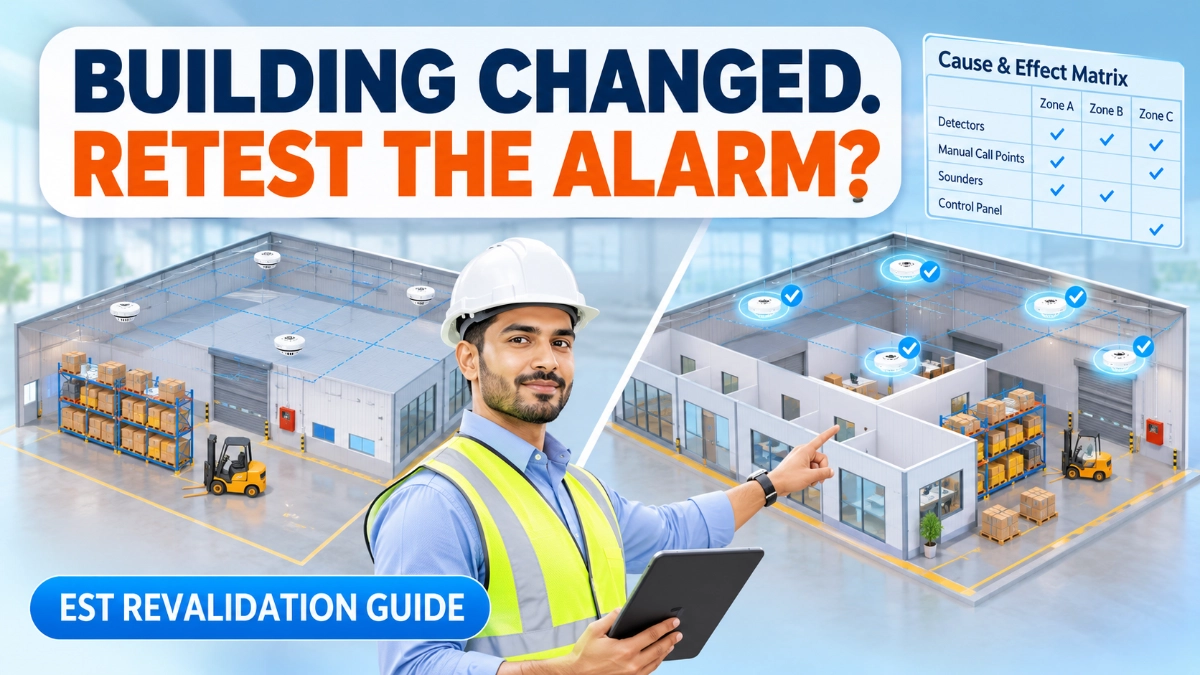
That gap creates a verification requirement. Physical changes can affect detector suitability, notification coverage, alarm zoning, device identification, wiring routes and interfaces. A panel showing normal status confirms communication, not that the design still fits the building.
Not every modification requires full recommissioning. The engineering team must first assess what changed and how it affects the approved design, then set a proportionate scope.
After building modifications, review detector locations and coverage, device addresses and descriptions, alarm zones, notification appliance coverage, wiring and circuit changes, input/output modules, cause-and-effect sequences, building system interfaces, and drawings and configuration records. The extent of testing depends on the modification, its impact on the existing system, the approved design, applicable standards, manufacturer instructions and the authority having jurisdiction.
Why Building Modifications Can Affect an Existing EST Installation
Detection and notification layouts rest on assumptions about room geometry, ceiling height, airflow, fire load and occupancy. These changes can invalidate them:
- New or removed partitions
- Changed ceiling heights or new suspended ceilings
- Newly concealed spaces
- Relocated machinery, with new heat or dust sources
- Changed rack and storage layouts
- New electrical and mechanical equipment
- Changed room usage
- Extensions and additional floors
- Altered escape routes and evacuation arrangements
Hypothetical example: An open warehouse is converted into separate storage and packing areas. Detectors that once covered one volume now straddle new walls. The packing line introduces dust and heat, and sounders may not serve the enclosed rooms. Every device still communicates with the panel, but the design basis has changed.
What Must Be Revalidated After Building Modifications?
| System element | What must be reviewed | What must be verified |
|---|---|---|
| Smoke detectors | Position, spacing, obstructions, environment | Continued suitability for revised layout |
| Heat detectors | Location and application | Suitability for changed operating conditions |
| Manual call points | Accessibility, escape route relationship | Appropriate location and identification |
| Device addresses | Added, removed, relocated or replaced devices | Correct device identification |
| Device descriptions | Building, floor, room and area labels | Consistency with approved drawings |
| Alarm zones | Revised layout and operational areas | Correct zone identification and indication |
| Notification appliances | Partitions, occupancy, acoustic conditions | Intended audible and visual coverage |
| Input/output modules | Changes to connected equipment | Correct monitoring and control functions |
| Interfaces | BMS, smoke control, access control, lifts | Required signal transmission and response |
| Wiring and circuits | New routes, joints, extensions | Correct installation and circuit integrity |
| Documentation | Drawings, schedules, cause-and-effect records | Alignment with the modified installation |
Not every row needs identical testing on every project. An impact assessment sets the scope. A new partition may touch only detection and notification, while a mezzanine touches nearly every row.
Which functions should be checked after a warehouse renovation? Check detection in affected areas, device identification and zone indication, alarm notification, modified circuits, input/output module functions, and any interfaced responses such as HVAC or access control release. Review the cause-and-effect matrix against the revised layout, and update the drawings and records.
Detector Relocation: Why Physical Coverage Must Be Reassessed
Moving a detector a short distance can change what it protects. Review these factors:
- Revised room geometry and new partitions
- Ceiling obstructions
- HVAC and air movement
- Equipment heat sources
- Dust-producing processes
- Changed storage arrangements
- Newly created concealed spaces
Two questions must be answered separately. First, does the detector communicate with the EST panel and report correctly? Second, does the new location remain suitable for the revised detection design? The first is a functional check. The second is an engineering judgement.
Hypothetical example: During a renovation, a smoke detector is moved to clear a new rack aisle. It reports normally, but it now sits beside a supply diffuser and near a new partition line. Passing a functional test does not show that the position still meets the design intent.
Spacing and placement rules depend on applicable codes, approved design documents and manufacturer instructions. A qualified engineer should confirm them for each case.
What should be revalidated after relocating an EST detector? Confirm the new location against the approved detection design and environmental conditions. Verify the address, description, panel indication and functional response. Check that any affected zone, cause-and-effect entry and drawing are updated, and record the results.
EST Programming, Device Identification and Cause-and-Effect Review
Modifications often change the configuration. Review:
- Added or removed devices
- Address and description changes
- Revised zone mapping
- Input/output module changes
- Changes to alarm routing and control sequences
- Updated interface relationships
Treat EST3 and EST4 as product families. Confirm exact configuration procedures against the applicable manufacturer documentation for the installed platform and version.
Hypothetical example: A production room becomes a separate storage area, and the detector layout changes. The zone description and alarm response documentation stay as before. Operators now see an alarm labelled for a room that no longer exists, and responders search the wrong space. A later technician may also map new devices to the wrong sequence.
Should the cause-and-effect matrix be reviewed after building modifications? Yes. Any change to devices, zones, modules or interfaces can alter the intended output. Compare the modified system against the approved matrix, correct discrepancies through controlled configuration changes, and retest the affected sequences.
Notification Appliances and Building Interface Testing
Detector tests alone do not show that the modified system works as intended.
Notification appliances. Reassess audible and visual coverage where partitions, occupancy, acoustic conditions, evacuation arrangements or newly created rooms have changed. A sounder that served an open hall may not serve three enclosed rooms.
Building interfaces. These are project-dependent. Review any that apply:
- BMS
- Smoke control
- HVAC shutdown or control
- Access control release
- Lift-related fire response
- Emergency communication and PAVA
Test the affected signal paths end to end, from initiating device through panel logic and interface module to the controlled equipment. Coordinate with the responsible system owners and follow an approved test plan.
Partial Testing vs Full System Recommissioning: How to Decide
| Modification | Potential impact | Appropriate engineering assessment |
|---|---|---|
| Minor room layout change | Local detector or notification impact | Assess affected area and functions |
| Detector relocation | Coverage and device identification | Review design suitability; test affected functions |
| New partitions | Detection and notification coverage | Reassess affected spaces |
| Building extension | Added devices, circuits, zones, interfaces | Wider system and integration assessment |
| Panel or network configuration change | Communication and system logic | Configuration review; appropriate functional testing |
| Smoke control modification | Cause-and-effect and interface behaviour | Coordinated integrated testing |
| Major renovation | Multiple elements affected | Formal assessment to set recommissioning scope |
This is an illustrative planning framework, not a universal compliance rule.
These activities are not interchangeable:
- Visual inspection: Checks installation, position, labelling and condition.
- Device functional testing: Confirms an individual device operates and reports.
- Circuit testing: Confirms wiring integrity and circuit performance.
- Integrated system testing: Confirms sequences across interconnected systems.
- Partial revalidation: Re-verifies the affected design, configuration and functions.
- Full recommissioning: Re-verifies the entire installation.
When is partial testing sufficient? Partial testing can be sufficient when a documented impact assessment shows the modification is localised. It must not affect shared logic, interfaces, network behaviour or the wider design basis. The affected devices, circuits, zones, documentation and related functions must all be reviewed and tested.
When is full recommissioning necessary? Consider it when modifications are extensive, or the impact cannot be bounded. Typical triggers include major renovations, system-wide configuration or network changes, a changed occupancy basis, or doubt about the existing records. The designer, installer and authority having jurisdiction should agree on the scope.
A Step-by-Step EST Post-Modification Testing Workflow
- Review the building modification. Identify changes to layouts, equipment, occupancy, ceilings and operational areas.
- Perform a fire alarm impact assessment. Identify affected devices, circuits, zones, interfaces and sequences.
- Compare existing and revised documentation. Review drawings, schedules, cause-and-effect matrices and configuration records.
- Define the testing scope. Decide what needs inspection or testing.
- Verify the physical installation. Inspect positions, identification, wiring changes, accessibility and workmanship.
- Test affected devices and functions. Verify operation, panel indication, notification and interface responses.
- Perform integrated testing where required. Confirm affected sequences across interconnected systems.
- Close documentation and handover. Record results, deficiencies, corrective actions, approvals and revisions.
Competent, authorised personnel must plan and perform this work under approved procedures. Plan for impairments too. Define how affected zones are isolated, how the building is protected meanwhile, who is notified, and how the system is restored and confirmed healthy. Record each disablement and reinstatement.
Common Mistakes During Post-Modification EST Testing
- Testing only new detectors. Extend the scope to affected neighbouring devices, zones and functions.
- Ignoring new partitions. Reassess detection and notification in each newly formed space.
- Not reassessing coverage. Compare the revised layout with the approved design.
- Leaving outdated descriptions in the panel. Correct device and zone descriptions through controlled configuration changes.
- Skipping the cause-and-effect review. Check the matrix against the modified system.
- Ignoring notification coverage. Assess audible and visual coverage in changed spaces.
- Overlooking BMS and smoke control interfaces. Identify and test affected signal paths with their owners.
- Testing devices without checking system functions. Verify what the device activation causes.
- Not updating as-built drawings. Revise drawings and schedules before handover.
- Closing without test evidence. Keep signed records, deficiencies and closure proof.
Post-Modification EST Testing Checklist
- Building modifications reviewed and recorded
- Fire alarm impact assessment completed
- Existing and revised drawings compared
- Detector locations and coverage reassessed
- Manual call point locations reviewed where affected
- Device addresses and descriptions verified
- Alarm zones reviewed
- Notification appliance coverage assessed
- Modified circuits and wiring inspected
- Relevant input/output modules verified
- Cause-and-effect matrix reviewed
- Affected interfaces tested
- Integrated testing completed where required
- Deficiencies recorded and closed
- Configuration and drawings updated
- Test results and approvals included in handover records
Why Post-Modification Testing Is Part of EST Lifecycle Management
Structured revalidation supports long-term reliability, accurate device identification, configuration governance, maintenance readiness, controlled expansion, auditability, easier troubleshooting and reliable handover records.
A system showing normal status is not proof that every modified detection, notification and interface function remains suitable. Normal status shows the panel can see its devices. It does not show the devices are in the right places for the building as it now exists.
Key Takeaways
- Completing building work does not confirm the fire alarm design still suits the building.
- Start with an impact assessment, not an assumed test list.
- Communication with the panel is not design suitability.
- Relocated detectors need engineering review as well as functional testing.
- Partitions, ceilings, airflow and equipment can change detection and notification needs.
- Device descriptions, zones and drawings must match the modified building.
- Review the cause-and-effect matrix after any change to devices, zones or interfaces.
- Test interfaces end-to-end with their system owners.
- Inspection, functional, integrated, partial and full recommissioning activities differ.
- Verify both the affected equipment and the continued suitability of the design.
Read Also: EST Alarm Investigation: How to Separate Device Events, Wiring Faults and Configuration Issues
Read Also: Fire Alarm Network Faults That Appear Intermittently: How to Investigate Without Guesswork