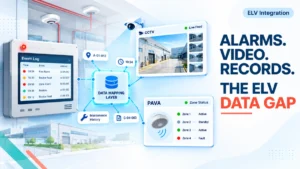
A fire alarm event appears on the operator’s screen for a warehouse zone. The operator needs to review the CCTV footage, confirm which PAVA zone was involved, and check whether maintenance recently affected nearby equipment.
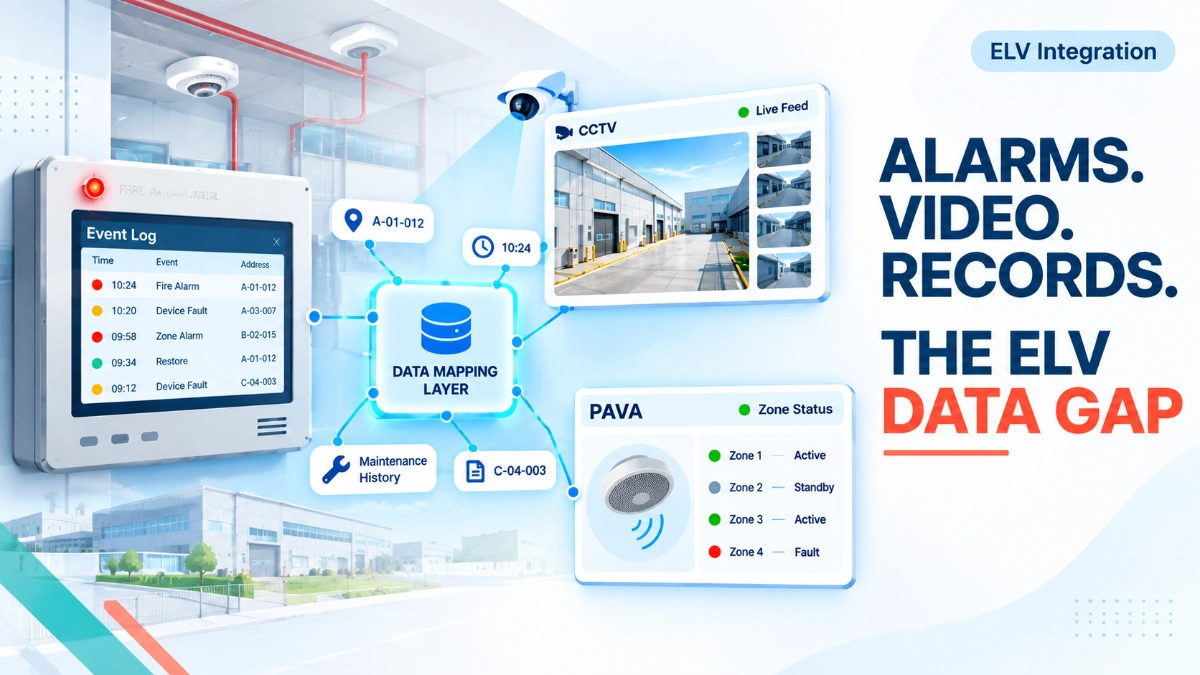
The panel identifies the device by an address and label. The CCTV platform names cameras after columns or aisles. The PAVA records use a zone number. The system clocks disagree by an unknown margin. The work order cites an asset ID that appears in none of the other platforms.
Each system may be working exactly as designed. Even so, the operator must search several platforms by hand and cannot immediately confirm that the records describe the same place and moment. If every system records information independently, what lets an operator reconstruct the full picture?
Separate ELV systems typically use different device names, asset identifiers, location labels, timestamps, event formats, and maintenance databases. These differences make it hard to match a fire alarm event with relevant video, PAVA records, or earlier maintenance activity. Reliable cross-system investigation needs consistent identification, trustworthy time references, clear event mapping, and documented relationships between assets. Direct technical integration helps, but data quality and maintenance discipline matter equally.
Why Multiple ELV Systems Do Not Automatically Create One Operational Picture
Independently functioning systems can still give fragmented information. Typical causes include:
- Platforms maintained by different teams or vendors.
- Different naming conventions and asset registers.
- Independent event logs and clock settings.
- Different definitions of an event, alarm, fault, or status.
- Maintenance records held outside the ELV platforms.
- Drawings and schedules that lag behind modifications and expansions.
Three conditions are easy to confuse. Systems are physically connected when cabling or networks exist between them. They are technically interoperable when a supported interface exchanges data. They are operationally useful when an operator can use that data to investigate an incident. A facility can achieve the first two and still miss the third.
This does not mean every facility needs one centralised platform. The right architecture depends on operational requirements, system capabilities, safety boundaries, and project constraints.
Five Data Gaps That Make Cross-System Investigation Difficult
1. Inconsistent Device Names and Location Labels
A smoke detector known by a panel address, a camera named after a column grid, and a PAVA zone identified by floor number can cover overlapping spaces without sharing any identifier. Contractors often describe rooms and buildings differently. Labels drift from current drawings, and devices get replaced or relocated without record updates.
Systems do not need identical names. Each can keep its native identifier, provided a documented cross-reference ties them to a common location reference. Consistent naming rules and maintained device schedules reduce ambiguity. For EST Detectors and Devices, this means keeping each device’s address, label, and physical location aligned in the schedule.
2. Timestamp Misalignment
Matching events across fire alarm logs, CCTV footage, PAVA records, and maintenance systems requires trustworthy time references. Common problems include:
- Different system clocks and clock drift on unsynchronised devices.
- Incorrect time zone or daylight-saving settings.
- Differences between event time, recording time, export time, and work-order time.
- Varying timestamp precision and logging delays.
A camera clock offset by several minutes sends an operator to the wrong footage window. Verify time settings and synchronisation arrangements against the installed architecture and manufacturer capabilities. Do not assume every system supports the same synchronisation method.
3. Inconsistent Asset IDs and Equipment Records
A maintenance asset register often uses identifiers that differ from the fire alarm panel’s device address, the CCTV platform’s camera ID, or the PAVA controller’s zone reference. Useful mapping covers:
- Asset IDs and device addresses.
- Panel and loop references, where applicable.
- Camera IDs, PAVA zones, and equipment identifiers.
- Physical locations.
- Work-order references.
Replacement, relocation, expansion, and renaming should each trigger updates to these records. Without that discipline, the mapping decays quietly.
4. Different Event Formats and Meanings
An alarm, device fault, communication fault, CCTV analytics alert, video recording marker, PAVA equipment fault, and work-order status are different kinds of information. Descriptions, priorities, status values, and logging methods vary by system.
A sound integration preserves each event’s source and meaning rather than flattening everything into a generic “alert.” Monitoring and data sharing are also separate from safety-related control. CCTV or PAVA records do not replace the fire alarm system’s own event information or safety functions.
5. Disconnected Maintenance History
Maintenance records supply context that logs cannot. Examples include:
- A detector replaced shortly before a recurring fault.
- A camera moved during facility modifications.
- A PAVA amplifier or speaker circuit serviced before a reported fault.
- A network change affecting several connected systems.
- A work order closed without updating the asset register or drawings.
These records can inform a hypothesis, but they cannot on their own prove that an earlier intervention caused a later event.
How the Data Gap Appears Across Fire Alarm, CCTV, and PAVA
Actual records and available functions depend on the installed products and their configuration.
| System | Typical information available | Common correlation challenge | What helps |
|---|---|---|---|
| GST or Edwards/EST fire alarm system | Available alarm, fault, supervisory, device, and event information | Panel identifiers may not match camera or maintenance labels | Consistent device schedules, location references, and event records |
| CCTV system | Camera IDs, recordings, recording timestamps, available event markers | Operators may not know which camera covers the alarm location or time window | Camera-to-location mapping, verified time settings, coverage records |
| PAVA system | Available zone status, faults, and event information | Zone names may not match fire alarm areas or asset IDs | Documented zone mapping and maintained interface records |
| Maintenance or asset-management system | Work orders, service reports, asset IDs, history | Asset references may not match operational identifiers | Controlled asset register and cross-system identifier mapping |
For a platform such as the EST Fire Alarm System, the available event information depends on the installed configuration, so confirm it against current manufacturer documentation. Platform-specific records for EST3 and EST4 should be kept with the project documentation so their identifiers can be mapped correctly.
A Practical Example: Reconstructing One Incident Across Multiple Systems
This is an illustrative scenario, not a real or verified incident.
- A fire alarm event is recorded for a device in a warehouse zone.
- The operator tries to retrieve CCTV footage for the same location.
- The camera uses a different location name, and its clock differs from the panel’s.
- A work order shows equipment in the area was serviced recently, but its asset ID does not match the panel’s device identifier.
- The team uses the approved device schedule, camera coverage map, documented timestamp offset, and asset cross-reference to narrow the footage window and identify the relevant work order.
- The resulting timeline shows what needs further investigation.
Without those records, the same steps depend on guesswork and take longer. With them, the team can separate recorded facts (the alarm time, the footage, the work-order date) from mapped information (which camera covers which device) and from hypotheses (whether the servicing is related). The team does not assume the maintenance activity caused the alarm, and no root cause is declared until it is confirmed.
How to Build a More Reliable ELV Data Correlation Framework
- Establish a common location hierarchy: Define building, floor, room, zone, and area references while preserving system-specific identifiers.
- Maintain a cross-system asset register: Map fire alarm devices, cameras, PAVA zones, panels, and maintenance asset IDs.
- Validate timestamp settings: Document the time source, time zone, synchronisation method, and known offsets for each platform.
- Define event mapping: Record each event’s source, native meaning, identifier, timestamp, location, and any approved mapped representation.
- Connect maintenance records: Link work orders and service reports to assets and locations without assuming every system needs direct integration.
- Document system interfaces: State what information is shared, how it is represented, and who maintains the mapping.
- Verify the workflow: Use controlled or approved test scenarios to confirm operators can locate relevant records across systems.
- Maintain the records: Update mappings after device replacement, expansion, camera relocation, PAVA changes, or other modifications.
Depending on project requirements, this can be implemented through controlled documents and procedures, an integration platform, or a combination.
Data Integration Does Not Mean Merging Every System
Good ELV data integration does not require every platform to share every data point. Consider:
- Operational need: share what operators actually use.
- Ownership: assign a responsible party for each system and mapping.
- Data boundaries: define what is exchanged and in which direction.
- Data quality: protect event meaning during exchange.
- Access control and cybersecurity: limit access in proportion to the information shared.
- Monitoring versus control: keep monitoring separate from authorised control functions.
- Resilience: define what happens when an interface or receiving platform is unavailable.
Fire alarm safety functions must stay governed by the approved design, applicable requirements, and manufacturer-supported architecture. CCTV and maintenance platforms are not substitutes for fire alarm control functions.
Common Mistakes That Keep the ELV Data Gap Open
- Assuming connected systems share meaningful data. Connectivity does not guarantee usable content. Verify what is actually exchanged.
- Using inconsistent names across drawings, registers, and interfaces. Operators then search for the wrong place. Maintain one controlled naming scheme with cross-references.
- Ignoring timestamp differences. Footage review targets the wrong window. Document offsets and check them first.
- Treating a CCTV analytics alert as a fire alarm event. The two have different sources and meanings. Preserve each event’s origin.
- Linking records by approximate location. Overlapping coverage creates false matches. Check the mapping.
- Updating equipment without updating documentation. Records silently become wrong. Tie record updates to change procedures.
- Treating a recent maintenance record as proof of cause. This anchors the investigation on one hypothesis. Treat it as context.
- Building an integration without data-quality ownership. Mappings decay. Assign responsibility.
- Testing connectivity but not operator interpretation. A working link can still mislead. Test whether operators can read and use the result.
How Better ELV Data Correlation Improves Operations
Better cross-system data quality supports faster incident investigation and more reliable retrieval of relevant footage. It also improves maintenance history and recurring-fault analysis, coordination among fire safety, security, and facility teams, commissioning and handover consistency, and traceability during audits and modifications. It reduces ambiguity when several systems report events around the same time. Results depend on implementation and operational discipline.
Key Takeaways
- Connectivity alone does not guarantee useful ELV systems integration.
- Identifiers and location references must be mapped consistently.
- Timestamp accuracy is essential for reliable event reconstruction.
- Maintenance records provide context, not automatic proof of cause.
- Data mapping and ownership must be maintained throughout the system lifecycle.
For project coordination and documentation support, an EST Fire Alarm System Distributor in India such as Innxeon can help teams select products and plan reliable documentation. Verify product-specific features against current official documentation.
Read Also: Configuration Version Control for Fire Alarm Systems: An Overlooked Engineering Discipline
Read Also: Fire Alarm Event Correlation: How Engineers Distinguish One Fault From a Wider System Problem