Modern CCTV systems generate a continuous flow of video, audio, event notifications, and device-management traffic. As organisations deploy more IP cameras, network video recorders (NVRs), and video management systems (VMS), managing this traffic becomes an important part of network engineering.
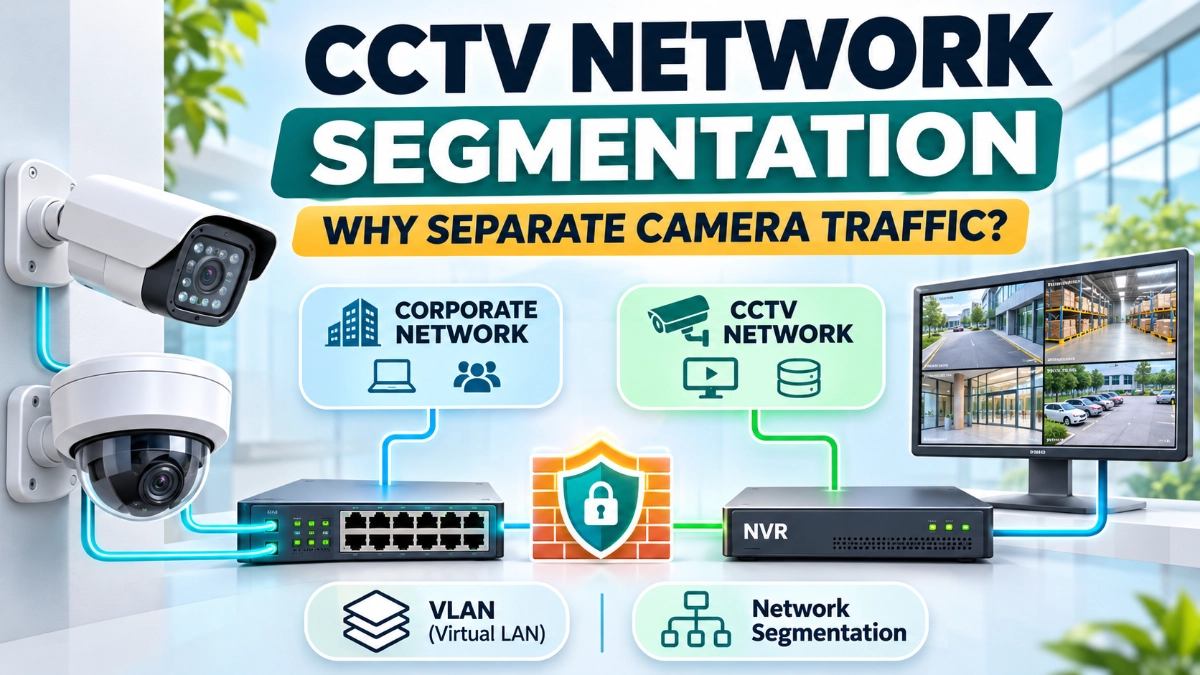
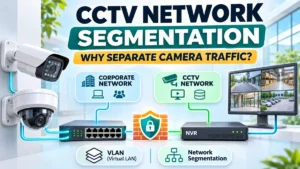
One common approach is CCTV network segmentation, which separates surveillance traffic from corporate IT networks and other connected devices.
However, creating a separate VLAN does not automatically make a CCTV system secure, efficient, or reliable. Engineers must consider how cameras communicate with NVRs, how administrators access devices, how much bandwidth the system requires, and which network services must remain available.
A poorly planned segmentation strategy can cause camera disconnections, failed recordings, inaccessible devices, and unexpected network bottlenecks.
So, what should engineers evaluate before separating CCTV traffic?
This article explores the important technical considerations, practical network design decisions, and common mistakes that can affect CCTV performance after segmentation.
What Should Engineers Evaluate Before CCTV Network Segmentation?
Before separating CCTV traffic, engineers should evaluate:
- Network bandwidth and uplink capacity.
- Camera, NVR, and VMS communication requirements.
- VLAN architecture and IP addressing.
- Routing, firewall rules, and access control lists (ACLs).
- PoE switch capacity and power requirements.
- Remote monitoring and administrative access.
- Multicast, discovery, and network protocols.
- Cybersecurity requirements and future scalability.
The objective is to isolate surveillance traffic without interrupting essential communication between cameras, recording devices, management systems, and authorised users.
1. Understand the Existing Network Architecture
Before creating separate network segments, engineers should understand how the existing CCTV infrastructure operates.
In many commercial and industrial environments, cameras share network switches, uplinks, and sometimes IP addressing infrastructure with computers, servers, access control systems, and other devices.
This arrangement can create unnecessary traffic exposure and make troubleshooting more difficult.
Start by documenting the existing architecture.
Important details include:
- Number of connected IP cameras.
- Camera resolutions and frame rates.
- Camera IP addresses and subnets.
- Existing network switches.
- NVR and VMS locations.
- Available uplink bandwidth.
- Existing VLAN configuration.
- Remote monitoring requirements.
- Connections with other security systems.
For example, a facility with 40 cameras connected through multiple access switches may require a different segmentation design from a small office with eight cameras and one NVR.
Engineering insight: Do not design VLANs before understanding the actual communication requirements of the CCTV system.
2. Plan the CCTV VLAN Architecture
A Virtual Local Area Network (VLAN) allows engineers to logically separate devices within a physical network infrastructure.
For CCTV deployments, a dedicated surveillance VLAN can help isolate camera traffic from general corporate network traffic.
A basic architecture may look like this:
Corporate IT Network → Firewall/Core Switch → CCTV VLAN → PoE Switches → IP Cameras
The NVR or VMS can connect to the CCTV network through an appropriately controlled interface.
However, larger deployments may benefit from additional separation.
For example:
- Camera VLAN: IP cameras and video endpoints.
- Recording VLAN: NVRs and recording servers.
- Management VLAN: Authorised administration devices.
- Monitoring VLAN: Operator workstations and viewing clients.
These segments should communicate only through approved network paths.
Not every project needs four separate VLANs. The right architecture depends on system size, security requirements, operational needs, and available infrastructure.
The important principle is to create meaningful security boundaries rather than adding VLANs without a clear purpose.
3. Evaluate Bandwidth Before Separating Camera Traffic
Bandwidth planning is one of the most important parts of CCTV network segmentation.
IP cameras continuously transmit video streams. As camera resolution, frame rate, and bitrate increase, network requirements also increase.
Consider a simple example:
A facility has 32 IP cameras, and each camera generates an average bitrate of 5 Mbps.
Total camera bitrate = 32 × 5 Mbps = 160 Mbps.
This is the estimated combined video bitrate before accounting for additional network traffic and operational overhead.
Engineers should also consider:
- Secondary video streams.
- Remote viewing traffic.
- Live monitoring on multiple screens.
- Playback requests.
- Video analytics.
- Network protocol overhead.
- Future camera expansion.
A dedicated CCTV VLAN cannot solve insufficient physical network capacity.
If the switch uplink is overloaded, video streams may experience latency, packet loss, or interruptions even after segmentation.
Therefore, calculate expected traffic across access switches, distribution switches, and core network links before implementation.
4. Check Routing and Firewall Requirements
Network segmentation introduces communication boundaries.
Once cameras and NVRs operate in different VLANs, routing and firewall policies determine which devices can communicate.
For example, an NVR may need access to cameras for live viewing and recording. Administrators may also require access to camera interfaces for configuration and maintenance.
If the firewall blocks the required communication, the cameras may appear offline even though they remain connected to their switches.
Before implementation, identify:
- Camera-to-NVR communication.
- NVR-to-VMS communication.
- Administrator-to-camera access.
- Monitoring workstation access.
- DNS and NTP requirements.
- Firmware update requirements.
- Approved remote access paths.
Create firewall rules based on documented device requirements.
Avoid allowing unrestricted communication between the CCTV VLAN and the corporate network.
Instead, permit only the required source addresses, destination addresses, protocols, and ports.
Remember that ONVIF discovery, video streaming, and device management may use different communication methods. Engineers should verify the actual requirements of the selected devices rather than assuming that one open port supports every function.
5. Consider PoE Switch Capacity and Physical Infrastructure
Network segmentation is a logical change, but it can also involve physical infrastructure modifications.
Most IP CCTV cameras receive power through Power over Ethernet (PoE) switches.
When designing separate camera networks, engineers should evaluate both network performance and electrical power capacity.
Check the following:
- Total PoE budget of each switch.
- Individual camera power requirements.
- Available PoE ports.
- Switch uplink capacity.
- Cable distance and quality.
- Fibre connectivity between network cabinets.
- UPS backup capacity.
- Environmental operating conditions.
For example, adding more cameras to a dedicated CCTV switch may exceed its available PoE budget even when sufficient network bandwidth remains.
This can cause cameras to restart, disconnect, or operate inconsistently.
Engineers should therefore evaluate PoE power consumption alongside network traffic requirements.
6. Plan Multicast, Unicast and Video Streaming
CCTV systems can use unicast or multicast communication depending on device capabilities and deployment requirements.
With unicast, a separate stream may be transmitted to each requesting client.
With multicast, one stream can serve multiple subscribed receivers, potentially reducing duplicate network traffic.
However, multicast requires appropriate network configuration.
Engineers should evaluate:
- IGMP snooping support.
- IGMP querier configuration.
- Multicast routing, where required.
- Switch compatibility.
- Receiver subscription behaviour.
- Video management system support.
Incorrect multicast configuration can create unnecessary traffic or prevent video streams from reaching the intended receivers.
For smaller deployments, unicast may be sufficient. Larger monitoring environments with multiple viewing clients may benefit from carefully designed multicast architecture.
Important: Do not enable multicast simply because the switches support it. Confirm that the cameras, NVRs, VMS, and network architecture can use it correctly.
7. Maintain Secure Remote Monitoring and Administrative Access
Many organisations need to monitor CCTV systems from control rooms, branch offices, or authorised remote locations.
Separating camera traffic should not unintentionally remove these capabilities.
However, exposing cameras directly to the public internet is not a suitable solution.
A better approach is to provide controlled access through approved security infrastructure.
Engineers should evaluate:
- VPN connectivity.
- Firewall access policies.
- User authentication.
- Role-based permissions.
- Secure device management.
- Encrypted communication.
- Remote monitoring requirements.
- Logging and access monitoring.
Administrative access should be restricted to trusted devices and authorised personnel.
Where possible, separate routine video viewing from privileged device administration.
This reduces unnecessary exposure of camera interfaces and recording infrastructure.
8. Evaluate Compatibility Between Cameras, NVRs and VMS
Network segmentation must preserve interoperability.
Cameras, NVRs, and VMS platforms may communicate through different protocols and services.
For example, an IP camera may use ONVIF for device integration, RTSP for video streaming, and NTP for time synchronisation.
If network rules block any required communication, some features may stop working.
Before implementation, verify:
- Camera and NVR compatibility.
- ONVIF profile support.
- Video streaming protocols.
- Authentication requirements.
- Device discovery.
- Event notifications.
- Time synchronisation.
- Firmware update access.
Do not assume that successful ping responses guarantee complete CCTV functionality.
Always test live viewing, recording, playback, and event notifications after segmentation.
9. Consider Cybersecurity and Future Scalability
One major benefit of network segmentation is limiting unnecessary communication between different device groups.
If a corporate workstation becomes compromised, properly implemented segmentation and access controls can help restrict an attacker’s ability to move directly into the surveillance network.
However, VLAN separation alone does not provide complete security.
Engineers should combine segmentation with:
- Firewall enforcement.
- Strong device passwords.
- Regular firmware updates.
- Restricted administrative access.
- Secure remote connectivity.
- Network monitoring.
- Access logging.
- Removal of unused services.
Scalability also matters.
A network designed for 20 cameras may struggle when the organisation expands to 100 cameras across multiple buildings.
Consider future requirements such as additional camera locations, higher resolutions, AI analytics, centralised recording, and remote monitoring.
A scalable design should allow expansion without requiring major changes to the entire network architecture.
10. Common CCTV Network Segmentation Mistakes
Even technically sound network equipment can produce unreliable results when engineers overlook communication dependencies.
Here are some common mistakes to avoid:
| Common mistake | Possible impact |
|---|---|
| Creating VLANs without mapping traffic | Cameras or NVRs become unreachable |
| Blocking required firewall ports | Video streaming or recording stops |
| Ignoring uplink bandwidth | Video delays and packet loss |
| Incorrect multicast settings | Unstable or unavailable video streams |
| Overlooking PoE capacity | Camera restarts and disconnections |
| Allowing unrestricted inter-VLAN access | Increased cybersecurity exposure |
| Ignoring NTP and DNS | Time errors and service failures |
| Skipping post-change testing | Undetected recording or monitoring problems |
The solution is to treat segmentation as a complete network design exercise rather than a simple switch configuration task.
11. Practical CCTV Network Segmentation Checklist for Engineers
Before approving a CCTV segmentation design, review these essential points.
Network planning
- Document the existing network topology.
- Identify all cameras, NVRs, and VMS devices.
- Calculate expected bandwidth.
- Plan VLANs and IP addressing.
- Verify switch uplink capacity.
Security planning
- Define firewall rules.
- Restrict inter-VLAN communication.
- Secure administrative access.
- Review remote monitoring requirements.
- Enable appropriate network logging.
Infrastructure planning
- Check PoE power budgets.
- Verify switch capabilities.
- Review fibre and Ethernet connectivity.
- Evaluate UPS requirements.
- Allow room for expansion.
Testing and validation
- Test camera connectivity.
- Verify live video.
- Confirm continuous recording.
- Test playback.
- Verify event notifications.
- Check time synchronisation.
- Test remote viewing.
- Monitor network performance after deployment.
Choosing CCTV Equipment for a Segmented Network
Network architecture and hardware selection should work together.
Engineers should evaluate camera specifications, supported network protocols, encoding options, NVR compatibility, and recording requirements before finalising a surveillance design.
For example, when evaluating Impact by Honeywell CCTV, consider the intended application, network capacity, camera placement, and recording architecture.
Impact by Honeywell bullet cameras may suit applications requiring directional coverage, while Impact by Honeywell dome cameras can be considered for indoor environments and locations where a compact camera design is preferred.
The recording infrastructure also deserves attention. Impact by Honeywell NVR’s should be evaluated according to supported camera channels, recording resolution, storage requirements, network interfaces, and system compatibility.
Organisations sourcing surveillance equipment can also explore an Impact by Honeywell distributor in India when comparing suitable products and availability for their project requirements.
The important consideration is to select compatible equipment that meets the project’s operational and network requirements rather than choosing cameras independently of the overall system design.
Conclusion: Build Segmentation Around Communication, Not Just VLANs
CCTV network segmentation is a key part of designing secure, reliable IP surveillance infrastructure.
However, separating camera traffic requires more than assigning devices to different VLANs. Engineers must understand how cameras communicate with NVRs, how video streams move across network switches, and how authorised users access surveillance systems.
Bandwidth, routing, firewall rules, PoE capacity, multicast, interoperability, cybersecurity, and future expansion all influence the final architecture.
A well-designed segmented network provides better traffic control, reduces unnecessary exposure, and makes surveillance infrastructure easier to manage.
The best CCTV network segmentation strategy is one that improves security without compromising video availability, recording continuity, or operational performance.
For engineers, the goal is simple: isolate what needs protection, allow what needs communication, and validate every connection before putting the system into operation.
Read Also: CCTV Storage vs Usable Evidence: Why Recording Days Alone Do Not Prove Readiness
Read Also: Choosing Bullet and Dome Cameras by Surveillance Task, Not Just Appearance