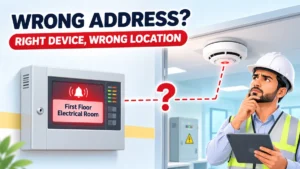
An alarm appears on an EST fire alarm network serving four buildings. The event description names a detector as “Store Room Old.” The drawings call the space “Spares Store,” the device schedule uses a different room number, and the label on the detector says something else again.
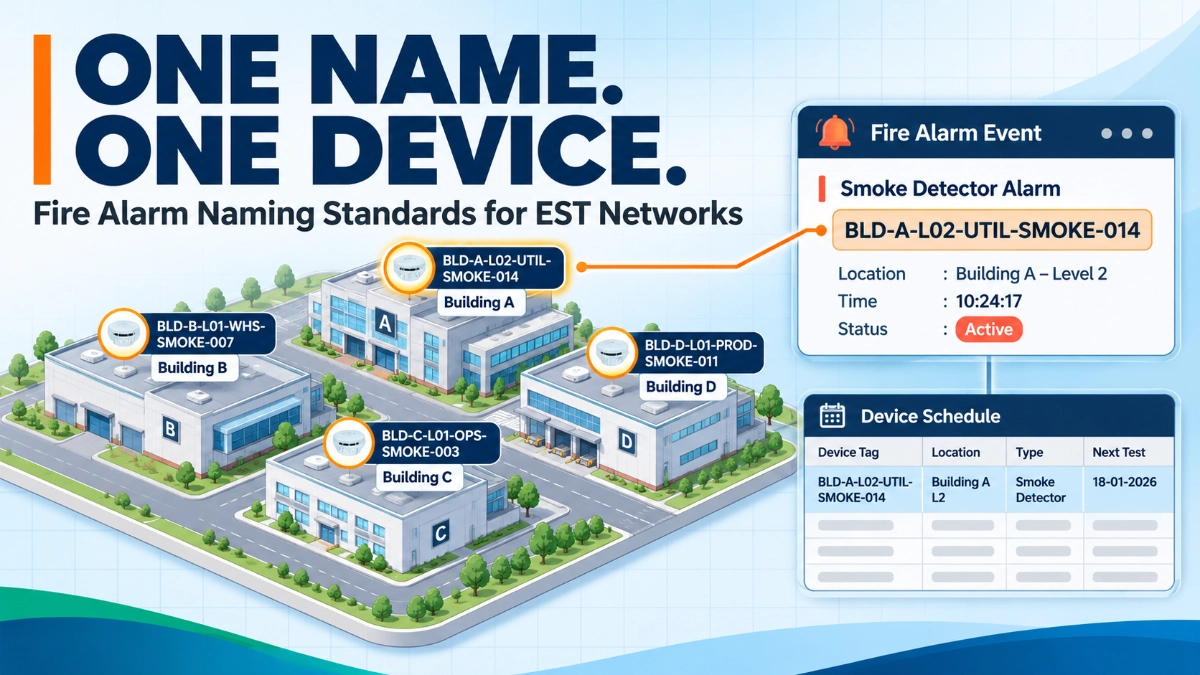
Before anyone can investigate the event, the maintenance team must work out the building, floor, room and physical location. Nothing is technically wrong yet, but the response is already slower and less certain.
This is rarely a software problem. It is a documentation problem that was tolerated until a real event exposed it. On a large installation, the device description links the panel display, drawings, device schedule, maintenance records and field label. When they disagree, people reconcile them under pressure.
Device naming is not an administrative afterthought. It is part of operational control over a large fire alarm installation.
Consistent device naming lets anyone reading an alarm event identify the same physical device on the panel, drawings, schedules and field labels without interpretation. On large Edwards EST networks, it shortens investigation, reduces transcription errors, keeps records aligned across contractors and project phases, and supports configuration governance. It does not change a device’s address or electrical operation. Engineers must verify platform limits and project requirements before fixing a format.
Why Device Naming Becomes Difficult in Large EST Networks
A scheme that works for one building often fails across a campus. Several pressures drive this:
- Multiple buildings and fire alarm panels, commissioned at different times.
- Large numbers of addressable devices, where small inconsistencies multiply.
- Many floors, zones and operational areas.
- Repeated names such as “Electrical Room” or “Plant Room” in every building.
- Expansions and modifications that outlive the original naming logic.
- Different contractors installing and servicing, each with their own habits.
- Drawings, software and site records that drift apart.
In one building, local knowledge fills the gaps. On a campus, staff change and that knowledge disappears. The name must carry its own context.
Why is consistent device naming important in an EST network? Consistent naming lets operators and technicians match an alarm or fault message to one physical device across panel displays, drawings, schedules and field labels. It reduces investigation time, separates repeated room names, and keeps records reliable across contractors, buildings and expansions. It supports correct addressing but does not replace it.
What Should a Fire Alarm Device Naming Standard Include?
Consider these fields:
- Building or block identifier
- Floor or level identifier
- Department or area identifier
- Room or space reference
- Device type
- Unique device reference or sequence
The exact fields depend on site architecture, the configuration capabilities of the platform, project specifications and applicable requirements. Do not assume every panel, network display, or report shows a description identically.
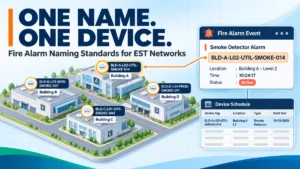
Illustrative example: BLD-A-L02-UTIL-SMOKE-014
| Segment | Meaning |
|---|---|
| BLD-A | Building A |
| L02 | Level 2 |
| UTIL | Utility area |
| SMOKE | Smoke detector |
| 014 | Unique sequence |
This is a hypothetical convention, not an official Edwards naming format or manufacturer requirement.
Keep address and description separate. The address identifies the device on its signalling line circuit. The description is a user-defined label. Changing a description does not alter the address or the device’s electrical operation.
What is a fire alarm device naming standard? It is a documented set of rules for giving every device a structured, unique, human-readable description. It defines fields, abbreviations, sequence numbering and approval, so the same name appears on panels, drawings, schedules and field labels and survives expansion and maintenance.
What information should a fire alarm device label contain? A label should identify the building, floor, area or room, device type and a unique sequence number. Where practical, it should align with the approved drawing reference. Exact content depends on platform limits, project specification and authority requirements, which engineers must verify.
How to Build a Consistent Naming Convention Across EST3 and EST4 Networks
- Set a building and floor hierarchy. Fix identifier formats, including basements, mezzanines and roof levels.
- Define standard abbreviations. Keep them in an approved register.
- Assign unique device references. Make them unique within a defined scope, such as the whole campus.
- Align descriptions with approved drawings. Use the same room and area terms.
- Keep configuration records and device schedules consistent. Treat them as one dataset.
- Define rules for expansion. Reserve identifiers and sequence ranges for future buildings and areas.
- Assign ownership and approval. Name one role responsible for the standard.
Write the standard at project level, so it applies to both EST3 and EST4 documentation. Confirm each platform’s configuration interface and any description limits in the manufacturer’s documentation. The two platforms may not behave identically, so define a shortened form of the convention if a limit requires it.
6. Where Device Naming Errors Create Operational Problems
| Problem | Possible operational impact | Recommended control |
|---|---|---|
| Duplicate device descriptions | Confusion during alarm investigation | Unique location-based references |
| Outdated room names | Incorrect field identification | Controlled record updates |
| Different drawing and panel labels | Slower troubleshooting | Configuration-to-drawing verification |
| Inconsistent abbreviations | Misinterpretation | Approved abbreviation register |
| Missing building identifiers | Confusion across campuses | Mandatory building references |
| Uncontrolled device renaming | Documentation mismatch | Formal change control |
These errors seldom cause a life-safety failure on their own. The realistic consequence is avoidable delay, wrong-location visits and records nobody trusts.
What problems can inconsistent device labels create? Inconsistent labels can slow alarm investigation, send technicians to the wrong location, create mismatches between panel, drawing and schedule, complicate fault diagnosis and make service records unreliable. They seldom cause failure alone, but they add delay and uncertainty when accuracy matters.
Device Naming During Commissioning, Maintenance and System Expansion
Commissioning
- Verify descriptions against approved drawings.
- Confirm physical location and device identity.
- Check event descriptions against field identification.
- Record discrepancies before handover.
Maintenance
- Use the same references in work orders and service reports.
- Record replacements and relocations.
- Never rename informally without updating records.
Expansion
- Reserve building and area identifiers.
- Follow the existing hierarchy.
- Check for duplicate references.
- Update drawings, schedules and configuration records together.
8. Practical Example: Standardising Device Names Across a Multi-Building Facility
This hypothetical facility has Building A (Administration), B (Production), C (Warehouse) and D (Utilities). It is not a real Innxeon or Edwards installation.
| Device name | Meaning |
|---|---|
| BLD-A-L01-RECP-SMOKE-003 | Admin, Level 1, reception, smoke detector |
| BLD-B-L00-PACK-HEAT-021 | Production, ground level, packing hall, heat detector |
| BLD-C-L00-DOCK-SMOKE-007 | Warehouse, ground level, loading dock |
| BLD-D-L01-SWGR-SMOKE-002 | Utilities, Level 1, switchgear room |
| BLD-D-L00-BOIL-HEAT-005 | Utilities, ground level, boiler house |
A technician reading BLD-D-L01-SWGR-SMOKE-002 knows the building, floor and room type before leaving the control room. The same “plant” or “electrical” room in another building cannot be confused with it.
How should engineers name devices across multiple buildings? Use one campus-wide convention with a mandatory building identifier, standard floor format, controlled abbreviations and sequence numbers unique within the defined scope. Reserve identifiers for future buildings, and keep every panel, drawing and schedule to the same rules.
Common Device Naming Mistakes Engineers Should Avoid
- Informal room names: Use the approved drawing terms.
- Reused sequence numbers: Enforce uniqueness in the register.
- Missing building or floor identifiers: Make them mandatory fields.
- Inconsistent abbreviations: Publish one abbreviation register.
- Renaming without updating drawings: Require change control for every rename.
- Separate contractor rules: Issue the standard in the contract documents.
- Overlong descriptions: Check platform limits first, then shorten systematically.
- No central register: Appoint an owner and keep one controlled master.
Fire Alarm Device Naming Governance Checklist
- A documented naming convention exists.
- Building and floor identifiers are standardised.
- Approved abbreviations are maintained.
- Device references are unique within the defined project scope.
- Panel descriptions match approved device schedules.
- Drawings and configuration records are aligned.
- Physical device locations have been verified.
- Device relocations and replacements trigger record updates.
- Naming changes follow an approval process.
- Handover records include the latest device register.
Why Device Naming Is Part of Long-Term EST Configuration Governance
A naming standard decays unless someone controls it. Over the system’s life, that means:
- Configuration version control: Know which description set is live.
- Approved change records: Log who changed what, and why.
- Drawing revision management: Issue drawings and configuration changes together.
- Device replacement history: Keep references traceable through replacements.
- Periodic audits: Compare panel, drawings and field labels.
- Defined responsibility: One accountable owner for the register.
Naming is one part of wider EST configuration management. Consistent names do not guarantee reliability, but they make the records on which maintenance depends trustworthy.
How can facility teams maintain accurate fire alarm device records? Keep one controlled device register and update it with every replacement, relocation or renaming, tied to an approval process. Reconcile panel configuration, drawings and field labels at scheduled audits, and include the latest register in handover documentation.
Key Takeaways
- Treat naming as configuration governance, not labelling.
- Keep address and description distinct.
- Always include building and floor identifiers.
- Make references unique across the defined scope.
- Align panel, drawings, schedules and field labels.
- Verify platform limits for EST3 and EST4 before finalising.
- Control renaming through approval.
- Update records at every replacement, relocation and expansion.
- Audit periodically.
Read Also: The ELV As-Built Gap: Why Approved Drawings Can Differ from the Installed Infrastructure
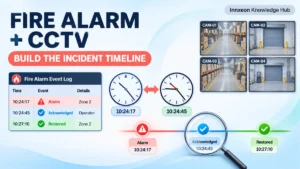
Read Also: Fire Alarm and CCTV Event Correlation: How to Build a More Useful Incident Timeline