For years, enterprise CCTV design focused on a familiar set of questions:
How many cameras are required? How much storage is needed? What resolution should we choose?
Those questions still matter. However, they no longer tell the complete story.
Artificial intelligence is changing what engineers, security teams, facility managers, and system integrators expect from enterprise video surveillance.
Modern CCTV is moving from a system that captures and stores video to a system that can help organisations detect events, find information, understand situations, and respond faster.
This shift is important for factories, warehouses, offices, campuses, logistics facilities, retail chains, data centres, and other large sites.
The key question is no longer just:
“Can the CCTV system record everything?”
It is increasingly:
“Can the CCTV system help us understand what matters?”
That change is influencing camera selection, NVR design, networking, storage, analytics, cybersecurity, and even the way engineers plan the entire surveillance architecture.
What Is AI Changing in Enterprise CCTV?
Traditional CCTV mainly performs three jobs:
- Capture video.
- Record video.
- Allow operators to review footage.
AI adds another layer of intelligence.
Depending on the platform and configuration, AI-enabled CCTV can help with:
- Event detection
- Object classification
- Video search
- Activity analysis
- Intrusion detection
- People and vehicle detection
- Area monitoring
- Alert prioritization
- Faster incident investigation
The goal is not simply to create more information.
The goal is to make large amounts of video easier to understand and use.
That distinction is becoming central to enterprise CCTV design.
Why Recording More Video Does Not Always Mean Better Security
Imagine a manufacturing facility with 300 cameras.
Every camera records continuously. The organisation has weeks of storage and high-resolution footage.
An incident occurs at 11:40 PM.
The security team knows that a person entered a restricted area, but they do not know which camera captured the most useful view.
Without effective search and analytics, an operator may need to review several camera feeds manually.
That takes time.
Now consider a system that can help narrow the investigation to relevant events, locations, time periods, or object types.
The difference is significant.
The first system gives the organisation video.
The second helps provide information from video.
That is one of the most important changes AI brings to enterprise surveillance.
AI Is Moving CCTV From Camera-Centric to Event-Centric Security
Traditional surveillance often revolves around individual camera views.
An operator might think:
“I need to check Camera 27.”
AI can change that workflow.
The operator may instead think:
“I need to find activity involving a person in the restricted area between 10 PM and midnight.”
This is a major shift.
The camera remains important. However, the operator’s focus moves from individual video feeds toward events and security questions.
For engineers, that means CCTV design should consider what information the system needs to produce after installation.
A camera should not be selected only because it has a particular resolution.
The designer should also ask:
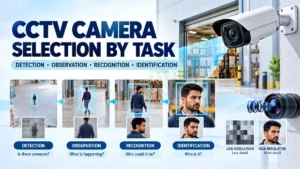
- What does this camera need to detect?
- What does it need to identify?
- What area does it need to cover?
- What lighting conditions will it face?
- Will analytics use this video?
- How will operators investigate an event?
These questions create a much stronger design process.
Camera Placement Still Matters More Than AI Hype
AI can analyse video.
But it cannot analyse information that the camera never captures.
This makes basic CCTV engineering more important, not less.
Engineers should consider:
- Camera height
- Viewing angle
- Lens selection
- Field of view
- Object distance
- Lighting
- Glare
- Shadows
- Background movement
- Environmental conditions
For example, a high-resolution camera pointed at the wrong location may produce less useful evidence than a lower-resolution camera positioned correctly.
Similarly, a camera with excellent specifications may struggle when strong backlighting, poor illumination, reflections, or excessive distance affects the scene.
Therefore:
AI does not replace good camera design. It depends on it.
Resolution Is Only One Part of AI-Ready CCTV
Resolution often receives most of the attention during CCTV procurement.
However, engineers should evaluate the complete imaging chain.
Important factors include:
Lens
The lens determines how much of the scene the camera sees and how large an object appears within the image.
Lighting
AI analytics depend on usable image data. Poor illumination can affect both human viewing and automated analysis.
Field of view
A wide view may provide better situational awareness, while a narrower view may provide greater detail in a specific area.
Mounting position
A poorly positioned camera can create difficult angles, occlusion, and insufficient detail.
Scene complexity
Crowded areas, moving vehicles, shadows, reflections, and changing environmental conditions can make analytics more challenging.
As a result, engineers should evaluate the complete camera application, rather than comparing resolution numbers alone.
AI Can Help Reduce Operator Fatigue
Enterprise security teams often monitor large numbers of cameras.
Human operators cannot give the same level of attention to every screen throughout a long shift.
This creates a practical challenge.
A person may miss an important event simply because the scene looked normal for hours.
AI can help by identifying activity that matches predefined rules or conditions and bringing potentially relevant events to the operator’s attention.
For example, a system may help identify:
- Movement in a restricted zone
- Activity during a defined time period
- People entering specific areas
- Vehicle movement
- Unusual activity
- Objects remaining in a monitored area
The operator can then verify the event and decide what action to take.
This creates a useful model:
AI analyses at scale. People provide judgment.
That is a more realistic and responsible approach than expecting AI to make every security decision independently.
AI Is Changing What Engineers Expect From NVRs
The NVR has traditionally been evaluated around recording requirements.
Engineers often look at:
- Number of supported cameras
- Recording resolution
- Storage capacity
- Recording bandwidth
- Playback performance
- Retention period
- Network interfaces
These specifications remain essential.
However, AI introduces additional questions.
Engineers may now need to consider:
- Where analytics processing occurs
- Supported analytics
- Event search
- Metadata handling
- Processing capacity
- Integration capabilities
- Scalability
- System response
- Management features
For organisations evaluating Impact by Honeywell NVR’s, the NVR should therefore be considered as part of the complete CCTV architecture.
It is not simply a box that stores video.
Its role depends on how cameras, analytics, networks, storage, users, and operational workflows interact.
Edge AI vs Centralised AI
One important architectural decision is where AI processing should occur.
Edge AI
With edge processing, analytics can occur closer to the camera.
This approach can offer advantages such as:
- Distributed processing
- Faster local event analysis
- Reduced dependence on a central processing point for certain workloads
- Potentially lower transmission requirements for some analytics workflows
However, the camera must have the required processing capabilities.
Centralised AI
A centralised architecture processes analytics using servers, recording infrastructure, or another central platform.
This can provide:
- Centralized management
- Easier administration for some deployments
- Flexible processing resources
- Consistent management across large camera populations
Neither architecture is automatically the right choice.
The correct decision depends on the project.
Engineers should consider camera capabilities, network design, processing requirements, scale, cost, reliability, and future expansion.
AI Makes Network Planning More Important
AI does not remove the need for strong networking.
In fact, enterprise AI surveillance can make network planning even more important.
Large CCTV deployments can generate substantial traffic because cameras continuously transmit high-resolution streams.
Engineers should calculate:
- Camera bitrate
- Aggregate bandwidth
- PoE requirements
- Switch capacity
- Uplink bandwidth
- Fiber requirements
- Network segmentation
- Redundancy
- Network monitoring
The designer should also consider where analytics processing occurs.
If processing happens at the edge, the architecture may handle data differently than a centralised model.
Therefore, CCTV and network engineering should not operate as separate projects.
Camera, switch, network, NVR, storage, and analytics requirements should work together.
AI Does Not Make Bullet and Dome Cameras Obsolete
The arrival of AI does not change the basic purpose of selecting the right camera for the right environment.
For example, Impact by Honeywell bullet cameras may suit applications where a directional camera design works well, such as certain outdoor, perimeter, entrance, or long-view applications.
On the other hand, Impact by Honeywell dome cameras may be suitable for indoor environments or installations where their form factor fits the application.
The important point is not the camera shape.
It is the result the camera needs to deliver.
Engineers should evaluate:
- Required coverage
- Viewing distance
- Lens
- Lighting
- Mounting position
- Environmental conditions
- Required image detail
- Analytics requirements
A simple rule helps:
AI can only work with the visual information the camera captures.
AI Is Changing How Engineers Think About Storage
More cameras usually mean more storage.
AI adds another consideration: what information actually needs to be retained?
An enterprise may have different requirements for:
- General surveillance
- Critical zones
- Access points
- Perimeter areas
- Incident footage
- Archived evidence
Continuous recording may make sense in some applications.
Event-based or intelligently managed recording may suit others.
The correct strategy depends on the site’s risk profile and retention policy.
Engineers should therefore calculate storage based on actual project requirements rather than simply selecting the largest available capacity.
Searchability Can Matter More Than Raw Storage
Consider two CCTV systems.
System A stores 90 days of video but requires manual review.
System B stores 45 days but provides much faster event search and investigation.
Which system is more useful?
There is no universal answer because retention requirements differ.
However, the comparison illustrates an important point:
Storage capacity alone does not define CCTV effectiveness.
In many enterprise environments, the ability to find relevant information quickly can be just as important as the number of days stored.
AI can help move surveillance from:
“We have the footage.”
to:
“We can find the footage we need.”
That is a meaningful engineering improvement.
AI Can Turn CCTV Into an Operational Tool
Security is not the only area where video intelligence can provide value.
Depending on the system and use case, organisations may use video analytics to support:
- Facility monitoring
- Traffic flow analysis
- Restricted-area monitoring
- Safety processes
- Queue monitoring
- Vehicle activity
- Situational awareness
- Operational investigations
However, engineers should avoid adding analytics simply because the technology exists.
Instead, define the problem first.
Then determine whether video analytics can solve it.
This keeps the project practical and prevents unnecessary complexity.
Cybersecurity Becomes More Important With Intelligent CCTV
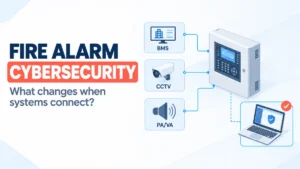
Modern CCTV is part of the connected technology environment.
Cameras, NVRs, servers, switches, applications, and remote access can all become part of an organization’s digital infrastructure.
Therefore, cybersecurity must form part of the CCTV design.
Engineers should consider:
- Strong authentication
- Role-based access
- Secure remote access
- Network segmentation
- Firmware updates
- Device hardening
- User management
- Logging
- Backup and recovery
A surveillance system should improve physical security without creating avoidable cybersecurity risks.
This becomes especially important when CCTV connects to an organization’s wider IT network.
What Happens When AI Gets It Wrong?
This question deserves more attention.
AI systems can produce false positives and false negatives.
For example, environmental conditions may affect analytics.
Rain, shadows, reflections, low light, crowded scenes, camera movement, or unusual activity can influence results.
Therefore, engineers should not assume that every AI alert represents a confirmed security incident.
A better design uses AI to prioritise and assist.
Human operators can then verify important events before taking action.
This approach also helps organisations create realistic operating procedures.
AI Does Not Replace Basic CCTV Engineering
Despite the rapid development of AI, the fundamentals remain unchanged.
A reliable enterprise CCTV project still needs:
- Correct camera placement
- Appropriate lenses
- Adequate lighting
- Reliable networking
- Proper PoE and power planning
- Sufficient storage
- Suitable NVR capacity
- Cybersecurity
- Redundancy where required
- Operator training
- Clear response procedures
- Preventive maintenance
AI works on top of this foundation.
If the underlying CCTV design is poor, AI cannot magically correct it.
In fact, poor camera positioning or poor image quality can reduce the usefulness of analytics.
How Engineers Should Design an AI-Ready CCTV System
A practical approach starts with the security requirement.
Step 1: Define the problem
Ask what the organisation actually wants to achieve.
Is the objective:
- Detection?
- Identification?
- Investigation?
- Monitoring?
- Safety?
- Operational visibility?
Step 2: Map the site
Identify critical assets, entrances, exits, restricted areas, movement paths, blind spots, and high-risk locations.
Step 3: Define each camera’s job
Do not simply assign cameras based on floor area.
Define what each camera must see and what information it needs to provide.
Step 4: Select the camera
Evaluate resolution, lens, field of view, lighting, mounting, environment, and analytics requirements.
Step 5: Design the network
Calculate bandwidth, PoE, switching, uplinks, segmentation, and redundancy.
Step 6: Select the recording architecture
Determine NVR capacity, storage, retention, recording modes, and backup requirements.
Step 7: Define AI requirements
Select only the analytics that support a real security or operational objective.
Step 8: Design the response workflow
Determine how operators receive alerts, verify events, investigate footage, and respond.
Step 9: Plan cybersecurity and maintenance
Define access control, firmware management, system monitoring, backups, and lifecycle support.
This approach creates an AI-ready CCTV system without unnecessarily complicating the project.
What Engineers Should Expect From Enterprise CCTV Now
The expectations are clearly changing.
Engineers are moving away from questions such as:
“How many megapixels does this camera have?”
and toward questions such as:
“What can this camera help the security team understand?”
They are also asking:
- Can operators find incidents faster?
- Can the system reduce unnecessary monitoring?
- Can analytics support a defined security objective?
- Can the architecture scale?
- Can the network support the workload?
- Can the system remain reliable?
- Can operators understand alerts?
- Can the organisation secure the devices?
- Can the system integrate with future technologies?
These questions produce better designs because they focus on outcomes instead of specifications alone.
The Role of an Experienced CCTV Partner
Technology selection is only one part of a successful enterprise surveillance project.
Implementation also matters.
Organisations may need help with:
- Site surveys
- Camera placement
- System architecture
- NVR selection
- Network planning
- Storage calculations
- Installation
- Configuration
- Commissioning
- Training
- Maintenance
For companies looking for an Impact by Honeywell distributor in India, the important consideration should be more than product availability.
The right partner should understand how the cameras, recording infrastructure, networking, analytics, and site requirements fit together.
That system-level approach becomes even more valuable as CCTV deployments become more intelligent.
The Future of Enterprise CCTV Is Not “More AI”
It is easy to assume that the future of surveillance means adding AI to every camera.
That is not necessarily the best approach.
The better direction is purpose-driven intelligence.
Engineers should ask:
What problem are we solving?
Then:
What information does the security team need?
And finally:
What combination of cameras, analytics, networking, storage, and people can deliver that information reliably?
This approach prevents technology from becoming the objective.
Instead, technology becomes the tool.
Final Thoughts
AI is changing enterprise CCTV because it is changing what organisations expect from video surveillance.
CCTV is no longer only about capturing images and storing them for later.
Increasingly, organisations want systems that can help them:
See → Detect → Understand → Investigate → Respond.
That does not make traditional CCTV engineering less important.
It makes it more important.
Camera positioning, lenses, lighting, networking, storage, NVR capacity, cybersecurity, and system reliability still determine the quality of the foundation.
AI adds another layer by helping organisations extract useful information from that foundation.
For engineers, the opportunity is therefore not simply to install more intelligent cameras.
It is to design better surveillance architectures.
The strongest enterprise CCTV systems will combine reliable hardware, thoughtful engineering, useful analytics, strong network infrastructure, effective recording, and human decision-making.
That is the real shift.
The future of enterprise CCTV is not about recording more video. It is about making every useful piece of video easier to understand and act upon.
Read Also: Difference Between Recording Video and Building a Useful Security System
Read Also: Why Industrial CCTV Needs to Be Designed Around Risk, Not Just Coverage