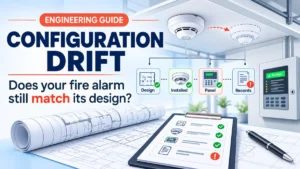
Every fire alarm system is designed around a specific building at a specific point in time. An engineer calculates the number of detectors, modules, notification appliances, zones or loops, and interfaces needed for the building on the approved drawings. That design is correct for that building, on that day.

Years later, the building changes: a new floor, a partitioned warehouse, a production line expanding into an adjacent shed, or a BMS integrated with the fire alarm panel. Each change seems small on its own, but together they push the system past the assumptions it was built on.
This is not simply a question of how many more detectors can be added. It is a system-level question touching capacity, power, network architecture, programming logic, and documentation all at once. Treating it as a device-count problem is exactly how fire alarm systems get quietly overloaded.
When a fire alarm system outgrows its original design, the building’s growth exceeds one or more of the assumptions the system was engineered around: device capacity, loop or zone capacity, power and battery capacity, notification loading, network architecture, or programming resources. The panel may still function normally, which is why the problem often goes unnoticed. Engineers should not simply add devices to fill physical space; they should reassess the complete system before approving any expansion.
Why Do Fire Alarm Systems Outgrow Their Original Design?
Several factors typically combine to push a system beyond its original design basis:
- Building expansion: new floors, wings, or standalone structures.
- Change in occupancy: different detection and notification needs.
- New production or storage areas with different hazard profiles.
- Increased device count beyond what the loop or panel was sized for.
- Renovation and partition changes altering coverage and cable routes.
- New notification requirements in additional zones.
- Additional interfaces to sprinkler systems, smoke control, or lift homing.
- BMS, HVAC, or access control integration never in the original design.
- Operational changes: shift patterns, new stored materials, evacuation changes.
- Platform limitations: older panels nearing end-of-support.
- Little original expansion margin, sized tightly from day one.
Individually, each factor seems manageable. Together, they change the design basis even if the panel is still working perfectly.
The First Warning Sign: Available Capacity Is Disappearing
Before any expansion is considered, capacity must be checked, not estimated. This includes device capacity per loop and panel, zone capacity, I/O module capacity, notification circuit capacity, overall panel capacity across networked panels, power supply capacity under standby and alarm conditions, battery capacity, and network capacity for multi-panel systems.
Capacity must be verified against manufacturer documentation and the approved project design, not how much physical space appears free inside a cabinet.
Why Adding More Devices Is Not Always the Answer
A common mistake is assuming empty terminals or unused cabinet space mean the system can absorb more devices. It doesn’t work that way.
Physical space is not engineered capacity. A panel may have room for extra wiring while its loop is close to its device limit, or a cabinet may look half-empty while the power supply is close to its calculated alarm load.
Several factors limit expansion even when things look available at a glance: loop loading from every added detector, voltage drop on longer cable runs, the standby/alarm power budget, notification loading against rated circuit capacity, growing cause-and-effect complexity, network architecture limits, and the condition of an ageing system with recurring faults.
Physical space available is not engineered capacity available. Only the second one matters.
How to Determine Whether the Existing System Can Be Expanded
A structured assessment avoids guesswork: review original design documents and as-built drawings; verify installed device count against records; check panel, loop, and device capacity against current manufacturer documentation; review power and battery calculations; review notification loading per circuit; review cause-and-effect programming for affected areas; check for existing faults; review interfaces to other systems; and assess anticipated future needs, not just the current request.
| Area to Check | Why It Matters | Typical Question |
|---|---|---|
| Panel capacity | Determines expansion capability | Is sufficient capacity available? |
| Loop/device capacity | Limits additional field devices | How many devices can be added? |
| Power supply | Supports connected equipment | Is the power budget adequate? |
| Batteries | Supports standby/alarm operation | Do revised calculations remain adequate? |
| Network | Important for larger/distributed systems | Can the existing architecture support expansion? |
| Cause & effect | Additional devices may create new actions | Does programming need modification? |
| Documentation | Prevents engineering errors | Are drawings/configuration records current? |
Exact numerical limits should never be assumed; always verify them against the manufacturer’s current technical documentation and the applicable project design.
When an Existing Fire Alarm System Can Still Be Expanded
Expansion is often practical when:
- Sufficient device, loop, and panel capacity remains.
- Revised power and battery calculations still fall within limits.
- Existing cabling and pathways suit the new areas.
- New devices are compatible with the existing platform and firmware.
- Cause-and-effect logic can accommodate the additions cleanly.
- Notification and interface needs can be met without overloading circuits.
- The existing system is in good working condition.
- Foreseeable future requirements have also been considered.
These decisions should rest on manufacturer documentation, the actual system configuration, and current project requirements, not assumptions carried over from the original installation.
When Expansion Starts Becoming an Upgrade Project
At some point, “adding to the system” stops being realistic and the project becomes a genuine upgrade or redesign. Warning signs include:
- Capacity across loops, panels, or power supplies is nearly exhausted.
- Multiple expansion phases are already planned.
- The panel or platform is ageing or nearing end-of-support.
- Replacement devices are hard to source.
- Existing wiring is unsuitable for more circuits.
- System faults are already occurring.
- Network architecture is limiting further growth.
- Integration needs have become far more complex than originally scoped.
- Documentation is incomplete or inconsistent with the installation.
- The original design no longer reflects how the building is used.
There is a meaningful difference between adding to an existing system and re-engineering or upgrading the fire alarm system. The first assumes the original design basis still holds. The second acknowledges it doesn’t, and starts fresh from the building as it exists today.
EST Fire Alarm System as Part of a Scalable Fire Alarm Strategy
When evaluating any fire alarm platform for a facility likely to grow, scalability deserves as much attention as day-one functionality, including when considering an EST Fire Alarm System as part of a long-term fire and life safety strategy.
Relevant considerations include networking architecture for multiple panels, how loop and device capacity is structured, integration with other building systems, and lifecycle and firmware support over time. These are the same questions worth asking of any addressable platform; the goal is understanding how the architecture behaves as demand increases, not assuming one platform fits every project.
Don’t Forget the Field Devices
Expansion planning tends to focus on the control panel, but the field side deserves equal scrutiny, including EST Detectors and Devices and similar field equipment.
Engineers need to evaluate detector placement against the revised layout, device compatibility with the existing platform and firmware, spare I/O availability, manual call point coverage, notification loading, interfaces to other systems, condition of existing wiring, environmental suitability, and how addresses will be allocated without disrupting the device map. A capacity assessment that ignores field devices is incomplete.
Why the Right Distributor Matters During Expansion
Expanding an installed system usually raises practical questions beyond design calculations: is a device still available, is documentation available for a legacy panel revision, and can configuration support be arranged for the new areas? This is where a knowledgeable EST Fire Alarm System Distributor in India can matter.
Access to current product documentation, availability of compatible replacement devices, and support for configuration and project planning reduce the risk of engineering errors during expansion. This is a support consideration, not a substitute for design review; the engineering assessment still has to be done regardless of the distributor involved.
Real-World Example — A Building That Added New Areas
Consider a mid-sized manufacturing facility fitted with an addressable system sized for its production floor, a small office block, and one storage area. Over several years, it added a second storage building, converted part of the office block into workspace, and installed access control interfacing with the fire panel.
When a consultant planned detection for the new storage building, the assessment revealed issues unrelated to that area. The original storage loop was already close to its device limit. Power calculations had never been revisited despite notification appliances added informally over the years. The cause-and-effect matrix had grown ad hoc, with some interlocks undocumented. The as-built drawings no longer matched the installed device count.
None of this meant the panel was faulty; it was operating normally. But the building’s design basis had shifted well beyond what the original engineering accounted for, a gap only visible once someone looked closely.
10 Warning Signs Your Fire Alarm System May Be Outgrowing Its Design
- Recurring concerns about spare capacity.
- Frequent modifications without an updated design review.
- Devices on site not on current drawings.
- Drawings and configuration records that are out of date.
- Little or no spare capacity on existing loops.
- A growing number of interfaces to other systems.
- Recurring or unexplained system faults.
- Difficulty sourcing compatible replacement components.
- Major occupancy, layout, or hazard changes since design.
- Known future expansion plans not yet engineered.
How Engineers Can Design for Future Fire Alarm Expansion
- Build in a reasonable expansion margin at the design stage.
- Maintain accurate, current documentation throughout the system’s life.
- Keep detailed configuration and cause-and-effect programming records.
- Maintain an updated device schedule.
- Consider known future building phases during the original design.
- Revisit power and battery calculations whenever devices are added.
- Plan cable pathways with future circuits in mind.
- Document every interface to other systems as it’s added.
- Periodically reassess capacity, even with no expansion planned.
- Avoid informal short-term fixes that create long-term risk.
Key Takeaways
- A system that still functions correctly may be poorly positioned for further expansion.
- Capacity should be evaluated as a complete system, not a single device count.
- A building modification can change the design basis even while the panel operates normally.
- Physical space inside a cabinet is not the same as engineered capacity.
- Expansion decisions should account for current and foreseeable future needs.
- Documentation quality directly affects the safety of future modifications.
- Approaching practical limits calls for an honest upgrade conversation, not patching.
Read Also: Planning an EST3 to EST4 Migration: Key Engineering Questions
Read Also: What Happens When a Fire Alarm System Outgrows Its Original Design?