A technician resets a fault on Monday. The same detector trips again on Thursday. By the following month, it has happened five times and each time, the service report says the same thing: “fault cleared, panel reset.”
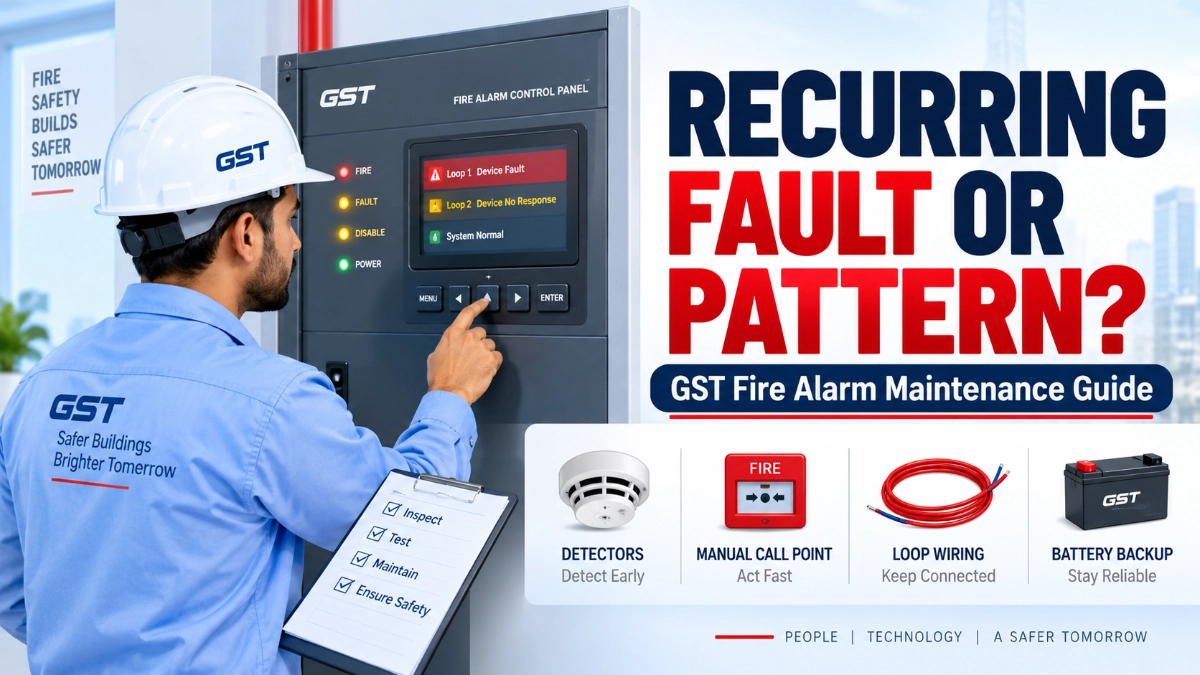
This is one of the most common blind spots in fire alarm maintenance. Individually, each event looks minor. Together, they tell a different story. A fault that keeps returning is rarely bad luck; it is usually a signal that something in the system, the environment, or the installation needs deeper investigation.
When does a fire alarm fault stop being an isolated problem and become a pattern? That question sits at the centre of good maintenance practice, and it is the focus of this article.
What Does a “Pattern” Mean in Fire Alarm Maintenance?
In fire alarm maintenance, a pattern is a fault or alarm that repeats by device, location, timing, or fault type, rather than occurring as a single, unrelated event.
A pattern can show up in several ways:
- The same detector repeatedly alarming
- Multiple devices on the same loop showing faults
- Faults appearing in the same building zone
- Alarms occurring at similar times of day
- Repeated battery failures
- Recurring communication failures
- Repeated earth faults
- Multiple devices failing after an environmental change (monsoon, HVAC changes, construction work nearby)
It helps to think of fault development as a chain:
Symptom → Fault → Recurrence → Pattern → Root Cause
A symptom is what the panel shows. A fault is the underlying trigger. Recurrence is the fault happening again. A pattern emerges once recurrence has a consistent shape: same device, same zone, same time, or same fault code. Root cause is the actual reason the pattern exists. Maintenance that stops at “fault cleared” never reaches root cause, which is why the same problem keeps coming back.
Which Fire Alarm Problems Should Be Treated as Patterns?
Not every repeated fault has the same underlying cause. The classification below is a starting point for investigation, not a diagnosis.
1. Repeated Detector False Alarms
A detector that trips once may simply have caught dust from a one-off event. A detector that trips repeatedly, in the absence of an actual fire condition, may indicate that the detector type does not suit its environment: steam near a smoke detector, dust in a workshop, or airflow from an HVAC vent hitting the sensing chamber. It can also indicate detector ageing or contamination.
2. Repeated Loop or Wiring Faults
Wiring-related patterns are among the most consequential to miss. Recurring loop faults can point to:
- Open circuits
- Short circuits
- Earth faults
- Loose terminations
- Cable damage from rodents, sharp edges, or vibration
- Poor termination workmanship
- Moisture ingress into cable joints or conduits
A single loop fault after a storm may be coincidental. The same loop faulting after every heavy rain is a pattern worth tracing to cable routing and moisture protection.
3. Repeated Battery or Power-Supply Faults
Standby power problems that keep recurring can be caused by:
- Battery ageing beyond its rated service life
- Charger circuit problems
- Voltage instability on the incoming supply
- Excessive standby load on the panel
- Incorrect battery capacity for the installed load
- Maintenance records that show replacement without root-cause testing
4. Multiple Devices Failing in One Location
When several devices in the same area fail within a similar window, the common factor is rarely coincidence. It usually points to shared infrastructure, a loop segment, a power supply branch, or an environmental condition affecting that zone (heat, humidity, dust, vibration, or electrical interference).
5. Repeated Communication Faults
On addressable and networked systems, recurring communication faults between devices, loop cards, or interconnected panels can be caused by network wiring issues, interface card problems, address conflicts, or firmware/configuration mismatches. These faults deserve system-level review rather than device-by-device troubleshooting.
6. Recurring Alarms at Similar Times
Alarms clustering around particular times of day often correlate with operational activity: HVAC start-up cycles, cleaning schedules that raise dust, kitchen or process steam, shift-change movement, or machinery operation. Reviewing the time pattern alongside facility activity logs can shorten the investigation considerably.
7. Repeated Faults After Device Replacement
If a fault returns after a detector or module has already been replaced, the original device was probably not the cause. This is one of the clearest signs that the fault lies in the wiring, the power supply, the environment, or the system configuration, not the component that keeps getting swapped out.
Pattern Recognition Table
| Observed Problem | What Repetition May Indicate | What Engineers Should Investigate |
|---|---|---|
| Same detector alarms repeatedly | Environmental or application mismatch | Location, airflow, dust, steam, detector type |
| Repeated loop fault | Wiring or termination problem | Cable route, joints, insulation, continuity |
| Repeated battery fault | Power supply or battery ageing | Battery health, charger, standby load, voltage |
| Several devices fail together | Common infrastructure issue | Loop segment, power supply, environment |
| Alarms cluster at set times | Environmental or operational trigger | HVAC cycles, cleaning, temperature, occupancy |
| Fault returns after reset or replacement | Underlying cause remains unresolved | Root cause instead of repeated component swap |
These are indicators for investigation, not automatic diagnoses. The same symptom can have more than one cause, depending on system design, building conditions, and maintenance history.
Why Fault Frequency Matters
A simple way to frame pattern recognition:
Frequency + Location + Timing + Device Type + Maintenance History = Pattern
Service records, reviewed over weeks or months, reveal trends that a single visit cannot.
Example 1: One detector gives one false alarm in six months. This is reasonable to investigate as an isolated event.
Example 2: The same detector gives five alarms in three weeks. This should be treated as a pattern, with attention to detector type and local conditions, not just a sensitivity check.
Example 3: Six detectors in the same area generate alarms within a short period. Rather than replacing six detectors, the environment and system design in that zone deserve review first.
Example 4: A loop develops an earth fault repeatedly after rain. This points toward moisture ingress along the cable pathway rather than a device defect.
These examples are illustrative, based on plausible facility scenarios, and are meant to show the reasoning process rather than predict a specific outcome for any real installation.
How Maintenance Teams Can Track Patterns
Step 1 — Record Every Event
Each entry should capture date, time, device ID, device type, zone or loop, building or location, fault or alarm type, environmental conditions at the time, and the corrective action taken.
Step 2 — Look for Repetition
Ask whether the same device is involved, the same area is involved, the same fault code is recurring, the timing is similar, or the fault follows a particular activity.
Step 3 — Group Related Events
Grouping events by device, zone, or fault type turns a long list of isolated tickets into a visible trend.
Step 4 — Investigate the Common Factor
Move the investigation from the individual device to the wider system it belongs to: the loop, the power branch, or the environment.
Step 5 — Document the Root Cause
A service report that only says “detector replaced” loses the information the next engineer needs. Recording the suspected or confirmed cause helps future maintenance visits build on prior findings instead of repeating them.
Step 6 — Verify After Corrective Action
Once corrective work is complete, the system should be monitored for a defined period to confirm the fault has genuinely stopped, not just gone quiet temporarily.
Addressable vs Conventional Systems: Pattern Recognition Differs
Addressable Fire Alarm Systems
An addressable fire alarm panel identifies each device individually, which makes pattern recognition more direct. Because addressable detectors report their own ID, loop position, and event history, engineers can trace a recurring fault to a specific device or loop segment with far less manual cross-checking.
Conventional Fire Alarm Systems
A conventional fire alarm panel reports faults by zone rather than by individual device. Conventional detectors do not carry the same self-reporting capability, so identifying which specific device is responsible for a recurring zone fault relies more heavily on physical inspection, systematic zone testing, and thorough maintenance records.
Neither architecture is automatically superior for every application. The right maintenance methodology should match the system that is actually installed. Addressable systems reward data-driven, device-level trend analysis, while conventional systems reward disciplined, zone-based inspection routines and careful documentation.
When Maintenance Fixes the Symptom Instead of the Cause
Several habits quietly undermine long-term fire safety, even when each visit looks compliant:
- Repeatedly resetting the panel without logging why the fault occurred.
- Replacing detectors without checking the surrounding environment.
- Ignoring recurring earth faults because “the system still works”.
- Treating each battery fault as a one-off rather than tracking battery age and load.
- Failing to record device IDs, which makes trend analysis impossible later.
- Poor or inconsistent maintenance documentation.
- Overlooking location-based clusters of faults.
- Closing service tickets without verifying the fault has actually stopped.
- Replacing components without checking compatibility with the existing system.
- Skipping a review of historical service data before starting new troubleshooting.
None of these is unusual mistakes; they happen under time pressure, on busy sites, with rotating technicians. Recognising them is the first step toward a more durable maintenance approach.
A Root-Cause Framework Engineers Can Use
Detect → Record → Compare → Group → Investigate → Correct → Verify → Monitor
- Detect: Identify the fault or alarm as it occurs.
- Record: Log full details: device, location, time, conditions, action taken.
- Compare: Check the new event against historical records for the same device or zone.
- Group: Cluster related events to reveal a trend.
- Investigate: Move beyond the device to the wiring, power, environment, or configuration.
- Correct: Apply the fix that addresses the actual cause, not just the symptom.
- Verify: Confirm the fault has stopped after corrective work.
- Monitor: Continue tracking the device or zone for a defined period to confirm the pattern is genuinely resolved.
This framework is one of the most practical habits a maintenance team can adopt, because it turns routine service visits into a continuous improvement loop rather than a series of disconnected repairs.
A Note on Safety
Fire alarm systems are life-safety systems. Investigating a recurring fault is not a reason to disable detectors, bypass safety circuits, permanently silence alarms, or leave an active fault unresolved while “monitoring” continues. Corrective work should be carried out by competent, qualified personnel, following applicable regulatory requirements and the system manufacturer’s documentation. Where a recurring fault cannot be immediately diagnosed, interim safety measures should follow the facility’s fire safety procedures rather than being left unaddressed.
GST Context for Fire Alarm Equipment and Maintenance
Because this topic is often searched alongside “GST fire alarm system” queries in India, it is worth a brief, careful note that this section is informational, not tax advice, and should be verified against current CBIC notifications before being used for invoicing or compliance decisions.
Fire alarm equipment as goods is generally classified under HSN heading 8531 (electric sound or visual signalling apparatus, including fire and burglar alarms), commonly reported at an 18% GST rate under sub-headings such as 85311020 for fire alarm devices.
Fire alarm maintenance, repair, and AMC (Annual Maintenance Contract) services are generally treated separately from the goods and typically fall under SAC heading 9987 (maintenance, repair, and installation services except construction), commonly reported at 18% GST, with further sub-classification depending on the exact nature of the service.
A few points are worth keeping in mind:
- The distinction between fire alarm equipment as goods and maintenance as a service matters for correct GST classification, since goods and services can carry different HSN/SAC codes even within the same commercial relationship.
- Whether a contract is treated as a supply of goods, a supply of services, or a composite/mixed supply can depend on how the contract is structured; for example, whether it is a pure AMC, an AMC that includes spare parts, or a combined supply-and-install contract.
- India’s GST rate structure has been revised through recent GST Council reforms, and rates are subject to change by government notification.
- This article does not state a rate or classification as final or guaranteed. Anyone issuing invoices, filing returns, or structuring a maintenance contract should verify current HSN/SAC codes and applicable rates directly on the official GST portal or with a qualified tax professional, referencing the latest CBIC notification.
A professional maintenance contract for a GST fire alarm system typically documents scope items such as preventive maintenance, corrective maintenance, device testing, panel inspection, battery checks, fault investigation, replacement of defective components, testing records, service reports, and, where the pattern-based approach described in this article is followed, recurring fault analysis as part of the service deliverable.
Read Also: How Engineers Should Approach Redundancy in Large Fire Alarm Installations
Read Also: Why Industrial Fire Alarm Projects Need More Than a Standard Panel-and-Detector Approach