A facility has run the same fire alarm platform for over a decade. It still passes periodic tests, but replacement components are harder to source, documentation is incomplete, building areas have been reconfigured, and the maintenance team increasingly depends on a shrinking pool of engineers who know the platform well.
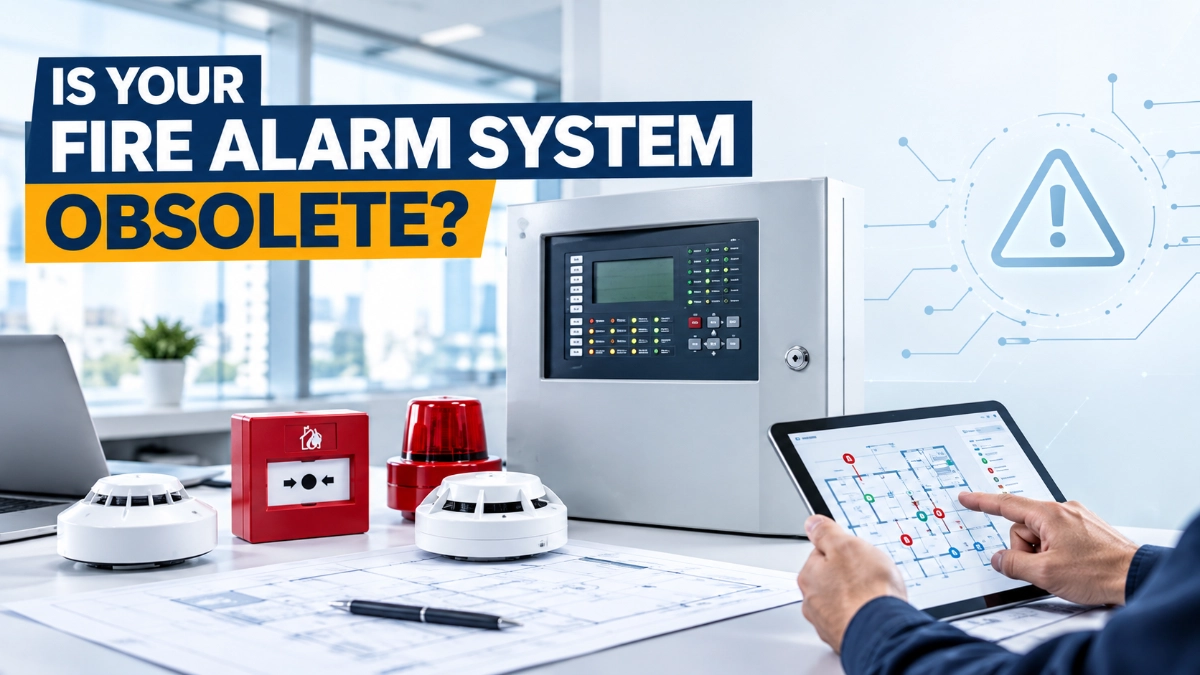
None of this means the system has failed, but it raises a real question: should the organisation wait until a critical component fails, or should planning begin now?
Most replacement projects start here: not a dramatic failure, but a slow build-up of lifecycle, support, and documentation pressure. Planning early gives engineers room to evaluate the problem instead of reacting to it.
When Should Fire Alarm Replacement Planning Begin?
Planning should begin before the existing system reaches a point where a lack of parts, reduced manufacturer support, incomplete documentation, limited capacity, or poor compatibility starts creating operational risk.
A structured review examines lifecycle status, architecture, field devices, wiring, documentation, integrations, capacity, and realistic upgrade, migration, or replacement options. The goal isn’t to justify replacement, but to establish, with evidence, whether it’s the right response and when.
What Does Fire Alarm System Obsolescence Actually Mean?
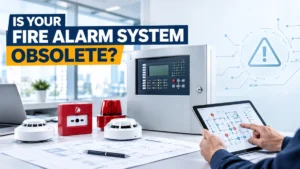
Obsolescence is broader than a simple age question. Indicators worth reviewing include:
- Limited or unavailable replacement components
- Reduced manufacturer support
- Devices difficult to source
- Outdated configuration software
- Limited capacity for additional devices
- Constraints integrating with newer systems
- Gaps in as-built documentation
- Rising cost of routine maintenance
- Architecture that no longer matches building use
- Fewer technicians trained on the platform
An old system is not automatically an obsolete system, and age alone isn’t sufficient justification for replacement. But when lifecycle limitations, reduced support, and technical constraints appear together, that’s reason for structured evaluation, not an immediate decision to replace.
Why Waiting for Failure Can Complicate Replacement
The difference between a planned replacement and an emergency replacement is mostly how much control the engineering team retains. Planned replacement allows time to evaluate architecture options, review documentation, and sequence work around operations. Emergency replacement triggered by a failed panel or an unsourceable component compresses that into a short window, straining procurement, site access, documentation, shutdown coordination, integration, training, and budget approval at once.
This isn’t a reason to treat every ageing system as an emergency just to start early enough that replacement, if needed, is scheduled, not reactive.
10 Things Engineers Should Review Before Replacing an Existing Fire Alarm System
- Existing system architecture: panel count, networking, dependencies.
- Panel condition and lifecycle status, support and parts availability.
- Field devices condition, age, and type of installed detectors.
- Wiring and infrastructure cabling condition and suitability for reuse.
- System capacity: spare loop, zone, or addressable capacity remaining.
- Network architecture: how panels, repeaters, and monitoring points communicate.
- Power infrastructure supply, battery calculations, standby arrangements.
- Integrations: connected systems and criticality of each interface.
- Documentation: whether records reflect what is actually installed.
- Future building requirements, planned changes in occupancy or use.
Review the Existing Architecture Before Selecting the Replacement
It is tempting to start a replacement project by researching new panels. That skips the step that determines what the replacement actually needs to do.
Before any product selection, engineers should document panel count, how panels relate, network topology, detection loops and circuits, field devices per circuit, remote annunciation, communication paths to monitoring stations, interfaces to other systems, and dependencies between buildings.
Do not begin by choosing a new panel. Begin by understanding what the existing system actually does.
Evaluate the Field Devices — Not Just the Fire Alarm Panel
A replacement project is often framed as a panel swap, but the panel is only one part of the installed base. Detectors, call points, input/output modules, sounders, interface units, and specialised detection equipment all need assessment for condition, compatibility, and remaining service life.
This is where the distinction between a panel replacement and a full system migration or replacement matters. Retaining field devices while replacing the panel is appropriate only after verifying devices, wiring, and protocols against the new platform’s requirements. Engineers may reference EST Detectors and Devices to understand relevant device categories and confirm compatibility through technical verification.
What Should Engineers Check in Existing Fire Alarm Wiring?
Wiring is often the most underestimated part of a replacement project, largely because it’s hardest to inspect without partial dismantling. A proper review checks cable condition, loop configuration, termination quality, routing, junction points, visible damage, and unrecorded modifications.
It’s also worth confirming segregation requirements were followed, and critically that documented wiring matches what is actually installed. Existing wiring should only be reused once the new system’s requirements and site conditions have been evaluated together; assuming reuse is a common source of cost overruns.
Check Capacity and Future Expansion — Not Just Current Requirements
A replacement sized only for today’s device count can create a new lifecycle problem almost immediately. The review should cover current device count, zone/loop allocation, spare capacity, known expansion plans, new floors under consideration, equipment likely to need detection, and anticipated occupancy changes.
The guiding principle: design the replacement around the building’s expected lifecycle, not only its current state. A system that just meets present-day needs will likely need revisiting soon.
Review Documentation Before Removing Anything
Before physical work begins, engineers should gather as-built drawings, cause-and-effect documentation, device schedules, loop records, panel configuration files, network diagrams, interface schedules, testing records, maintenance logs, and records of prior modifications.
Poor or outdated documentation doesn’t just slow design work; it raises the cost and complexity of commissioning, since assumptions have to be re-verified on site. Documentation should be checked against field conditions, since drift between the two is common on long-serving systems.
Evaluate Integrations Before Replacement
Modern fire alarm systems rarely operate in isolation. They may interface with PA/VA systems, access control, building management systems, HVAC shutdown or damper control, monitoring services, security systems, or other life-safety systems.
An apparently simple panel replacement can become a much larger project once interfaces are taken into account. Each interface needs identifying, its function understood, and its reconfiguration planned as part of the same project, not discovered mid-installation. No assumption should be made about whether an integration is automatically supported by a manufacturer; this needs direct verification.
EST3, EST4 and Platform Migration Considerations
When lifecycle and migration options are evaluated, engineers may look at established platforms such as EST3 and EST4 as reference points for how addressable architectures have evolved. Reviewing an existing EST Fire Alarm System installation is mainly about understanding architecture and panel relationships, not assuming any upgrade path or compatibility outcome.
Specific migration compatibility, device support, network capacity, and lifecycle timelines should be confirmed through technical verification rather than assumption. For procurement, organisations in India often work with an EST Fire Alarm System Distributor in India to confirm current availability and support for their site.
Replacement vs Upgrade vs Migration — What Is the Actual Project?
Before scoping work, it helps to define the type of project being planned.
| Approach | Typical Objective | Key Engineering Question |
|---|---|---|
| Repair | Keep current system operational | Can the system remain maintainable? |
| Upgrade | Improve selected components | What can be retained safely? |
| Expansion | Add capacity or coverage | Can the architecture support the change? |
| Migration | Move toward another platform | What must be retained, replaced, or reconfigured? |
| Full replacement | Replace the existing system | What is required to recreate the required functionality? |
None of these is universally correct; the right choice depends on the reviews above.
How to Build a Fire Alarm Replacement Assessment
- Document the existing system architecture, panels, devices, and layout.
- Assess lifecycle and support status, parts, and software currency.
- Inspect field devices and infrastructure condition, age, and wiring integrity.
- Review architecture and dependencies: how panels and buildings relate.
- Identify current limitations: capacity, integration, documentation gaps.
- Define future requirements: expansion, occupancy changes, new interfaces.
- Evaluate replacement/migration options matched against those requirements.
- Review interfaces and cause-and-effect for every connected system and sequence.
- Develop a phased implementation plan sequencing that protects continuity.
- Define testing, commissioning, and handover requirements before procurement.
Common Fire Alarm Replacement Planning Mistakes
- Waiting until a major component fails removes planning time.
- Treating panel replacement as the entire project overlooks devices and interfaces.
- Assuming old devices are automatically compatible creates commissioning delays.
- Ignoring existing wiring conditions leads to unexpected remedial work.
- Using outdated drawings design based on inaccurate site conditions.
- Forgetting future expansion system needs revisiting almost immediately.
- Ignoring system integrations turns a contained project into a larger one.
- Failing to review maintenance history misses recurring fault patterns.
- Selecting equipment before understanding architecture poor design fit.
- Not planning commissioning and handover early compresses testing time.
Fire Alarm Replacement Planning Checklist
- Is the platform still supported?
- Are replacement components available?
- Is the architecture documented?
- Does documentation match the installed system?
- What is the condition of field devices?
- What is the condition of existing wiring?
- How much capacity remains?
- What building changes are planned?
- What systems are integrated with it?
- What functionality must be retained?
- What can be reused?
- What must be replaced?
- Is phased migration required?
- How will testing and commissioning be performed?
- What documentation and training are needed after replacement?
How to Plan Replacement Without Creating a New Lifecycle Problem
A replacement should match the building’s next lifecycle stage, not just its current condition: scalability, maintainability, documentation quality, ongoing support, technician training, spare parts strategy, and future expansion.
Rather than “future-proof” a claim that rarely holds up, it’s more useful to design toward a system better aligned with anticipated building requirements and lifecycle needs.
Conclusion: Plan Before Obsolescence Becomes a Project Constraint
A fire alarm replacement project shouldn’t begin with “which new panel should we buy?” It should begin with a more fundamental question: what does the existing system do, what limitations are emerging, what must the replacement preserve, and what will the building need next?
Starting the assessment early lets engineers base decisions on architecture, lifecycle status, infrastructure, documentation, integrations, capacity, and future requirements rather than reacting to a sudden failure. That’s the difference between a planned project and an emergency procurement exercise.
Read Also: The Difference Between a Recurring Fault and a Random Fault
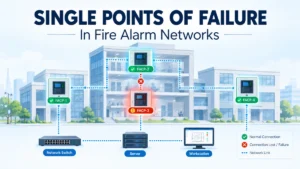
Read Also: How to Identify Single Points of Failure in a Fire Alarm Network