A warehouse manager in Pune doesn’t care about neural networks. She cares that a forklift nearly clipped a worker at 2 a.m. and nobody knew until the next morning’s footage review. That gap between something happening and someone finding out is the real story behind edge AI in surveillance.
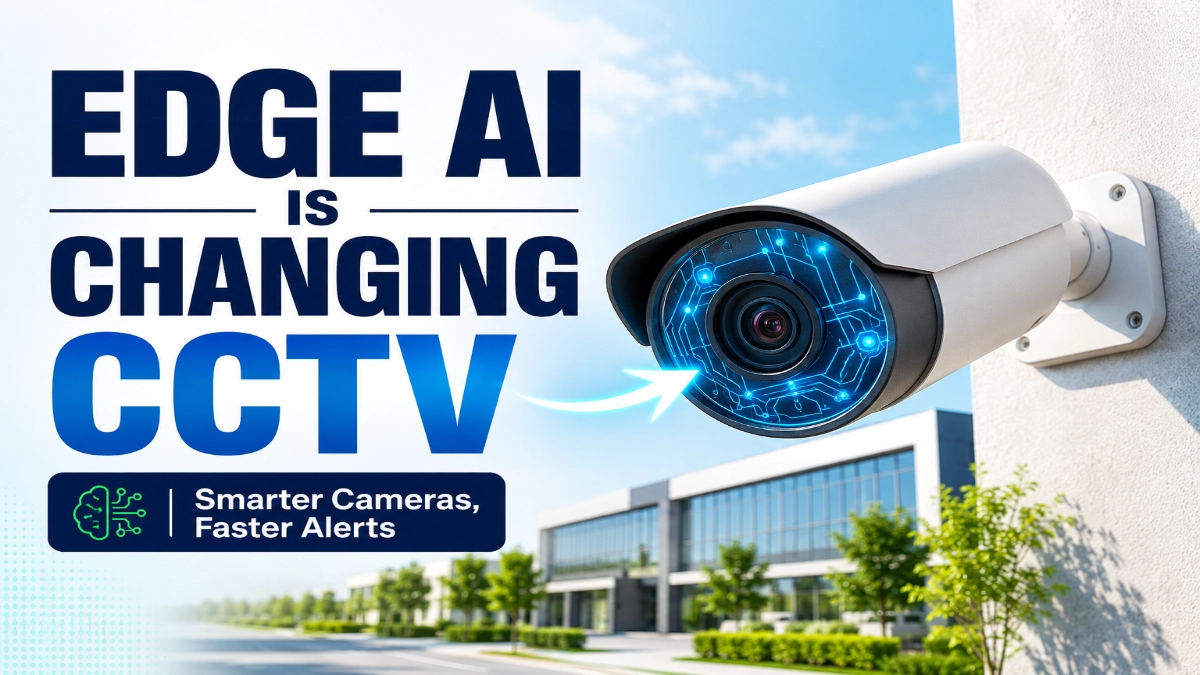
For twenty years, “smart” CCTV meant sending video to a server room or the cloud and waiting for software to tell you what happened. It worked, but slowly, and only when the network cooperated. Today, the analysis happens inside the camera itself, in the time it takes light to hit the sensor and a chip to make sense of it.
This shift isn’t a marketing refresh. It’s a structural change in how commercial security systems are designed, priced, and operated, and it’s happening because the hardware finally caught up to the ambition. In 2026, the addressable market for edge AI security cameras crossed roughly $2.1 billion, a trajectory that has been building since the technology reached commercial maturity around 2022. Understanding why will change how you spec your next surveillance project.
Key Takeaways
- Edge AI processes video directly on the camera or a local device, instead of sending raw footage to the cloud for analysis.
- It cuts latency from seconds to milliseconds, which matters for intrusion detection and safety alerts.
- It reduces bandwidth and storage costs dramatically, since only metadata or flagged clips need to travel across the network.
- It keeps systems operational during internet or WAN outages, a critical resilience factor for warehouses, plants, and remote sites.
- Privacy and data sovereignty improve because raw video doesn’t have to leave the building to be analysed.
- It is not a replacement for traditional CCTV; it’s an intelligence layer added to it.
- Buyers should evaluate chipsets, ONVIF compliance, and firmware update policy, not just camera resolution.
What Is Edge AI in CCTV?
Edge AI in CCTV means running artificial intelligence models directly on the camera or an on-site device, rather than sending video to a remote server for analysis. The camera itself detects people, vehicles, or events and generates an alert in real time, without waiting for a round trip to the cloud.
Think of it as the difference between a security guard who has to radio a control room and wait for instructions, versus one trained to recognise a threat and act immediately. Edge AI gives the camera that on-the-spot judgment.
This is possible because modern camera chipsets, often called SoCs (system-on-chip), now include a dedicated AI processing block sometimes called an NPU (neural processing unit) or, in Axis Communications’ terminology, a DLPU (Deep Learning Processing Unit). Manufacturers such as Axis build a Deep Learning Processing Unit into their ARTPEC SoC line, and the current ARTPEC-9 generation runs on-camera analytics faster than the previous generation and can run models of any size that fit in the device’s memory. Similarly, chipmakers like Ambarella produce vision SoCs that run modern neural networks, including transformer-based models, while drawing under 3 watts of power and still having capacity to run more than one detection model simultaneously.
How Edge AI Actually Works
Understanding the mechanics helps when you’re specifying hardware, not just buying on spec sheets.
On-device inference
“Inference” is the step where a trained AI model looks at new data in this case, a video frame and makes a prediction: is that a person, a vehicle, a bag left unattended? On-device inference means this prediction happens inside the camera’s own processor, not on a remote server.
AI chips inside cameras
The chip doing this work is purpose-built for pattern recognition, not general computing. It’s optimised to run “quantised” versions of deep learning models compressed so they fit in limited on-camera memory while still running fast. This is why a $2,000 enterprise camera can do in real time what used to require a rack of GPUs.
Edge computing architecture
In a typical deployment, the architecture has three tiers:
- The camera (edge): Captures video and runs the first pass of detection and classification.
- A local server or NVR (near edge): Aggregates metadata, manages storage, and runs heavier analytics across multiple camera feeds.
- The cloud (optional): Used for long-term archiving, remote access, or fleet-wide reporting, not for primary detection.
This layered design means the system keeps working even if the top layer goes offline.
Video analytics and deep learning models
The models themselves are trained to recognise specific categories of interest:
- Object detection: Identifying and locating objects (people, bags, vehicles) within a frame.
- Human detection: Distinguishing people from animals, shadows, or moving foliage, which is the single biggest reason modern systems generate fewer false alarms than old motion-detection cameras.
- Vehicle detection: Classifying cars, trucks, and forklifts, often combined with speed and direction tracking.
- Intrusion detection: Flagging when a person or object crosses a defined virtual boundary.
- License plate recognition (LPR/ANPR): Reading and logging plates at gates or loading docks.
- Behaviour analysis: Recognising patterns like loitering, running, or a person entering a restricted zone, based on movement over time rather than a single frame.
- Face recognition: Matching faces against a watchlist or access database. This capability carries real privacy and regulatory weight; many jurisdictions restrict or require consent for biometric processing, so deployment should always involve legal review, not just a technical install.
Real-time alerts and bandwidth optimization
Because detection happens on the camera, only the relevant event a bounding box, a classification tag, a short clip needs to travel over the network, instead of a continuous high-resolution stream. Analyst estimates suggest edge processing can cut network bandwidth consumption by a wide margin compared with streaming raw 4K video for every camera around the clock, since only flagged events or compressed metadata typically need to move across the network.
Edge AI vs Cloud AI: A Direct Comparison
| Factor | Edge AI Surveillance | Cloud AI Surveillance |
|---|---|---|
| Processing location | On the camera or local NVR/server | Remote data centre |
| Speed (latency) | Near-instant — milliseconds | Seconds, dependent on upload speed |
| Internet dependency | Works offline for detection and local alerts | Requires stable internet for analysis |
| Privacy | Raw video can stay on-premises; only metadata/events may leave | Raw video typically transmitted off-site |
| Bandwidth usage | Low — only events/metadata sent | High — continuous video streaming |
| Scalability | Scales per camera; add units independently | Scales via cloud compute, easier centralised management at large fleet size |
| Cost structure | Higher upfront hardware cost, lower recurring bandwidth/cloud fees | Lower upfront cost, ongoing subscription and bandwidth fees |
| Reliability during outages | Continues local detection and recording | Detection paused or degraded without connectivity |
| Maintenance | Firmware updates per device; more devices to manage | Centralized updates on server side |
| Typical applications | Warehouses, factories, remote sites, privacy-sensitive facilities | Multi-site retail chains, centralized SOC monitoring, elastic analytics workloads |
Most enterprise deployments today use a hybrid model: edge AI handles real-time detection and local resilience, while the cloud handles long-term storage, cross-site reporting, and remote access.
Why Businesses Are Adopting Edge AI Now
Businesses are adopting edge AI surveillance because it solves three long-standing problems at once: slow response times, high bandwidth costs, and unreliable connectivity at remote sites. A decade ago, running deep learning models required server-grade GPUs. Now that capability fits inside a camera housing, so businesses get faster detection without rebuilding their network infrastructure.
There’s also a compliance angle. Sending video to the cloud often crosses jurisdictional borders and can trigger compliance concerns in regulated sectors like healthcare, government, and finance. With on-device inference, a camera can send only the result, for example, a “person detected” event rather than the raw video feed, which helps organisations stay aligned with local data residency requirements.
Security has become a factor too. Every mile of network between a camera and a data centre is a potential interception point, and even encrypted video streams remain an attractive target. Edge processing narrows that exposure by converting visual data into encrypted metadata at the point of capture, rather than transmitting continuous raw footage.
Core Capabilities Explained
What are the biggest advantages?
The biggest advantages of edge AI are lower latency, reduced bandwidth costs, offline reliability, and improved privacy. Detection happens in milliseconds rather than seconds, only relevant events consume network capacity, cameras keep working during outages, and sensitive video doesn’t need to leave the premises for analysis.
Are there any limitations?
Yes. Edge AI cameras cost more upfront, have finite on-device processing power, and require firmware and model updates managed across potentially hundreds of individual devices. Complex analytics that need cross-camera correlation like tracking a person across a large campus often still benefit from centralised or cloud-assisted processing. Edge hardware also ages: a camera bought today may lack the compute headroom for the AI models released three years from now, which is why lifecycle and update policy matter as much as day-one specs.
Which industries benefit the most?
Warehouses, manufacturing, logistics, retail, healthcare, and education see the largest gains, because they combine high camera counts, safety-critical timing, and often unreliable or costly network backhaul at the edge of the site.
Is Edge AI replacing traditional video surveillance?
No. Edge AI is an intelligence layer added on top of traditional CCTV, not a replacement for cameras, recorders, or human oversight. Video still needs to be captured, stored, and reviewed. What’s changed is that the system can now interpret what it sees and act on it immediately, instead of just recording it for later.
How does Edge AI improve security operations?
By filtering out noise before it reaches a human. Traditional motion detection triggers on anything that moves: a shadow, a moth near the lens, a plastic bag in the wind. Edge AI’s human and vehicle detection models cut false alarms dramatically, so control room operators spend their attention on real events instead of scrolling through irrelevant clips.
Commercial Use Cases
- Warehouses: Edge cameras at dock doors combine vehicle detection with intrusion zones, alerting supervisors the instant a forklift enters a pedestrian walkway, before an incident report is even possible.
- Manufacturing plants: Behaviour analysis flags workers entering machine zones without proper PPE detection cues or bypassing safety barriers, feeding alerts directly into existing safety protocols.
- Retail stores: People-counting and dwell-time analytics run locally, giving store managers foot-traffic insight without streaming customer video to a third-party cloud, a meaningful privacy distinction under regulations like GDPR.
- Hospitals: Edge processing keeps patient-area footage on-premises, easing HIPAA-adjacent compliance concerns while still enabling real-time fall-detection or restricted-area alerts.
- Schools: Perimeter intrusion detection and license plate recognition at drop-off zones improve response time without requiring a 24/7 cloud connection dependency.
- Smart offices: Integration with access control systems lets a camera confirm “person detected, no badge presented” as a single automated event, rather than a human reviewing two separate systems.
- Airports: High camera density and strict latency requirements make edge processing essential; waiting on a cloud round-trip isn’t viable when tracking unattended baggage across a terminal.
- Logistics hubs: LPR at gate entries logs every vehicle locally, even if the site’s internet connection drops, then syncs the log once connectivity returns.
- Commercial complexes: Multi-tenant buildings use edge AI to segment analytics per tenant while keeping a shared backbone, since detection results, not raw footage, are what typically get shared upstream.
Common Mistakes When Deploying Edge AI
- Buying on resolution alone: A 4K sensor with a weak AI chip will still produce laggy, inaccurate detections. The processor matters as much as the lens.
- Ignoring firmware update policy: AI models improve constantly. A camera line with a short support lifecycle becomes obsolete for analytics long before the hardware fails.
- Skipping a network audit: Even “edge” systems need PoE budget planning, switch capacity, and NVR storage. Sizing edge AI correctly reduces bandwidth; it doesn’t eliminate the need for a sound network design.
- Treating face recognition as a default feature: It carries privacy and legal obligations that vary by state and country. Enable it deliberately, not because it shipped on by default.
- Assuming full VMS interoperability: Not every AI camera exposes its analytics the same way. Verify ONVIF Profile M or Profile T conformance before assuming your VMS can consume the metadata.
- No cybersecurity hardening plan: An internet-facing camera is a computer with a lens. Default credentials and unpatched firmware are the most common entry point for camera botnets.
Practical Buying Considerations
When should a business adopt edge AI? When any of the following apply: multiple remote or bandwidth-constrained sites, safety-critical response-time needs, high camera counts where cloud analytics costs scale poorly, or privacy/compliance requirements that discourage sending raw video off-site.
- Camera hardware requirements: Look for a dedicated NPU or DLPU, not just a fast general CPU. Check the model’s power draw, operating temperature range for outdoor sites, and whether the vendor publishes third-party analytics app support (Axis’s ACAP ecosystem, for instance, lists over 900 certified third-party analytics applications as of 2025, letting integrators add capability without swapping hardware).
- Network considerations: Even with reduced bandwidth needs, plan PoE budgets per switch, redundant uplinks for critical sites, and VLAN segmentation to isolate camera traffic from business systems.
- Storage planning: Edge AI reduces streamed bandwidth, not necessarily local storage. Cameras generally still record full video for evidentiary purposes. Size NVR storage around retention policy, not just camera count.
- AI model updates: Ask vendors how models are updated: over-the-air firmware push, manual upload, or app-store-style analytics packages. This affects long-term accuracy as detection models improve.
- Integration with VMS: Confirm ONVIF conformance level. Profile S covers basic streaming and PTZ control, Profile T adds advanced streaming with H.265 and metadata support, and Profile M covers metadata and AI-based event analytics. The profile that matters most for AI integration is Profile M, since it standardises how analytics results move between camera and VMS regardless of manufacturer.
- Future scalability: Choose a platform, not just a camera model. A chassis that supports app-based analytics additions will outlast one where every new capability requires a hardware refresh.
Future Trends
- Multimodal edge sensors: Cameras increasingly combine visual AI with thermal, radar, or audio sensing on the same chip, improving accuracy in poor visibility.
- Federated and privacy-preserving learning: Models improve across a fleet of cameras without raw video ever being centralised, addressing both bandwidth and privacy concerns simultaneously.
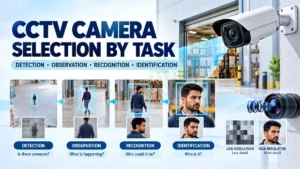
- Standardised pixel-density benchmarks: Newer measurement frameworks are replacing older ad-hoc “identify vs detect” distance guidance with formal pixel-per-meter benchmarks tied to specific analytic tasks, giving integrators a more precise way to spec cameras for a required detection distance.
- Tighter device-level cybersecurity: Expect more cameras shipping with hardware-rooted chains of trust, where every software layer from bootloader to AI application must be cryptographically signed before the device will boot, a defence against firmware injection and botnet recruitment.
- Edge-to-edge camera collaboration: Cameras beginning to share detection context directly with neighbouring units, enabling smoother multi-camera tracking without a centralised server doing the heavy lifting.
Expert Recommendations
- Start with a pilot deployment at one high-value site before a full rollout to validate false-alarm rates in your actual environment, not a vendor demo.
- Treat cybersecurity as part of the surveillance spec, not an IT afterthought: change default credentials, segment camera VLANs, and confirm the vendor’s patch cadence.
- Prioritise ONVIF-conformant hardware so you’re not locked into a single vendor’s ecosystem as your needs grow.
- Budget for camera lifecycle, typically five to eight years for enterprise-grade hardware, and check the manufacturer’s committed firmware support window before purchase.
- Involve legal or compliance teams early whenever face recognition or biometric matching is part of the design.
Conclusion
Edge AI didn’t reshape commercial surveillance by replacing cameras; it reshaped it by giving cameras judgment. That shift, from passive recording to real-time interpretation, is why the technology has moved from a premium add-on to a baseline procurement expectation across warehouses, plants, hospitals, and campuses.
The practical takeaway for anyone specifying a system today: resolution and camera count are no longer the whole conversation. The processor inside the camera, the update policy behind it, and the standards it speaks to your VMS matter just as much. Get those right, and the system pays for itself in faster response times, lower bandwidth bills, and fewer 2 a.m. surprises discovered the next morning instead of the moment they happen.
Read Also: Why Intelligent Video Analytics Matters More Than Higher Resolution
Read Also: Beyond Security: How CCTV Supports Business Operations