False alarms remain one of the most persistent challenges in fire alarm system design. They disrupt building operations, reduce occupant trust, waste emergency response resources and can even lead to regulatory penalties. As buildings become more complex and safety expectations rise, reducing false alarms is no longer optional; it is essential.
Modern GST addressable fire alarm systems are designed specifically to address this challenge. By combining intelligent devices, advanced algorithms and flexible programming, GST systems significantly reduce unwanted alarms without compromising life safety.
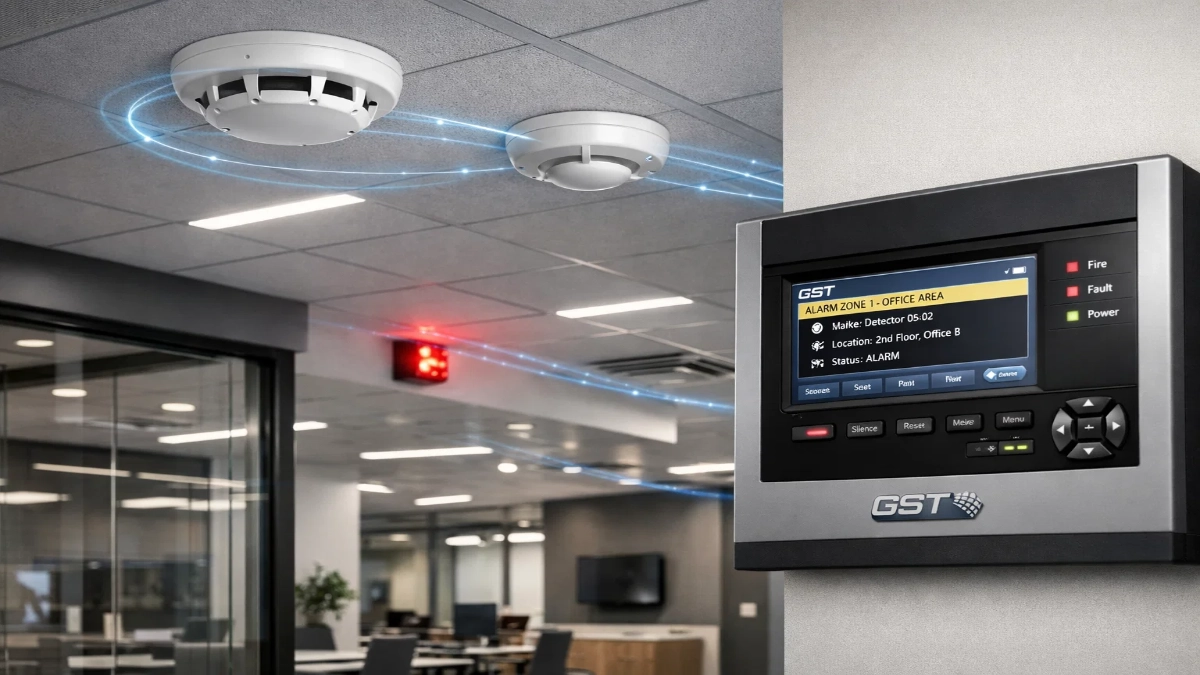
This article explains why false alarms occur, how GST addressable systems prevent them and what best practices engineers and facility managers should adopt to achieve reliable, compliant and disturbance-free fire detection.
Understanding the Impact of False Alarms
False alarms are not harmless events. Over time, they create serious operational and safety risks.
Common Consequences of False Alarms
- Occupant desensitisation: People begin ignoring alarms
- Operational disruption: Evacuations halt business activities
- Emergency service penalties: Authorities may impose fines
- System credibility loss: Facility managers lose confidence
- Maintenance overload: Repeated investigations waste resources
Many of these problems originate from outdated system design, improper device selection or environmental factors that traditional systems cannot interpret accurately.
Why Traditional Systems Struggle With False Alarms
Limitations of Conventional Detection
A conventional fire alarm panel groups detectors into zones. When one detector activates, the panel only knows the zone, not the exact device or cause. This design creates several issues:
- No ability to analyse alarm patterns
- No differentiation between smoke types
- High sensitivity with low intelligence
- Manual investigation is required for every alarm
Similarly, conventional detectors react to basic thresholds without understanding context. Dust, steam, insects or temperature fluctuations can easily trigger alarms.
As buildings evolve, these limitations become unacceptable.
Why Addressable Systems Are the Solution
An addressable fire alarm panel communicates individually with each device on the loop. This allows the system to analyse, verify and respond intelligently.
Key Advantages Over Conventional Systems
- Exact device-level identification
- Continuous self-monitoring
- Dynamic sensitivity adjustment
- Event history and trend analysis
- Advanced cause-and-effect logic
GST has refined these advantages through intelligent engineering and field-tested system architecture.
How GST Addressable Systems Reduce False Alarms
1. Intelligent Addressable Detectors
GST addressable detectors continuously analyse environmental data rather than responding to a single trigger.
Multi-Criteria Detection
GST detectors evaluate:
- Smoke density
- Heat rise rate
- Temperature stability
- Signal consistency over time
This allows the detector to distinguish between:
- Real fire conditions
- Cooking fumes
- Dust accumulation
- Steam or humidity spikes
As a result, alarms only activate when genuine fire signatures are present.
2. Dynamic Sensitivity Adjustment
One of the strongest false alarm reduction techniques in the GST fire alarm system is automatic sensitivity adjustment.
How It Works
- Detectors adjust sensitivity based on ambient conditions
- Day/night profiles can be configured
- High-risk periods get optimised thresholds
- Low-risk periods maintain heightened protection
For example:
- A hotel kitchen detector remains less sensitive during cooking hours
- The same detector becomes highly sensitive at night
This balance maintains safety while eliminating nuisance alarms.
3. Pre-Alarm and Alert Thresholds
GST addressable panels allow multi-stage alarm logic:
- Pre-alarm: Early warning for abnormal conditions
- Alert: Local notification for investigation
- Fire alarm: Full evacuation and system activation
Instead of triggering a full alarm instantly, the system allows time for verification, dramatically reducing unnecessary evacuations.
4. Advanced Algorithm-Based Decision Making
GST panels use intelligent algorithms rather than fixed thresholds.
Algorithm Benefits
- Pattern recognition instead of single-point activation
- Time-based validation
- Cross-device correlation
- Environmental compensation
For example, a sudden smoke spike that disappears within seconds will not trigger a full alarm unless confirmed by sustained data.
This intelligence is impossible in a conventional fire alarm panel.
5. Device-Level Fault and Contamination Monitoring
Dust buildup is one of the leading causes of false alarms.
GST addressable systems continuously monitor:
- Detector contamination levels
- Optical chamber health
- Sensor drift over time
When contamination reaches warning levels:
- The panel issues a maintenance alert
- The detector remains operational
- False alarms are prevented before they occur
This proactive approach eliminates guesswork and reactive maintenance.
6. Cause-and-Effect Programming
GST systems allow precise cause-and-effect logic:
- Single detector → pre-alarm only
- Two detectors in sequence → confirmed alarm
- Smoke + heat → immediate evacuation
This logic ensures that alarms are triggered based on confirmed fire behaviour, not isolated events.
7. Zoning and Risk-Based Device Placement
False alarms often result from incorrect detector selection.
GST Design Best Practices
- Smoke detectors in clean areas
- Heat detectors in kitchens and parking zones
- Beam detectors in large open spaces
- Multi-sensor detectors in mixed environments
GST systems support all detector types on the same loop, allowing engineers to design smarter layouts without compromise.
8. Event Logging and Analytics
Every event in a GST system is logged with:
- Time
- Device address
- Event type
- Duration
- Resolution
Over time, this data helps identify:
- Repeating nuisance zones
- Environmental changes
- Maintenance priorities
This analytical capability supports data-driven fire safety management, a key requirement for modern facilities.
GST Addressable vs Conventional Systems: False Alarm Comparison
| Feature | GST Addressable System | Conventional Fire Alarm Panel |
|---|---|---|
| Device Identification | Individual | Zone-based |
| Sensitivity Control | Dynamic | Fixed |
| Alarm Verification | Algorithm-based | None |
| Contamination Alerts | Yes | No |
| False Alarm Probability | Very Low | High |
| Maintenance Efficiency | Predictive | Reactive |
Compliance and Regulatory Alignment
Reducing false alarms is not just operational; it is regulatory.
GST addressable systems support:
- NBC of India recommendations
- International standards (EN, UL variants)
- Local fire authority requirements
- Smart building compliance frameworks
Authorities increasingly prefer intelligent systems because repeated false alarms undermine emergency readiness.
Best Practices to Maximise False Alarm Reduction
To fully benefit from GST systems:
- Use addressable detectors instead of conventional detectors
- Enable pre-alarm thresholds
- Program cause-and-effect logic carefully
- Schedule contamination-based maintenance
- Train facility staff on alarm interpretation
- Review event logs quarterly
- Avoid over-sensitising detectors unnecessarily
Why Large Projects Prefer GST Addressable Systems
Large facilities such as:
- Hospitals
- Airports
- Data centers
- IT parks
- High-rise residential towers
cannot afford false alarms.
They chose GST because:
- Reliability remains consistent over time
- Expansion does not increase nuisance alarms
- Systems adapt to changing environments
- Life safety remains uncompromised
Note: False alarms are not an unavoidable reality; they are a design failure.
With intelligent detection, adaptive algorithms and precise system logic, GST addressable fire alarm systems set a new standard in reliability. By replacing guesswork with intelligence, GST ensures that when an alarm sounds, it truly matters.
For modern buildings aiming for safety, compliance and operational excellence, false alarm reduction is no longer optional, and GST delivers it by design.
Read Also: Why Large Projects Choose GST Fire Alarm Panels for Compliance & Reliability
Read Also: Response Time Behaviour of GST Addressable Fire Alarm Systems