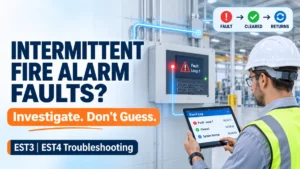
Introduction – The Fault Disappeared. Did the Problem?
An Edwards EST fire alarm panel reports a communication fault on a device or network segment. A technician attends, inspects the installation and finds normal status. The fault has cleared. A few days later, it returns.
This is a difficult maintenance situation. The fault may be absent during inspection, but its disappearance does not show the underlying cause is resolved. A clear panel is an observation, not a diagnosis.
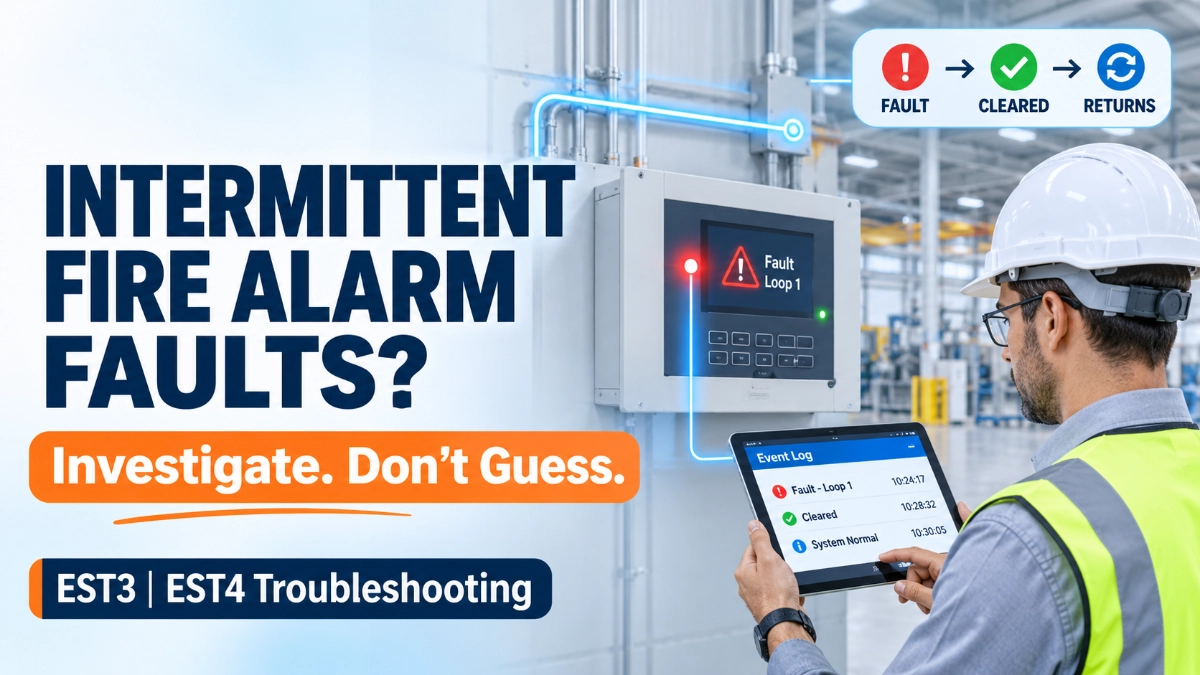
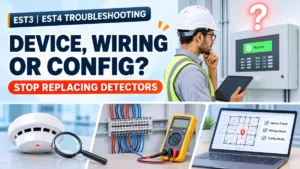
Intermittent faults need evidence-based investigation across devices, wiring, power, network paths, configuration and environmental conditions. Not every intermittent fault is a network hardware problem, and assuming so sends teams chasing the wrong component. This guide sets out a structured method for EST systems.
Treat an intermittent fire alarm network fault as a repeatable technical symptom. Capture the exact fault text and event history, identify repeat patterns, and establish which devices or network sections are affected. Inspect wiring and connections, review power and environmental conditions, and compare configuration records. Test affected functions under an approved plan. Record findings before replacing any equipment, so the cause, not the first reporting device, drives the repair.
Why Intermittent Fire Alarm Faults Are Difficult to Diagnose
An intermittent fire alarm network fault is a condition that appears, clears and reappears without a consistent pattern. The panel may log the fault and its restoration while the underlying wiring, power, device, communication or configuration issue remains unresolved.
Diagnosis is hard because:
- Faults appear only under specific operating conditions.
- The system may restore before anyone attends.
- Several devices can show related symptoms.
- Events may coincide with maintenance or building activity.
- Temporary recovery can mask an unresolved connection.
| Permanent fault | Intermittent fault |
|---|---|
| Remains continuously present | Appears and clears unpredictably |
| Often easier to reproduce | May disappear during inspection |
| Symptoms are relatively stable | Symptoms may vary over time |
| Investigation can follow a visible condition | Investigation needs event correlation and repeatable evidence |
Common Causes of Intermittent Faults in EST Fire Alarm Networks
Intermittent communication faults in addressable fire alarm systems can arise from wiring, power, device, network, configuration or environmental factors. Each is a possibility requiring evidence, not a presumption.
A. Loose or Unstable Wiring Connections
Loose terminals, poorly secured connections, damaged insulation, weak joints and mechanical movement can create connections that hold, then fail. Inspect accessible terminals and joints, then test using approved procedures.
B. Cable Damage and Environmental Stress
Vibration, moisture ingress, temperature variation, corrosion and mechanical damage degrade cable routes. Construction or maintenance disturbance adds risk. The fault may track the installation environment rather than a device.
C. Power Supply Instability
Supply interruptions, battery condition, voltage fluctuations, loose power connections and shared electrical disturbances can mimic communication faults. Review power supply monitoring and related events before concluding the network has failed.
D. Device-Level Communication Problems
Consider individual device faults, unstable connections, addressing inconsistencies, replacement or relocation history, and compatibility with the approved configuration. Do not assume a failure mode without evidence.
E. Network Communication Issues
Possible areas include network connections, communication paths, interface hardware, cable routes, intermittent connectivity and topology changes. Verify against installed design and manufacturer documentation for the specific EST3 or EST4 system.
F. Environmental and Operational Influences
Industrial vibration, dust, moisture, electrical interference, nearby machinery, temperature changes and recent construction can all influence an installation. Event timing helps reveal correlations, which remain leads until supported by evidence.
How to Investigate an Intermittent Fault Without Guesswork
Step 1 – Capture the exact fault information. Record fault text, device or network reference, date, time, panel indication and related events.
Step 2 – Review the event history. Look for repeated events, timestamps, locations, restorations and patterns.
Step 3 – Identify the scope. Determine whether one device, several devices, a loop, a network section or multiple panels are affected. Similar symptoms do not automatically share a root cause.
Step 4 – Compare fault timing with site activity. Check machinery operation, HVAC startup, electrical switching, maintenance, construction and environmental changes. Treat correlations as leads, not proof.
Step 5 – Inspect the physical installation. Review accessible terminals, cable routes, joints, enclosures, connectors and signs of damage or exposure.
Step 6 – Review power and system conditions. Check power supply indications, battery records and event information using approved procedures.
Step 7 – Review configuration and modification history. Identify device replacements, address changes, programming changes, network alterations and building modifications.
Step 8 – Conduct controlled testing. Define a safe, approved plan to reproduce or isolate the fault.
Step 9 – Record evidence and verify corrective action. Document findings, changes and whether the fault recurs under relevant conditions.
Competent personnel must perform all testing under approved procedures, with impairments and compensatory measures managed. Never bypass, disconnect or disable life safety circuits as an informal shortcut.
Fault Symptom vs Possible Cause: A Practical Diagnostic Table
All entries are possibilities to investigate, not confirmed diagnoses.
| Observed symptom | Possible investigation areas | Evidence to collect |
|---|---|---|
| Same device repeatedly reports a fault | Device, local wiring, connection, environment | Event history, inspection, approved device testing |
| Multiple devices show related faults | Shared wiring, circuit conditions, power, common network section | Event timing, affected device list, circuit records |
| Fault appears during machinery operation | Vibration, interference, power disturbance | Timestamps, machinery activity, electrical inspection |
| Fault clears before technician arrives | Intermittent connection, environmental condition | Historical events, recurrence pattern, site activity |
| Fault follows device replacement | Addressing, installation, configuration, compatibility | Replacement record, device identification, configuration review |
| Fault follows building modifications | Cable disturbance, altered routes, changed devices | Revised drawings, modification records, inspection results |
To distinguish a device fault from a wiring or network problem, compare scope and history. A fault that stays with one device after local wiring checks points toward the device. A fault shared across devices, or one that moves with the circuit, points toward wiring, power or network sections.
Why Replacing Devices Without Evidence Can Make Troubleshooting Worse
- The original fault remains unresolved.
- The replacement may show the same symptom.
- Addresses or descriptions may become inconsistent.
- Maintenance records become outdated.
- Cost and downtime increase.
- Repeated swaps obscure the original fault pattern.
Replace a device when evidence, approved diagnostic procedures, manufacturer guidance or inspection establishes a device-related problem. Use approved, compatible EST detectors and devices.
Practical Example: An EST Communication Fault That Keeps Returning
Hypothetical scenario for illustration. A warehouse EST installation reports intermittent communication faults on devices near a production area. The system restores before staff arrive.
- Event history shows repeated faults in similar time windows.
- Affected devices are mapped against approved drawings.
- Site records show nearby machinery running during some faults.
- Engineers inspect accessible cable routes and connections.
- A physical installation issue is identified only after controlled inspection and testing.
- Corrective work follows approved procedures.
- Affected functions are verified and records updated.
The root cause here is illustrative. No single cause is established without supporting evidence.
How to Document and Close an Intermittent Fault Investigation
A useful record contains:
- Original fault description and each occurrence’s date and time.
- Affected panel, device, loop or network reference.
- Event history extracts and site conditions.
- Inspection and testing performed.
- Findings, supporting evidence and corrective action.
- Post-repair verification and outstanding risks.
- Updated drawings or configuration records.
Recording a fault as “cleared” documents a symptom. Root cause and verified resolution require evidence.
Common Troubleshooting Mistakes Engineers Should Avoid
| Mistake | Correction |
|---|---|
| Replacing the first reporting device | Establish scope first |
| Ignoring timestamps | Build an event timeline |
| Treating cleared as resolved | Verify under relevant conditions |
| Skipping related devices | Check neighbouring devices and circuits |
| Overlooking cable routes | Inspect routes and connections |
| Ignoring site activity | Review construction and maintenance logs |
| Unrecorded configuration changes | Document every change |
| Testing without a plan | Use an approved test plan |
| Not verifying the whole function | Test the complete affected function |
Intermittent EST Fault Investigation Checklist
- Exact fault text and reference recorded.
- Date and time of each occurrence captured.
- Event history reviewed.
- Related events and restorations checked.
- Affected devices and network sections identified.
- Recent site activities reviewed.
- Accessible wiring and connections inspected.
- Power supply conditions reviewed.
- Replacement and configuration history checked.
- Environmental influences considered.
- Controlled testing completed where appropriate.
- Corrective action supported by evidence.
- Affected functions verified.
- Records and drawings updated.
Key Takeaways
- A symptom is not a diagnosis.
- Event history is the starting evidence.
- Define scope before choosing a cause.
- Correlations are leads, not proof.
- Inspect physical connections and cable routes.
- Check power before blaming the network.
- Test under approved procedures with impairments managed.
- Verify and document before closing.
Read Also: EST System Testing After Building Modifications: What Must Be Revalidated?
Read Also: Fire Alarm Device Naming Standards: Why Consistent Labels Matter Across Large EST Networks