Introduction: The Panel Reports a Problem. Where Does the Investigation Start?
An Edwards EST fire alarm panel shows an abnormal indication against a detector in a production building. The maintenance team suspects the detector and prepares a replacement. Then someone opens the event history. Earlier communication faults appear on the same reference, and the device was moved during recent renovation work.
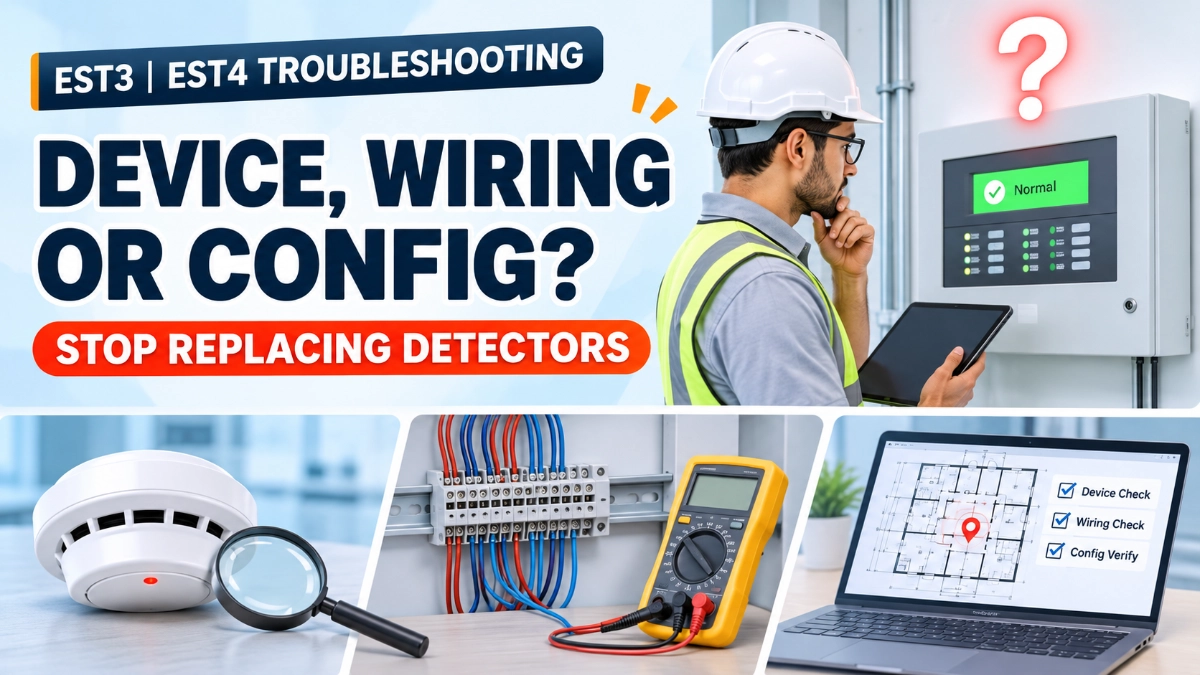
Replacing the detector now may fix nothing. The fault could sit in a disturbed cable, a loose terminal, or a panel record that no longer matches the field.
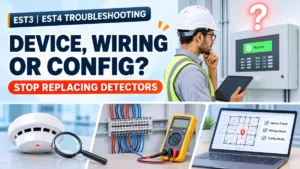
Every investigation of an EST Fire Alarm System should separate three questions:
- What happened at the field device?
- Is the physical wiring or circuit responsible?
- Is the configuration or device identification wrong?
A panel indication is a symptom to investigate, not a diagnosis of the root cause. Good troubleshooting starts with collecting evidence and classifying symptoms.
Record the exact panel indication, then classify it as a fire alarm, supervisory, trouble, communication or identification issue. Review event history for patterns, establish how many devices are affected, and verify device identity against approved drawings. Inspect the installation and wiring, check configuration and modification records, then run controlled tests under approved procedures. Replace hardware only when evidence points to the device, and verify and document the result.
First, Understand What the EST Panel Is Reporting
Classify the indication before chasing a cause. Terminology and indication detail vary with system configuration and product family, so read the documentation for your EST3 or EST4 installation.
A genuine fire alarm must be handled under the site’s approved emergency response procedures. Troubleshooting must never delay the response to a suspected fire.
| Indication category | What it generally represents | Initial investigation direction |
|---|---|---|
| Fire alarm | Reported fire condition or activated initiating device | Follow emergency response procedures and verify the event through approved processes |
| Supervisory | Abnormal monitored condition | Identify the monitored equipment or input |
| Trouble/fault | System or circuit abnormality | Investigate the affected component or circuit |
| Communication issue | Device or network communication abnormality | Review affected references, connections and event history |
| Identification mismatch | Device reference or description does not match records | Compare configuration and documentation |
Investigation Area One: Is It a Device-Level Event or Fault?
Start by separating an actual initiating event (smoke, heat or manual call point operation) from a device trouble indication. They need different responses.
Device-level causes include contamination or environmental influences, physical damage, incorrect installation or relocation, and device-specific communication or response problems. Replacement history matters too.
Collect:
- Exact event description, device reference and location
- Date and time
- Related event history
- Physical device condition and environment
- Maintenance and replacement records
A detector is not defective simply because its reference appears in an event description. The panel reports what it observed at that point, and that observation can have several origins.
Investigation Area Two: Could the Problem Be in the Wiring?
Wiring problems often present as device problems. Typical sources are open-circuit, short-circuit, and ground fault conditions, loose terminals, damaged insulation, poor joints, moisture ingress, mechanical damage, incorrect termination and cable disturbance during building modifications.
Scope is a useful clue. One affected device suggests a local inspection. Several devices with related symptoms may justify reviewing shared circuit sections or common infrastructure. This is an investigation clue, not proof of a particular defect.
Compare field conditions with approved wiring drawings and circuit schedules. Use test procedures appropriate to the circuit and project, performed by competent personnel.
Investigation Area Three: Could It Be a Configuration Issue?
Configuration inconsistencies confuse commissioning, operation and maintenance. Distinguish the physical device addressing from the user-defined device description. The address identifies the point in the system, while the description tells people where it is. Either can be wrong without the hardware being faulty.
Common discrepancies:
- Duplicated or incorrect device references
- Descriptions that do not match drawings
- Replaced or relocated devices without record updates
- Changed alarm zones
- Incorrect input/output associations
- Outdated cause-and-effect documentation
- Uncontrolled programming changes
A discrepancy does not mean the device is defective. Rely on approved configuration records, revision history, device schedules and change control. EST3 and EST4 may differ in configuration interfaces and diagnostic capability, so follow the manufacturer documentation for the installed platform.
Device Event vs Wiring Fault vs Configuration Issue: Comparison Framework
| Investigation factor | Device-related issue | Wiring-related issue | Configuration-related issue |
|---|---|---|---|
| Initial symptom | Associated with a specific device or activation | May affect one or several devices | May appear as incorrect identity, response or mapping |
| Event history | Device-specific event or trouble history | Related circuit or communication symptoms may appear | May reveal changes or inconsistent identification |
| Physical inspection | Device condition and installation | Cable, terminal, joint and connection condition | Device identity compared with drawings and records |
| Documentation review | Device history and maintenance records | Wiring drawings and circuit schedules | Configuration files and revision records |
| Verification | Approved device testing | Appropriate circuit and connection testing | Controlled configuration review and functional verification |
Symptoms overlap, and more than one issue can exist at once.
A Step-by-Step EST Alarm Investigation Workflow
- Record the exact panel indication. Capture event text, date, time, panel reference, device address and displayed location.
- Classify the event. Fire alarm, supervisory, trouble, communication issue or identification discrepancy.
- Review event history. Check preceding and subsequent events, restorations and recurring patterns.
- Identify the affected scope. One device, several devices, a circuit, a network section or an interface.
- Verify device identity. Compare the panel description with physical location, drawings and device schedule.
- Inspect the physical installation. Device, accessible connections, cable routes, terminations and environment.
- Review configuration and modification history. Replacements, relocations, programming changes and building works.
- Conduct controlled testing. Select tests for the suspected cause, following manufacturer and project procedures.
- Verify corrective action. Confirm the device, circuit or function operates as intended.
- Close with evidence. Record findings, actions, test results, approvals and documentation updates.
Only competent, authorised personnel should test, isolate or change configuration under approved procedures. Any impairment must follow applicable safety requirements, never informal bypassing or disabling.
Practical Investigation Example: One Panel Indication, Three Possible Causes
Hypothetical example. A warehouse detector repeatedly appears in the EST event history with an abnormal condition. No cause is established until evidence is collected.
Scenario A: Device-related. Inspection finds contamination or an environmental influence at the detector. Evidence: a device-specific history, a pattern linked to conditions, and approved testing of the device. Action: clean, relocate or replace per procedure, then verify.
Scenario B: Wiring-related. Inspection finds a damaged cable or loose termination near the device. Evidence: related communication symptoms, a physical defect, and circuit testing that confirms it. Action: repair the connection and retest the circuit.
Scenario C: Configuration-related. The detector was relocated during renovation, but its panel description and device schedule were never updated. Evidence: the physical location contradicts the records. Action: update records through change control, then verify.
Common EST Alarm Investigation Mistakes
| Mistake | Corrective action |
|---|---|
| Replacing a detector on the displayed event alone | Establish evidence first |
| Ignoring earlier event history | Review before and after events |
| Confusing a fire alarm with a trouble indication | Classify first; follow emergency procedures for alarms |
| Assuming multiple faults mean a network problem | Examine shared circuits and infrastructure |
| Overlooking terminations | Inspect connections and routes |
| Ignoring relocation history | Check modification records |
| Not comparing descriptions with drawings | Verify identity physically |
| Unapproved configuration changes | Use change control |
| Closing without functional verification | Test the affected function |
| Not documenting | Record evidence and actions |
EST Alarm Investigation Checklist
- Exact panel indication recorded.
- Date, time and affected reference captured.
- Event category identified.
- Event history reviewed.
- Related events checked.
- Affected device or circuit scope established.
- Device identity verified against drawings.
- Physical device condition inspected.
- Wiring and accessible connections reviewed.
- Environmental conditions considered.
- Configuration and modification history checked.
- Appropriate testing completed.
- Root cause supported by evidence.
- Corrective action verified.
- Configuration and documentation updated where required.
Why Evidence-Based Investigation Matters for Long-Term EST System Reliability
Structured investigation speeds fault resolution, cuts unnecessary device replacement, strengthens configuration governance, and builds a useful service history. It also improves commissioning quality and handover documentation. Clearing a panel indication is not closure: the underlying issue and affected functions must be verified.
Key Takeaways
- A panel indication is a symptom, not a root cause.
- Classify before investigating; alarms follow emergency procedures.
- Event history often shows the pattern the current event hides.
- A detector appearing in an event is not proof it is defective.
- Scope guides wiring investigation but proves nothing alone.
- Device addressing and descriptions are different things.
- Configuration discrepancies do not imply hardware failure.
- Causes can coexist.
- Verify, document and update records before closing.
Read Also: Fire Alarm Network Faults That Appear Intermittently: How to Investigate Without Guesswork
Read Also: EST System Testing After Building Modifications: What Must Be Revalidated?