In a real fire emergency, every second matters. A fire alarm system must do more than detect smoke or heat; it must also alert occupants to the presence of fire. It must continue operating reliably even when part of the system fails. This is where fault isolation becomes critical.
Fault isolation is the ability of a fire alarm system to identify, contain and manage faults such as wiring issues, device failures or power interruptions without compromising the entire system.
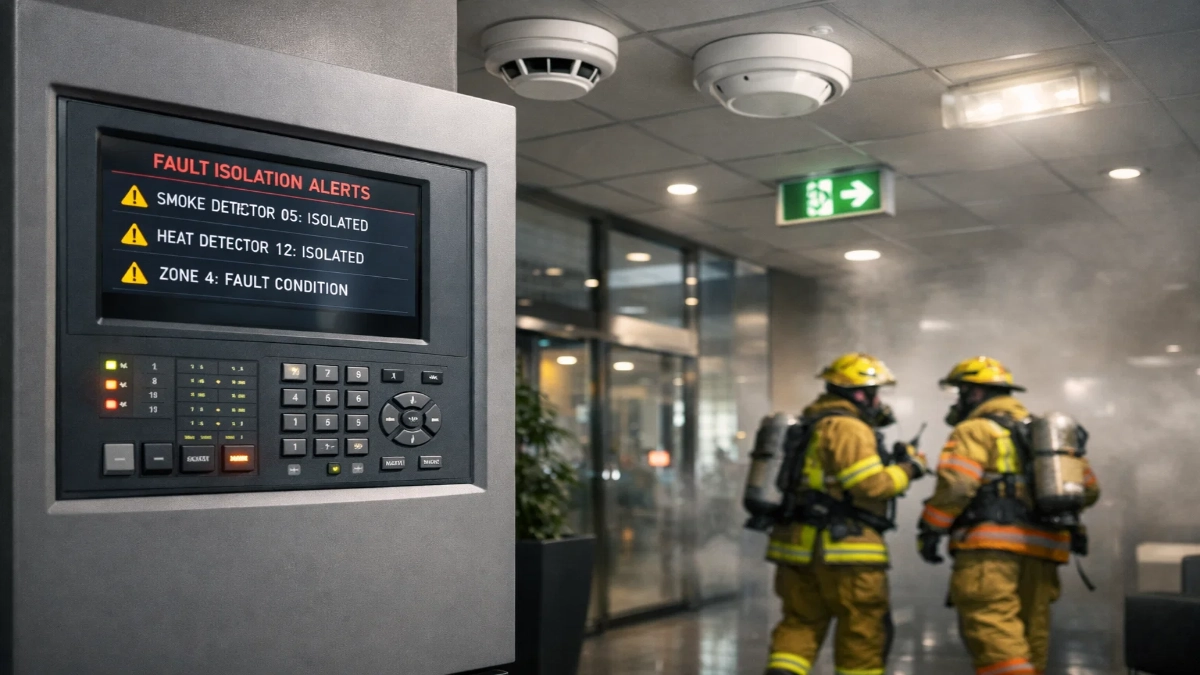
Modern buildings demand this level of resilience. Hospitals, airports, data centres, high-rise towers and industrial facilities cannot afford system-wide shutdowns during emergencies. This is why GST fire alarm panels have gained strong preference among consultants, engineers and facility managers.
In this article, we will explain how GST fire alarm panels handle fault isolation during emergencies, why their architecture is superior and how they protect lives and assets when conditions are most critical.
Understanding Faults in Fire Alarm Systems
Before exploring GST’s approach, it is important to understand what types of faults occur in fire alarm systems.
Common Faults During Emergencies
- Cable short circuits due to heat or physical damage
- Open circuits caused by broken wiring
- Device failures from extreme temperature or moisture
- Power supply interruptions
- Communication errors between panels and devices
In traditional systems, even a single fault can disable an entire zone. This risk increases during fires when cables and devices face harsh conditions.
The Problem with Conventional Fault Handling
In many older or basic systems, fault handling is limited.
Limitations of a Conventional Fire Alarm Panel
A conventional fire alarm panel divides the building into zones, but it does not identify individual devices. When a fault occurs:
- The entire zone may stop functioning
- Fire signals can be delayed or lost
- Fault location remains unclear
- Maintenance teams struggle to respond quickly
Conventional systems rely heavily on conventional detectors, which lack intelligence and communication capabilities. During emergencies, this design becomes a serious limitation.
Why Addressable Systems Are Better at Fault Isolation
An addressable fire alarm panel works very differently. Each device has a unique digital address, allowing the system to monitor, control and isolate issues precisely.
Key Advantages of Addressable Architecture
- Individual device identification
- Real-time fault monitoring
- Faster fault localization
- Continued operation of unaffected areas
GST has built its fire alarm technology around this intelligent, addressable design.
GST Fire Alarm Panels: Built for Fault Isolation
A GST fire alarm system is engineered with fault tolerance as a core design principle, not as an add-on feature.
Design Philosophy of GST
GST panels focus on three critical goals:
- Detect faults instantly
- Isolate the faulted section automatically
- Maintain full operation in safe zones
This ensures the system continues protecting occupants even under partial failure conditions.
Loop-Based Architecture: The Foundation of Fault Isolation
At the heart of GST panels is a loop-based addressable architecture.
How GST Loops Work
- Devices connect in a closed-loop circuit
- Communication flows in both directions
- If a break occurs, the loop converts into two lines
- Both sides continue operating independently
This design ensures that a single cable fault does not disable the loop.
Automatic Short Circuit Isolation in GST Systems
One of the most critical fault scenarios during a fire is a short circuit caused by heat damage.
How GST Handles Short Circuits
GST uses built-in short circuit isolators, either:
- Integrated inside addressable detectors
- Installed as separate loop isolator modules
When a short circuit occurs:
- The isolator detects abnormal current
- It disconnects only the faulty segment
- The rest of the loop continues communication
- The panel displays the exact fault location
This happens automatically and within milliseconds.
Intelligent Device-Level Fault Identification
Unlike conventional systems, GST panels know exactly which device has failed.
Role of Addressable Detectors
GST addressable detectors constantly exchange data with the panel, including:
- Device health status
- Communication integrity
- Power consumption levels
If a detector malfunctions:
- The panel identifies the device address
- Displays a clear fault message
- Maintains the operation of surrounding devices
This precision is critical during emergencies when manual inspection is impossible.
Panel Intelligence During Emergency Conditions
GST panels use advanced microprocessors and firmware logic to prioritise fire signals over faults.
Fire Takes Priority, Always
During an emergency:
- Fire alarms override fault alerts
- Sounders and evacuation controls remain active
- Faults are logged without suppressing alarms
This ensures life safety is never compromised due to a technical issue.
Redundant Power and Communication Paths
GST fire alarm panels include multiple layers of redundancy.
Power Redundancy
- Main power supply
- Battery backup with automatic switchover
- Continuous battery health monitoring
Even if primary power fails, the system continues operating without interruption.
Communication Redundancy
- Dual-path loop communication
- Fault-tolerant data transmission
- Self-healing loop behaviour
This design ensures fault isolation without communication loss.
Visual and Text-Based Fault Indication
During emergencies, clarity matters.
How GST Panels Display Faults
GST panels provide:
- Clear text descriptions
- Device address and location
- Fault type classification
- Time-stamped event logs
This helps emergency teams and maintenance staff act quickly and accurately.
Comparison: GST vs Conventional Systems During Emergencies
| Feature | GST Addressable System | Conventional System |
|---|---|---|
| Fault isolation | Automatic, device-level | Zone-level or none |
| System continuity | Maintained | Often disrupted |
| Fault location | Precise address | Approximate zone |
| Emergency reliability | Very high | Limited |
| Detector type | Addressable detectors | Conventional detectors |
This comparison clearly explains why GST systems outperform older designs in real emergencies.
Compliance with Global and Local Standards
GST designs its panels to comply with major standards such as:
- EN 54
- UL certifications (for select models)
- Local fire authority requirements
This compliance ensures fault isolation features meet regulatory and safety expectations worldwide.
Fault Isolation in Large and Complex Buildings
Fault isolation becomes even more critical in:
- High-rise buildings
- Hospitals and healthcare facilities
- Airports and metro stations
- Industrial plants and warehouses
GST fire alarm panels scale efficiently across thousands of devices without losing fault isolation performance.
Maintenance Benefits Beyond Emergencies
Fault isolation is not only useful during fires.
Long-Term Advantages
- Faster troubleshooting
- Reduced downtime
- Lower maintenance costs
- Improved system uptime
Engineers can address faults without shutting down the entire system, which is a major operational advantage.
Why Engineers Prefer GST for Fault-Tolerant Designs
Fire safety consultants and system integrators often specify GST because:
- The system behaves predictably during failures
- Fault isolation is proven in real-world installations
- Panels offer detailed diagnostics
- Expansion does not compromise reliability
These factors make GST a trusted choice for mission-critical projects.
Fault Isolation That Protects Lives
In fire emergencies, system reliability is not optional; it is essential. A fire alarm system must detect danger, communicate clearly and continue operating even when part of the system fails.
GST fire alarm panels achieve this through:
- Intelligent addressable architecture
- Automatic fault isolation
- Redundant communication paths
- Clear fault reporting
- Emergency-priority logic
Whether compared to conventional designs or evaluated in complex modern buildings, GST fire alarm systems consistently deliver superior fault isolation performance.
For projects where safety, compliance and reliability matter most, GST stands as a proven and trusted solution.
Read Also: False Alarm Reduction Techniques Using GST Addressable Systems
Read Also: Why GST Addressable Fire Alarm Panels Perform Better During Partial Failures