Fire alarm systems today protect far more than small buildings. Modern infrastructure includes airports, data centres, hospitals, smart commercial complexes and industrial campuses with thousands of devices connected on a single network. In such environments, loop stability, isolation and redundancy are not optional features. They define whether a fire alarm system performs reliably during emergencies or fails when it matters most.
Many projects still compare GST fire alarm systems with generic addressable or conventional panels only on price. However, experienced consultants, system integrators and safety managers know that loop behaviour under fault conditions is the real differentiator.
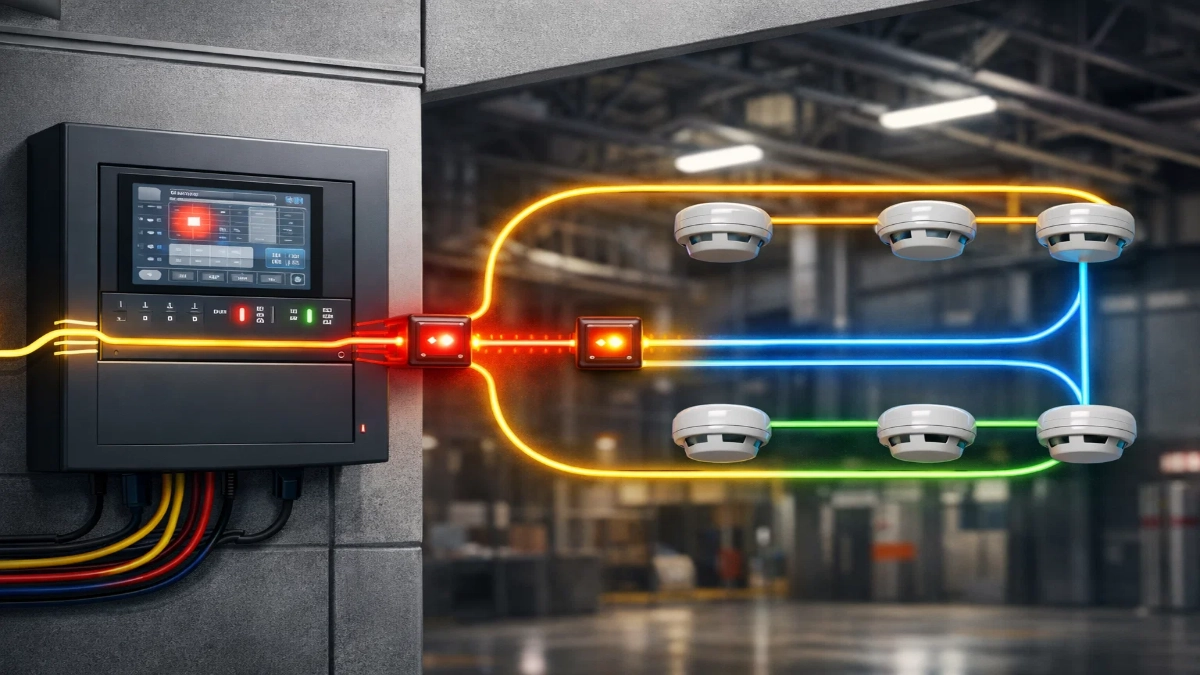
This article explains, in clear and practical terms, how GST panels outperform generic fire alarm panels when it comes to loop stability, intelligent isolation, and built-in redundancy and why these factors directly impact life safety, compliance and long-term operational cost.
Understanding Fire Alarm Loops in Simple Terms
Before comparing GST and generic panels, let’s first understand what a fire alarm loop is.
In an addressable fire alarm panel, all field devices, such as smoke detectors, heat detectors, manual call points, and modules, connect on a single communication loop. Each device has a unique address, allowing the panel to identify exactly where an alarm or fault occurs.
In contrast, a conventional fire alarm panel divides the building into zones rather than individual device addresses.
Why Loops Are Critical
The loop is the backbone of an addressable system. If the loop becomes unstable or fails:
- Devices may go offline
- Alarms may be delayed
- Faults may mask real fire events
- Large sections of the building may lose protection
That is why loop design quality separates premium systems like GST from generic panels.
What Is Loop Stability and Why Does It Matter
Loop stability refers to the ability of a fire alarm loop to maintain reliable communication with all connected devices, even under challenging conditions such as:
- Long cable distances
- High device density
- Electrical noise
- Partial wiring faults
- Environmental interference
Common Problems with Generic Panels
Generic fire alarm panels often struggle with:
- Voltage drop over long loops
- Communication timeouts
- Random device faults
- Sensitivity to cable quality
- Limited tolerance for mixed device types
These issues result in frequent nuisance faults and increased maintenance calls.
How GST Panels Ensure Superior Loop Stability
GST addressable panels are designed with advanced loop communication algorithms and robust power management, ensuring stable performance even in complex installations.
Key GST loop stability features include:
- High loop current capacity supporting large numbers of addressable detectors
- Advanced digital communication resistant to electrical noise
- Automatic loop learning and optimisation
- Stable performance over long cable runs
- Compatibility with a wide range of GST addressable detectors
As a result, a GST addressable fire alarm panel maintains consistent communication, even when loop conditions are not ideal.
Isolation: Containing Faults Instead of Spreading Failure
Isolation is one of the most misunderstood yet critical aspects of fire alarm design.
What Is Loop Isolation?
Loop isolation means the ability of a system to automatically isolate a faulty section of the loop, such as a short circuit, without disabling the entire loop.
Without isolation:
- One short circuit can take down dozens or hundreds of devices
- Fire protection may be lost in critical areas
- System downtime increases significantly
Isolation Capabilities: GST vs Generic Panels
Generic Panels: Limited or Optional Isolation
In many generic systems:
- Isolators are optional, not standard
- External isolator modules must be added manually
- Fault isolation is slower and less precise
- Poor placement can still cause large loop failures
In budget installations, isolators are often skipped entirely to reduce upfront cost, creating a major safety risk.
GST Panels: Built-In Intelligent Isolation
GST panels take a safety-first approach by integrating isolation intelligence directly into the system design.
GST advantages include:
- Built-in short-circuit isolation logic
- Fast fault detection and automatic loop segmentation
- Compatibility with isolator bases and isolator modules
- Minimal device loss during loop faults
- Continuous operation of unaffected loop sections
Even during a wiring short, the GST fire alarm system ensures that the rest of the loop remains active and responsive.
Redundancy: Designing for Fail-Safe Operation
In fire safety, redundancy means no single point of failure.
What Redundancy Means in Fire Alarm Systems
Redundancy includes:
- Backup power supplies
- Battery autonomy
- Redundant communication paths
- Network survivability
- Fault-tolerant system architecture
Generic panels often meet only the minimum code requirements, while premium systems like GST exceed them.
Power Redundancy: A Key GST Advantage
Generic Panels
Most generic panels offer:
- Single power supply
- Limited battery monitoring
- Basic charger protection
- Minimal reporting during power faults
During extended power failures, system performance may degrade.
GST Panels
GST panels are engineered for continuous operation during adverse conditions.
Key redundancy features include:
- Dual power path architecture
- Intelligent battery management
- Continuous battery health monitoring
- Automatic switchover without system reset
- Clear fault reporting at the device level
This ensures that even during prolonged outages, the system remains reliable and compliant.
Loop Redundancy and Network Survivability
In large installations, loop redundancy becomes critical.
Generic Panel Limitations
Generic systems often lack:
- Ring loop support
- Redundant communication paths
- Intelligent loop recovery
- Advanced networking capability
A single break can isolate large building sections.
GST Loop Redundancy Strengths
GST systems support:
- Loop continuity monitoring
- Advanced fault location identification
- Fast loop recovery after restoration
- Network-level redundancy in multi-panel systems
- Seamless integration with intelligent modules
These features make GST ideal for airports, hospitals, IT parks and industrial campuses.
Device-Level Stability: Addressable vs Conventional
Conventional Detectors: Limited Feedback
In a conventional fire alarm panel, conventional detectors:
- Share zones
- Do not report individual faults
- Make isolation difficult
- Increase troubleshooting time
A single fault can disable an entire zone.
GST Addressable Detectors: Intelligent & Stable
GST addressable detectors offer:
- Individual device monitoring
- Stable digital communication
- Automatic compensation for environmental changes
- Clear alarm and fault reporting
- Reduced false alarms
This intelligent device-level stability dramatically improves overall system reliability.
Installation Flexibility Without Compromising Stability
Generic Panels: Strict Limitations
Installers often face:
- Maximum cable length restrictions
- Strict device count limitations
- Sensitivity to cable type
- High failure rates in complex layouts
GST Panels: Installer-Friendly Design
GST systems allow:
- Higher device density per loop
- Flexible cable routing
- Mixed device types on the same loop
- Stable performance in real-world conditions
This flexibility reduces installation errors and long-term maintenance costs.
Compliance, Standards & Long-Term Reliability
Fire alarm systems must comply with international and regional standards.
Generic Panels
Some generic systems:
- Meet only basic compliance
- Offer limited documentation
- Provide minimal diagnostic support
GST Panels
GST fire alarm systems:
- Comply with global fire safety standards
- Offer detailed system diagnostics
- Support consultant-approved designs
- Deliver long-term reliability
This makes GST a preferred choice for consultants, government projects and large EPC contracts.
Real-World Scenario Comparison
Scenario: Short Circuit on a Floor Loop
Generic Panel Result
- Entire loop goes offline
- Multiple floors lose protection
- Manual intervention required
- Extended downtime
GST Panel Result
- Fault isolated automatically
- Only the affected segment is disabled
- Remaining devices continue working
- Clear fault location displayed
This single difference can save lives.
Total Cost of Ownership: The Hidden Advantage of GST
While GST systems may have a higher initial cost compared to generic panels, they offer:
- Lower maintenance expenses
- Fewer nuisance faults
- Faster troubleshooting
- Reduced downtime
- Longer system lifespan
Over 10–15 years, GST delivers a significantly lower total cost of ownership.
Final Verdict: GST vs Generic Panels
When it comes to loop stability, isolation and redundancy, the difference between GST and generic fire alarm panels is clear.
Generic panels may meet basic requirements, but GST systems deliver:
- Superior loop stability
- Intelligent fault isolation
- Robust redundancy
- Better compliance
- Long-term reliability
For projects where safety, uptime, and performance truly matter, GST fire alarm systems are not just a better choice; they are the professional standard.
Read Also: How GST Panels Handle High Device Density Better Than Conventional Designs
Read Also: Why Engineers Choose GST-IFP4E Addressable Fire Alarm Panel for Mid-to-Large Projects