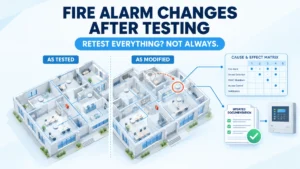
A fire alarm system has completed testing. Before final handover, the client requests a room modification. A detector is relocated, an interface is changed, or an additional device is installed. The physical work takes an hour, and the test records are already signed.
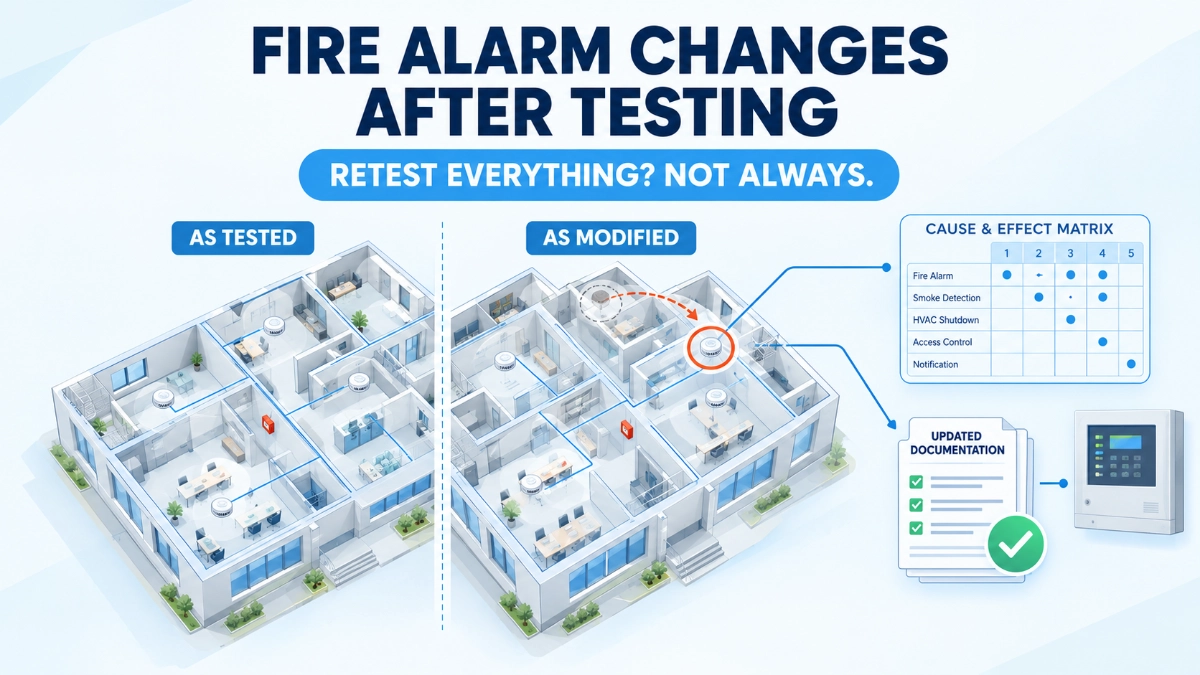
The change may look minor, but the original testing was performed against an earlier system configuration. That raises the central question: what exactly changed, what could that change affect, and what evidence shows the modified system still performs as intended? Managing fire alarm changes after testing calls for controlled engineering judgment, not automatic retesting of everything.
When a fire alarm system is changed after initial testing, engineers should first identify exactly what changed, then assess its potential impact. They should verify whether drawings, configuration, cause-and-effect and interfaces are affected, and define a retesting scope proportionate to that impact. The modification must be approved and documented, and the affected functions verified to confirm they operate as intended. Earlier test results remain useful for functions the change record shows were unaffected.
What Counts as a Fire Alarm Change After Initial Testing?
A post-testing fire alarm change is any physical, wiring, or configuration alteration made after tests were performed that could affect the tested condition. Typical examples:
- Detector relocation or device replacement
- Additional devices
- Wiring, loop, or circuit modifications
- Panel configuration changes
- Cause-and-effect changes
- Interface modifications
- Building layout or protected-area changes
- Client-requested changes and changes introduced during construction closeout
- Changes made during routine maintenance
Impact depends on the nature of the change. Swapping like-for-like in an unchanged location differs greatly from moving a device into a re-partitioned space or altering an output to another system.
Why a Previously Tested System Cannot Simply Be Assumed Unchanged
Two conditions must be distinguished: the initial tested configuration and the current installed and configured condition. When they diverge, that is configuration drift. Test records describe only the first.
Later changes can invalidate parts of the original evidence. A verified cause-and-effect sequence, for example, may no longer reflect the programmed response. This does not mean every modification invalidates commissioning. Most original results remain valid for unaffected functions. The task is to establish which ones, and to prove it.
Step 1: Identify Exactly What Changed
Traceability starts with a precise change description. Record:
- What changed, and where?
- Why was it changed?
- Who authorised it, and when?
- Was it physical, configuration-based, or both?
- Which drawings and documents are affected?
- Which system functions could potentially be affected?
If these cannot be answered, the change is not yet controlled.
Step 2: Assess the Engineering Impact
Use the table below as a starting point. A possible impact is not proof of a problem. It marks what the review must address.
| Change Type | Possible Impact Area | Review Required |
|---|---|---|
| Detector relocation | Detection coverage, accessibility | Compare against approved layout and design basis |
| Device replacement | Device identification, configuration | Confirm records and programming match the installed device |
| Wiring change | Circuit or loop integrity | Review affected circuit and its supervision/test records |
| Configuration change | System behavior | Compare against previous configuration record |
| Cause-and-effect modification | Programmed response | Verify against approved matrix |
| Interface change | External system response | Coordinate with the interfaced system owner |
| Building layout change | Coverage assumptions | Re-check zoning and protected-area basis |
Step 3: Review the Fire Alarm Architecture
Engineers should understand where the change sits within the overall system before deciding what it touches. Consider the panel, field devices, circuits or loops, networked panels where applicable, interfaces, cause-and-effect, monitoring arrangements, and protected areas.
A change on one circuit may appear local yet carry programmed relationships to outputs elsewhere. For an existing EST Fire Alarm System, review the as-built architecture and project documentation, not assumptions about how such systems are typically arranged.
Step 4: Review Cause-and-Effect
Post-testing changes can affect previously verified sequences. Areas that may warrant review include:
- Alarm outputs and supervisory functions
- Fault reporting
- Interface signals
- Building services
- Access control
- PA/VA
- BMS interfaces
No output or interface can be assumed to behave in a fixed way. The approved cause-and-effect matrix and project-specific design determine what requires verification. A common error is testing the new device’s activation while overlooking the actions programmed to follow it.
Step 5: Review Detector and Device Changes
Field device changes can require engineers to revisit:
- Device identity and location
- Coverage assumptions and accessibility
- Environmental conditions at the new position
- Circuit or loop association
- Configuration
- Maintenance records
A relocated detector may sit in a different environment, on a different circuit, or under a different zone description. Even a like-for-like replacement can leave records referring to the old device. When reviewing EST Detectors and Devices on an existing installation, confirm each item against the project’s device schedule and installed condition.
Step 6: Determine the Appropriate Retesting Scope
Retesting should be impact-based, not identical for every modification. No universal rule applies across projects. Use this framework:
| Element | Question |
|---|---|
| Change | What was modified? |
| Impact | Which functions could be affected? |
| Evidence | What earlier testing covered those functions? |
| Verification | What must be tested again? |
| Documentation | Which records need updating? |
Does every fire alarm change require complete retesting? No. A localised, well-understood change may need focused verification of the affected device, its circuit, and its programmed responses. A change touching interfaces, multiple zones, or core configuration may justify broader testing. The right scope depends on the approved design, project requirements, applicable standards, and authority requirements.
EST3 and EST4: Why Platform Context Still Matters
Engineers modifying an existing installation should establish the actual installed platform, whether EST3 or EST4, before assessing impact. Review the approved design, project documentation, current configuration records, and modification history.
Panel capacities, loop limits, network arrangements, software behaviour, compatibility, and migration options must not be assumed. These are project-specific and should be verified against approved documentation and manufacturer information for the installed system.
What Should Be Updated After the Change?
Updating documentation is part of technical completion, because future engineers rely on it to understand the installed condition. Checklist:
- As-built drawings
- Device schedules
- Cause-and-effect matrix
- Configuration records
- Panel and device information
- Interface documentation
- Test and commissioning records
- Modification history
- Maintenance records
- Handover documents
Why “It Was Already Tested” Is a Weak Handover Argument
“The system was tested” describes a past configuration. “The current system configuration has been verified after the modification” describes the delivered one.
The second statement gives stronger traceability because it links a specific change to specific verification evidence. It lets a facility team or auditor see what changed, what was rechecked, and why remaining results still apply.
Common Mistakes When Changes Are Made After Testing
- Treating minor physical changes as automatically insignificant.
- Modifying devices without checking documentation.
- Changing configuration without updating records.
- Testing the new device but not the affected cause-and-effect.
- Forgetting external interfaces.
- Leaving original drawings unchanged.
- Not recording who authorised the change.
- Assuming earlier commissioning evidence covers the modified condition.
- Updating the BOQ but not the system documentation.
- Completing the work without a final verification record.
A Practical Post-Testing Change-Control Workflow
- Record the proposed change.
- Identify affected system elements.
- Review the approved design and existing documentation.
- Assess architectural and functional impact.
- Approve the modification through the responsible parties.
- Implement the change.
- Perform impact-based testing and verification.
- Update documentation and configuration records.
- Record final acceptance and handover evidence.
Where a modification involves expansion, product availability, or review of an existing installation, technical support from an EST Fire Alarm System Distributor in India can help coordinate documentation and product continuity. The engineering decisions above still rest with the responsible design and commissioning team.
What Engineers Should Ask Before Closing the Change
- What exactly changed?
- Was the approved design updated?
- Did the change affect coverage, cause-and-effect, or an interface?
- Was configuration changed?
- Which original tests remain valid, and which functions were retested?
- Were drawings and records updated?
- Is the current installed condition traceable?
- Has the responsible team accepted the change?
Key Takeaways
- A tested system is not automatically validated after a later change.
- Identify the change precisely before deciding anything else.
- Retesting scope should follow impact assessment, not a blanket rule.
- Cause-and-effect and interfaces are easily overlooked.
- Platform context (EST3 or EST4) must come from project documentation, not assumptions.
- Documentation updates are part of technical completion.
- Handover evidence should show verification of the current configuration.
Read Also: Why Fire Alarm System Boundaries Matter in Large Industrial Projects
Read Also: How Too Many CCTV Feeds Can Reduce Operator Attention