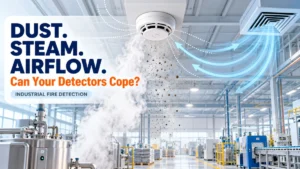
A detector can be technically functional while the surrounding environment makes reliable fire detection harder. The device passes its functional test, the panel shows no faults, and the layout matches the drawing. Yet the air around it carries dust, water vapour, or fast-moving ventilation flows that change what actually reaches the sensing element.
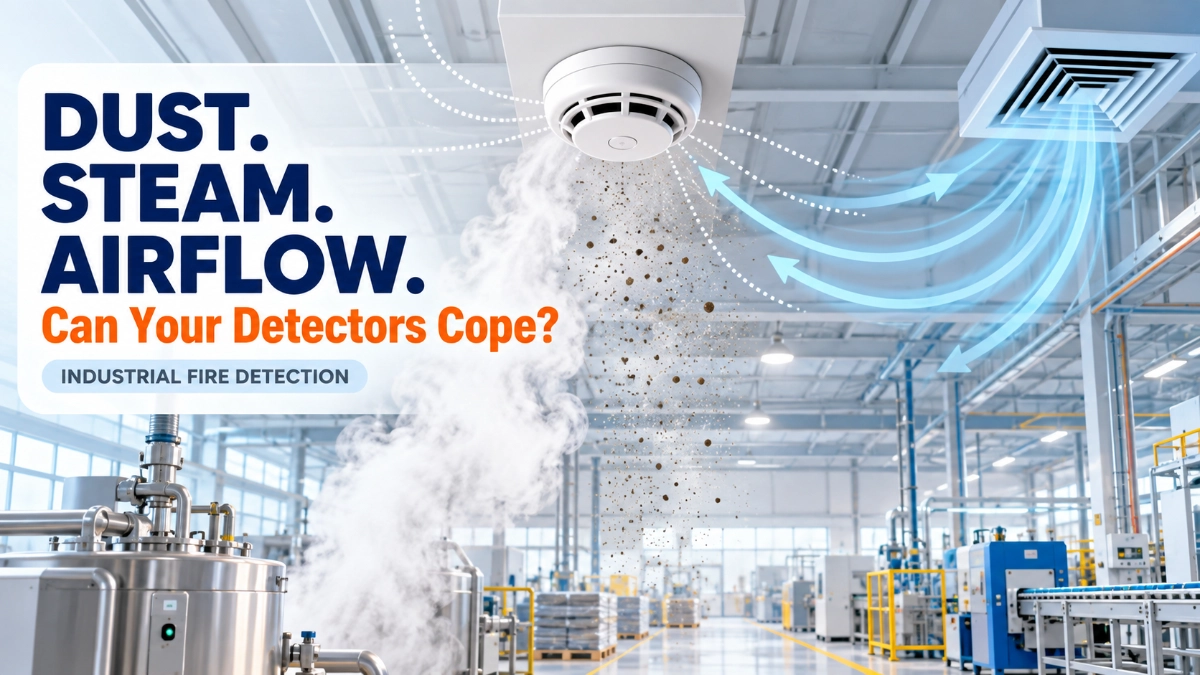
That gap between where a detector is installed and how the environment behaves around it is the central problem in industrial fire detection. Offices and retail spaces have stable temperatures, clean air and predictable ventilation. Industrial buildings often have none of these. This article explains why, and how engineers can design, place and maintain fire detection systems accordingly.
Why Industrial Environments Make Fire Detection More Complex
Industrial fire detection is harder than commercial detection because the environment continuously changes the signals detectors rely on: smoke particles, heat and, in some technologies, flame radiation.
Several factors set industrial facilities apart:
- Airborne particles: Woodworking, grain handling, cement, textiles, metal grinding and packaging can all generate dust.
- Steam and humidity: Boiler rooms, washdown zones, cooking lines and process areas release water vapour.
- Powerful air movement: Process ventilation, extraction hoods, make-up air units and large fans move air faster than typical comfort HVAC.
- Temperature variation: Furnaces, ovens, cold stores and solar-heated roofs create thermal gradients.
- Combustion by-products: Forklift exhaust, welding fumes and engine emissions can resemble early fire signatures.
- Geometry: High ceilings, large open volumes, beams, mezzanines and enclosed equipment spaces alter how smoke rises and spreads.
Each factor changes how smoke, heat or contaminants reach a detector. Those changes fall into distinct categories that this article keeps separate:
- Nuisance alarms come from non-fire stimuli.
- Contamination is the buildup of material inside the detector.
- Reduced sensitivity is a drift in response threshold.
- Detection delay is a slower response to a real fire.
How Dust Can Affect Fire Detection
Airborne dust can increase nuisance-alarm risk and contribute to detector contamination, particularly where dust-generating processes are continuous, and maintenance is limited. It does not always cause false alarms, and its effect depends on the detector technology, dust concentration and process conditions.
What happens inside the detector
Many point-type smoke detectors use photoelectric (light-scattering) sensing, where particles entering a chamber scatter light toward a receiver. Dust particles can scatter light too, so a sufficient concentration may be read as smoke. Over time, deposits can also build up inside the chamber or on optical surfaces. Depending on the design, this can shift the baseline, cause nuisance alarms, or reduce effective sensitivity.
Occasional versus continuous dust
The distinction matters in practice:
- Occasional dust, such as from a cleaning cycle or maintenance task, may cause isolated alarms that correlate with a specific activity.
- Continuous dust, such as in a milling or grinding area, can cause gradual contamination and recurring alarms.
Should smoke detectors be avoided wherever dust exists? No. Dust does not make smoke detectors automatically unsuitable. Options such as detectors designed for dusty environments, aspirating systems with filtration, or heat detection in specific zones may be appropriate, depending on the hazard and applicable standards. The right choice comes from assessing the fire scenario, not from ruling out a technology.
Why Steam Can Be Mistaken for a Fire Condition
Steam can trigger a smoke detector when visible vapour, which is made of tiny condensed water droplets, enters the sensing chamber in sufficient concentration. Whether it does depends on detector type, distance from the source, airflow and condensation conditions.
Fully dry water vapour is invisible. The “steam” people see is condensed droplets, and these can scatter light in a way that resembles smoke particles. Condensation may also form on cooler detector surfaces and affect the sensing chamber.
Typical steam sources include:
- Boiler rooms and steam distribution areas
- Food processing lines, cookers and retorts
- Industrial kitchens
- Washdown zones and CIP (clean-in-place) areas
- Process vessels and open hot-water baths
Steam is not smoke, but a detector cannot always tell the difference. The response depends on detector technology, humidity, airflow and installation design. Placement is often the deciding factor, because a detector directly in the path of a steam plume sees a very different environment from one several meters away in a stable zone.
Heat detectors are not automatically immune. Rate-of-rise elements can react to rapid temperature changes near steam sources, so the thermal profile of the area should be considered.
How Airflow and Ventilation Influence Detector Response
Airflow can change how much smoke reaches a detector and when it arrives, through dilution and by redirecting the smoke plume. It does not always delay detection, but it can change the exposure a detector sees.
Key mechanisms include:
- Smoke dilution: Strong ventilation mixes smoke with large volumes of air, lowering concentration at the sensing point.
- Smoke transport: Supply and return airflow can carry smoke toward or away from detectors.
- Ceiling jets and stagnation zones: Air discharged near the ceiling can disrupt the natural smoke layer or create still pockets.
- Stratification: In high spaces, warm smoke may lose buoyancy and level off before reaching the ceiling, especially where a warm layer is trapped above cooler air.
- Localised velocity: Air moving quickly past a detector may reduce the effective particle entry rate.
Consider a production area where a detector is installed beneath a ceiling-mounted supply outlet. The detector may be correctly positioned according to a simple floor plan, but the actual airflow pattern can influence how smoke reaches the sensing chamber. Smoke may be diluted or pushed away from the sensing chamber before it reaches the device.
Dust, Steam and Airflow: When Multiple Factors Interact
Industrial detection problems usually come from combined conditions rather than a single factor. Three examples show how.
Example 1: A dusty production area with strong mechanical ventilation.
Ventilation may keep general dust levels moderate while creating concentrated dust plumes near extraction points or air discharge. A detector near those locations may see repeated particle spikes, while one placed elsewhere could experience diluted smoke in a real event. The same airflow that reduces dust may also reduce smoke concentration.
Example 2: A food-processing environment with steam and regular washdown.
Steam, aerosolised water and condensation cycle through the space. Detectors near washdown activity may face moisture-related alarms, while heat build-up from cooking equipment creates a different thermal profile. A single detector type applied uniformly may be a poor fit for zones with such different conditions.
Example 3: A warehouse with high ceilings and changing airflow.
Rooftop heating, loading-dock doors, destratification fans and seasonal ventilation changes alter how smoke rises. A layout that performs well in one season or operating pattern may behave differently in another. Smoke may stratify below the ceiling on some days and reach detectors quickly on others.
These examples share a pattern. Contaminants, airflow and detector location interact, so the sensor’s specification alone doesn’t determine performance. The environment around it does.
Environmental Factors at a Glance
| Environmental Factor | Possible Detection Challenge | Engineering Consideration |
|---|---|---|
| Dust | Nuisance alarms; chamber contamination; drift in sensitivity | Assess concentration and process continuity; consider detectors suited to dusty conditions; plan cleaning intervals |
| Steam | Droplets scattered as smoke; condensation on detectors | Keep detectors away from plumes; evaluate heat or alternative detection near sources |
| Strong airflow | Smoke dilution; displacement of the smoke plume | Review air-handling layout; check placement relative to supply and exhaust points |
| High ceilings | Stratification; delayed smoke arrival | Consider beam, aspirating or multi-level detection; verify against applicable standards |
| Humidity | Condensation; changes in sensor baseline | Check detector environmental ratings; manage placement near cold surfaces |
| Process-related contaminants | Fumes, oil mist or vapours mimicking smoke signatures | Identify the contaminant; select technology and sensitivity accordingly |
Choosing the Right Detection Approach for Industrial Areas
No single detector technology is universally best for industrial areas. Selection should depend on fire characteristics, environmental conditions, ceiling configuration, airflow and applicable codes.
Technology options:
- Smoke detection suits many early-warning applications but is sensitive to airborne particles and moisture.
- Heat detection can suit dusty or steamy zones where smoke detection is unreliable, but it typically responds later in the fire’s development.
- Multi-sensor detection combines smoke and heat elements, and may improve discrimination in some applications.
- Special-purpose systems, such as aspirating, beam or flame detection, may suit particular geometries or hazards.
System architecture:
For larger sites needing device-level identification, an addressable fire alarm panel can report each device individually and support detailed event logging. Simpler zoned areas may be served by a conventional fire alarm panel, where detectors report by zone. Neither architecture removes environmental challenges. Addressable systems can make problems easier to diagnose, but they do not eliminate dust, steam or airflow effects.
Device-level choices follow the same logic. Addressable detectors allow individual monitoring and, in some designs, sensitivity adjustment. Conventional detectors are common in straightforward zoned installations. Manufacturers such as GST (Gulf Security Technology) offer both approaches, and the GST fire alarm system range includes addressable and conventional options. The right selection still depends on the project.
Other design considerations include alarm verification (delay or confirmation logic to reduce nuisance alarms), zoning strategy, maintenance accessibility, and applicable requirements. These vary by jurisdiction and application, so check them against local code and project specifications.
Detector Placement Matters as Much as Detector Selection
Placement determines what environment the detector actually experiences. Practical considerations include:
- Supply outlets: Discharge airflow can dilute or divert smoke, so applicable standards typically require minimum clearances.
- Exhaust points: These may draw smoke toward or past detectors quickly, and can also pull in dust.
- Strong airflow paths: Review air velocity patterns instead of relying on floor-plan geometry alone.
- Steam sources: Keep detectors away from direct plumes and condensation zones.
- Dust-producing equipment: Position detectors to limit exposure where possible, and ensure they can be reached for cleaning.
- High or obstructed ceilings: Beams, ducts, mezzanines and equipment can interrupt smoke flow.
- Changing process areas: Layout changes can invalidate the original design assumptions.
The applicable standard, such as NFPA 72 or EN 54-based national codes, sets spacing and location rules. Those rules are a minimum starting point, and installation should also reflect how the environment behaves. Convenient mounting locations should never drive placement.
Maintenance Is Part of Detection Reliability
Detector performance is not only an equipment-selection issue. A well-chosen detector can degrade in a changing environment without regular attention.
Key practices include:
- Inspection and cleaning at intervals matched to dust and contamination levels.
- Functional testing as required by applicable standards and manufacturer instructions.
- Reviewing environmental changes, such as new process equipment, revised ventilation or altered layouts.
- Recording recurring alarms by location, time and activity.
- Analysing nuisance-alarm patterns to identify environmental causes.
Dust buildup, moisture exposure and process changes can each move a system away from its original design assumptions. A periodic review keeps detection aligned with actual conditions.
Practical Engineering Checklist for Industrial Fire Detection
- Identify airborne contaminants: Dust types, fumes, oil mists and exhaust.
- Identify steam and moisture sources, including washdown and condensation risks.
- Understand airflow patterns: supply, return, exhaust and localised velocities.
- Review ceiling height and geometry: beams, obstructions and stratification potential.
- Identify production-related changes, current and planned.
- Select appropriate detector technology for each zone, not one type for the whole facility.
- Review detector locations against real airflow, not floor plans alone.
- Consider applicable fire codes and standards for the jurisdiction and application.
- Establish inspection and maintenance procedures with defined intervals and records.
- Investigate recurring alarms instead of simply disabling devices.
Conclusion
Reliable industrial fire detection depends on how six things relate to one another: environmental conditions, fire characteristics, detector technology, detector placement, airflow and maintenance. Strengthening one does not compensate for neglecting another.
The practical takeaway is to treat every zone as its own environment. Start by understanding what the air carries, how it moves and how the process might change. Then choose and place devices to suit those conditions, and keep reviewing them as the facility evolves.
For teams sourcing equipment, Innxeon Technologies Pvt Ltd operates as a PAN-India GST fire alarm system distributor in India, and can be a supply-side contact for GST (Gulf Security Technology) products. System design, site assessment and code compliance remain matters for qualified fire protection professionals and the authority having jurisdiction.
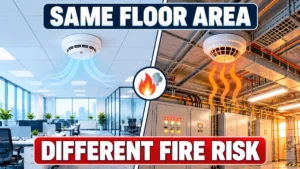
Read Also: Why Fire Alarm Coverage Should Follow Hazard Conditions, Not Just Floor Area
Read Also: How Site Infrastructure Can Affect Addressable Fire Alarm Performance