Security threats have changed dramatically over the past decade. Facilities that once relied on basic surveillance cameras now face a wide range of challenges, from organised theft and cyber-attacks to insider threats and safety incidents.
Yet many organisations still operate surveillance systems designed for risks that existed 10 or even 15 years ago.
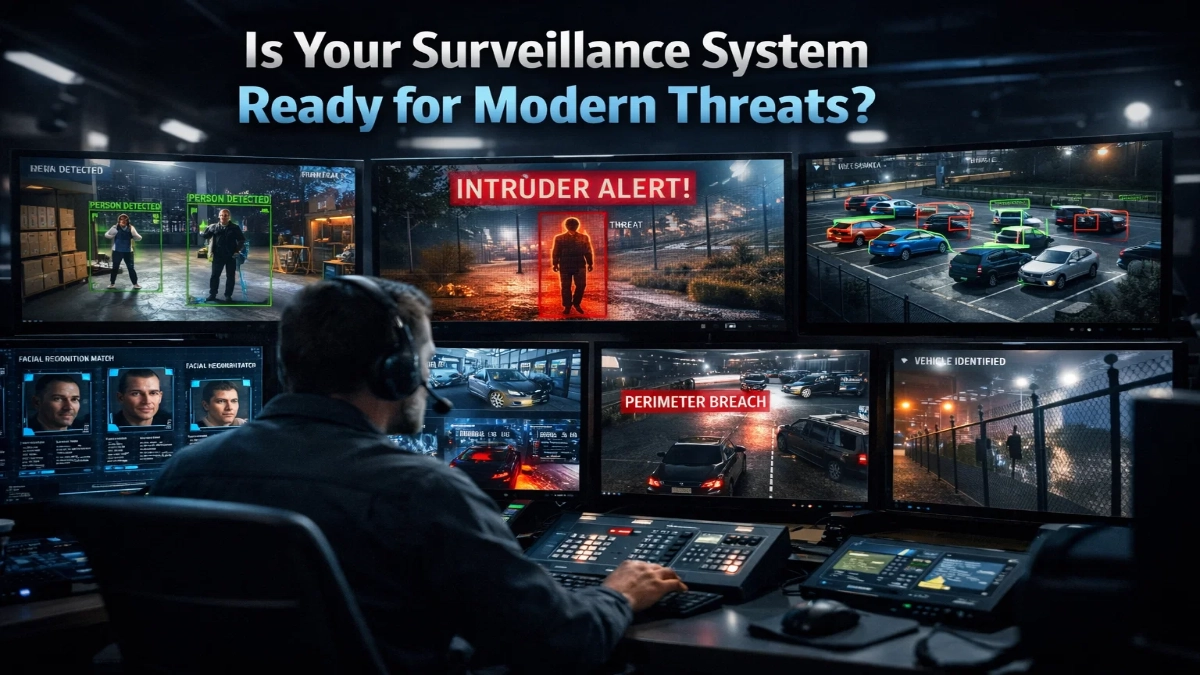
Modern facilities are smarter, more connected and more complex than ever before. Industrial plants, commercial buildings, warehouses, campuses and infrastructure sites all depend on surveillance systems that can do more than simply record video. They must detect threats early, support investigations, integrate with other safety systems and operate reliably under demanding conditions.
This raises an important question for security engineers and facility managers:
Is your surveillance system truly designed for today’s threats?
In this guide, we will explore how modern surveillance systems must evolve to address current security challenges, what design elements make a system future-ready and how engineers can ensure surveillance infrastructure delivers reliable protection.
Why Traditional Surveillance Systems Are No Longer Enough
For many years, surveillance systems were installed primarily for after-incident investigation. Cameras recorded footage, and security teams reviewed recordings only after something went wrong.
This traditional approach has several limitations.
First, older systems often rely on low-resolution cameras that cannot clearly identify faces, license plates or suspicious activities.
Second, many legacy systems operate as isolated devices without integration with access control, fire alarms or building management systems.
Third, older surveillance infrastructure typically lacks real-time analytics, meaning threats go unnoticed until it is too late.
Today’s threats demand something different.
Modern surveillance must be proactive rather than reactive. Instead of merely recording events, systems must help detect, analyse and respond to incidents in real time.
For engineers designing security infrastructure, this shift fundamentally changes how surveillance systems must be planned and deployed.
The Security Threat Landscape Has Evolved
Organisations today face a broader range of risks than ever before. Surveillance systems must now address threats such as:
1. Organised Theft and Asset Loss
Large facilities, warehouses and logistics centres frequently face organised theft. High-value assets, raw materials and finished goods can disappear quickly if monitoring is weak.
Modern surveillance systems must support:
- License plate recognition
- Object tracking
- Behavioral analytics
These features allow security teams to identify suspicious activity before losses occur.
2. Insider Threats
Not all threats come from outside. Employees, contractors and temporary staff may unintentionally or deliberately compromise security.
Surveillance systems must therefore provide:
- Clear identification capabilities
- Activity monitoring in restricted areas
- Integration with access control systems
This ensures security teams can track who enters critical areas and when.
3. Perimeter Intrusions
Industrial facilities, substations, warehouses and infrastructure sites often cover large areas.
Traditional cameras cannot effectively monitor these perimeters, especially at night or in harsh weather.
Modern surveillance systems must support:
- Thermal cameras
- Intelligent motion detection
- Automated intrusion alerts
These technologies significantly improve perimeter protection.
4. Cybersecurity Risks
Modern surveillance systems are IP-based and connected to networks.
This connectivity improves functionality but also introduces cybersecurity risks. Poorly secured cameras can become entry points for cyber-attacks.
A well-designed surveillance system must therefore include:
- Network segmentation
- Secure firmware updates
- Encrypted communication
- Strong access authentication
Cybersecurity is now a critical part of surveillance design.
Key Characteristics of a Modern Surveillance System
To address today’s threats, surveillance systems must be engineered with specific capabilities. Let’s examine the core elements that define a modern security infrastructure.
1. High-Resolution Imaging for Accurate Identification
Clear video evidence is the foundation of any surveillance system.
Older cameras often produce blurry images that cannot reliably identify individuals or vehicles.
Modern systems use high-resolution cameras such as:
- 4MP cameras
- 8MP (4K) cameras
- Multi-sensor panoramic cameras
These technologies allow security teams to capture fine details even across large coverage areas.
High-resolution imaging also improves the performance of AI analytics and forensic searches.
2. Intelligent Video Analytics
Artificial intelligence has transformed surveillance systems.
Instead of relying solely on human monitoring, modern platforms can automatically analyse video streams.
Key analytics capabilities include:
- Intrusion detection
- Loitering detection
- Crowd density monitoring
- Vehicle classification
- Abandoned object detection
These analytics enable real-time alerts that allow security teams to respond immediately.
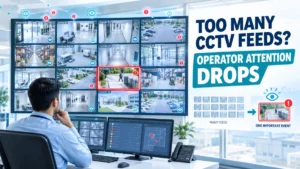
For large facilities with hundreds of cameras, AI analytics dramatically reduce monitoring workload.
3. Integration with Access Control and Safety Systems
A surveillance system should never operate in isolation.
The most effective security infrastructure integrates with other building systems, such as:
- Access control systems
- Fire alarm systems
- Intrusion detection systems
- Building management systems
For example:
If a door alarm triggers, the system can automatically display nearby camera footage.
If a fire alarm activates, cameras can help operators assess evacuation conditions.
This level of integration significantly improves incident response.
4. Reliable Network Infrastructure
IP surveillance systems depend heavily on network performance.
Poor network design can result in:
- Video lag
- Lost recordings
- Camera disconnections
To ensure reliability, engineers must carefully design:
- Network bandwidth capacity
- Switch architecture
- Redundant communication paths
- VLAN segmentation
Reliable networking ensures surveillance systems function continuously, even during high traffic loads.
5. Scalable Video Management Platforms
As facilities grow, surveillance systems must expand easily.
Modern systems rely on Video Management Software (VMS) that allows organisations to manage hundreds or thousands of cameras from a centralised interface.
Key VMS capabilities include:
- Centralised monitoring dashboards
- Smart video search tools
- Event-based alerts
- Remote access for authorised users
Scalable VMS platforms ensure surveillance systems remain manageable as infrastructure grows.
6. Cybersecurity by Design
Security systems themselves must be secure.
Unfortunately, many organisations still deploy cameras using default passwords or outdated firmware.
Cyber-secure surveillance systems require:
- Strong password policies
- Role-based user access
- Encrypted data transmission
- Secure firmware management
Engineers must treat surveillance networks with the same seriousness as IT infrastructure.
7. Redundancy and System Reliability
A surveillance system that fails during an incident provides no protection.
Critical facilities therefore, require redundancy at multiple levels:
- Redundant network paths
- Backup recording storage
- Power backup through UPS systems
- Failover recording servers
These measures ensure the system continues operating even during equipment failures or power disruptions.
Common Signs Your Surveillance System Is Outdated
Many organisations continue using surveillance infrastructure that no longer meets modern security requirements.
Here are several warning signs that a system may be outdated.
Low Image Quality
If security footage cannot clearly identify people or vehicles, the system is not providing meaningful protection.
Limited Camera Coverage
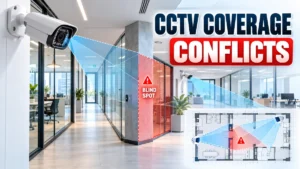
Blind spots around entrances, corridors, or perimeter areas significantly weaken security.
No Real-Time Alerts
Systems that only record video without automated alerts rely entirely on human monitoring, which is often inefficient.
No System Integration
Standalone surveillance systems cannot support coordinated incident response.
Weak Cybersecurity Controls
Cameras with default credentials or outdated firmware pose serious security risks.
If any of these issues exist, organisations should consider upgrading their surveillance infrastructure.
Best Practices for Designing a Future-Ready Surveillance System
Designing an effective surveillance system requires careful planning. Engineers must evaluate both technical requirements and operational needs.
Here are several best practices to follow.
Conduct a Security Risk Assessment
Before installing cameras, organisations must understand the risks they face.
A proper risk assessment identifies:
- High-value assets
- Vulnerable access points
- High-traffic areas
- Perimeter exposure
This analysis guides camera placement and system design.
Design Camera Coverage Strategically
Camera placement should support both deterrence and identification.
Key coverage areas typically include:
- Entrances and exits
- Perimeter boundaries
- Parking areas
- Loading docks
- Critical operational zones
Proper camera angles and lighting conditions are essential for capturing usable footage.
Ensure Proper Storage Capacity
High-resolution cameras generate significant amounts of data.
Engineers must calculate storage requirements based on:
- Camera resolution
- Frame rate
- Retention policies
- Number of cameras
Adequate storage ensures organisations retain footage for investigations and compliance.
Plan for Future Expansion
Facilities evolve over time. Surveillance systems must therefore support easy expansion.
Scalable architectures allow organisations to:
- Add new cameras
- Integrate new technologies
- Expand monitoring locations
Future-ready systems protect the initial investment.
The Role of AI and Automation in Modern Surveillance
Artificial intelligence is rapidly transforming the surveillance industry.
AI-enabled surveillance systems can now detect patterns that humans may miss, such as:
- Suspicious behaviour patterns
- Unauthorised vehicle movements
- Crowd anomalies
- Safety violations
These capabilities are especially valuable in large facilities where manual monitoring is difficult.
In the coming years, AI will play an even larger role in predictive security and automated incident detection.
Why Engineers Must Lead Surveillance System Design
Security infrastructure should never be treated as a simple equipment installation.
Poorly designed systems often suffer from:
- Inadequate coverage
- Network bottlenecks
- unreliable storage systems
- ineffective monitoring workflows
Engineers bring the technical expertise needed to design surveillance systems that are:
- reliable
- scalable
- cyber-secure
- operationally effective
Their role is critical in ensuring surveillance systems provide real protection rather than just passive recording.
Note: Security threats continue to evolve and surveillance systems must evolve with them.
Modern surveillance is no longer just about installing cameras. It involves designing intelligent, integrated systems capable of detecting threats, supporting investigations and enabling rapid response.
Organisations that rely on outdated surveillance infrastructure risk leaving critical assets, personnel and operations exposed.
By adopting high-resolution imaging, AI analytics, integrated platforms, strong cybersecurity practices and resilient network design, facilities can build surveillance systems that are ready for today’s threats and tomorrow’s challenges.
For engineers, consultants and facility managers, the key question is not whether surveillance is important.
The real question is:
Is your surveillance system truly designed for the threats your facility faces today?
Read Also: 10 Mistakes Businesses Make While Installing CCTV Cameras
Read Also: Importance of Redundancy and Fault Tolerance in Fire Alarm Systems