It was 11:47 PM at a large manufacturing unit on the outskirts of Noida, Uttar Pradesh. The fire alarm triggered in Zone 4. The security team hesitated. Was it a real fire, or another false alarm from that dusty corner near the compressor room?
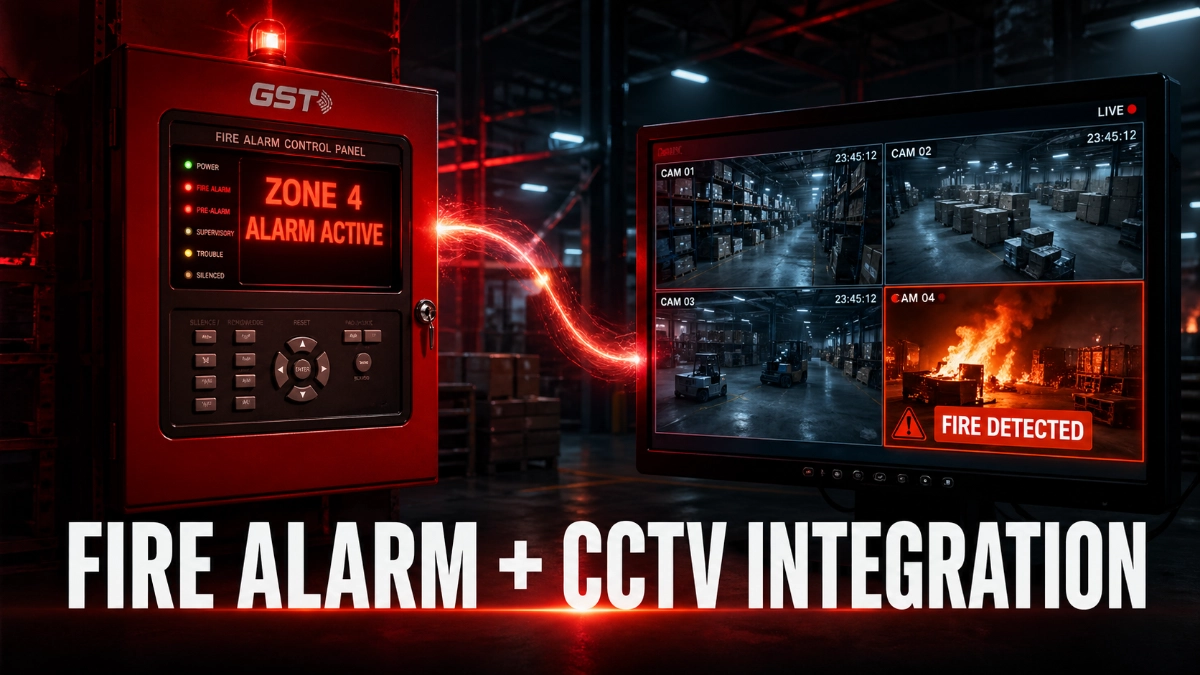
By the time they walked to the zone to check, the cable tray had already caught fire. The damage ran into lakhs. And the worst part? A camera was pointed directly at that zone. But nobody had connected the dots; the fire alarm and the CCTV system were working in isolation.
This is not an unusual story. Across industrial zones in Delhi NCR, Pune, Hyderabad and Chennai, thousands of facilities run fire alarms and CCTV cameras as completely separate systems. The result: slow response, poor verification and non-compliance with fire safety regulations.
Fire Alarm System Integration with CCTV solves this critical problem. When both systems work together, your security team sees exactly what is happening the moment an alarm triggers instantly, automatically and with zero ambiguity.
In this guide, we explain how integrated systems work, how they address real compliance challenges in India and why GST fire alarm panels are becoming the preferred choice for industrial buyers, facility managers and safety consultants across the country.
What Is Fire Alarm System Integration with CCTV?
| Fire Alarm System Integration with CCTV is the process of connecting a fire alarm control panel with a CCTV surveillance system so that when a fire alarm triggers, the relevant camera feed automatically appears on the monitoring screen, enabling instant visual verification of the alarm event. |
In a traditional setup, fire alarms and CCTV operate independently. A fire alarm goes off and a guard physically walks to the zone to investigate. With integration, the process becomes automatic and instant.
How It Works: Step by Step
- A smoke detector or heat sensor triggers the fire alarm panel.
- The panel sends a signal to the Video Management System (VMS) or integration middleware.
- The VMS instantly pulls up the camera closest to the alarm trigger point.
- The monitoring team sees live footage on their screen within seconds.
- They confirm whether the alarm is real or a false alert, all without moving an inch.
Why Traditional Systems Fall Short
- No visual confirmation: Guards rely on physical checks, which take time.
- High false alarm rate: Without visual proof, every alarm creates panic.
- Poor documentation: Incidents lack video evidence for insurance or legal purposes.
- No audit trail: Compliance officers struggle to prove alarm response times.
- Delayed escalation: Without confirmation, fire brigade calls are often delayed.
How Integration Improves Incident Verification
Real-Time Alerts with Visual Confirmation
The moment a detector activates, the integrated system cross-references the alarm zone with the camera map. The closest relevant camera feed pops up on the control room screen automatically. This gives security personnel a live visual within 3 to 5 seconds of the alarm trigger.
In industrial facilities in Noida or Greater Noida industrial estates, where a single factory floor may span 20,000+ square feet, this capability is not just helpful; it is essential.
Faster Decision-Making
When a security operator sees flames or smoke on the CCTV feed, they can immediately escalate to the fire brigade. When they see a dusty environment triggering a smoke detector, they can dismiss the alarm without evacuating the entire facility.
This decision, whether a real fire or a false alarm, used to take 5 to 10 minutes. With integration, it takes under 30 seconds. This is the critical difference between a controlled response and a catastrophe.
Dramatic Reduction in False Alarms
False alarms are a serious problem across Indian industries. Welding sparks, steam emissions, exhaust fumes and even dusty environments routinely trigger smoke detectors. Each false alarm costs time, money and eventually erodes employee trust in the alarm system itself.
Integration solves this by allowing operators to visually verify every alarm before taking action. Studies consistently show that integrated systems reduce unnecessary evacuation events by up to 70%.
Video Evidence and Audit Trail
- Every alarm event is timestamped and linked to the corresponding video footage.
- Insurance companies accept integrated alarm and video evidence for faster claim processing.
- Fire authorities, during inspections, can review response logs with video confirmation.
- Legal disputes regarding fire incidents become far easier to resolve.
Key Components of an Integrated Fire Alarm and CCTV System
A. Fire Alarm Control Panel (FACP)
The brain of the system. An addressable fire alarm panel allows precise identification of every detector in the network. It supports two-way communication, enabling the panel to receive device status and send commands, including triggering camera switches in an integrated setup.
B. CCTV Cameras and DVR/NVR
IP cameras are preferred for integration because they connect over the same network as the fire alarm panel. The NVR (Network Video Recorder) stores footage and works alongside the VMS for real-time display and event-triggered recording.
C. Video Management Software (VMS)
VMS is the integration layer. It receives alarm signals from the fire panel and maps them to specific cameras. Advanced VMS platforms support alarm-triggered pop-ups, automatic PTZ (pan-tilt-zoom) camera movement toward the alarm zone and automated recording start.
D. Detectors and Sensors
Addressable detectors provide device-level identification. Each unit has a unique address on the loop, making it possible to trigger the exact camera associated with that device’s physical location. In contrast, conventional detectors report by zone, which makes camera mapping less precise but still functional in smaller facilities.
E. Integration Protocols
- BACnet / Modbus — industrial automation protocols
- OPC (Open Platform Communications) — for wider system integration
- Dry contact/relay output — basic but reliable for conventional panels
- RS-485 serial interface — common in Indian industrial setups
Addressing Compliance Challenges in India
The Regulatory Landscape
Fire safety compliance in India is governed by multiple layers of authority. The National Building Code (NBC) 2016 sets the foundational standards. Local fire departments such as Delhi Fire Service, UP Fire Department, or Maharashtra Fire Brigade have their own inspection criteria. For certain industries, STQC (Standardisation Testing and Quality Certification) and BIS standards also apply.
The challenge for facility managers is that these regulations do not always speak the same language. NBC 2016 recommends automatic fire detection and alarm systems for buildings above certain occupancy thresholds, but local fire authorities may have additional requirements for zone mapping, response plans and system certification.
Common Compliance Mistakes Businesses Make
- Installing systems that are not certified or tested to IS 2189 (Indian Standard for fire detection and alarm systems).
- Using non-addressable panels in large buildings where zone isolation is required.
- Failing to maintain service records is a common reason for failed fire NOC renewals.
- Not integrating fire systems with building management infrastructure as required by NBC for high-rise and industrial buildings.
- Using uncertified third-party detectors that do not match the panel manufacturer’s approved device list.
What Fire Authorities Actually Check
- Is the system design approved by a qualified fire safety consultant?
- Are all devices tested and recorded in a commissioning report?
- Does the panel display zone-wise or device-wise alarm status?
- Is there a dedicated fire control room with 24×7 monitoring capability?
- Does the system have a battery backup of at least 24 hours in standby and 30 minutes in alarm condition?
Failing these checks results in delayed Fire NOC (No Objection Certificate) approvals, which can stall building occupancy, factory operations, and even affect insurance validity.
How GST Fire Alarm Panels Solve Compliance Issues
GST fire alarm systems have established a strong reputation across industrial and commercial installations in India. Here is why safety consultants and facility managers in Delhi NCR and beyond consistently recommend them.
Certified and Compliant Out of the Box
GST panels are designed and tested to meet IS 2189 requirements. This means they arrive with documentation that fire authorities recognise and accept, saving weeks of back-and-forth during inspection.
Addressable Technology for Precision
GST’s addressable fire alarm panel range supports loop configurations with up to 250 devices per loop. Each device is individually identifiable on the panel display. This level of precision is exactly what fire NOC inspectors look for in large industrial or commercial buildings.
Seamless CCTV Integration
GST panels support standard output protocols, including dry contacts, RS-485, and, in advanced models, direct network communication. This makes them straightforward to connect with most VMS platforms used in Indian industrial setups.
Scalable for Growing Facilities
As your facility expands, your fire alarm network can grow with it. Add new loops, new devices and new camera mappings without replacing the core infrastructure. This protects your initial investment and ensures compliance as your building footprint increases.
Comprehensive Service Network
One of the most practical compliance advantages is service availability. Fire authorities expect AMC (Annual Maintenance Contract) records as part of NOC renewals. GST’s established service network across India ensures you can maintain these records consistently.
Addressable vs Conventional Fire Alarm Systems
Choosing the right panel type is the first compliance decision you make. This table gives you a direct comparison:
| Feature | Addressable Fire Alarm Panel | Conventional Fire Alarm Panel |
| Zone Detection | Pinpoint exact device location | Zone-level detection only |
| Device Capacity | Up to 250+ devices per loop | Limited zone capacity |
| False Alarm Reduction | Advanced filtering & thresholds | Basic threshold only |
| CCTV Integration | Seamless via protocol mapping | Requires extra middleware |
| Compliance (NBC India) | Fully compliant, preferred | Compliant for small buildings |
| Scalability | Highly scalable, add devices easily | Requires rewiring to expand |
| Fault Diagnosis | Precise fault location displayed | Zone-level only |
| Cost | Higher upfront, lower long-term | Lower upfront cost |
| Best For | Large factories, data centres, malls | Small offices, budget projects |
| Recommendation: For factories, warehouses, data centres and commercial buildings above 500 sq.m., always choose an addressable fire alarm panel. The precision, scalability and compliance advantages far outweigh the higher initial investment. |
Real-World Use Cases Across India
A. Manufacturing Factories (Noida / Greater Noida Industrial Area)
A large auto-parts manufacturer with a 40,000 sq.ft. plant installed 200 addressable detectors linked to 32 IP cameras via a GST addressable panel and a leading VMS platform. Result: alarm response time dropped from 8 minutes to under 45 seconds. The factory passed its fire NOC inspection on the first attempt.
B. Cold Storage and Warehouses (Delhi NCR Logistics Parks)
Cold storage facilities face unique challenges. Ammonia refrigerant leaks can trigger gas detectors and create hazardous conditions faster than a traditional fire. Integrated systems here allow operators to confirm the nature of the alarm (fire vs. gas leak) and dispatch the appropriate response team.
C. Commercial Buildings and Malls
High footfall areas require fast, reliable evacuation decisions. Integrated fire and CCTV systems allow security supervisors to see crowd density in the affected zone and direct evacuation accordingly, preventing stampede risks while confirming the actual threat.
D. Data Centres
Data centres cannot afford water-based suppression system activations without visual confirmation. A false alarm that triggers a gas suppression system (like FM-200) can cause millions of rupees in downtime. Integration allows operators to visually confirm before suppression activates or to delay activation by a defined window for verification.
Step-by-Step Guide to Implementing Integration
Step 1: Site Survey and Zone Mapping
A certified fire safety consultant surveys the site and creates a zone map that aligns fire detection zones with camera coverage areas. Every high-risk zone must have corresponding camera coverage.
Step 2: System Design and Selection
Based on the site survey, select between addressable and conventional systems. For buildings above 1000 sq. m. or with multiple floors, an addressable panel is standard. Specify the CCTV camera count, types, and VMS platform.
Step 3: Panel and Camera Installation
Install the fire alarm panel in the fire control room. Install detectors, manual call points, and sounders as per the approved design. Install IP cameras at positions that provide coverage of all alarm zones.
Step 4: Network and Protocol Configuration
Configure the integration between the panel and VMS. Set up alarm trigger rules: which camera to pull up for which zone or device address. Test dry contact or network outputs from the panel to the VMS.
Step 5: End-to-End Testing
Test every detector and confirm that the correct camera feed activates on the monitor. Document all test results in the commissioning report. This report is submitted to the fire authority.
Step 6: Staff Training
Train the control room team on reading the integrated display, understanding alarm vs. fault conditions, and following the emergency response procedure. Staff competence is checked during fire NOC inspections.
Step 7: Fire NOC Application
Submit the commissioning report, system design drawings, equipment certifications, and staff training records to the local fire authority. With a properly integrated and documented system, approval timelines are reduced significantly.
Step 8: AMC and Ongoing Compliance
Sign an Annual Maintenance Contract with a certified service provider. Maintain quarterly service visit records. Update the fire authority with any system changes or expansions.
Key Benefits for Your Business
Safety
- Faster fire detection and confirmed response save lives.
- Visual verification prevents both under-reaction and over-reaction to alarms.
- Integrated systems support faster fire brigade dispatch with confirmed alarm data.
Compliance
- Certified systems meet IS 2189 and NBC 2016 requirements.
- Detailed alarm logs and video evidence satisfy the fire authority inspectors.
- Addressable technology demonstrates best-practice fire safety management.
Insurance Advantages
- Insurers increasingly require fire detection systems in industrial policies.
- Integrated systems with video evidence support faster and higher claim settlements.
- Some insurers offer premium discounts for certified, integrated fire safety systems.
Cost Savings
- Reduce false alarm costs, no unnecessary evacuations, no wasted emergency resources.
- Lower insurance premiums over time with a proven integrated safety system.
- Prevent costly fire damage through faster detection and response.
11. Common Mistakes to Avoid
| Avoid these critical errors that cause compliance failures and safety risks: |
- Using cameras with insufficient resolution or field of view, the VMS cannot accurately map alarm zones.
- When installing uncertified detectors to save cost, fire authorities will flag these immediately.
- Skipping the VMS configuration without proper alarm-to-camera mapping integration adds no value.
- Not training the control room staff on an integrated system is useless without trained operators.
- Ignoring battery backup requirements, systems that fail during power cuts fail the inspection.
- Using a conventional panel in a large multi-floor building, zone-only detection does not satisfy NBC requirements for such occupancies.
- Not maintaining AMC records the most common reason for Fire NOC renewal failure in Delhi NCR.
The Future: AI, Smart Monitoring, and Automation
AI-Powered Video Analytics
The next generation of integrated systems uses AI-based video analytics to detect smoke, flame, and unusual heat patterns directly from camera feeds before the fire alarm even triggers. This adds a second layer of early detection and dramatically reduces false alarm rates.
Cloud-Based Monitoring
Cloud VMS platforms allow facility managers to monitor their fire alarm and camera systems remotely from anywhere. For businesses with multiple factory locations across industrial zones in UP, Haryana, or Rajasthan, centralised cloud monitoring provides a single dashboard for all sites.
Smart Building Integration
Modern fire systems are increasingly connected to broader Building Management Systems (BMS). When a fire alarm triggers, the BMS can automatically cut HVAC to prevent smoke spread, unlock emergency exits, activate emergency lighting, and send alerts to the fire brigade all simultaneously.
Predictive Maintenance
AI-driven diagnostics can analyse detector performance data and predict failures before they occur. This keeps your system in peak condition, reduces service costs and ensures that when an emergency happens, every device works as expected.
Conclusion: Build a Smarter, Safer, Compliant Facility
Fire Alarm System Integration with CCTV is no longer an advanced feature reserved for premium projects. It is a practical, proven solution that addresses three critical challenges simultaneously: incident verification accuracy, emergency response speed and fire authority compliance in India.
Whether you manage a factory in Noida, a warehouse in Delhi NCR, a data centre in Hyderabad, or a commercial complex in Mumbai, the combination of a certified fire alarm panel with integrated CCTV delivers measurable benefits from day one.
GST fire alarm systems offer the reliability, certification, and integration capability that Indian industrial buyers need. With support for both addressable fire alarm panels and conventional fire alarm panels, a comprehensive range of addressable detectors and conventional detectors, and proven compliance outcomes, GST is a partner you can trust when safety counts.
Do not wait for an incident to discover the gaps in your fire safety infrastructure. Invest in integration today, achieve compliance with confidence, and protect what matters most.
Read Also: Network Latency in Fire Alarm Systems: Does It Impact Detection Time?
Read Also: Fire Alarm Panels as Critical Infrastructure: Security & Reliability Risks