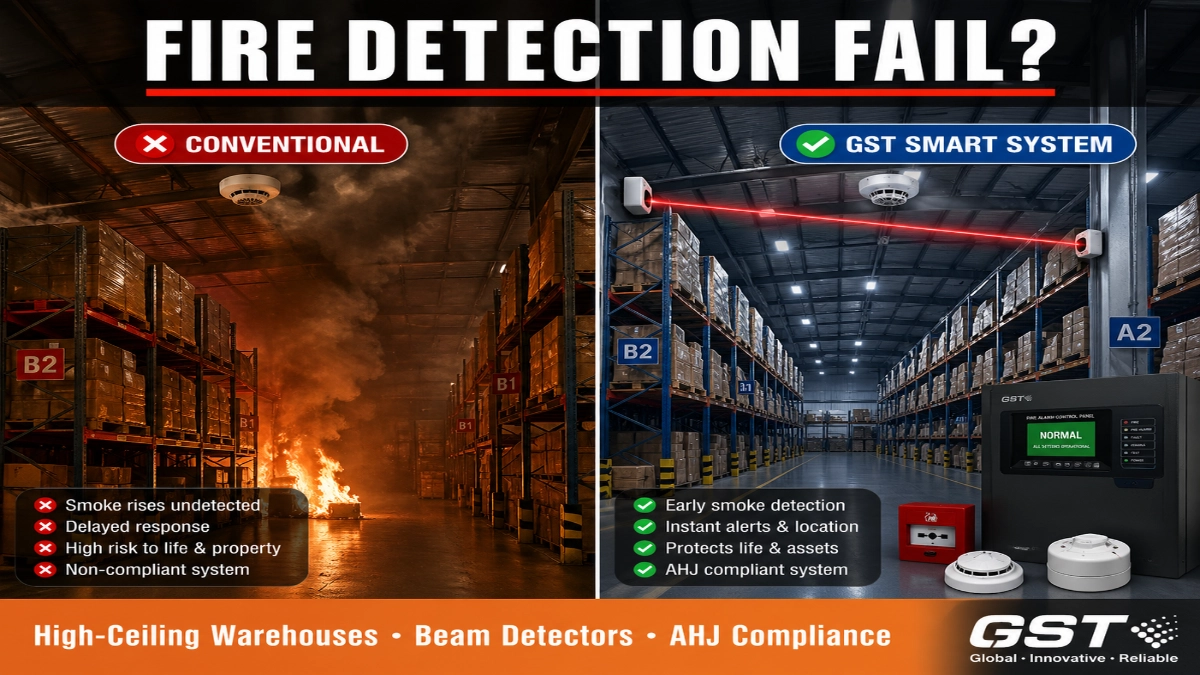
Picture this: It is 2 a.m. at a sprawling logistics hub on the outskirts of Pune. A small electrical fault inside a stacked pallet of goods quietly ignites. The smoke rises slowly, silently drifting upward into the vast, 18-metre-high void of the warehouse ceiling. The conventional smoke detectors mounted near the roof barely detect a trace. By the time an alarm finally triggers, the fire has already consumed three aisles of inventory worth crores of rupees.
This is not a hypothetical story. It is the kind of scenario that fire safety engineers across India deal with regularly. And the root cause is almost always the same: the wrong fire detection system installed in the wrong environment.
Fire detection in high-ceiling warehouses is one of the most technically demanding challenges in the fire safety industry. Standard point detectors, the kind typically installed in offices and commercial buildings, simply are not designed for spaces where ceilings soar above 8 metres. In such environments, you need specialised tools: GST beam detectors and GST multi-sensor detectors, backed by an intelligent GST fire alarm system that is fully compliant with Indian fire safety regulations.
This article explains why high-ceiling environments are uniquely challenging, how advanced GST technology addresses those challenges and how the right addressable fire alarm panel can help you meet compliance requirements from the Authority Having Jurisdiction (AHJ).
What Makes High-Ceiling Warehouses So Challenging?
Warehouses, cold storage units, aircraft hangars and large manufacturing plants share one dangerous characteristic: extreme ceiling height. This single factor creates a cascade of fire detection problems that most building owners do not fully appreciate until it is too late.
Height-Related Detection Delays
Standard point smoke detectors work by sensing particles that physically enter the detector’s sensing chamber. In a warehouse with a ceiling height of 12 to 25 metres, smoke from a small, ground-level fire can take anywhere from 10 to 30 minutes to rise to the detector’s level if it ever gets there at all. By that time, a manageable fire could already be a full-scale emergency.
Smoke Stratification: The Invisible Trap
This is a phenomenon that catches many designers off guard. As hot smoke rises, it may encounter a layer of cooler air at a mid-height level. When this happens, the smoke loses buoyancy and spreads horizontally, forming an invisible, flat cloud somewhere in the middle of the space rather than continuing to rise to the ceiling. Conventional detectors mounted at the roof level will never see this smoke layer, resulting in a catastrophic detection failure.
Airflow and Ventilation Issues
Large warehouses often have powerful HVAC systems, industrial fans and cross-ventilation arrangements. These airflow patterns can disperse smoke rapidly, diluting its concentration and preventing it from reaching ceiling-mounted point detectors. In some cases, air currents can actually push smoke away from detectors entirely.
Dust, Humidity and Environmental Interference
Indian warehouses, particularly those storing agricultural commodities, textiles, chemicals, or construction materials, often have elevated levels of ambient dust and humidity. Conventional detectors are highly susceptible to false alarms in dusty environments. Conversely, some dust particles can block a detector’s sensing chamber, making it less sensitive to actual smoke, a dangerous condition known as detector blinding.
Why Conventional Fire Detection Systems Fall Short
A conventional fire alarm panel operates on a simple principle: the detection circuit for an entire zone either triggers or it does not. When an alarm activates, you only know that something triggered somewhere in that zone, not exactly where. This limitation is manageable in small offices. In a 50,000 square foot warehouse divided into a handful of zones, it is wholly inadequate.
Similarly, conventional detectors, both smoke and heat, were designed for residential and light commercial applications where ceiling heights are typically 3 to 4 metres. Their detection principles are not calibrated for the vastly different thermal and smoke dynamics of high-ceiling industrial spaces.
Here are the key limitations of conventional systems in warehouse environments:
- No pinpoint location: You know which zone alarmed, not which specific device.
- Coverage gaps: A single point detector covers a limited area; covering a large warehouse requires hundreds of devices.
- High false alarm rates: Dust and ambient conditions trigger unwanted alarms, leading to alarm fatigue.
- Maintenance challenges: Accessing detectors at heights of 15+ metres for testing and replacement is costly and disruptive.
- No intelligent data logging: Conventional panels cannot record event histories for compliance reporting.
How GST Beam Detectors Solve the High-Ceiling Detection Problem
The GST beam detector, formally known as a projected beam smoke detector, is specifically engineered to address the limitations of point detectors in large, open spaces. Instead of waiting for smoke to drift to the detector’s location, the beam detector projects an invisible infrared beam of light across the width of the protected space, typically from one wall to another or from a transmitter to a reflector.
When smoke enters and obscures this beam even partially, the detector measures the change in light intensity and triggers an alarm. This technology offers several critical advantages for fire detection in high-ceiling warehouses:
Long-Range Protection
A single GST beam detector can protect a detection path of up to 100 metres in length, with a detection band that covers a vertical slice of the warehouse. Multiple beams installed at different heights, for example, at 4 metres, 8 metres, and 12 metres, provide layered coverage that defeats the stratification problem. If smoke stratifies at mid-height, the beam at that level catches it.
Ideal for Large, Open Spaces
Beam detectors require a clear line-of-sight between the transmitter and receiver (or reflector), which makes them perfectly suited for open warehouse aisles and large production halls. They are not affected by racking systems or shelving units, provided installation is planned correctly during the design phase.
Faster Response and Continuous Monitoring
Unlike point detectors, which only sample air at a fixed location, beam detectors continuously monitor the entire column of air along their detection path. This means they can detect smoke at any height within their coverage zone, dramatically reducing response time compared to ceiling-mounted point detectors in tall spaces.
Lower Maintenance Cost
Since GST beam detectors are mounted at accessible heights, typically 0.3 to 0.5 metres below the ceiling on side walls, they can be cleaned, aligned and tested from a ladder or elevated platform, without the need for expensive scissor lifts or scaffolding. This significantly reduces annual maintenance costs.
The Role of GST Multi-Sensor Detectors in Industrial Environments
For areas within the warehouse that require point detection, such as control rooms, server rooms, loading bays, and office spaces, GST multi-sensor detectors offer a far superior alternative to single-technology detectors.
Multi-sensor detectors combine two or more detection technologies within a single detector housing. GST’s multi-sensor range typically combines optical smoke detection with heat detection and in some models, incorporates CO (carbon monoxide) sensing as well. The onboard microprocessor analyses signals from all these sensors simultaneously and uses sophisticated algorithms to determine the fire probability before raising an alarm.
Dramatic Reduction in False Alarms
In warehouses with elevated dust, vehicle exhaust fumes, steam, or cooking odours, a single-technology smoke detector would trigger false alarms frequently. The multi-sensor detector’s cross-referencing intelligence means it does not raise an alarm unless the combination of signals matches a genuine fire pattern. This virtually eliminates false alarms, a common pain point in industrial settings.
Superior Detection Accuracy
Different fire types produce different signatures. A slow, smouldering fire produces lots of smoke but little heat. A fast, flaming fire produces significant heat but relatively little visible smoke in the early stages. A multi-sensor detector recognises both fire types quickly and reliably, whereas a single-technology detector might be slow to respond to one type or the other.
Role as Addressable Detectors
GST multi-sensor detectors are fully compatible with GST’s addressable detectors ecosystem. Each device has a unique address on the loop, allowing the fire alarm panel to identify exactly which detector has alarmed the room, zone, row, aisle with complete precision. This is a fundamental advantage that conventional single-sensor detectors simply cannot offer.
Why Addressable Systems Are Critical in Warehouse Fire Safety
An addressable fire alarm panel is not merely an upgraded version of a conventional panel. It represents a fundamentally different and more intelligent approach to fire detection and alarm management.
Pinpoint Exact Fire Location
In a warehouse covering 20,000 square metres with hundreds of detection devices, knowing the exact location of a triggered detector is operationally critical. An addressable system can display the precise detector identity, for example, ‘Beam Detector, Aisle 7, 8-metre level’ on the panel’s LCD screen within seconds of alarm activation. Emergency responders can head directly to the right location, potentially saving the entire facility.
Faster Emergency Response
Time is the most critical variable in any fire emergency. Studies in fire engineering consistently show that detection and alarm response time is directly correlated with fire damage extent. An addressable system’s ability to instantly identify the fire’s origin allows facility management, security personnel and responding firefighters to take targeted, effective action within the first critical minutes.
Scalable and Intelligent System Design
The GST fire alarm system platform is fully scalable. A small warehouse with 50 devices and a large industrial complex with 2,000 devices can both be managed on the same system architecture. Zones can be reconfigured, devices can be added, and system logic can be updated, all without replacing the core panel infrastructure. This makes GST an intelligent long-term investment for growing businesses.
Self-Monitoring and Fault Detection
Addressable loops continuously monitor themselves. If a detector develops a fault, is physically damaged, or loses communication with the panel, the system immediately raises a fault alert identifying the specific device. This proactive fault management ensures that no weak link goes undetected in your fire safety chain.
Addressing Authority Compliance Issues: What Indian Warehouses Must Know
Who is the Authority Having Jurisdiction (AHJ)?
In India, the term Authority Having Jurisdiction (AHJ) refers to the government body responsible for enforcing fire safety regulations at a given facility. This is typically the State Fire Department, working in conjunction with local municipal authorities, the DGFASLI (Directorate General Factory Advice Service & Labour Institutes) for industrial premises, and in some cases, insurance underwriters and third-party safety auditors.
The AHJ has the legal authority to approve or reject fire safety system designs, conduct inspections, grant No-Objection Certificates (NOC) and order shutdowns of non-compliant facilities. Satisfying the AHJ is not optional; it is a legal requirement for occupancy and operation.
Common Compliance Challenges Faced by Indian Warehouses
Indian warehouses face a unique set of compliance challenges that are distinct from those in other countries:
- Fire Department Approvals: Obtaining a fire NOC from State Fire Services requires detailed system drawings, equipment specifications, and often an on-site demonstration of the installed system. Many warehouses face rejections due to incorrect detector spacing or improper coverage documentation.
- NBC (National Building Code) Compliance: Part 4 of the National Building Code of India (NBC 2016) specifies fire detection and alarm system requirements for different occupancy types. Warehouses storing hazardous materials may be classified under high-hazard occupancy, requiring more stringent detection coverage.
- IS 2189 Compliance: This Indian Standard governs the selection, installation, and maintenance of automatic fire detection and alarm systems. Specifying detectors and panels that conform to IS 2189 is essential for obtaining AHJ approval.
- Documentation and System Validation: AHJs increasingly require comprehensive as-built drawings, device schedules, commissioning certificates, and maintenance contracts as part of the NOC application. Many facilities fail at this stage due to poor documentation.
- Factory Act Requirements: Warehouses and industrial facilities registered under the Factories Act must ensure their fire safety systems are maintained and inspected periodically, with records available for government inspection at any time.
How GST Fire Alarm Panels Ensure Regulatory Compliance
The GST fire alarm system is designed from the ground up to meet the rigorous compliance requirements of international and Indian fire safety standards. Here is how GST panels help you stay on the right side of the AHJ:
Comprehensive Event Logging
Every GST addressable fire alarm panel maintains a detailed, time-stamped event log of all alarms, faults, isolations and operator actions. This log can be printed or downloaded and submitted directly to the AHJ as part of an inspection or NOC renewal process. The ability to demonstrate a complete, auditable maintenance and alarm history is increasingly required by Indian fire authorities.
Integration with Fire Safety Systems
GST panels offer seamless integration with suppression systems (sprinklers, clean agent systems), smoke control systems (powered ventilation and smoke exhaust), access control, CCTV and public address systems. This integration capability allows the fire alarm panel to act as the central intelligence hub of a comprehensive fire safety strategy, which is exactly what modern AHJs expect to see in large industrial facilities.
Internationally Recognised Certification
GST fire alarm products carry internationally recognised certifications, including EN 54, UL and ISO-compliant manufacturing standards. Many Indian AHJs and insurance companies specifically recognise EN 54-certified equipment as meeting the required quality benchmarks. Specifying certified equipment dramatically simplifies the approval process.
Reliable Performance Track Record in India
GST has established a strong presence across Indian industrial sectors, with installations in automobile manufacturing plants, FMCG warehouses, pharmaceutical storage facilities and large e-commerce fulfilment centres. This proven track record provides confidence to both clients and AHJs that the system will perform as designed when it matters most.
Design Best Practices for Fire Detection in High-Ceiling Warehouses
Effective system design is the foundation of successful fire detection in high-ceiling warehouses. Here are the key principles that fire safety designers should follow:
Layered Beam Detector Placement
Install multiple GST beam detectors at different heights, for example, at 4 m, 8 m and 12 m in a 15-metre-high warehouse. This layered approach defeats the stratification problem by ensuring that smoke at any height within the space will be detected. Position beams across the shorter dimension of the warehouse to minimise the number of reflectors required.
Combine Beam and Multi-Sensor Systems
Use GST beam detectors for large open areas and high-ceiling zones, and deploy GST multi-sensor detectors in enclosed spaces, control rooms, charging areas and offices within the warehouse complex. This hybrid approach ensures optimal detection across all micro-environments within the facility.
Intelligent Zoning and System Layout
Divide the warehouse into logical zones that reflect actual fire risk areas, emergency response pathways, and suppression system boundaries. Each zone should correspond to a natural fire compartment, for example, a separate rack-storage bay, a loading dock, or a battery charging room. Well-designed zoning allows the addressable fire alarm panel to provide actionable location information rather than a broad, ambiguous zone alert.
Environmental Compensation
Programme GST detectors with appropriate sensitivity settings for the specific environmental conditions at each location. High-dust areas may require reduced sensitivity to prevent false alarms, while clean storage areas holding high-value or flammable goods may warrant increased sensitivity. GST panels allow individual detector sensitivity to be configured and monitored remotely.
Real-Life Use Case: A Logistics Hub in Delhi NCR
| Case Study: Logistics Warehouse, Delhi NCR Region |
| Facility: Third-party logistics provider | Area: 35,000 sq. ft. | Ceiling Height: 14 metres | Location: Delhi NCR |
Before GST Installation:
The facility was running a conventional fire alarm panel with 120 conventional smoke detectors mounted on the ceiling, 14 metres above the floor. Over 18 months, the facility recorded 34 false alarms, mostly triggered by dust from forklift operations, and received a notice from the local fire department for failing to demonstrate compliant detection coverage in the high rack storage area. The company’s insurance underwriter had also flagged the system as inadequate.
After GST Installation:
The conventional system was replaced with a GST addressable fire alarm panel managing 6 GST beam detectors (installed in pairs at two height levels across the warehouse) and 28 GST multi-sensor addressable detectors in support areas. Within the first 6 months of operation:
- False alarms reduced from 34 to zero.
- The facility successfully obtained fire NOC renewal from the Delhi Fire Services on the first application.
- The addressable panel’s event log provided the complete documentation required by the AHJ.
- The client’s insurance premium was revised downward following confirmation of the upgraded system.
The warehouse manager noted that the ability to see each detector’s exact status on the GST panel, including dust accumulation levels, had transformed their maintenance programme from a reactive to a proactive approach.
Get Your Warehouse Fire Detection Right – The First Time
Fire detection in high-ceiling warehouses is not simply a matter of installing more detectors. It requires a systematic understanding of how fire and smoke behave in large, complex industrial spaces, combined with the right technology choices and a system design that satisfies both engineering best practices and regulatory requirements.
GST beam detectors and GST multi-sensor detectors, managed by an intelligent GST fire alarm system with a fully addressable fire alarm panel, provide a proven, certified and compliant solution specifically suited to the challenges of Indian warehouses and industrial facilities.
Whether you are designing a new warehouse, upgrading an ageing conventional system, or facing pressure from the AHJ to achieve compliance, GST provides the technical reliability, compliance credibility and design flexibility to meet your needs, today and as your facility grows.
Read Also: Fire Alarm System Integration with CCTV for Incident Verification
Read Also: Network Latency in Fire Alarm Systems: Does It Impact Detection Time?