The Fire That No One Detected in Time
In 2019, a large auto-components warehouse in Pune lost inventory worth crores in a fire that broke out long after working hours. The facility had conventional detectors, but they were designed for a compartmentalised office building, not a sprawling, high-ceiling open floor.
Smoke rose, diluted, and dispersed across 40,000 square feet before the nearest detector could register a threshold alert. By the time the alarm sounded, the fire had spread across three storage bays.
The detectors weren’t faulty. The strategy was.
This is the central truth that many industrial safety planners miss: fire detection is not just about choosing good equipment, it’s about choosing the right strategy for your specific layout.
Whether you manage a pharmaceutical plant, a steel mill, a food processing facility, or a logistics hub, your building’s physical structure determines how smoke behaves, how quickly a fire spreads and how your detection system must respond.
In this guide, we break down the critical difference between open and compartmentalised industrial layouts, explain the fire detection strategies best suited to each and help you avoid the most common planning mistakes that put lives and assets at risk.
Understanding Industrial Layout Types
What Is an Open Industrial Layout?
| An open industrial layout is a large, undivided space where machinery, equipment and storage occupy a continuous floor area without fixed internal walls or partitions. Airflow is unrestricted and visibility spans the entire facility. |
Open layouts are the standard in industries where unobstructed movement and large equipment are operational necessities. Think of a car assembly plant where robots and conveyor belts must operate across hundreds of metres, or a logistics warehouse where forklifts need clear aisles between towering racks.
Common examples in India include:
- Automobile and auto-component manufacturing plants (Pune, Gurugram, Chennai)
- Textile mills and weaving units (Surat, Ludhiana, Coimbatore)
- Steel rolling mills and foundries (Raipur, Bhilai, Jamshedpur)
- Large cold storage and distribution warehouses
- Airport cargo terminals and logistics parks
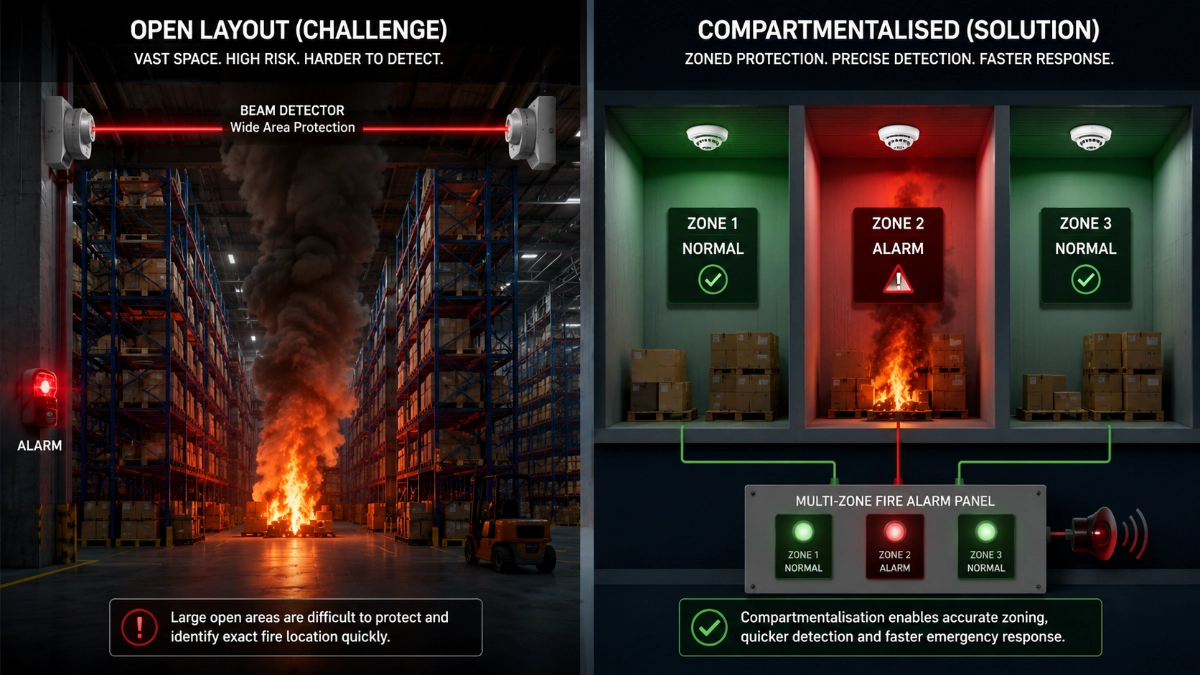
The defining characteristic is ceiling height, often between 8 and 20 metres, and minimal structural barriers between zones. This creates a unique fire detection challenge: smoke and heat rise rapidly, spread laterally and may never reach a spot detector until concentration levels are dangerously high.
What Is a Compartmentalised Industrial Layout?
| A compartmentalised industrial layout consists of defined, enclosed rooms, chambers, or zones separated by walls, partitions, or fire-rated barriers. Each compartment operates as a semi-independent space with its own airflow pattern and occupancy level. |
Compartmentalised layouts are common where hygiene, temperature control, process separation, or regulatory compliance demands physical segregation. They are far more predictable from a fire detection perspective, but they require meticulous zone mapping.
Common examples in India include:
- Pharmaceutical manufacturing units (Hyderabad, Baddi, Ahmedabad)
- Food and beverage processing plants with separate clean rooms
- Chemical manufacturing facilities with hazardous zone isolation
- IT/ITES office campuses with separate server rooms, data centres, and offices
- Hospital utility blocks and boiler rooms
Here, smoke is contained within a compartment and concentrates faster. Detection can be quicker, but false alarms due to dust, steam, or cooking fumes also increase if the system isn’t calibrated for the specific environment of each room.
Fire Detection Strategy for Open Industrial Layouts
The Core Challenge
In an open layout, the enemy of early detection is dilution. Smoke particles rise and spread across a massive volume before they reach any sensor. A standard smoke detector mounted at 10 metres may not activate until the fire has been burning for 15–20 minutes at floor level.
The second challenge is airflow from ventilation systems and industrial fans. In a working factory floor, mechanical airflow can push smoke horizontally, completely bypassing vertically mounted point detectors.
Recommended Detection Technologies
The following detection technologies are proven to be effective in open industrial settings:
A) Linear Beam Smoke Detectors
These use an emitter-receiver pair mounted across the width or length of the facility. If smoke crosses the invisible beam of light, the system triggers. They are ideal for warehouses, hangars and large open halls where individual spot detectors would need hundreds of units.
B) Aspirating Smoke Detection (ASD) Systems
ASD systems actively draw air samples from the environment through a network of pipes and analyse them for trace smoke particles. They offer the earliest possible warning, often detecting a fire in the smouldering stage before flames appear. These are highly recommended for facilities storing high-value inventory or flammable materials.
C) Multi-Sensor Detectors
Modern multi-sensor detectors combine smoke, heat and CO sensing in a single unit. They cross-reference signals to reduce false alarms, a critical need in dusty or smoky industrial environments. Addressable detectors of this type deliver device-level identification, telling you exactly which detector has activated.
D) Heat Detectors for High-Dust Zones
In areas where airborne dust or fumes are constant, such as grinding sections, cement plants, or ceramic kilns, smoke detectors will perpetually false-alarm. Rate-of-rise or fixed-temperature heat detectors are the appropriate choice here.
Panel Selection: Why an Addressable System Matters
For open layouts spanning large areas, a conventional fire alarm panel creates a significant operational problem: when a zone triggers, you don’t know which detector initiated the alarm. In a 50,000 sq ft warehouse, locating the fire source zone can cost critical minutes.
An addressable fire alarm panel resolves this by assigning a unique address to every detector on the loop. When smoke is detected at detector #47 on Loop 2, the panel displays that exact location on a zone map. First responders move directly to the source, not to a general zone.
Modern GST fire alarm systems offer addressable panels with loop capacities sufficient for large open facilities, supporting hundreds of devices per loop with real-time event logging, cause-and-effect programming and integration with building management systems.
| Step-by-Step Strategy for Open Layouts Step 1: Conduct a site-specific risk assessment, identify heat sources, ventilation paths, and ceiling heights. Step 2: Select detector technology based on ceiling height (beam detectors for >8m; aspirating for high-value zones). Step 3: Map detector placement to account for airflow direction and avoid placing detectors directly in front of industrial fans. Step 4: Install an addressable fire alarm panel with a full zone map of the facility. Step 5: Integrate with sprinkler suppression systems and emergency lighting where required. Step 6: Commission with sensitivity testing, set alarm thresholds appropriate for the industrial environment. Step 7: Schedule quarterly maintenance and annual sensitivity recalibration. |
Fire Detection Strategy for Compartmentalised Layouts
The Core Challenge
In compartmentalised layouts, the challenge shifts from dilution to diversity. Each room or zone has a distinct environment with different temperatures, humidity levels, potential ignition sources and occupancy patterns. A single uniform detection approach across all zones will underperform in many of them.
A pharmaceutical clean room, a chemical storage area, a boiler house and a data server room all sit within the same facility, but each demands a different type of detector and a different sensitivity setting.
Recommended Detection Technologies
A) Ionisation and Photoelectric Smoke Detectors
For standard office and administrative areas within a compartmentalised facility, conventional point detectors remain effective. Photoelectric detectors are better for slow-smouldering fires; ionisation detectors respond faster to fast-flaming fires.
B) Heat Detectors for Kitchens, Boiler Rooms, and Dusty Zones
In any zone where cooking, steam, or high airborne particulate levels are present, heat detectors prevent constant false alarms while still providing early warning. Fixed-temperature and rate-of-rise models are widely used.
C) Flame Detectors for Flammable Storage Areas
In chemical storage rooms or fuel-handling zones where fires may erupt suddenly without a smouldering phase, UV/IR flame detectors provide near-instantaneous response to the optical signature of flames.
D) Aspirating Detection for Server Rooms and Data Centres
Even within a compartmentalised layout, high-value technical rooms benefit from ASD systems. A data server room fire detected 10 minutes earlier can mean the difference between a backup restored and a catastrophic data loss.
Conventional vs Addressable Panel — Making the Right Choice
For smaller compartmentalised facilities with fewer than 5–6 zones and a stable layout that is unlikely to change, a conventional fire alarm panel may be sufficient and cost-effective. Each zone triggers a collective alert for that section.
However, as the number of zones grows beyond 8–10, the limitations of conventional detectors become apparent. Fault-finding becomes difficult, and zone expansion requires rewiring.
Scaling-up compartmentalised facilities is best served by an addressable fire alarm panel that can add new device addresses without infrastructure overhaul. A single panel can manage dozens of zones, each with individually calibrated detectors.
| Step-by-Step Strategy for Compartmentalised Layouts: Step 1: Map every compartment and classify it by hazard type (low, moderate, high). Step 2: Select detector type per compartment based on the environment (smoke, heat, flame, or ASD). Step 3: Decide on panel type, conventional for small, stable facilities; addressable for larger or expanding ones. Step 4: Define cause-and-effect rules, which alarm triggers, and which response (door release, air handling shutdown, etc.). Step 5: Install manual call points at all exits and high-traffic corridors. Step 6: Test each zone independently during commissioning with smoke cartridges or heat guns. Step 7: Document zone maps and train emergency response teams on the panel interface. |
Open vs Compartmentalised: Side-by-Side Comparison
| Feature | Open Layout | Compartmentalised Layout |
| Space Structure | Large, undivided floor areas | Divided into enclosed rooms/zones |
| Airflow Pattern | Unrestricted; smoke disperses widely | Controlled; smoke stays localised |
| Detector Type | Linear beam, multi-sensor, aspirating | Spot detectors; conventional/addressable |
| Panel Recommended | Addressable fire alarm panel | Conventional or addressable panel |
| Detection Challenge | High ceilings dilute smoke quickly | Multiple zones need individual coverage |
| Response Time Risk | Delayed if only spot detectors used | Faster if properly zoned |
| False Alarm Risk | High without calibrated systems | Lower with proper zone mapping |
| System Scalability | Requires scalable, intelligent systems | Zone-by-zone expansion possible |
| India Use-Case Example | Steel plants, warehouses, auto plants | Pharma, food processing, IT/ITES parks |
Common Mistakes in Industrial Fire Detection Planning
Even experienced safety engineers make these errors. Knowing them in advance can save months of rework and, more critically, prevent avoidable risk.
Mistake #1: Applying Office-Grade Detection to Industrial Spaces
Standard ceiling-mounted spot detectors designed for 3-metre office ceilings are routinely installed in 12-metre factory halls. The physics of smoke dispersion make these devices nearly useless at height. Always match detector technology to ceiling height and volume.
Mistake #2: Ignoring Airflow Patterns
Industrial fans, HVAC systems, and process exhaust create dominant airflow channels. Detectors placed against these airflows will never receive the smoke they are meant to sense. A proper airflow analysis must precede detector placement.
Mistake #3: Under-Specifying the Panel
Selecting a conventional fire alarm panel for a facility that will expand within three years locks you into a costly retrofit. Always plan for the facility’s five-year growth trajectory when specifying the panel.
Mistake #4: Single-Technology Solutions for Complex Environments
A single type of detector cannot handle the full range of environments in most industrial facilities. Mixed-technology approaches using smoke detectors in some zones and heat or flame detectors in others are the professional standard.
Mistake #5: Skipping Sensitivity Calibration
Out-of-the-box sensitivity settings are designed for average environments. Industrial facilities are rarely average. Without site-specific calibration, systems either miss real fires or generate chronic false alarms that condition staff to ignore alerts.
Mistake #6: No Integration with Suppression and Access Systems
A fire alarm that only sounds a buzzer is a fraction of a complete safety system. In compartmentalised layouts, alarm events should trigger automatic door releases, shut down air handling units (to prevent smoke spread) and interface with suppression systems.
Best Practices for Industrial Safety Engineers
If you are responsible for fire safety planning in an industrial facility, apply these principles consistently:
- Risk-First Approach: Conduct a layout-specific risk assessment before any specification work. Bring a fire detection engineer on-site.
- Follow Indian Standards: Use IS 2189 (Bureau of Indian Standards) as the baseline compliance framework. Many Indian facilities remain below this standard.
- Insist on FAT Testing: Mandate factory acceptance testing (FAT) for all panel and detector combinations before site installation.
- Lifecycle Maintenance: Build a maintenance contract into the procurement from day one. Detection systems degrade without regular cleaning, testing, and firmware updates.
- Train Your People: Train your safety officers on the specific panel interface, not just on the existence of the alarm system.
- Reassess After Expansion: Review your detection strategy after any major facility expansion or process change. A layout change is a fire risk change.
- Analyse Your Alarm History: Log all alarms, including false alarms, to identify systemic weaknesses in detector placement or calibration.
The Role of Advanced, Scalable Fire Alarm Systems
As Indian industries modernise and scale, fire detection systems must keep pace. The shift from conventional to intelligent, addressable infrastructure is not a luxury; it is operational risk management.
The GST fire alarm system range addresses the full spectrum of industrial detection needs. For open layouts, GST’s addressable loop technology supports linear beam detectors, multi-sensor devices, and aspirating system interfaces within a unified, programmable architecture. For compartmentalised facilities, their systems offer granular zone control, cause-and-effect programming, and modular expansion, allowing a pharmaceutical plant’s detection system to grow as new wings are added.
The addressable detectors in the GST range carry individual device addresses that allow panel-level diagnostics identifying not just which zone has triggered, but which specific device, its sensitivity status and its maintenance history.
For safety consultants specifying systems for Indian industrial clients, this level of precision translates directly into faster emergency response, lower false alarm rates and demonstrable compliance with NFPA 72 and IS 2189 standards.
Scalability, in particular, is a decisive factor. A system that can grow from 50 devices to 500 without replacing the panel or rewiring the infrastructure is not just convenient, it is a strategic asset for any facility with long-term expansion plans.
Strategy First, Equipment Second
Every fire detection decision must start with the same question: What kind of space am I protecting?
An open layout demands technologies that overcome dilution, distance and airflow. A compartmentalised layout demands zone-by-zone intelligence and precision calibration. Applying the wrong strategy to either environment doesn’t just waste money; it creates a false sense of security that can cost lives.
The most effective industrial fire safety programmes in India today share one common trait: they treat detection strategy as an engineering discipline, not a procurement exercise. They assess the layout, understand the airflow, select the appropriate detection technology for each zone, specify the right panel, and plan for the facility’s growth trajectory from day one.
Whether you are specifying a system for a greenfield plant or upgrading legacy infrastructure in an existing facility, work with a qualified fire detection engineer, reference IS 2189, and invest in systems such as the GST fire alarm system range, which are engineered specifically for the scale and complexity of industrial environments.
| Key Takeaway: Your building’s layout is the most important variable in fire detection planning. Match your strategy to your space, not just your budget, and you will build a detection system that genuinely protects your people, your assets, and your operations. |
Read Also: Fire Alarm Event Flow in Integrated Command Centres
Read Also: Device-Level Failure Patterns in Addressable Fire Alarm Systems: Causes, Detection & Prevention