For decades, CCTV systems were built around a single idea: record what happens, and review the footage if something goes wrong. This passive approach to security served its purpose in a simpler era. But the demands on modern surveillance infrastructure have changed completely.
Today’s enterprises manage multi-site operations, high-density facilities, complex logistics environments, and critical infrastructure that require proactive security, not reactive footage review. Industrial facilities need real-time perimeter threat detection. Airports need automated passenger flow analytics. Retail environments need occupancy intelligence and loss prevention automation. Data centres need continuous anomaly detection and access verification.
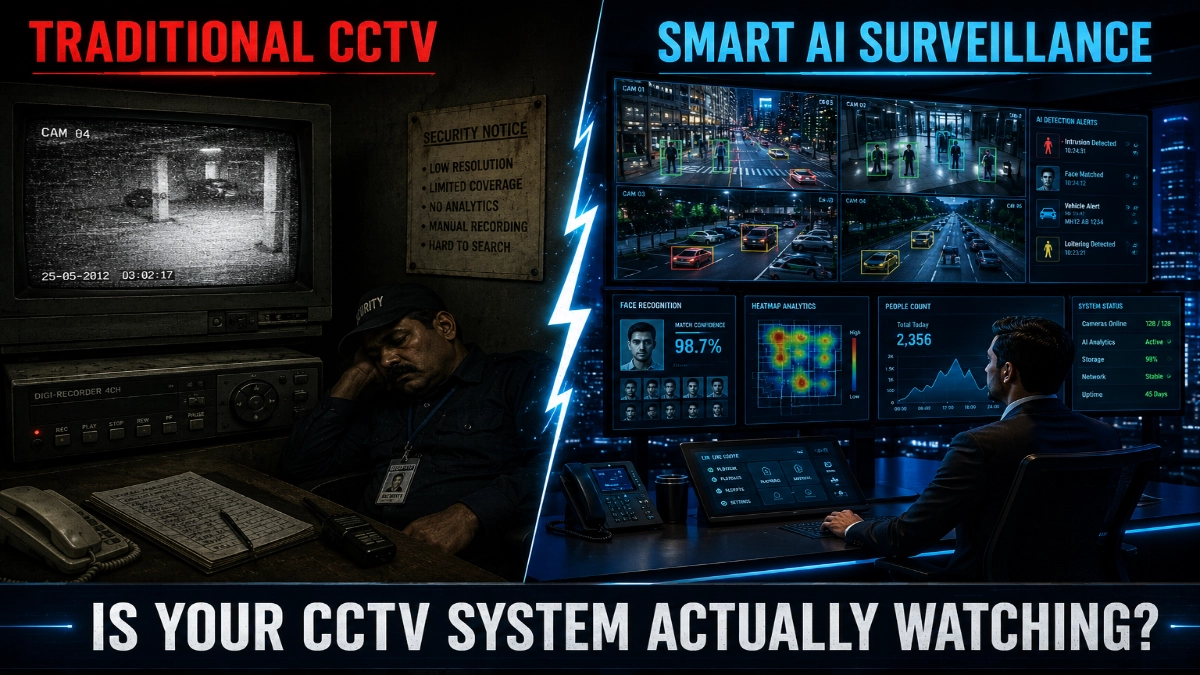
Traditional CCTV systems were never designed to meet these demands. They generate enormous volumes of video data that no human team can monitor around the clock, offer no actionable intelligence, and provide limited investigative tools after an incident.
This is why intelligent AI-powered CCTV systems are rapidly replacing conventional surveillance architectures across enterprises, smart cities, industrial parks, commercial towers, logistics hubs, and manufacturing facilities worldwide.
This article provides a comprehensive, engineering-focused analysis of what makes modern CCTV systems fundamentally smarter than their traditional counterparts and why intelligent surveillance infrastructure has become a strategic operational necessity.
What Traditional CCTV Systems Were Designed For
Traditional CCTV systems were engineered as deterrence and documentation tools. Their core function was simple: place cameras at key locations, record continuously or on motion, and store footage for post-incident review. These systems performed adequately for low-complexity environments like small retail outlets, parking lots, and basic perimeter monitoring.
Core Architecture of Conventional Surveillance
A standard traditional CCTV setup consists of analogue or basic IP cameras connected to a central digital video recorder (DVR) or network video recorder (NVR). The footage is stored locally and accessed through a monitoring station. The entire system operates in isolation, disconnected from other security or building management platforms.
The monitoring model is inherently reactive. Security personnel watch live feeds and review recorded footage when incidents are reported. There is no automated detection, no intelligent alerting, and no data-driven decision support.
Why Traditional Surveillance Systems Are Struggling in Modern Environments
As enterprise infrastructure grows in complexity, traditional surveillance systems have exposed serious operational limitations that create security gaps and operational inefficiencies.
1. The Human Attention Problem
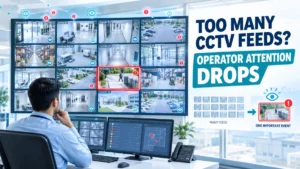
Research in surveillance operations consistently demonstrates that human operators lose effective monitoring capability after approximately 20 minutes of watching multiple screens. In large facilities with dozens or hundreds of cameras, continuous manual monitoring is operationally impossible. Traditional systems that depend entirely on human vigilance are structurally unreliable.
2. No Actionable Intelligence
Traditional CCTV systems generate footage, not intelligence. They provide no object classification, no behavioural pattern analysis, and no automated anomaly detection. Every insight must come from a human operator viewing raw video. This approach is time-consuming, inconsistent, and unscalable.
3. Slow Incident Response
Without automated alert systems, incident response depends on someone noticing an event on a monitor and manually escalating it. In practice, this means incidents are often discovered hours or days after they occur through post-event footage review rather than real-time intervention.
4. Poor Scalability
Expanding a traditional surveillance system means adding cameras, expanding local storage, and increasing the monitoring workload proportionally. There is no architectural path to scaling operations efficiently. Adding cameras without adding intelligence simply creates more unmonitored footage.
5. Isolated from Enterprise Systems
Traditional CCTV systems operate as standalone security tools. They have no connection to access control systems, fire safety platforms, building management systems (BMS), or enterprise resource planning tools. When an incident occurs, security teams must manually correlate data from multiple disconnected platforms, a process that is slow, error-prone, and operationally disruptive.
6. Limited Forensic Investigation Capability
Finding specific footage in a traditional DVR/NVR system requires manually scrubbing through hours of recorded video, a process that can take many hours even for experienced operators. In time-sensitive investigations, this limitation is critical. Modern enterprises require forensic search capabilities that allow investigators to find relevant footage in seconds.
7. Cybersecurity Vulnerabilities
Many legacy CCTV systems run on outdated firmware, unencrypted communication protocols, and default credentials that make them vulnerable to cyber attacks. Compromised surveillance systems can serve as entry points into broader enterprise IT networks, creating serious security risks beyond the physical layer.
What Defines a Smart CCTV System Today
A modern intelligent CCTV system is not simply a higher-resolution camera or a faster NVR. It is a comprehensive surveillance ecosystem built on four foundational pillars: artificial intelligence, edge computing, cloud connectivity, and deep system integration.
Smart CCTV systems do not just record, they understand. They classify objects, recognise patterns, detect anomalies, generate automated alerts, and deliver actionable intelligence to security operations centres and enterprise decision-makers in real time.
The shift from passive recording to active intelligence marks the defining architectural difference between traditional and modern surveillance infrastructure.
Advanced Capabilities That Make Modern CCTV Systems Smarter
1. AI-Powered Video Analytics
At the core of every intelligent surveillance system is AI-powered video analytics and deep learning algorithms that continuously analyse live and recorded video streams to extract structured, actionable data.
These analytics engines classify objects in real time: people, vehicles, animals, and infrastructure anomalies. They detect behavioural patterns, identify rule violations, and flag unusual events without human intervention. Modern platforms process hundreds of video streams simultaneously, delivering intelligence at a scale no human monitoring team could achieve.
For industrial facilities, AI video analytics enables automated perimeter monitoring, equipment anomaly detection, and safety compliance verification. For commercial environments, it powers customer flow analysis, occupancy management, and loss prevention automation.
2. Human and Vehicle Classification
Modern AI engines distinguish between people, vehicles, and other objects with high accuracy. They differentiate between pedestrians and cyclists, between cars and trucks, and between employees and visitors, enabling context-aware alerting that eliminates false positives from environmental factors like birds, light changes, or moving foliage.
In logistics hubs and warehouses, human-vehicle classification enables automated safety zone monitoring, generating immediate alerts when pedestrians enter vehicle operation zones without authorisation.
3. Facial Recognition Technology
Facial recognition capabilities allow modern CCTV systems to match detected faces against pre-configured watchlists in real time. Security operations centres receive immediate alerts when a flagged individual enters a monitored area, enabling proactive intervention rather than post-event investigation.
In enterprise deployments, facial recognition integrates with access control systems to verify identity at secure entry points, providing a seamless layer of biometric security across facility perimeters and restricted zones.
4. Behavioural Analysis and Anomaly Detection
Behaviour analysis represents one of the most powerful capabilities in modern intelligent surveillance. AI algorithms learn normal patterns of activity in a monitored environment and automatically flag deviations that may indicate security threats or operational anomalies.
Examples include: Detecting individuals loitering near restricted zones, identifying unusual crowd density changes that may indicate an incident, recognising abandoned objects in public areas, and monitoring for aggressive or erratic behaviour patterns in high-traffic environments.
5. Real-Time Threat Detection
Modern intelligent surveillance platforms combine object detection, behaviour analysis, and rule-based automation to deliver genuine real-time threat detection. Security operators receive contextually rich alerts, including camera location, detected event type, and relevant video clip, enabling them to assess and respond to threats within seconds of detection.
In airport deployments, real-time threat detection monitors sterile zones, tracks passenger flow anomalies, and flags unauthorised access attempts at airside boundaries. In data centres, it continuously monitors server room access, detects unauthorised individuals in restricted infrastructure areas, and verifies that only cleared personnel have access to sensitive zones.
6. Edge AI Processing
Edge AI is a transformative architectural innovation in modern surveillance infrastructure. Rather than transmitting raw video to a central server for analysis, edge AI-enabled cameras process video data on the device itself, delivering real-time intelligence without bandwidth-intensive video streaming.
This approach dramatically reduces network load, enables faster alert generation, ensures system resilience during network interruptions, and supports deployment in remote or bandwidth-constrained environments like oil and gas facilities, mining sites, and rural infrastructure.
For large multi-site enterprises, edge AI processing enables consistent intelligent surveillance across all locations without requiring enterprise-grade network connectivity at every site.
7. Smart Search and Forensic Investigation
One of the most operationally valuable capabilities of modern AI-driven CCTV systems is intelligent forensic search. Instead of manually reviewing hours of footage, investigators can search recorded video by object type, colour, time window, location, face, or license plate and retrieve relevant clips in seconds.
In retail loss prevention investigations, smart search enables investigators to track a suspect’s movement across an entire facility in minutes. In industrial incident investigations, it allows safety teams to reconstruct event sequences quickly and accurately, supporting root cause analysis and regulatory reporting.
8. Cloud-Connected Surveillance Monitoring
Cloud connectivity extends the operational reach of surveillance infrastructure beyond physical facility boundaries. Modern cloud-connected platforms enable authorised security personnel to monitor, manage, and investigate from any device, from any location, at any time.
For multi-site enterprise operations, cloud connectivity enables centralised surveillance management across hundreds of locations from a single command centre, eliminating the need for on-site security teams at every facility and significantly reducing operational costs.
Platforms like Impact by Honeywell provide cloud-native and hybrid deployment options that give enterprises the flexibility to scale surveillance operations without proportional increases in hardware and staffing costs.
9. Intelligent Alert Automation
Modern intelligent surveillance systems replace manual monitoring with automated alert workflows. When the AI engine detects a defined event, unauthorised access, perimeter breach, abandoned object, or crowd anomaly, it automatically generates an alert, routes it to the appropriate response team, and provides supporting video evidence.
Alert automation dramatically reduces response times, eliminates the inconsistency of human monitoring, and ensures that no critical event goes unnoticed, even outside business hours or during shift transitions.
10. Operational Heatmaps and Occupancy Analytics
Beyond security functions, modern CCTV systems generate valuable operational intelligence through heatmap analytics and occupancy monitoring. Heatmaps visualise movement patterns and high-traffic zones across facilities, enabling operations teams to optimise layouts, staffing allocation, and resource deployment.
In manufacturing plants, operational heatmaps help identify bottlenecks in production workflows. In commercial buildings, occupancy analytics support energy management by adjusting HVAC and lighting systems based on real-time space utilisation data.
11. License Plate Recognition (LPR/ANPR)
Automatic Number Plate Recognition (ANPR) systems integrated into modern CCTV infrastructure automate vehicle access management, track vehicle movements through facilities, and generate alerts when unauthorised vehicles enter restricted zones.
In logistics hubs and warehouses, ANPR automates gate management and delivery verification. In commercial parking facilities, it enables frictionless access for authorised vehicles. In industrial facilities, it supports the enforcement of vehicle access policies across large, multi-gate campuses.
12. Remote Surveillance Management
Enterprise security teams can remotely manage camera configurations, health monitoring, firmware updates, and alert threshold settings through centralised management platforms. This capability eliminates the need for on-site technical teams at every location and enables rapid response to system issues.
Impact by Honeywell distributors in India provides enterprises with locally supported deployment of these remote management capabilities, ensuring that regional operations benefit from the same level of intelligent surveillance infrastructure as the global headquarters.
13. Integrated Command Centre Workflows
Modern intelligent surveillance systems anchor integrated security command centres where surveillance data, access control events, fire safety alerts, and environmental monitoring data converge on a single operational platform. Security operators no longer need to monitor multiple isolated systems; they manage unified situational awareness from a single interface.
This integration enables coordinated incident response workflows where a perimeter breach detected by the surveillance system automatically triggers access control lockdowns, alerts emergency response teams, and initiates intercom communication with the relevant zone.
14. Predictive Surveillance Analytics
The most advanced modern surveillance platforms are moving beyond reactive and real-time intelligence toward predictive analytics. By analysing historical event patterns, traffic flows, behavioural trends, and environmental factors, predictive AI engines identify elevated risk windows before incidents occur.
In smart city deployments, predictive surveillance analytics support proactive traffic management and crowd safety planning for large events. In industrial facilities, they enable predictive security posture adjustments based on shift patterns, visitor volumes, and historical incident data.
Traditional vs. Intelligent AI-Driven CCTV Systems: A Comparison
The table below summarises the fundamental differences between conventional surveillance architecture and modern intelligent CCTV infrastructure:
| Feature | Traditional CCTV Systems | Intelligent AI-Driven CCTV Systems |
| Video Recording | Continuous or motion-triggered recording only | Smart recording with event-based triggers and AI tagging |
| Analytics | None or basic motion detection | Deep learning analytics: people counting, behaviour analysis, heatmaps |
| Alert System | Manual monitoring required | Automated real-time alerts with context-aware intelligence |
| Search Capability | Manual scrubbing through footage | Smart forensic search by object, colour, face, license plate |
| Integration | Standalone system, isolated from other platforms | Integrated with access control, BMS, fire, and ERP systems |
| Scalability | Hardware-limited, expensive to scale | Cloud-native or hybrid, scales with operational needs |
| Processing | Central server-dependent | Edge AI + cloud hybrid for real-time local processing |
| Facial Recognition | Not available | Real-time facial recognition with watchlist matching |
| License Plate Recognition | Not available | Automated ANPR for vehicle access and tracking |
| Cybersecurity | Minimal, often unencrypted | End-to-end encryption, zero-trust access, cyber-hardened |
| Remote Management | On-site only, limited VPN access | Full remote monitoring, configuration, and diagnostics |
| Operational Insights | Security only | Operational heatmaps, occupancy analytics, workforce safety |
| Incident Response | Reactive, post-event investigation | Proactive, real-time alerts and automated response workflows |
| Maintenance | Scheduled, manual inspection | Predictive diagnostics with automated health monitoring |
How Intelligent CCTV Systems Improve Enterprise Operations
Situational Awareness
Real-time AI analytics give security teams a complete, continuously updated picture of activity across an entire facility or enterprise campus far beyond what any human monitoring team could achieve through manual observation.
Incident Response Speed
Automated alert workflows reduce incident response times from minutes to seconds. When integrated with access control and emergency systems, intelligent surveillance platforms can initiate automated lockdowns, alert response teams, and preserve evidence simultaneously.
Operational Efficiency
Occupancy analytics, heatmaps, and people counting data inform facility management decisions, optimise energy consumption, and improve workforce deployment. Security infrastructure becomes a source of operational intelligence, not just a cost centre.
Investigation Workflows
Smart forensic search reduces investigation time by orders of magnitude. What once required days of manual footage review can be completed in minutes, supporting both internal investigations and regulatory compliance reporting.
Workforce Safety
In industrial environments, behaviour analytics and human-vehicle separation monitoring actively protect worker safety by detecting and alerting on safety violations in real time before accidents occur.
Business Continuity
Predictive diagnostics and health monitoring ensure surveillance infrastructure operates reliably. Automated system health alerts enable proactive maintenance, minimising downtime and ensuring continuous coverage of critical areas.
Infrastructure Scalability
Cloud-native and hybrid deployment architectures allow enterprises to scale intelligent surveillance across new sites, additional cameras, and expanded analytics capabilities without proportional increases in hardware investment.
Practical Deployment Examples Across Industries
Industrial Facilities
Modern AI-driven CCTV systems monitor perimeter integrity, track personnel movement in hazardous zones, enforce PPE compliance, and generate automated safety violation alerts across large industrial campuses.
Smart Cities
Intelligent surveillance infrastructure in smart city deployments monitors traffic flow, detects road incidents, manages public space safety, and supports law enforcement operations through real-time facial recognition and behavioural analytics.
Airports
Airport deployments leverage AI analytics for sterile zone monitoring, passenger flow management, abandoned baggage detection, access control verification at airside boundaries, and automated threat assessment.
Commercial Towers and Corporate Campuses
Multi-zone surveillance with integrated access control manages visitor verification, monitors common areas, tracks occupancy for emergency evacuation planning, and generates operational analytics for facility management teams.
Warehouses and Logistics Hubs
ANPR automates vehicle gate management, AI analytics enforce safety zone compliance, and smart search capabilities support rapid investigation of inventory discrepancies and security incidents.
Manufacturing Plants
Operational heatmaps identify production workflow inefficiencies, behaviour analytics monitor worker safety in high-risk zones, and integrated surveillance-BMS workflows optimise facility energy management.
Retail Environments
Customer flow analytics, heatmaps, occupancy monitoring, and AI-powered loss prevention tools transform retail surveillance from a security function into a strategic business intelligence platform.
Data Centers
Continuous biometric verification at entry points, behaviour analytics in server rooms, and integrated access-surveillance workflows ensure that only authorised personnel access critical infrastructure.
Multi-Site Enterprise Operations
Centralised cloud management platforms enable enterprise security teams to monitor, manage, and investigate across hundreds of locations globally from a single command centre interface. Impact by Honeywell provides enterprise-grade platforms specifically engineered for this multi-site scalability challenge.
How Intelligent CCTV Systems Are Reshaping Enterprise Security
The transformation from passive surveillance to intelligent security infrastructure is redefining how enterprises think about safety, compliance, and operational management.
Security operations centres are evolving into integrated intelligence hubs where surveillance data informs not just incident response but broader operational decisions from workforce safety to energy management to regulatory compliance.
Enterprise decision-makers increasingly recognise that modern CCTV infrastructure delivers measurable returns well beyond traditional security value. When surveillance data integrates with building management, access control, fire safety, and enterprise operations platforms, it becomes a strategic operational asset.
Leading security platforms like Impact by Honeywell are purpose-built for this enterprise-scale transformation, delivering AI-driven analytics, cloud-native scalability, deep system integration, and cyber-hardened architecture in a unified intelligent surveillance ecosystem. Impact by Honeywell distributors in India ensures that enterprises across the subcontinent have access to localised implementation expertise, support infrastructure, and regional deployment capabilities.
The enterprise security teams and system integrators that invest in intelligent surveillance infrastructure today are building the operational foundation for the next decade of smart facility management.
Integration with Enterprise Infrastructure Ecosystems
Access Control Integration
Modern intelligent CCTV systems natively integrate with access control platforms, enabling synchronised video verification at all secure entry and exit points. Access events automatically trigger corresponding video retrieval, and suspicious access attempts generate combined access-surveillance alerts.
Fire Alarm and Life Safety Integration
Integration with fire alarm systems enables surveillance cameras to automatically redirect monitoring focus to alarm zones during fire events, giving emergency responders real-time visual intelligence on evacuation status and fire progression.
Building Management System (BMS) Integration
Surveillance data feeds into BMS platforms to optimise energy management, space utilisation, and environmental control based on real-time occupancy intelligence.
Emergency Response Platform Integration
Modern surveillance systems integrate with emergency response and mass notification platforms, ensuring that security incidents immediately trigger coordinated response protocols across all relevant systems.
Cybersecurity in Modern Intelligent Surveillance Ecosystems
As surveillance systems become increasingly network-connected and cloud-integrated, cybersecurity has become a critical design pillar, not an afterthought.
Modern intelligent CCTV platforms incorporate:
- End-to-end video stream encryption to prevent unauthorised interception.
- Zero-trust access architecture with role-based permissions and multi-factor authentication.
- Automated firmware update management to eliminate known vulnerability windows.
- Network segmentation to isolate surveillance infrastructure from enterprise IT networks.
- Comprehensive audit logging for all system access and configuration changes.
- Compliance-ready architecture supporting GDPR, ISO 27001, and regional data protection regulations.
Enterprises deploying intelligent surveillance infrastructure must include cybersecurity assessment and hardening as a mandatory phase of every implementation project.
Future-Focused: The Next Generation of Intelligent Surveillance
Predictive AI Surveillance
Next-generation surveillance platforms will move beyond real-time detection to predictive threat modelling, analysing patterns to identify elevated risk conditions before incidents materialise.
Autonomous Monitoring Systems
Fully autonomous AI surveillance systems will manage monitoring, alerting, and initial response protocols with minimal human intervention, enabling large facilities to operate with significantly smaller security teams.
Digital Twins for Surveillance
Digital twin technology will create live virtual replicas of physical environments, where surveillance data feeds a 3D operational model that security teams can navigate and analyse remotely.
Unified Security Ecosystems
Future enterprise security architecture will fully unify surveillance, access control, fire safety, cybersecurity, and environmental monitoring in a single platform, eliminating the last operational siloes in enterprise security management.
AI-Assisted Command Centres
AI co-pilots in security command centres will continuously analyse incoming surveillance data, prioritise alerts, recommend response actions, and generate automated incident reports, dramatically improving operator efficiency.
Edge Intelligence Evolution
As edge AI hardware continues to advance, cameras will perform increasingly sophisticated analytics on-device, delivering richer intelligence with lower bandwidth requirements and greater operational resilience.
Cloud-Native Surveillance Operations
Cloud-native architectures will enable enterprises to dynamically scale surveillance infrastructure, access AI analytics without on-premise hardware investment, and manage global operations from unified cloud platforms.
Read Also: Synchronisation Challenges in Multi-City Surveillance Operations
Read Also: Why Industrial Surveillance Is Becoming an Operational Intelligence Layer